
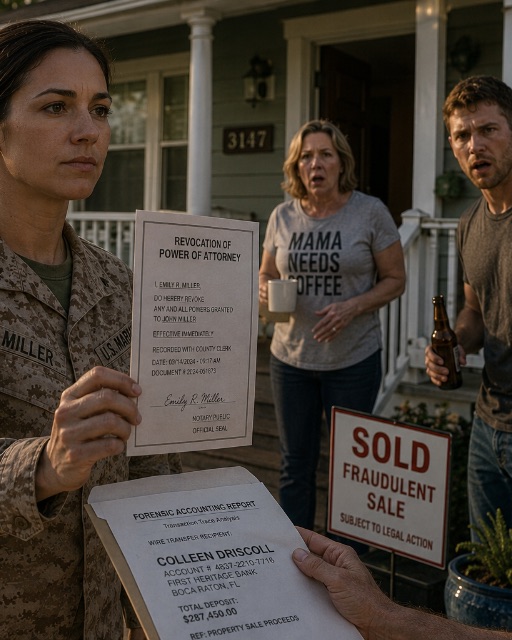
I was still wearing my cammies and dust from Okinawa when I stepped out of the taxi and saw them lounging on my porch like they’d won something. My dad. My older brother Terrence with a beer. Same smirks, same lazy confidence I grew up under.
I hadn’t even set my seabag down before Dad said it, like he’d rehearsed in the mirror.
“You’re homeless now.”
No hello. No welcome home. Just a sentence meant to hit harder than any blast wave I’ve ever felt.
I didn’t shout. I didn’t cry. I didn’t even look at the front door I’d paid for with deployment checks and weekends spent laying flooring myself.
“What are you talking about?” I asked.
Terrence snorted. “We sold your house, sis. Try to keep up. Dad had power of attorney.” He actually toasted himself. Clinked his bottle against the railing like he’d closed a deal on Wall Street instead of gutting his own sister’s life.
Here’s the thing about Marines: silence is a weapon when you hold it long enough.
I watched their nerves arrive late to the party. Dad shifting his weight. Terrence tapping the railing with his ring finger. The neighborhood looked the same. My name on the mailbox didn’t.
I’d called every week from the island. Heard dishes clatter in the background. Voices I didn’t recognize. Got a clipped text two weeks before my flight home: “Call before you come.”
I was too busy running convoys to push on it. That was my mistake.
“Family sacrifices for family,” Dad said, pointing at Terrence like he was a cause instead of a pattern. “You’re always gone anyway. You don’t need it.”
I thought about the balcony in Okinawa three months ago. The automated alert that pinged my phone at 0200: PROPERTY OWNERSHIP UPDATE – COUNTY RECORDER’S OFFICE.
I thought about the JAG captain who sat me down the next morning, coffee still steaming, and said five words that changed everything: “Trust is good. Oversight is better.”
I thought about the county log file I pulled – dates that lined up a little too neatly with Terrence’s heart-emoji texts and my dad’s missed calls.
They thought I spent those last three months crying into my pillow. I spent them on the phone with attorneys, the VA, a forensic accountant, and a very patient clerk at the county recorder’s office.
The front door opened behind them. A woman stepped out holding a mug that said MAMA NEEDS COFFEE. She introduced herself as Rhonda, “the new owner.” Her smile faltered when I didn’t blink.
“Congratulations,” I told her. Then I turned back to the two men who sold what wasn’t theirs to sell.
“Did they tell you everything?”
Dad stiffened. Terrence finally shut up.
“Did they tell you about the revocation?” I asked.
Silence.
“I revoked the power of attorney eight weeks before the sale. Filed it with the county. Notarized. Timestamped. Recorded.” I pulled a folded envelope from my cargo pocket – the one I’d carried across the Pacific like a grenade with the pin already out.
“That means the sale was fraudulent. Which means Rhonda, you don’t own this house. Which means my father and brother committed deed fraud, wire fraud, and forgery – all federal when it involves a service member’s VA-backed property under the SCRA.”
Rhonda’s mug started shaking.
Terrence looked at Dad.
Dad looked at the ground.
I looked at the black sedan that had just pulled up to the curb. Two people stepped out – one in a blazer, one in a polo with a lanyard.
“That’s my attorney,” I said, nodding to the blazer. “And that gentleman is from the Office of the Inspector General.”
I picked up my seabag and walked past all of them, up the steps, through the front door of my house.
Because the house they sold while I was overseas – the home I bought with a VA loan, protected with paperwork they never bothered to read — was never legally transferred. Not for one single day.
I set my bag down in the hallway. My flooring. My walls. My sweat in every baseboard.
Behind me, I heard Rhonda’s voice crack: “You told me this was clean.”
And my dad, for the first time in my life, had absolutely nothing to say.
But the part that really made my blood freeze? When my attorney handed me the second envelope — the one from the forensic accountant — and I saw exactly where the money from the sale actually went. It wasn’t bail money for Terrence. It wasn’t even close.
The account it was wired to belonged to someone whose name I recognized immediately.
Someone who was supposed to be dead.
I looked up at my father. “Who is Colleen Driscoll?”
His face went white. His mouth opened. No sound came out.
My brother grabbed the porch railing like the ground had shifted beneath him. “Dad… who is that?”
Dad’s hands were trembling. He looked at me — not with guilt, not with shame — but with raw, undiluted fear.
His voice came out cracked, barely a whisper. “She’s the reason I sent you to Okinawa in the first place…”
And then I opened the envelope all the way — and saw the photograph paper-clipped behind the wire transfer.
It was a picture of me.
At six years old.
Standing next to a woman who had my exact same eyes.
The world on my front porch went quiet. The only sound was the rustle of leaves and the distant hum of traffic, a world moving on while mine had just stopped.
The man in the blazer, my attorney, Mr. Harrison, gave a slight nod to the IG agent. They knew this part of the script. This was the family implosion.
My dad just sank. He didn’t fall, he just… deflated, sitting down hard on the top step, his head in his hands.
Terrence, for once, looked utterly lost. The smirk was gone, replaced by a confusion so deep it almost looked like innocence.
“Dad, what is she talking about?” he asked, his voice shaking.
Rhonda, the poor woman caught in the middle of this family shrapnel, just set her mug down on the railing and backed away slowly, as if she was afraid the crazy was contagious.
Mr. Harrison stepped forward, his voice calm and steady. “Sir, I think it’s time you came with us to answer a few questions.”
He wasn’t talking to my dad. He was talking to Terrence.
The IG agent looked at my father. “And you, sir. We have a lot to discuss.”
I held up the photograph. The glossy paper felt heavy, like it weighed as much as the twenty-plus years of lies it represented.
“Before you go,” I said, my voice dangerously even. “I want an answer. Now.”
My dad looked up. His eyes were red-rimmed. He looked older than he had ten minutes ago. “I can’t. Not here.”
“You sold my house to pay a ghost,” I said, my voice rising just a little. “You owe me more than ‘not here’.”
He finally looked at the picture in my hand. A sound escaped his throat, a choked sob. “She found me. After all these years, she found me.”
“Found you for what?” Terrence demanded.
“For her,” Dad whispered, looking at me. “She wanted her back.”
The IG agent cleared his throat. “Ma’am, perhaps we can continue this in a more private setting. Your father and brother are looking at serious charges.”
I nodded, feeling numb. I stepped back inside my house and shut the door on all of them. I leaned my forehead against the cool wood, the wood I’d sanded and painted myself.
My house. My fortress. And a lie was already inside.
A few hours later, I was sitting in a sterile interview room with Mr. Harrison. Rhonda was next door with her own counsel, working out an agreement to get her money back from the escrow company. She was a victim, just like me.
My dad and Terrence were in separate rooms, being read their rights and their futures.
“The wire transfer was a direct request,” my forensic accountant explained over speakerphone. “The account for Colleen Driscoll was opened two months ago. The request for the exact sale amount of your house was made three weeks ago.”
“She demanded the money?” I asked.
“It looks less like a demand,” the accountant said, “and more like an invoice.”
Later that evening, Mr. Harrison arranged for me to speak to my father. Not out of kindness to him, but because the IG agreed that his cooperation on the Colleen Driscoll matter might be… beneficial.
We sat across from each other at a metal table. He wouldn’t meet my eyes.
“Mom died in a car crash when I was five,” I said. It wasn’t a question. It was the bedrock of my childhood story.
“Yes,” he said quickly. Too quickly.
“Then who is Colleen Driscoll?” I pushed the picture across the table.
He flinched. “Your mother and I… we were very young. We weren’t married. Things were complicated.”
“Complicated how?”
He took a deep breath. “Colleen… she wasn’t stable. She had problems. She ran with a bad crowd. After you were born, she just got worse.”
I listened, my face a mask of stone. I’d learned in the military how to hide my emotions until I was in a safe place to feel them.
“I had to protect you,” he continued, his voice gaining a self-righteous tone. “She was unfit. Dangerous. So I took you. I left town. I told everyone she had died in an accident. It was easier that way. Safer for you.”
“You told me my mother was dead?” I asked, my voice flat.
“I gave you a good life! A stable life!” he insisted. “Terrence’s mom, she was a good woman. She raised you as her own until she passed.”
This was true. My stepmom had been kind. But that was a different wound for a different day.
“So after twenty-five years, Colleen just shows up?” I asked.
“She found me online. Sent me a picture of you in your uniform. She’d been watching you. She said I owed her. She said I stole her daughter, so now she was going to take mine.”
The words hung in the air. It was a threat.
“She didn’t want you,” Dad said, his eyes finally meeting mine, pleading. “She wanted the money. The price of the house was the price for her to disappear again. To leave you alone. I panicked. Selling the house was the only way I could get that much cash that fast.”
He looked at me, expecting… what? Forgiveness? Understanding?
“You did it to protect me?” I repeated.
“Yes! Everything I did was to protect you!”
“You signed the power of attorney over to Terrence without my consent,” I said, listing the facts. “You forged my signature on the preliminary sale documents. You lied to Rhonda. You worked with Terrence, who has two prior fraud convictions, to steal from your own daughter. And you did all of this to pay off a woman you told me was dead.”
His face crumbled. The righteous anger was gone, replaced by the pathetic look of a man who’d been caught.
“What was I supposed to do?” he whispered.
I stood up. “You were supposed to tell me the truth.”
I left him there.
For the next week, my house was my sanctuary. I scrubbed floors, touched up paint, and tried to erase the feeling of their presence. Mr. Harrison handled the legal storm. Terrence was released on bail, facing a laundry list of charges. My father, however, was held. The combination of fraud and the underlying story about Colleen Driscoll had the investigators digging deeper.
But I couldn’t rest. His story didn’t feel right. The picture of a dangerous, unstable woman demanding blood money just felt… too simple. Too convenient for his narrative.
This Colleen Driscoll, this ghost with my eyes, had been watching me. I deserved to know why.
Using the information from the forensic accountant and a few skills I picked up in intelligence briefings, I started my own investigation. It wasn’t hard to find her. She wasn’t hiding.
She lived two states away, in a quiet suburban town, in a small, rented apartment. No bad crowd. No signs of a dangerous life. Her online footprint was minimal but clean: a librarian’s assistant, according to the local library’s staff page.
So I took a week of leave. I packed a small bag, got in my car, and drove.
I didn’t call. I didn’t warn her. I just showed up, the same way I’d showed up on my own porch.
I found her in the biography section of the Milldale Public Library. She was restocking a cart, her back to me. She was smaller than I expected. The photo was twenty-five years old, but I recognized the slope of her shoulders, the way her hair curled at the nape of her neck.
“Colleen Driscoll?” I said.
She turned around, and I felt the air leave my lungs. It was like looking into a mirror that showed the future. The same eyes, the same shape of the face, just etched with more time, more sorrow.
She knew who I was instantly. Her hand went to her mouth, and the books she was holding tumbled to the floor.
“You’re here,” she whispered.
We sat at a small table in the library’s quietest corner. The air buzzed with unspoken questions.
“My father told me you were dangerous,” I started, needing to get it out. “That you were unstable. That he took me to protect me.”
Colleen listened, her hands clasped tightly on the table. She didn’t get angry. She just looked… tired.
“Your father,” she said, her voice soft but clear, “is a very good storyteller. He always was.”
And then she told me her story.
They were young, seventeen and in love. Or what they thought was love. She got pregnant. His parents were furious. Her family was gone.
“He promised we’d run away together,” she said, her gaze distant. “But one night, he just disappeared. He took you, you were only six months old, and he took every dollar we had saved. I woke up, and you were both gone.”
My heart hammered in my chest.
“I went to the police, but they said it wasn’t kidnapping if the father took his own child. They told me he probably just got scared and that he’d be back. He never came back.”
She spent years looking. She was a teenager with no money and no help. She worked dead-end jobs, saving every penny, hiring private investigators who took her money and found nothing.
“He told me you died,” she said, and a single tear traced a path down her cheek. “About five years after he left, a letter came. No return address. It just had a newspaper clipping about a little girl who died in a house fire in a town a thousand miles away. The name was different, but the age was right. There was a note. It just said, ‘I’m sorry. She’s gone.’”
I felt sick.
“I believed him,” she whispered. “For twenty years, I grieved for a daughter who was alive.”
“What changed?” I asked, my voice hoarse.
“A few months ago, I was helping an older gentleman with a genealogy project. We were looking at military service records online. For his grandson.” She took a shaky breath. “And I saw a picture in an article about Marines deployed to Okinawa. It was just a picture of a group of you, standing in front of a truck. But I saw your eyes. I knew.”
She started digging again, but this time with the power of the entire internet. She found my service record. My hometown. She found my father.
“I didn’t want money,” she said, looking me straight in the eye. “I never asked for money. I sent him one letter. It had a copy of that photograph from Okinawa, and a copy of the one you’re holding. All it said was, ‘You stole my daughter. Now I want the truth. I want to meet her.’”
It clicked. The “invoice” my accountant saw. My father knew the truth would destroy the life he’d built. The fraud charges, the family shame. So he tried to buy her silence. He offered her money, the full value of my house, if she would just disappear again and let the lie live.
“He wired the money,” she said. “The day before you were due home. With a message. ‘This is for your trouble. Now leave us alone.’”
I stared at her. “So, you still have the money?”
A small, sad smile touched her lips. “I called a lawyer the second it hit my account. I couldn’t keep it. It’s your money. It’s tainted. It’s being held in a trust until it can be legally returned to you or the bank. I just wanted to meet my daughter.”
We sat in silence for a long time. The story was told. The lies were exposed. The truth was finally, painfully, out.
The legal fallout was swift. My dad, faced with Colleen’s testimony and the evidence of the wire transfer, confessed to everything. The fraud, the forgery, and the decades-old lie that had poisoned all of our lives. He received a prison sentence that, at his age, felt like a life term.
Terrence, seeing the whole rotten structure collapse, took a plea deal. He got probation and was ordered to pay restitution to Rhonda. I haven’t spoken to him since.
I kept my house. Walking through the front door no longer felt like a victory, but like a starting line. It was the one solid piece of ground in a world that had turned to quicksand.
Colleen and I are… figuring it out. There’s no magic reunion. There are no tears and hugs and a lifetime of catching up in a single afternoon. There are twenty-five years of empty space between us.
But we talk. We have coffee over video calls. She tells me about her favorite books. I tell her about my last mission. It’s awkward and new, but it’s real.
She used some of her savings to move to a small apartment a few towns over from me. Not to be intrusive, she said, but just to be… near.
Last weekend, she came over for the first time. She stood in my doorway, looking nervous.
“I love what you’ve done with the floors,” she said, her voice soft.
I stepped back and held the door open wider. “I did them myself.”
Family isn’t always the one you’re born into. Sometimes, it’s the one you have to fight for, the one you have to rebuild from the ground up on a foundation of hard-won truth. My house is more than just walls and a roof; it’s a testament to that. It’s the home I earned, the home I saved, and the home where I’ll begin to learn what family really means.



