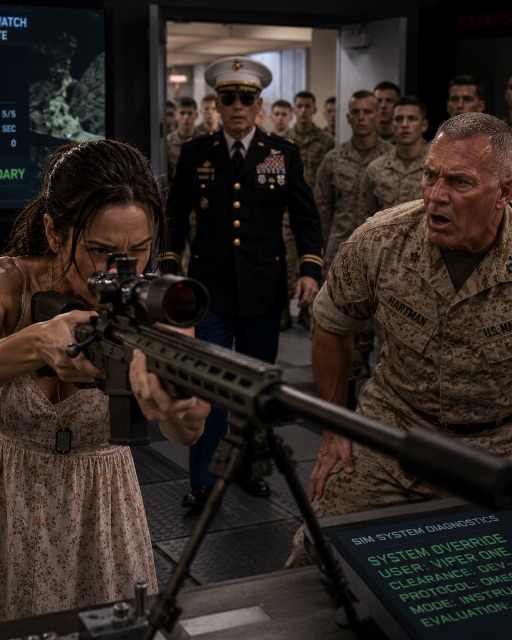
“Are you deaf, sweetheart, or just stupid?” Gunnery Sergeant Hartman’s spit hit my cheek, hot and smelling of cheap coffee and wintergreen dip.
I didn’t flinch. I just stared at the vein pulsing in his thick neck.
I’m Tracy Evans. I hadn’t come to Quantico to start a war. I came to drop off my little brother’s forgotten duffel bag. That was it. In and out.
But Hartman took one look at my faded sundress and decided I was the perfect prop for his midday power trip.
Fifty young Marines stood at rigid attention around the multi-million-dollar tactical simulation bay. My brother, Corporal Evans, was among them – pale, jaw clenched, watching his sister get publicly humiliated.
“I asked you a question, little girl!” Hartman roared, kicking a simulated MK11 sniper rifle across the rubberized floor. It skidded and clipped the toe of my sandal. “Your brother says you know your way around a rifle. You think you can waltz onto my base and judge my firing line? Pick it up!”
The screen behind him flashed red. Level 9 Urban Overwatch. A statistically impossible scenario. A rigged scenario.
I knew it was rigged. Because I wrote the code.
My brother opened his mouth to intervene. One word from him and his career was over. I caught his eye.
Stand down.
I bent down and picked up the heavy synthetic weapon. It settled into my hands like an old friend shaking my hand after twenty years.
“You want me to shoot?” My voice came out barely above a whisper. The room was so quiet it carried anyway.
“I want you to TRY, sweetheart,” Hartman sneered, arms crossed over his barrel chest. “So I can show these maggots what real failure looks like. Sixty seconds. Five hostiles. Crosswind. Go.”
I didn’t walk to the firing mat.
Instead, I turned to the diagnostic console mounted on the side of the bay. My fingers moved on their own – a sequence of keystrokes nobody in this room should have known. A developer-level override. The system chirped. The rigged parameters dissolved.
The screen reset itself, then displayed three words in the corner that made the technician behind the glass stand straight up out of his chair:
ADMIN: VIPER ONE.
“What the HELL did you just do to my machine?” Hartman barked, lunging toward the console.
Too late. I’d already shouldered the rifle. Exhale. Squeeze.
The simulated crack split the air.
That’s when the double doors at the back of the bay slammed open so hard one of them cracked against the wall. Boots. A lot of boots. And one voice – sharp, clipped, the kind of voice that turned full colonels into nervous children.
“ATTEN-TION ON DECK!”
Fifty Marines snapped so hard I heard knees pop. Hartman whipped around, his face still twisted in rage – and then I watched, in real time, every drop of blood drain from his cheeks.
Because standing in the doorway, in full dress blues, flanked by two MPs and the Base Commanding General himself, was a man Hartman had a framed photograph of on his own office wall.
The General’s eyes swept past Hartman like he wasn’t even there. They landed on me. And then, in front of fifty Marines, in front of the man who had just called me stupid, the General did something I will never forget as long as I live.
He saluted me first.
“Chief,” he said, his voice carrying to every corner of that bay. “We’ve been looking for you for three years. We need to talk about what they found in the Viper One source code last night.”
Hartman made a small sound. Like an animal that had just understood the trap.
I lowered the rifle, turned to face him fully for the first time, and finally let myself smile.
“Gunny,” I said softly. “Pick up the rifle.”
His hands were shaking too hard to bend down. But it was what the General pulled out of the leather folder under his arm next that made Hartman’s knees actually buckle.
General Marcus Thorne held up a glossy eight-by-ten photograph. It was a formal portrait, a young Marine in his dress blues, looking so proud it hurt to see. He had my eyes.
He had my smile.
Hartman stared at the photo, and a raw, guttural sob tore from his throat. He stumbled backward, catching himself on a training bench before his legs gave out completely. He finally sank to the rubberized floor, head in his hands, crying like a man who had seen a ghost.
The young Marine in the picture was Corporal Michael Evans.
My older brother.
“Eight years ago,” the General’s voice was cold and hard as steel, cutting through Hartman’s wretched sobs. “Then-Sergeant Hartman led a fire team on a reconnaissance mission in the Korengal Valley.”
He looked at the fifty young men standing witness. Their faces were a mixture of confusion and dawning horror.
“The official report, filed by Sergeant Hartman, stated that Corporal Michael Evans disobeyed a direct order, breaking cover and compromising the team’s position. It stated Corporal Evans was responsible for the firefight that followed.”
The General paused, letting the weight of the accusation settle in the silent room.
“It stated that Corporal Evans was responsible for his own death.”
My brother, Daniel – Corporal Evans—made a choking sound beside me. I reached out and squeezed his arm, my own anchor in a storm that had been brewing for almost a decade.
“Last night,” General Thorne continued, gesturing toward the main screen, “an encrypted data packet was activated from within the source code of this very training system. A packet we never knew existed.”
All eyes went to me.
“The simulator you’re all training on, gentlemen, is called the ATLAS system. It was designed and built by a private contractor. The lead coder, the chief architect, went by the callsign ‘Viper One.’”
The General looked directly at me.
“We now know ‘Viper One’ is Ms. Tracy Evans.”
A ripple of murmurs went through the room. Hartman just kept weeping, his body shaking on the floor.
“What Ms. Evans built into her code was a ghost. A black box. She was worried that technology could be used to alter records, to change the truth. So she created a failsafe.”
He pointed a gloved finger at Hartman. “The pre-mission planning for that patrol in the Korengal was run through an early prototype of this system. Sergeant Hartman logged every route, every contingency. And when the mission went live, the system’s ghost went with it.”
The air was so thick I could barely breathe. This was it. The moment I had worked toward for eight long years.
“The black box recorded everything. Not the fabricated nonsense from the after-action report. It recorded the real-time comms logs. The biometric data from the squad’s gear. The helmet cam footage.”
The General’s face was grim. “It recorded then-Sergeant Hartman panicking when his planned route led the team into an ambush. It recorded him freezing, unable to give a single command for a full thirty-seven seconds while his men were taking fire.”
My heart hammered against my ribs. I had seen the data. I had lived with it for years. But hearing it spoken aloud, in this place, was a different kind of justice.
“And it recorded Corporal Michael Evans,” the General’s voice softened with respect, “seeing his Sergeant frozen, seeing his team being pinned down, and making the only call a leader could make. He took command. He ordered his men to a new position. He laid down covering fire so they could get there.”
The General looked down at the pathetic man on the floor. “He saved every man in that fire team. Except himself. The report Hartman filed was a complete fabrication to cover his own cowardice. He built his career on the grave of a hero he slandered.”
Silence. Complete and total silence, broken only by Hartman’s gasps.
The General nodded to the two MPs. “Gunnery Sergeant Hartman, you are under arrest. You will be charged with dereliction of duty, filing a false official report, and conduct unbecoming a Marine. I imagine the UCMJ will find a few more things to add to that list.”
The MPs hauled Hartman to his feet. He was limp, all the fire and bluster gone, replaced by the hollowed-out shell of a man whose lies had finally caught up to him. As they dragged him past, his eyes met mine. They weren’t angry. They were just… empty. Filled with the terror of a debt finally coming due.
Then they were gone, and the heavy doors swung shut.
The tension in the bay finally broke. The rigid postures of the young Marines relaxed. My brother Daniel rushed to me, wrapping me in a hug so tight it felt like he was trying to put my broken pieces back together.
“Tracy… I never knew,” he whispered into my hair. “Why didn’t you ever tell me?”
“Because I didn’t want this to be your fight,” I said, my voice thick with unshed tears. “I wanted you to be a Marine because you wanted to be. Not because you were seeking revenge for Michael.”
He pulled back, his eyes searching mine. “Dropping off my duffel bag… that was just an excuse, wasn’t it?”
I gave him a watery smile. “I heard you got assigned under him. I couldn’t let it go. I had to be sure.”
My plan wasn’t supposed to be this dramatic. I was just going to observe, to collect more data on Hartman’s current behavior. But when he called me out, when he spat on me in front of Michael’s legacy—in front of the new generation of Marines he was supposed to lead—something inside me snapped.
I didn’t need to stalk him. He had handed me the stage himself.
General Thorne walked over, his expression unreadable. “Ms. Evans. Your methods were… unorthodox.”
I braced myself.
“But effective,” he finished, a flicker of a smile touching his lips. “You exposed a rot in my Corps that we should have found years ago. On behalf of the United States Marine Corps, I offer you our deepest apology. We failed your brother. We failed your family.”
“You didn’t fail him, General,” I corrected him gently. “Hartman did. The system just believed the lie.”
“A system you just fixed,” he acknowledged with a nod. He looked around at the now quiet simulation bay. “This machine… your work… it’s incredible. We’d like to offer you a position. A senior civilian post at Marine Corps Systems Command. Name your price.”
I thought about it for a moment. Eight years of my life had been dedicated to this single, burning purpose. I had funneled my grief and my rage into lines of code, building a digital monument to my brother’s honor.
“Thank you, General. But no,” I said quietly.
He looked surprised. My brother Daniel looked shocked.
“I can’t,” I explained. “I did this for Michael. My work was an act of love. If I put it on a government payroll, it becomes a job. I think I’d rather just be a sister for a while.”
I looked at Daniel, who was watching me with so much love and pride it made my chest ache.
“But,” I added, turning back to the General, “I’ll be happy to consult. On one condition.”
“Name it.”
“You create an award. A yearly award for integrity in technology. For the person, military or civilian, who best uses technology to uphold the truth, no matter the cost. Call it the ‘Viper One Award.’” I looked at the picture of Michael, which the General was still holding. “No, call it the Corporal Michael Evans Award for Digital Integrity.”
General Thorne’s stern face broke into a genuine, warm smile. He extended his hand. “Ms. Evans, it would be my distinct honor.”
We shook hands. It felt like closing a book that had been open for far too long.
A few months later, we held a ceremony. Not on a parade ground, but in a small, quiet hall at Quantico. The fifty Marines from the simulation bay were there, on their own time, dressed in their service uniforms.
Gunnery Sergeant Hartman had been court-martialed and dishonorably discharged, sentenced to time in Leavenworth. The truth of that day in the Korengal was now part of the official record.
More importantly, Michael’s record was corrected. He was posthumously awarded the Silver Star for his gallantry and leadership. The medal was presented to my parents, their tears this time not of grief, but of pride and relief.
Daniel stood next to me, straighter and taller than I’d ever seen him. He was no longer just the little brother I had to protect. He was a Marine, part of a brotherhood that now understood the true meaning of honor, thanks to the brother he barely remembered.
After the ceremony, Daniel and I walked out into the cool evening air.
“You know,” he said, “I always felt like I was living in his shadow. Trying to be the Marine he was.”
“You don’t have to be him, Danny,” I told him, bumping his shoulder with mine. “You just have to be you. That’s more than enough.”
He stopped and looked at me. “He’d be so proud of you, Tracy.”
I knew he was right. I could almost feel Michael there with us, a gentle presence in the breeze. My fight was over. His name was cleared. His honor was restored.
Vengeance, I realized, feels hot and angry. But justice… justice feels like peace. It doesn’t scream from the rooftops. It settles quietly in your soul, a silent, unshakeable truth. It’s the strength to stand down when you need to, and the courage to stand up when you must. It is the quiet promise you make to the people you love, a promise to always, always fight for the truth.