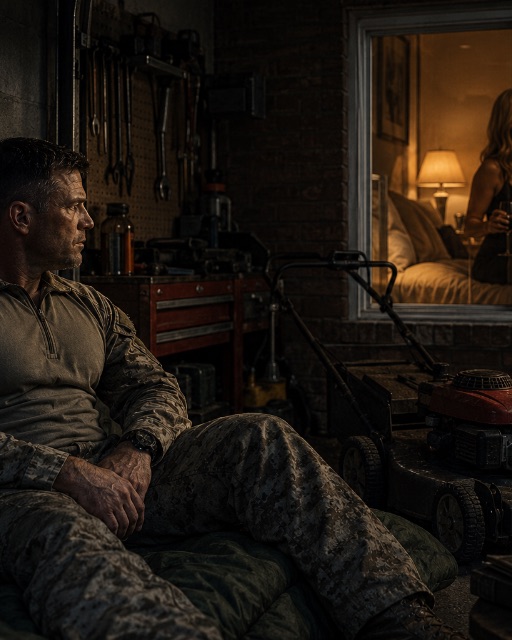
I watched the master bedroom go dark through the salt-streaked garage window. My wife, Sarah, was in there. So was the “business consultant” she swore was helping with her taxes.
The concrete under my sleeping bag felt like ice. Gasoline. Cut knuckles. A 2012 mower for a nightstand.
“It’s for your own good, Elias,” she’d said earlier, voice honeyed over nails. “Your PTSD makes the house feel… heavy. Marcus actually helps. On a real paycheck, not your measly pension.”
Marcus didn’t help with anything but my top-shelf scotch.
Every time I tried to speak, she’d smirk. “Oh look, war stories. Go polish a medal.”
I stayed. Because I had nowhere else to go. Or so she thought.
She didn’t know about the settlement – inked in a conference room with no windows, names blacked out, numbers that made my hands shake.
She didn’t know about my grandfather’s trust that unlocked on my twentieth year of service. Tomorrow.
I didn’t need a bed to plan a mission.
I closed my eyes and waited for dawn.
At 07:10, I showered at the gym, put on a clean shirt from a plastic bin, and drove to a building with frosted glass and too much air freshener.
“Colonel?” the receptionist blinked when I gave my name. A door clicked. A woman with a steel bun and a folder stepped out. “Ms. Park,” she said, shaking my hand. “We’ve been waiting.”
We signed. We confirmed. A gold seal was pressed. Ms. Park slid me a key I hadn’t seen since I was a kid, initials etched in brass.
By 11:40, I was back in my own driveway.
Sarah answered in a robe that wasn’t hers. Marcus unfolded behind her, wearing my T-shirt like a trophy.
“You can’t just show up,” she hissed. “You agreed to the garage.”
I didn’t argue. I turned the folder so they could see the seal.
Her smile twitched. Marcus laughed too loud, then coughed when engines rolled up the curb.
Black SUVs. County decal. A notary. Clipboards. Two men in suits. A third car, longer, darker.
“What did you do?” Sarah whispered, color draining.
“I took your advice,” I said. “I got help.”
The limousine door opened. Marcus’s glass hit the tile. And when Sarah saw who stepped out – and what he handed me – she finally understood whose name was on the house.
It was her own father, David.
He was a retired banker, a man of quiet suits and rigid principles. He looked from me to Sarah, his face a mask of profound disappointment.
He didn’t say a word to her.
Instead, he took a crisp, folded document from his breast pocket and handed it to me. The original deed.
Next, he produced a small, velvet bag. From it, he tipped two old keys into my palm. The original house keys, from before they were replaced with the cheap, modern ones Sarah preferred.
“Elias,” David said, his voice steady. “Welcome home.”
Sarah finally found her voice, a screech that tore the quiet morning air. “Dad? What is this? This is my house!”
David turned to her then, his eyes cold as a winter river. “No, Sarah. It was never your house.”
“We bought it together!” she shrieked, pointing a trembling finger at me. “With his money! From the army!”
“You put a down payment on it,” David corrected her calmly. “A small one. I covered the rest, as a gift. A gift I put in a trust.”
He let that sink in.
“A trust with one condition,” he continued. “That Elias complete his twenty years of honorable military service. That trust vested yesterday.”
He gestured to the house. “This property, and everything in it that isn’t your personal clothing, belongs to him. It was always meant to be a thank you for his sacrifice. A safe place for him to land.”
He looked at Marcus, then back at his daughter. “Not a playground for you to defile.”
Marcus, who had been frozen, finally moved. He tried to puff out his chest, the collar of my T-shirt straining.
“Now hold on a minute, sir,” he began, trying to sound authoritative. “Sarah and I have an arrangement.”
One of the men in suits stepped forward. He wasn’t a big man, but he moved with a purpose that made Marcus shrink back.
“Ms. Bishop,” the man said, ignoring Marcus completely. “You have thirty minutes to gather your personal effects. Things you can carry. Nothing else.”
“Thirty minutes?” Sarah gasped. “Where are we supposed to go?”
The man just glanced at his watch. “Twenty-nine minutes.”
Panic set in. Pure, undiluted panic.
“Elias, baby, you can’t do this,” she pleaded, her tone shifting from rage to a desperate, syrupy sweetness that once worked on me. “We can talk about this. I was stressed. It’s the taxes!”
I just looked at her. I saw the performance, the strings she was trying to pull, but they were all cut.
“There’s nothing to talk about, Sarah,” I said, my voice even.
Marcus scoffed. “So you’re just going to throw your wife out on the street? Some hero.”
I turned my gaze to him. The T-shirt he wore was one I’d been given by my unit. The name of a fallen brother was printed on the back.
“That’s a good shirt,” I said quietly. “Take it off.”
He blinked, stunned. “What?”
“Take it off,” I repeated, my voice dropping just enough to carry an old command. “It’s not yours.”
For a second, I saw a flash of defiance in his eyes. Then he looked at David, at the suited man, at the silent SUVs, and his courage evaporated.
He clumsily pulled the shirt over his head, leaving him bare-chested and pathetic on the porch. He threw it on the ground.
“You’re making a big mistake, old man,” he snarled.
“Am I?” I asked.
That was the cue for the second man in a suit. He was holding a different kind of folder, one with a prominent federal seal on it.
He stepped right up to Marcus. “Are you Marcus Thorne?”
Marcus narrowed his eyes. “Who’s asking?”
“Special Agent Reynolds, FBI,” the man said, flipping open a badge. “We have a warrant for your arrest.”
Sarah made a small, choking sound.
“Arrest?” Marcus stammered. “For what? A parking ticket?”
“Wire fraud,” Agent Reynolds stated flatly. “Conspiracy to commit fraud. And targeting of protected classes, specifically, military veterans.”
The world seemed to slow down.
Sarah looked from the agent to Marcus, then to me. Her face was a canvas of confusion and horror.
“What is he talking about?” she demanded of Marcus.
Marcus was sweating now, his eyes darting around for an escape that didn’t exist. “I don’t know! It’s a mistake!”
I decided to help him remember.
“Remember that investment group you run, Marcus?” I asked calmly. “The ‘Veterans Wealth Initiative’?”
His head snapped toward me, pure hatred in his eyes.
“You told my wife you were a tax consultant,” I continued, speaking to the group now. “But you told me you were a financial wizard. You promised to double the pensions of old soldiers.”
Agent Reynolds picked up the narrative. “What he actually did was funnel their life savings into his own offshore accounts. He preyed on their trust.”
Sarah stumbled back, catching herself on the doorframe. “Investor? You told me… you said you managed hedge funds.”
“Did he also tell you that my settlement was from a class-action lawsuit filed against him and his partners?” I asked her. “By dozens of veterans he scammed?”
The silence that followed was deafening.
“I wasn’t the first person he tried it on,” I explained, my voice steady. “But I was the one who had the training to see the red flags. To document everything. To work with them.” I nodded toward Agent Reynolds.
The “business consultant” wasn’t here for her taxes. He was here because he was trying to get his hands on my settlement money, the very money he had been forced to pay out.
He saw me as an easy mark, a broken soldier with PTSD he could manipulate through my wife.
He had underestimated me. Everyone had.
Agent Reynolds produced a pair of handcuffs. “Marcus Thorne, you have the right to remain silent.”
As they cuffed him, Marcus shot a venomous glare at Sarah. “You were in on it! You knew! You were helping me get his money!”
“No!” she screamed, tears streaming down her face. “I didn’t know! I thought… I thought…”
She couldn’t finish. What had she thought? That he was her ticket to a better life, built on the scraps of my dignity.
They led a struggling, shouting Marcus to one of the SUVs and placed him in the back. The door shut with a final, heavy thud.
The first suited man looked at his watch again. “Ms. Bishop. Fifteen minutes.”
She was completely broken now, her whole world dismantled in less time than it takes to drink a cup of coffee.
She ran inside, the sound of drawers being yanked open and objects crashing to the floor filling the air.
David walked over and put a hand on my shoulder. “I’m sorry, son. I’m so sorry it came to this. I should have seen what she was becoming.”
“It’s not your fault,” I told him, and I meant it. “People make their own choices.”
“That they do,” he said sadly.
A few minutes later, Sarah emerged, dragging a designer suitcase in one hand and clutching a large purse in the other. Her face was blotchy, her hair a mess.
She didn’t look at me. She couldn’t.
She walked past her father without a word, her shoulders slumped in defeat. She got into her convertible, the one Marcus had convinced her to lease, and sped away from the curb without a backward glance.
The SUVs and the limousine pulled away. The notary finished his work and departed.
Suddenly, it was just me and David, standing on the porch of a silent house.
I picked up the T-shirt from the ground, the one with my friend’s name on it. I folded it carefully.
“Come inside,” I said to David. “Let me make you some coffee.”
We sat in the kitchen, the one I hadn’t been allowed to eat in for months. I used the good coffee maker, the one Sarah had said was only for guests.
The house was still and calm. No tension. No heavy atmosphere. It just felt… like a house.
“The trust was my father’s idea,” David said, staring into his mug. “He admired your grandfather. Both served. Both believed a man’s word was his bond.”
“He wanted you to have a place of honor, Elias. A place that couldn’t be taken from you by market crashes or bad luck… or bad judgment.” He looked at me, his eyes filled with regret for his daughter’s actions.
After he left, I walked through the rooms alone.
I went into the master bedroom. The sheets were a mess, and the scent of Marcus’s cheap cologne lingered in the air.
I stripped the bed, bundling up the expensive linens Sarah had bought. I opened the window wide, letting the fresh, cool air pour in, chasing away the ghosts.
I walked to my old study, the one that had been turned into Sarah’s “yoga room.” My books were packed in boxes in the corner. My citations and a framed photo of my unit were shoved behind a pile of mats.
I took the photo out and wiped the dust from the glass. I saw a younger me, surrounded by brothers. Men who understood duty, honor, and sacrifice.
I had been so focused on the war overseas that I hadn’t seen the one being waged in my own home. I had mistaken patience for weakness, and I had let my quiet struggles become a weapon used against me.
But a soldier knows that a mission isn’t over until the objective is secure. My objective was peace. My objective was home.
I didn’t feel a surge of victory or a thirst for revenge. I just felt… quiet. The concrete floor of the garage seemed a lifetime away.
I put the photo on the mantelpiece, right in the center of the living room.
That night, I didn’t sleep in the master bedroom. I brought my old sleeping bag in from the garage and laid it on the floor in the living room, right in front of the fireplace.
The house was mine. The quiet was mine. The peace was mine. I had completed my final mission. I had come home.
True strength isn’t about how loudly you can shout, but how long you can endure with integrity. It’s about knowing your own worth, even when others try to strip it away. Sometimes the greatest victory isn’t won on a battlefield with weapons, but in the quiet corridors of your own life, with patience, honor, and a plan. And home isn’t just a place with four walls and a roof; it’s the peace you build for yourself when the fighting is done.