
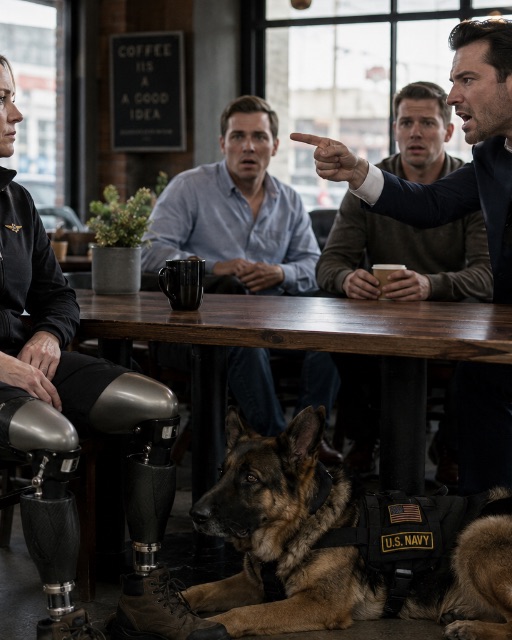
The man’s voice cut through the soft morning air like a rusted blade. “Careful with that dog, sweetheart. Wouldn’t want him learning bad habits from someone who can’t even stand.”
The café went quiet so fast it almost felt rehearsed.
It was midmorning at Harbor Bean in San Diego, the kind of place with polished wood tables, low music that never demanded attention, and regulars who came more for the silence than the coffee. Near the window sat a woman in her early forties named Diane Cross. She had a calm face, broad shoulders, and a military posture that had survived everything else life had taken from her.
She wore jeans, boots fitted over prosthetic legs, and a dark jacket with a small gold Trident pin clipped neatly above the pocket. Beside her lay a large German Shepherd named Gunner – alert but disciplined, his dark eyes tracking the room without moving his head.
Diane had come for one thing only. An hour of peace.
Instead, trouble walked through the door wearing cologne, arrogance, and the confidence that comes from never having been publicly challenged. The man’s name was Brandon Hale. He was local enough that people recognized him and disliked him in silence. Two of his friends followed him in, loud and careless, looking for attention before they even ordered.
It didn’t take Brandon long to find a target.
He stopped two feet from her table, looked down at her legs, and smirked like a man who had never once been hit back. “Hey, what happened? Tripped over a curb?” His friends snickered. One of them filmed it on his phone, holding it low like he thought no one could see.
Diane didn’t look up. She wrapped both hands around her coffee cup and breathed in slowly through her nose. Gunner’s ears shifted forward. A low sound began somewhere deep in the dog’s chest – not a growl yet. A warning.
“Easy,” Diane whispered. The dog stilled instantly.
Brandon took that as permission. He leaned closer, one hand on the back of her chair. “What, no comeback? You military types are always tough until somebody actually talks to you.”
The barista froze with a steaming pitcher in her hand. An older man two tables over slowly set down his newspaper. Nobody moved. Nobody ever moves. That’s the part Brandon was counting on.
He reached for the Trident pin on her jacket. “Cute little decoration. Where’d you buy that, the costume store?”
Diane’s hand caught his wrist before his fingers touched the metal. She didn’t squeeze. She didn’t twist. She just held it there, steady as a vise, and finally looked up at him.
“Son,” she said quietly, “you should let go of that pin before you make a phone call you can’t take back.”
He laughed in her face.
That was when the bell above the door rang for the second time that morning. Three men walked in—tall, weathered, dressed in plain clothes that didn’t quite hide what they were. The one in front had a beard going gray at the edges and a scar that ran from his ear to his collar. He took one look at the woman at the window table, and his entire face changed.
He stopped walking. His hand went to his chest, right over his heart, and stayed there.
“Chief?” he said, and his voice cracked in a way grown men’s voices aren’t supposed to crack.
Brandon turned around, still smirking. “Chief? What, is she your boss or something?”
The bearded man didn’t answer him. He walked past Brandon like he wasn’t there, knelt down beside Diane’s chair, and said something so soft that only she could hear it. She closed her eyes. Just for a second.
Then the second man stepped forward. And the third. And behind them, through the open door, a fourth was coming up the sidewalk. Then a fifth.
Brandon’s smirk started to slip. “Who the hell are you guys?”
The bearded man finally stood up, turned around slowly, and looked Brandon straight in the eye.
“We’re the reason she’s missing those legs,” he said. “Every single one of us.”
He took one step closer. The café was so quiet you could hear the espresso machine ticking as it cooled.
“Now,” he said, “say it again. Say what you said to her when we walked in. Say it loud enough for all of us to hear.”
Brandon opened his mouth. Nothing came out. His friend with the phone slowly, slowly lowered it to his side.
And then the bearded man pulled something out of his jacket pocket—something small, something folded, something he had clearly been carrying for a very long time—and held it up where everyone in the café could see it.
When Brandon saw what it was, his knees actually buckled.
It wasn’t a weapon. It was a photograph, worn soft at the edges from being held a thousand times.
The picture showed a group of people at a fancy charity gala. In the center, a younger Diane, radiant in her dress uniform, her hair up, her smile tired but genuine. Her legs were her own.
Shaking her hand was a beaming politician, a man with a practiced smile and a famous face. He was known all over the state, all over the country.
The man was Senator Hale. Brandon’s father.
Brandon stared at the photo, his face a mess of confusion and dawning horror. The blood drained from his cheeks, leaving behind a pasty, sick-looking white.
The bearded man, whose name was Mark, didn’t lower the photo. He let Brandon drink it in.
“You recognize him, don’t you?” Mark’s voice was dangerously low, a rumble that vibrated through the silent café. “Your old man. The great patriot.”
Brandon’s friend with the phone took a nervous step back, bumping into a table. The clatter was like a gunshot in the still room. He quickly pocketed the device, his eyes wide with fear.
“I… I don’t know what you’re talking about,” Brandon stammered. His voice was a thin, reedy thing now, all the earlier bravado gone.
“You don’t?” Mark took another step, closing the distance until he was towering over the younger man. The other four men fanned out behind him, a solid, unmovable wall. They didn’t look angry. They looked worse. They looked patient.
“Let me refresh your memory,” Mark said. “About seven years ago, your father, the Senator, threw a big fundraiser. A real media circus. It was for a new veterans’ charity he was championing.”
He gestured with the photo toward Diane. “Chief Cross was the guest of honor. Freshly back from a tour. He used her for a thousand photos that night. Talked a big game about sacrifice and courage.”
Brandon was shaking his head, a gesture of denial that was both panicked and pathetic. “So what? He supports the troops. Everyone knows that.”
“He supports a talking point,” a second man, Samuel, corrected him. His voice was sharper than Mark’s, high-strung and tight. “He doesn’t support the people.”
Mark continued, his gaze locked on Brandon. “See, while your father was busy getting good press and cashing checks from his donors, we were getting ready to go back overseas.”
“We were a team. Her team,” Mark said, a thumb jerked toward Diane. “She was our Chief, our EOD tech. The best there was. The one who went first. The one who made sure the rest of us came home.”
A heavy silence filled the air. Even the traffic outside seemed to have faded away.
The older man with the newspaper was now leaning forward, his full attention on the scene. The barista stood stock-still behind the counter, her phone now on the countertop, recording openly.
“Our last mission,” Mark said, and his own voice hitched for a second. “We were deep in-country. Intel said the village was clear. A soft target for a goodwill op. We were there to help rebuild a school.”
He paused, letting the words hang.
“The intel was bad. As soon as we stepped into the main square, everything lit up. They were waiting for us. Boxed us in. We were pinned down for six hours.”
One of the other men, David, cleared his throat. “We were out of options. The only way out was through a narrow alleyway, but it was rigged. We saw the wires.”
“Someone had to go clear the path,” Mark said. “Someone had to walk into that alley and take apart the bomb that was meant to wipe us all out.”
He looked back at Diane, and his entire expression softened, the hard edges giving way to a profound, aching respect.
“Chief here, she didn’t hesitate,” he said, speaking now to the whole café. “She told us to hold our positions, to cover her. And she went. Just her and her tool kit.”
He turned back to Brandon, his eyes hard as flint again. “She got the main device. A big, ugly thing wired to a cell phone. We heard her on the radio, calm as you please. ‘Device is safe.’ We were cheering. We were going home.”
Mark’s hand, the one not holding the photo, curled into a fist.
“But there was a second one. A pressure plate. Buried in the dirt right next to the first one. Something the new, cheap ground-penetrating radar your father’s favorite defense contractor sold the military couldn’t detect.”
Brandon flinched as if he’d been struck. The color was returning to his face, but this time it was a flush of ugly, dawning comprehension.
“That’s a lie,” he whispered.
“Is it?” Mark pushed. “Your father sat on the Armed Services Committee. He pushed through the contracts for a company called OmniDef. He swore their gear was state-of-the-art. In return, OmniDef’s CEO made a very generous, seven-figure donation to your father’s ‘charity’.”
He held up the photo again. “The same charity he was promoting the night he took this picture with Chief Cross. The same charity that quietly folded a year later, after the money was funneled into his reelection campaign.”
The puzzle pieces snapped into place with a sickening click that was audible to everyone in the room. The arrogance, the corruption, the casual cruelty, all connected. Brandon wasn’t just a bully; he was the product of a poisoned tree.
“She saved our lives,” Mark said, his voice dropping to a whisper that was more powerful than any shout. “All five of us. We have children we never would have met. We’ve had seven more years of sunrises. And she paid for it. She paid the price for your father’s photo-ops and his backroom deals.”
He finally lowered the picture.
“And you,” he said, his voice filled with a quiet contempt that was more chilling than rage, “you have the nerve to walk in here. You, who have lived a life of luxury built on the blood of people better than you’ll ever be. And you mock her.”
He looked down at her legs, then back at Brandon’s face.
“You asked her what happened. That’s what happened. Your father’s ambition is what happened.”
Brandon swayed on his feet. The whole world he had known, the foundation of power and wealth he had taken for granted, had just been ripped out from under him. He wasn’t the son of a great man. He was the son of a fraud.
His friend had already slipped out the door. The other was trying to make himself invisible in a corner.
Brandon looked at Diane. Her face was unreadable. She wasn’t angry. She wasn’t smug. She was just watching him, her gaze clear and steady. The absence of hatred in her eyes was somehow the most devastating blow of all.
“I… I didn’t know,” he choked out. The words were weak, a child’s excuse.
“No,” Mark said coldly. “You didn’t want to know. It was easier to be rich and stupid.”
An unbearable weight descended on Brandon. He opened his mouth, then closed it. An apology would be an insult. Silence was an admission of guilt. He was trapped.
That’s when Diane finally spoke. Her voice was soft, but it carried across the entire room.
“Mark.”
Mark turned his head slightly, but didn’t take his eyes off Brandon.
“It’s enough,” she said.
The words were simple, but they held the quiet authority of a commander. It wasn’t a request. It was an order.
Mark looked at her for a long moment. He saw the woman who had led them, the woman who had saved them, the woman who had never once, in all the years since, allowed herself to be a victim. He slowly uncurled his fist.
He turned back to Brandon. “Get out.”
Brandon didn’t need to be told twice. He stumbled backward, spun around, and practically fled from the café, not even looking at his remaining friend, who scrambled to follow him. The bell on the door chimed his pathetic retreat.
The silence they left behind was different. The tension wasn’t gone, but it had transformed into something else. Respect. Awe.
The café owner, a middle-aged woman with kind eyes, came out from behind the counter. She walked over to their table, holding a pot of fresh coffee.
“This is on the house,” she said softly. “All of it. For as long as you want to stay.”
She looked at Diane. “Thank you,” she whispered, and it was clear she meant it for more than just her service.
Mark and Samuel and the others pulled chairs from nearby tables. They settled in around Diane, creating a small, protective circle. Gunner, who had been a statue of coiled energy the whole time, finally rested his head on Diane’s lap, letting out a soft sigh.
Diane reached down and stroked his head, her hands steady. She looked at Mark, a small, weary smile touching her lips.
“I told you I was just coming for coffee,” she murmured.
Mark’s own face broke into a real smile, the first one he’d shown all morning. It erased the scar and a decade of pain.
“And we told you we’d be here,” he replied. “It’s our turn to have your six, Chief.”
She had walked into Harbor Bean looking for an hour of quiet solitude. But as she sat there, surrounded by the men who were more her brothers than her comrades, the men whose lives she had purchased at such a terrible cost, she found something better.
She didn’t find peace and quiet. She found peace in the chaos. The peace that comes from knowing you are not alone. The peace that comes from shared sacrifice and unbreakable loyalty.
The world is full of bullies like Brandon, men who mistake privilege for strength and silence for weakness. They build their fragile towers of ego on foundations of ignorance and cruelty. But true strength isn’t loud. It isn’t arrogant. True strength is quiet. It’s the steady hand that disarms a bomb, the calm voice in the middle of a storm, and the courage to endure the unendurable with grace. It’s the bond between people who have walked through fire together and come out the other side, not unscathed, but forever connected.



