
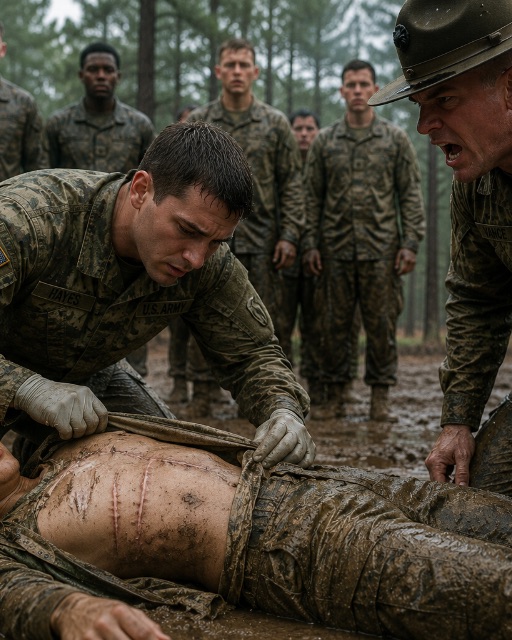
Georgia heat feels like a wet hand over your mouth. I hit the mud so hard my teeth clicked. No air. Just the taste of iron and clay.
“Get up, Lin!” Drill Sergeant Vance barked, laughing like it was a joke. “Quit faking!”
I wasn’t faking. I was drowning on dry land.
I clawed at my collar. It was always buttoned. Always. Five-foot-three, a hundred and fifteen, I knew I was the runt. I kept my head down, tied my boots too tight, counted steps. I’m Recruit Kara Lin, and for six weeks Vance made me his project.
Twelve miles with a ruck that felt like a person on my back. Mile eleven, my left side went numb. I dropped. My chest wouldn’t open. Stars popped at the edge of my vision.
“Step back!” someone yelled.
Specialist Hayes slid into the mud beside me, gloves already on. “She’s cyanotic,” he snapped at Vance. “Move.”
He didn’t ask. He grabbed his trauma shears and sliced straight up my blouse. The fabric tore with a rip that echoed.
Everything went silent.
Rain started ticking through the pines. Hayes’s hands shook. Vance actually took a step back.
I watched their faces change. Not pity. Recognition.
Across my ribs: cratered burns, ropes of warped skin, the sunken bite where metal once lived. Not clean, not pretty – old, ugly, violent. The kind of scars you don’t get from falling out of formation.
My heart pounded in my throat. Hayes swallowed, eyes locked on me like he’d seen a ghost.
He leaned closer and whispered a name I hadn’t heard since the night the sirens wouldn’t stop – and then he reached under my torn collar, lifted a bent dog tag I’d hidden flat against my skin, and my blood ran cold when I saw whose name was stamped into the metal.
“Kandahar,” Hayes had whispered, his voice cracking on the word.
Then he turned over the tag. Sergeant First Class David Lin. My father.
My vision tunneled. The shouting of other recruits, the hiss of the rain, Vance’s heavy breathing—it all faded into a dull roar. All I could see were Hayes’s eyes, wide with a terrible kind of understanding.
Another medic arrived with a stretcher. They worked fast, their movements professional and quiet. I was lifted from the mud, a blanket draped over me, hiding the roadmap of my past from the curious eyes of my platoon.
Vance stood frozen, his face a mask of confusion and something else I couldn’t place. He looked from the sliced uniform to my face, then back again. For the first time, he was speechless.
In the aid station, the air smelled of antiseptic and clean linen. Hayes hung an IV bag, his movements gentle now. He hadn’t said another word since the clearing.
He taped the line to my arm. “I was a private back then,” he said, his voice low. “Just a kid. FOB Falcon.”
I just stared at the ceiling tiles, counting the little holes in them. One, two, three.
“The VBIED at the north gate,” he continued. “I was on the response team. One of the first medics on scene.”
I closed my eyes. The smell of burning fuel and dust filled my memory. The sounds of screaming.
“There was a little girl. They pulled her from the wreckage of a civilian vehicle. Her father… he didn’t make it.”
My father had been driving me for ice cream. A rare treat. A moment of peace in a world of chaos.
“I helped carry you to the C-130,” Hayes said softly. “I never forgot. We never forget the kids.”
A tear traced a path through the dirt on my temple. I didn’t wipe it away.
He pulled a small, worn notebook from his pocket. He flipped through the pages, his thumb smudging the worn ink. He stopped on one page and looked at it for a long time.
“We heard your last name was Lin. A lot of us tried to follow up, to see if you… if you made it.” He looked up, his eyes glassy. “To see you here, wearing this uniform. It’s…”
He didn’t finish. He didn’t have to.
The tent flap zipped open. Captain Miller, our company commander, stepped inside. He was a tall man who rarely raised his voice, which made him more intimidating than all the drill sergeants combined.
He looked at me, then at Hayes. His gaze fell on my torn uniform, discarded on a chair. He saw the exposed scars. He didn’t flinch.
“Specialist Hayes, what’s the recruit’s status?” he asked, his tone all business.
“Exhaustion, dehydration, Sir,” Hayes replied. “Vitals are stabilizing. She’ll be fine.”
Captain Miller nodded. “And Drill Sergeant Vance?”
“He’s outside, Sir,” Hayes said.
The Captain looked at me again, a long, searching look. “Recruit Lin,” he said, his voice softening just a fraction. “Why are you here?”
I found my voice, rough and dry. “To finish what my father started, Sir.”
It was the simplest truth. The only truth that mattered.
He held my gaze for another moment, then nodded once, a sharp, definitive gesture. “Rest up, recruit. We’ll talk later.” He turned and left the tent.
I could hear him talking to Vance outside, his voice low but carrying a clear edge of command. I couldn’t make out the words, but the tone was unmistakable. It was the sound of a storm breaking.
The next few days were strange. I was placed on light duty, assigned to help in the supply room, sorting socks and stencils. The world of mud and shouting felt miles away.
The other recruits treated me differently. The whispers stopped. The looks were no longer of annoyance at the slow one, but of a quiet, hesitant respect. They’d leave a bottle of water by my bunk or save me a spot at the table in the chow hall. They didn’t know the story, but they had seen the scars. They understood that some battles are fought long before you ever put on the uniform.
Drill Sergeant Vance was still there, but he was a shadow. The booming voice was gone, replaced by a clipped, hollow version of itself. He stopped calling cadence on runs, letting another drill sergeant take over. He didn’t look at me. He didn’t look at anyone. He just went through the motions, a ghost in his own life.
Hayes started stopping by the supply room. He’d bring me a cold drink and an old field manual.
“Thought you might be interested,” he said, handing me a thick book on combat lifesaving. “You wanted to be a medic, right?”
I’d told him that in the aid station. It was the other half of my truth. I was here to be like my father, but also to be like the people who saved me.
We sat in the dusty quiet of the storeroom, surrounded by the smell of canvas and boot polish. He told me stories, not of the bad day, but of the good ones. Of the soldiers he’d patched up who went home to their families. Of the local children he’d given candy to.
He helped me see the other side of the uniform. Not just the sacrifice, but the service.
One afternoon, he pointed to a faded tattoo on his forearm, a serpent wrapped around a dagger. “You see this? It’s the Kask-e neesh. The snake-eater.”
“Special Forces?” I asked.
He shook his head, a small smile playing on his lips. “No. It’s an unofficial thing. Medics who served in a particular unit. Your father was part of it. He designed this patch.” He tapped the tattoo. “He was a legend. Not just a good soldier, a good man. He looked out for everyone.”
The pride that swelled in my chest was so fierce it hurt. It was a piece of my dad I’d never known.
As I got stronger, I returned to training. Vance was still a hollow shell, but his eyes followed me now. There was no mockery in them anymore. There was something else. Something that looked a lot like fear.
His behavior grew more erratic. He’d zone out in the middle of giving instructions. He once spent an entire afternoon making the platoon take apart and reassemble their rifles, over and over, until their fingers were raw, his expression completely blank. He was a tightly wound spring, and everyone knew he was about to break.
The final week of training was the Forge. A grueling, multi-day field exercise that tested everything we’d learned. The climax was a mass casualty, or MASCAL, simulation.
We were in a mock village, the air thick with purple smoke and the recorded sounds of chaos. Actors with gruesome fake injuries were scattered everywhere, screaming for help.
My squad was tasked with setting up the initial triage point. It was pure mayhem. My heart pounded, but not with fear. With focus.
“This one’s expectant,” I heard myself say, tagging a mannequin with almost no simulated pulse. “This one’s immediate! Get him to the CCP!”
The sights, the sounds—they should have sent me spiraling back to that day in Kandahar. But they didn’t. It was like Hayes said. I wasn’t the little girl on the ground anymore. I was the one with the ability to help.
I was kneeling beside a young soldier playing the role of an amputee, applying a tourniquet, when a figure stumbled through the smoke. It was Drill Sergeant Vance.
His face was pale, his eyes wide and unfocused. He wasn’t looking at the simulation. He was looking through it. He stared at me, my face smudged with dirt, my hands covered in fake blood.
“The gate,” he mumbled, his voice a raw whisper. “I was on the gate.”
I paused, my hands frozen on the tourniquet. The actor beside me stayed silent, sensing this was no longer part of the exercise.
“It was hot,” Vance continued, his eyes locked on mine. “We were tired. A truck came through… a produce truck. I was supposed to run the mirror under it. I just… waved it on.”
His entire body started to shake. “I was a corporal. I wanted to look like I was in control. I just waved it on.”
Hayes materialized out of the smoke, his expression grim. He had heard it.
Vance dropped to his knees in the dirt, just a few feet from me. The swaggering drill sergeant was gone. All that was left was a broken man.
“I saw the report later,” he choked out. “An officer’s family… a little girl. I never said anything. I kept my mouth shut and I got promoted.” His eyes finally met mine, and they were filled with a tormented agony that was years old. “Seeing you every day… this tiny little recruit… pushing so hard. You were the ghost. You were my ghost.”
I looked at him, kneeling in the dirt, the tough-guy facade stripped away to reveal the cowardice and guilt he’d carried for a decade. I didn’t feel anger. I didn’t feel hatred. I felt an enormous, hollow pity. His punishment wasn’t a demotion or a court-martial. His punishment was living with himself every single day.
I finished cinching the tourniquet. “Medic!” I yelled, my voice clear and steady. The simulation was still running. I had a job to do.
Two other recruits came and lifted the actor onto a stretcher. As they carried him away, I stood up and looked down at Vance.
“Get up, Sergeant,” I said quietly. It wasn’t a barked order. It was just a statement.
He didn’t move. Captain Miller and two military policemen appeared. They gently, firmly, helped Vance to his feet and led him away through the smoke. He never looked back.
Graduation day was bright and clear. The Georgia sky was a brilliant, endless blue. We stood in formation, our dress uniforms crisp, our boots polished to a mirror shine.
Captain Miller stood at the podium. He spoke about courage, honor, and sacrifice.
“True strength isn’t about how much you can lift or how fast you can run,” he said, his eyes scanning the ranks. “It’s about what you do after you’ve been knocked down. It’s about carrying the weight of your past without letting it break you.” He looked directly at me. “Some of you came here already having fought battles we can’t imagine. You are the soul of this army.”
During the awards ceremony, they called my name. “For demonstrating exceptional resilience and moral courage in the face of adversity, Honor Graduate, Recruit Kara Lin.”
The applause was thunderous.
After the official ceremony, Hayes found me. He held a small velvet box. Inside was a Combat Medic Badge.
“This was your father’s,” he said, his voice thick with emotion. “I tracked it down. I think he’d want you to have it.”
He didn’t pin it on my uniform. Instead, he handed it to me. “You earn your own,” he said with a grin. “But you can carry his with you.”
I held the cool, heavy metal in my hand. Then I looked at the new dog tags around my own neck. One read LIN, KARA. The other, bent and scarred, read LIN, DAVID.
I wasn’t a runt anymore. I wasn’t just my father’s daughter. I wasn’t a victim. I was a soldier. I was a survivor. I was a medic.
Our scars don’t have to be our cages. Sometimes, they are the very things that show us the map to who we are meant to be. They are a testament not to our weakness, but to the simple, incredible fact that we are still standing.



