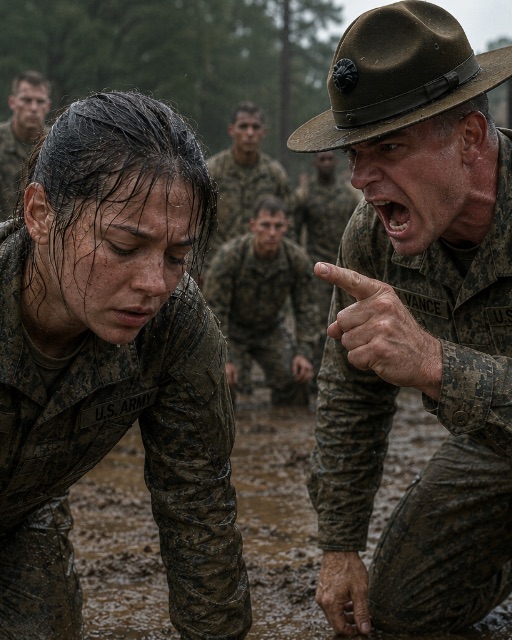
The Georgia heat at Fort Benning wasn’t just hot. It was violently offensive.
The kind of thick, suffocating humidity that clung to your skin the absolute second you stepped out of air conditioning. It made the heavy, rigid OCP uniform feel like a wet wool blanket wrapped tight around your chest.
For Specialist Morgan Chase, the blistering heat was a welcome distraction.
A tangible, physical discomfort that kept her mind anchored to the present. The stinging sweat in her eyes stopped her thoughts from drifting back to the cold, blood-soaked sand of a classified Syrian valley she’d left behind eight agonizing months ago.
She wasn’t supposed to be here.
Fort Benning was a training post. A place for green recruits who still flinched at the sound of blank rounds. Morgan had been sent here on what her handler called a “cooling assignment” – paperwork language for we need you somewhere boring before you snap.
She didn’t argue. She couldn’t. The last psych eval had three red flags and a recommendation she’d never seen before: “Operative demonstrates hyper-competence masking deep dissociative tendencies.” She didn’t know what that meant. She just knew they took her rifle and gave her a clipboard.
Her job now was simple: assist with Phase 2 infantry training. Observe. Blend in. Be nobody.
And she was doing fine with that.
Until Staff Sergeant Terrance Ridlow opened his mouth.
Ridlow was the kind of NCO who confused cruelty with leadership. Everybody on post knew him. He had a voice like a garbage disposal chewing through gravel, and he used it to break people – not build them.
Day one, Morgan was standing at the back of a formation of 200 trainees. Clipboard in hand. Hat low. Invisible.
Ridlow walked the line, chest puffed out, jaw working a wad of dip like it owed him money.
He stopped in front of her.
She felt every nerve in her body go taut. Not from fear. From something older. Something trained into her in rooms that don’t appear on any floor plan.
“Well, well,” he said, loud enough for the entire formation to hear. “Looks like they sent us a princess.”
A few recruits snickered. Most didn’t. They were too scared.
He leaned in close. She could smell the Cope Wintergreen on his breath.
“You gonna carry that clipboard into combat, sweetheart? Or you just here to look pretty for the Colonel?”
Morgan said nothing. She stared straight ahead. Her hands didn’t shake. Her jaw didn’t clench.
But behind her eyes, something shifted.
It was the same shift she’d felt on a rooftop in Deir ez-Zor when her spotter took a round through the throat and she had four seconds to make a decision that erased six men from existence.
She blinked. Slowly.
Ridlow grinned. He thought he’d won.
He hadn’t even started losing yet.
Over the next two weeks, Ridlow made it his personal project. Every formation. Every chow line. Every after-hours detail.
“Chase! You forget your tiara today?”
“Chase! Maybe try holding that rifle like it’s not a purse strap!”
“Chase! You want me to call your daddy to come pick you up?”
She took it. All of it. Face blank as drywall. The recruits started calling her “Ghost” behind her back – not because she was scary, but because she never reacted. Never flinched. Never spoke unless spoken to, and even then, only the minimum syllables required.
But the recruits closest to her – the ones she quietly helped zero their weapons after hours, the ones she showed how to tape their boots to stop blisters, the ones she slipped MRE peanut butter packets to when they were running on fumes – they noticed something.
Her hands.
When she helped a recruit strip and reassemble an M4, her hands moved with a speed and precision that didn’t belong at a training post. One private, a kid named Dustin Howell from Tulsa, later said it was like watching a surgeon operate on a heart.
“She didn’t look at the weapon,” Dustin told his bunkmate. “She looked at me. The whole time. Like the rifle was just… part of her hands.”
Nobody asked Morgan about her background. Her file was thin. Suspiciously thin. The kind of thin that made the company clerk, a specialist named Rhonda Fitz, raise an eyebrow and mutter, “Either this woman’s done nothing, or she’s done everything and someone doesn’t want us to know.”
Then came the night exercise.
Week three. A full battalion land navigation course through the pine forests south of the post. Pitch black. No NODs for the trainees. Just a compass, a protractor, and a red-lens flashlight.
Ridlow was in his element. He set up the course specifically to break people. Wrong grid coordinates planted in half the packets. Three-mile detours through swamp. And his favorite trick — he’d hide in the tree line and jump out screaming at disoriented trainees, then smoke them with push-ups in the mud while they cried.
Morgan was assigned to shadow his lane as a safety observer.
At 0200, she was standing at Checkpoint Four when she heard it.
Not screaming. Not Ridlow’s usual theatrics.
Whimpering.
She moved through the pines without a sound. No flashlight. She didn’t need one.
She found them in a clearing fifty meters off course.
Ridlow had a trainee — a nineteen-year-old named Paulette Vickers from Shreveport — pinned against a tree. Not physically. But close enough. He was inches from her face, finger jabbing into her sternum, voice a low, venomous hiss.
“You’re worthless. You hear me? You’re the weakest thing I’ve ever seen in a uniform. You’re going to get someone killed. You should quit. Right now. Say it. Say ‘I quit.’”
Paulette was shaking. Tears cutting clean lines through the camo paint on her face. Her lips were moving but no sound was coming out.
Morgan felt her heartbeat slow.
Not speed up. Slow.
That was the tell. The operators she’d trained with called it “the drop.” When the world goes quiet and every option becomes a clean, sharp line extending from your hands to the outcome.
She stepped into the clearing.
“Staff Sergeant.”
Ridlow spun around. His face twisted when he saw who it was.
“Get back to your checkpoint, Princess.”
“No.”
The word landed like a mortar round in the silence.
Ridlow’s eyes went wide. Not because he was scared. Because in his entire career, no one lower ranking had ever said that word to him. Not once.
“What did you just say to me?”
Morgan didn’t move. Didn’t blink.
“I said no. Step away from Private Vickers.”
“You think because you carry a clipboard you can give me orders? I will END your career, Chase. I will bury you so deep in paperwork—”
“You won’t.”
“Excuse me?”
“You won’t bury me in anything, Staff Sergeant. Because tomorrow morning at 0600, I’m going to be in Lieutenant Colonel Sharpe’s office. And I’m going to hand her the recording that’s been running on my phone since I heard Private Vickers from forty meters out.”
Ridlow went still.
“And if you think that’s all I have,” Morgan continued, her voice so flat and calm it could have been reading a grocery list, “you should know I’ve been documenting everything. Every smoke session that crossed the line. Every recruit you cornered alone. Every time you used rank to—”
“You’re bluffing.”
Morgan pulled her phone from her cargo pocket. Held it up. The red recording light pulsed in the dark like a heartbeat.
Ridlow stared at it.
Then he stared at her.
And for the first time since she’d arrived at Fort Benning, Morgan Chase let him see what was behind her eyes.
Not rage. Not hate.
Something worse.
Competence.
The kind earned in places where the penalty for hesitation isn’t push-ups. It’s a flag-draped coffin.
Ridlow took a step back. Involuntary. The kind of step your body takes before your brain gives permission.
Paulette slid down the tree trunk and sat in the mud, gasping.
Morgan looked at her. Her voice changed. Softer now. But not weak. Never weak.
“Vickers. You’re not quitting. Get your compass out. Your next checkpoint is 800 meters on a bearing of 247 degrees. You’re going to find it, and you’re going to log it, and tomorrow morning you’re going to stand in that formation like the soldier you already are.”
Paulette looked up at her. Wiped her face. Nodded.
She stood up. She walked into the trees.
Morgan turned back to Ridlow.
He opened his mouth.
“Don’t,” she said.
He closed it.
She walked back to Checkpoint Four.
The next morning, at 0545, Ridlow was pacing outside the battalion headquarters. He’d been there since 0500. He was waiting for Morgan. He had a plan — deny everything, flip it on her, pull rank, pull favors.
But Morgan never showed.
Instead, at 0600 sharp, Lieutenant Colonel Darlene Sharpe’s door opened. Her aide stepped out and called Ridlow inside.
He walked in expecting Morgan, a phone, and a he-said-she-said.
What he found was a conference table.
Seated around it: the battalion commander, the brigade JAG officer, the Equal Opportunity representative, the post Inspector General, and a woman in civilian clothes Ridlow didn’t recognize.
The woman in civilian clothes had a manila folder in front of her. It was thick. Very thick.
And it had a classification marking on the front that Ridlow had never seen before in his life.
LTC Sharpe gestured to a chair. “Sit down, Staff Sergeant.”
Ridlow sat.
The woman in civilian clothes opened the folder. Inside were printed transcripts, audio files on a USB, and a stack of sworn statements — not just from Morgan, but from fourteen recruits, two cadre members, and a chaplain.
“Staff Sergeant Ridlow,” the woman said, not looking up. “My name is not important. What is important is that Specialist Chase is not who you think she is.”
Ridlow felt his stomach drop.
“She was placed at this installation under a specific interagency agreement. Her presence here was never about training recruits.”
The room was dead silent.
“She was here to observe you.”
Ridlow’s mouth opened. Nothing came out.
The woman finally looked up. Her eyes were the same as Morgan’s. Flat. Calm. Ancient.
“You’ve been the subject of a command climate investigation for seven months. Specialist Chase was our eyes and ears. And Staff Sergeant—”
She slid a single photograph across the table.
Ridlow looked down at it.
The color drained from his face like someone had pulled a plug.
Because the photo wasn’t of Paulette Vickers in the woods. It wasn’t a screenshot of a recording.
It was a photo of Ridlow himself, taken from an angle that shouldn’t have been possible, in a location he had never told anyone about, doing something that would end more than just his career.
He looked up at the woman.
She smiled. Just barely.
“Specialist Chase sends her regards. She wanted me to give you a message.”
The woman leaned forward.
“She said to tell you: The princess found her tiara.”
But here’s the part nobody at Fort Benning ever learned.
Three weeks after Ridlow was escorted off post — rank stripped, discharge pending, career incinerated — Morgan Chase’s “cooling assignment” was officially terminated.
A black SUV picked her up at 0300 from a parking lot behind the PX. No goodbye. No handshake. No paperwork anyone could find.
Dustin Howell, the kid from Tulsa, tried to look her up in the Army directory two months later.
No results.
He tried her phone number. Disconnected.
He asked the company clerk, Rhonda Fitz, to pull her file one more time.
Rhonda turned pale.
“There is no file,” she whispered. “There never was.”
Dustin blinked. “What do you mean? She was here for a month. She signed rosters. She—”
“I mean the system says Specialist Morgan Chase does not exist. No enlistment record. No social. No next of kin.”
Dustin stood in the clerk’s office for a long time.
Then he looked down at his hands — the same hands she’d guided over an M4 receiver, patiently, silently, like she had all the time in the world.
And he realized something that made the hair on the back of his neck stand straight up.
He never once saw her wear a name tape.
Not once.
He went back to his bunk, pulled out the small slip of paper she’d handed him on her last night — the one with grid coordinates to his final land nav point, written in her sharp, clean handwriting.
He flipped it over.
On the back, in pencil, she’d written one line he hadn’t noticed before:
“You’re going to be fine, Dustin. But if you ever see me again—”
He squinted at the last four words. His hands started shaking.
Because the last four words were “you don’t know me.”
Five years passed. The world turned, and Dustin Howell turned with it.
He wasn’t a raw private anymore. He was Sergeant Howell now, with two combat tours under his belt and the kind of tired-but-steady eyes that other soldiers looked to when things got loud.
He was a good NCO. He wasn’t a screamer like Ridlow. He was quiet, like her. He taught his soldiers by showing, not shouting. He made sure they knew how to tape their boots to stop blisters and always had an extra peanut butter packet for someone running on empty.
Paulette Vickers was Sergeant Vickers. She’d reenlisted and was making a career of it, a confident leader who often told new privates about a night she almost quit in a Georgia forest. She never mentioned Morgan by name. She didn’t have one to give.
One day, on a pre-deployment inspection at Fort Hood, Dustin saw a familiar face. It was Colonel Darlene Sharpe now, and she was walking the line.
When she got to him, she paused, her eyes lingering on his rank.
Later, she had her aide pull him aside. They stood in her temporary office, the air thick with the smell of floor wax and efficiency.
“Sergeant Howell,” she said, her tone professional but her gaze direct. “I remember you from Benning. You were one of Chase’s kids.”
Dustin just nodded. It wasn’t a question.
“You probably wondered what really happened with Ridlow,” she continued, her voice lowering slightly.
“Yes, ma’am. I did.”
Colonel Sharpe went to her desk and picked up a heavily redacted report. “This is unauthorized, but I think you earned it. That investigation, the one ‘Specialist Chase’ was helping with, it wasn’t about bullying.”
She laid it on the table. “Ridlow had a gambling problem. A big one. The ‘climate investigation’ was a cover.”
Dustin stared at her, confused.
“He was selling things. Information. Schematics for our new drone surveillance systems. Meeting with foreign agents in a rundown motel off I-85. He thought he was untouchable.”
The pieces clicked together in Dustin’s mind. The high-level meeting. The woman in civilian clothes.
“That photo,” Dustin said, almost a whisper. “The one she showed him.”
“It was a picture of him with a Chechen operative,” Sharpe confirmed. “Taken from inside the air vent of his motel room. Ridlow wasn’t just a bad NCO. He was a traitor.”
It made a sickening kind of sense. The “princess” taunts weren’t just random cruelty; they were Ridlow projecting his own betrayal, belittling a woman to feel powerful while he was selling out his country for cash.
“Chase’s mission was to confirm the intel and build the case without spooking him,” the Colonel finished. “You and Private Vickers just gave her the perfect opportunity to close the loop without revealing her actual purpose.”
She took the report back. “She did good work. Saved us from a catastrophic intelligence leak. Then she disappeared, as she was supposed to.”
Dustin left the office with a weight off his shoulders he didn’t know he’d been carrying. Morgan wasn’t just a ghost who saved a private. She was a guardian who had stopped something terrible.
Another year passed. Dustin’s contract was up. He’d seen enough sand and helicopters for one lifetime. He decided not to reenlist.
He went home to Tulsa for a bit, then drifted west, looking for quiet. He found it in a small town nestled in Oregon’s Willamette Valley, a place surrounded by vineyards and pine trees that smelled of green, not swamp.
He took a job at a local hardware store. He liked the simplicity of it. He liked helping people find the right bolt or the best type of paint.
One Saturday morning, the store was busy. Sunlight streamed through the high windows. Dustin was helping a man figure out a plumbing issue when he heard a laugh from the garden section.
It was a soft, genuine laugh. And it stopped him cold.
He looked over. A woman had her back to him, her hair was a warm brown now, not the severe black bun she’d kept under her patrol cap. She was wearing jeans and a simple flannel shirt.
But it was her.
The way she stood, perfectly balanced. The economy of her movement as she bent down to pick up a fallen terracotta pot.
It was Morgan Chase.
His heart hammered against his ribs. He wanted to run over there. To thank her. To tell her that she had changed his life, that he became the kind of NCO she would have respected. That Paulette was okay.
He took a step.
And then he saw it. A small hand was holding onto her flannel shirt. A little girl, no older than four, with bright, curious eyes, was looking up at her.
“Mommy, can we get the red flowers?” the girl asked.
Morgan smiled down at her, and it was a smile Dustin had never seen before. It was open, unguarded, and filled with a kind of light that had never been allowed to exist at Fort Benning.
“Of course, sweet pea,” she said. “We can absolutely get the red flowers.”
In that moment, Dustin remembered the note. The last four words she ever wrote to him.
“You don’t know me.”
He understood now. It wasn’t a threat. It wasn’t a command born of secrecy.
It was a plea.
Approaching her, saying her name, would be like firing a gunshot in that peaceful garden. It would shatter this new life she had built. It would drag the ghost of Syria and Fort Benning and a thousand other dark places into the sunlight with her little girl.
He saw her glance around the store, a flicker of the old hyper-vigilance, and his decision was made.
He turned away. He walked back to the plumbing aisle, his own hands shaking just a little. He felt a pang of loss, of an unclosed chapter. But stronger than that was a profound sense of rightness.
Her final mission for him wasn’t about land navigation or marksmanship. It was about this. Protecting the peace she had finally found.
He finished with his customer, his mind a million miles away. As he walked toward the front of the store to restock, he passed the end of the garden aisle.
She was at the checkout counter now, the little girl holding a small pot of red geraniums. For a fraction of a second, her eyes met his across the store.
There was no shock. No fear.
Just a brief, almost imperceptible nod.
It was an acknowledgment. A thank you. A confirmation that she saw him, and she saw what he had done for her by doing nothing at all.
Then she turned back to her daughter, paid for the flowers, and walked out into the sunshine, leaving the ghost of Specialist Chase behind for good.
Dustin watched them go, a small smile on his own face. He finally understood. Real strength wasn’t about the battles you win in front of everyone. It’s about the quiet sacrifices you make for others, the unseen acts of protection that ensure someone else gets to live a life of peace. And sometimes, the greatest act of loyalty is to simply walk away, leaving a good soldier to enjoy the world she fought so hard to defend.