
“Negative. No air support.” The radio crackled like a door slamming shut.
I was standing on the edge of a dead runway at FOB Calder, hands frozen on a fuel hose, when I heard it. My stomach dropped. Echo Team was pinned in a smoking valley thirty miles out. Tanks crawling. Mortars walking in. No angels coming.
“Say again?” Chief Marcus Ramirez asked, voice like gravel. He already knew. We all did.
“Repeat: No air support.”
I tasted metal. Somewhere on that hill was a kid named Cody Dawson who still said “sir” like it meant something. I could hear him breathing.
Then a hangar door groaned behind me.
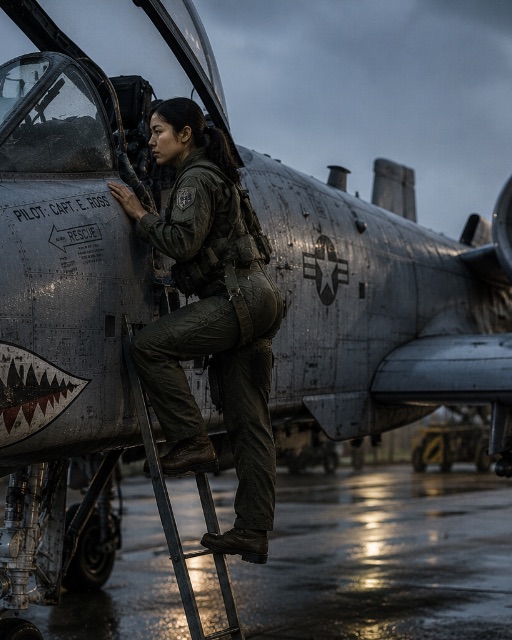
Captain Mallory Ross stepped out alone, eyes like flint, and looked at the old A‑10 with the shark mouth barely showing through sun-faded paint. On paper she pushed fuel forms. On paper she didn’t fly. On paper that hog was basically a museum piece.
She didn’t look at me. She just climbed the ladder.
“Tower to aircraft on Charlie-two, power down immediately. You are not authorized.”
She flicked the canopy shut.
My heart pounded so loud I missed the first spool of the engines. MPs were already jogging our way. The tower kept barking. Command cut in with the general’s voice now, colder than night. “Stand down, Captain. That’s an order.”
The GAU-8 coughed once, like it was clearing its throat.
Then the Warthog rolled, bounced, and clawed itself into the air.
Two minutes later the mountains answered with a roar you feel in your bones. I swear the valley itself shivered. Over the ridge, the shark mouth appeared low and mean, and the cannon finally spoke. One armored truck folded. Another spun out smoking. Over the radio, a man actually laughed – Ramirez, I think, this dry, shocked chuckle that made my eyes sting.
“Who is that?” someone whispered in the tower.
They all knew. They’d spent years trying to bury her because she made cowards look small.
Missile warning screamed in her headset. You could hear it through the open comms. The right wing was hit; fuel streaming like a comet tail. “You’re done,” the general snapped. “RTB now or you’re finished.”
“I’ll be back. Hold,” she told Echo. My blood ran cold at how calm she sounded.
She came in low over our busted service road. I lit it with two battered trucks and whatever headlights I could scavenge. I refueled that hog with my hands shaking while MPs shouted and waved papers in my face. Someone grabbed my shoulder; I shrugged him off like I was made of steel. I wasn’t.
“Sergeant, stand down!” an officer barked. I stepped in front of the nose wheel and didn’t move. If they wanted to stop her, they had to go through me.
She roared off again – one engine ragged, paint scorched, barely any ammo left. She flew straight at a radar truck that could have erased her. Blew it to scrap. Gave Echo a window. Ramirez started moving his guys. I was yelling alone on the tarmac, begging a machine not to die.
On the last pass, the right engine finally quit for good. The hog rolled hard toward the ridge. Dead quiet on the line except for Cody whispering something that sounded like a prayer.
Gear wouldn’t lock. Fire in the wing. No brakes worth a damn. Headlights on the strip lit up the smoke like a bad dream. MPs formed a wall. The general’s SUV screeched to a stop. He stepped out with cuffs in hand.
The Warthog dropped, skipped, and somehow stayed in one piece. Sparks showered. She veered. Slid. Halted a breath from my bumper. I ran. My hands were burned and I couldn’t feel them.
The canopy popped—and the general pushed past me, face purple with fury.
He leaned into the cockpit, looked at the name under the canopy rail, and said seven words that made my jaw hit the ground when I saw the faded callsign stitched on her shoulder patch.
“I promised him I would keep you safe.”
The world went silent. The crackle of the fire in the wing, the distant shouts, the idling engines of the MPs’ trucks—it all faded into a dull hum.
General Thorne stood there, not like a commander about to bring the hammer down, but like a man who’d just seen a ghost. His face was a mess of emotions, the fury draining away to reveal something raw and broken underneath.
His eyes were locked on her. In the dim light of the cockpit, I could see the name under the rail he was staring at. It was almost worn away. “Col. ‘Hawk’ Ross.”
Then my gaze fell to the patch on her shoulder. A small, embroidered sparrow holding a lightning bolt. Her callsign wasn’t some cocky pilot nickname. It was a legacy. She was Sparrow. Her father was Hawk.
Mallory didn’t flinch. She just sat there, breathing hard, smoke and sweat clinging to her flight suit. There was a smear of blood on her cheek.
“You promised him wrong, sir,” she said, her voice raspy but clear. “You promised to ground me.”
The MPs had gone still. The officer who’d been yelling at me now just stared, his mouth slightly open. No one knew what to do. The cuffs in the general’s hand seemed like a ridiculous prop from another play.
Thorne leaned closer, his voice dropping so low it was almost a whisper, but I was right there, close enough to feel the heat from the wrecked engine, close enough to hear every word.
“David and I… we were lieutenants together,” he said, his voice thick. “We flew Hueys in a different desert, a different war.”
He looked at the battered A-10 like he was seeing something else entirely.
“The day he went down,” Thorne continued, his gaze returning to Mallory, “the order was the same. ‘No support.’ He went in anyway. Saved his entire team.”
He paused, and the weight of that pause was heavier than the whole airplane. “He just didn’t come back out.”
My own breath caught in my throat. It all clicked into place. The years of paperwork. The flight status that was always “under review.” The assignments that kept her feet glued to the ground.
It wasn’t a punishment. It was a prison built from love and grief.
General Thorne had been trying to keep a promise to his dead friend by caging his daughter. He was so terrified of history repeating itself that he was willing to sacrifice other men, men like Cody Dawson, to keep her safe.
It was wrong, but in that moment, I understood it. I saw the man behind the uniform, a man haunted by a choice made decades ago in another forgotten valley.
“He taught me to fly, General,” Mallory said quietly. She finally unbuckled herself, her movements slow and pained. “He didn’t teach me how to sit on the sidelines while my people died.”
She swung her legs over the side of the cockpit, and I saw the tops of her boots were soaked in hydraulic fluid. She didn’t seem to notice.
Just then, a voice, tinny and distant, crackled to life from the radio in the General’s abandoned SUV. The door was still open.
“Calder command, this is Echo Six. Do you copy?” It was Ramirez.
For a second, nobody moved. It was like we’d all forgotten there was a world beyond this strip of tarmac.
Thorne turned from Mallory, his expression unreadable, and walked stiffly to his vehicle. He picked up the handset.
“This is Calder,” he said, his voice now back to the familiar, commanding tone, but with a new crack in it. “Go ahead, Echo.”
“Sir,” Ramirez’s voice was filled with a relief that was almost tangible. “Be advised, we are green. All personnel accounted for. We’re moving to the exfil point.”
There was a pause. You could hear the wind howling on his end. “Sir… who do we thank? Who was in that cockpit?”
The entire runway held its breath. This was it. This was the moment where he could bury her forever or make her a legend. He could say it was a classified asset, a rogue pilot under arrest, a dozen different things that would protect his career and end hers.
General Thorne looked back at the smoking wreck of the A-10. He looked at the girl who was the living image of his best friend, the girl who had just disobeyed his direct order and saved seventeen lives because of it.
He looked at me, just for a second, and then at the MPs. He was making a decision that would ripple through all our lives.
He lifted the handset back to his mouth. “You thank Captain Mallory Ross,” he said, his voice clear and steady, ringing out in the night. “Her callsign is Sparrow.”
A wave of relief so powerful it almost buckled my knees washed over me. The MPs visibly relaxed. The officer who’d been so ready to arrest me just a few minutes ago slowly shook his head, a look of awe on his face.
“Copy that, command,” Ramirez said, and you could hear the smile in his voice. “God bless you, Sparrow.”
Thorne put the handset down. He walked back to Mallory, who was now standing on the tarmac, swaying slightly. He dropped the useless cuffs on the hood of his truck.
“You’ve destroyed a multi-million-dollar aircraft, Captain,” he said, his voice stern, but his eyes told a different story.
“I know, sir,” she replied.
“You disobeyed a direct order from a commanding general.”
“Yes, sir.”
“You flew an airplane that hadn’t been certified for combat in a decade.”
“She handled beautifully, sir. Mostly.” A small, tired smile touched her lips.
The general looked up at the sky, at the stars that were just starting to get washed out by the coming dawn.
“Your father would be so damn proud of you,” he said. Then he added, “And he would have grounded you for a month for the landing.”
For the first time that night, Mallory’s composure broke. A single tear traced a clean path through the grime on her cheek.
The next few hours were a blur. Medics finally got to Mallory, fussing over her burns and exhaustion. An investigation was launched, of course. Papers were filed. Statements were taken.
But the story was already taking on a life of its own. It wasn’t the one about a disobedient captain. It was the one about the “Ghost of Calder,” the forgotten pilot in the forgotten plane who came out of nowhere when all hope was lost.
General Thorne handled the fallout. I heard he called in every favor he had. The official report was a masterpiece of creative writing. It cited a “communications breakdown” and a “time-sensitive tactical window of opportunity” that Captain Ross, as the ranking aviator on site, had the authority to exploit. The destroyed A-10 was written off as a necessary combat loss.
He didn’t get away unscathed. They moved him to a desk at the Pentagon a few weeks later. A promotion in name, but we all knew he was being put out to pasture. He took the blame for the “equipment and command failures” at FOB Calder, falling on his sword to protect her. He finally kept his promise, not by caging the Sparrow, but by giving her the sky.
I saw him one last time before he left. He walked up to me while I was signing out a fuel tanker. He just stood there for a moment.
“Sergeant,” he said, holding out his hand. I shook it. His grip was firm. “You did a good thing that night. Stepping in front of that tire.”
“I was just doing my job, sir,” I mumbled.
“No,” he said, looking me right in the eye. “You were doing the right thing. There’s a difference.” And then he was gone.
Six months passed. The base started to pack up. We were heading home.
One afternoon, I was walking by the hangar, the same one where it all started. The door was open. Inside, looking brand new, was the Warthog. Technicians were swarming over it. They had flown in a new wing, replaced the engine, and given it a fresh coat of paint.
The shark mouth was back, sharper than ever. And under the cockpit, in clean, black letters, it said “Captain Mallory Ross.” Below her name was the callsign, “Sparrow.” And just below hers, they had restored the old one: “Col. ‘Hawk’ Ross.” A legacy.
I saw her standing by the nose, talking to a young private. It was Cody Dawson. He was home safe. He wasn’t a grunt anymore; he’d transferred to aviation maintenance. He was pointing at something on the GAU-8, and Mallory was laughing. It was a good sound.
She saw me over his shoulder and waved me over.
“Heard you were the guy who kept her running for me,” she said, patting the fuselage of the A-10.
“Just topped her off,” I said, feeling my ears get hot.
“Well,” she said, her smile genuine and warm. “I wouldn’t be standing here if you hadn’t. No one would.”
Cody just nodded, his eyes full of a gratitude that you can’t put into words. He was alive because of the woman in front of him, and because some old Sergeant decided to stand in front of a tire.
We stood there for a minute in comfortable silence, the three of us, bound by a night of smoke, fire, and impossible courage.
That was the last time I saw her. I finished my tour and came home. But sometimes, when the sky is a certain shade of bruised purple at dusk, I think about that night. I think about how an order isn’t always right, and how a rule is sometimes just a guideline for people without the courage to see a better way.
Heroes aren’t always the ones with shiny medals and spotless records. Sometimes they’re the forgotten ones, the ones buried under paperwork, just waiting for the moment they’re needed most. Sometimes they’re the sergeants who refill the fuel, the grunts who hold the line, and the generals who learn that the best way to honor a promise is to let someone fly. That night, I learned that true courage isn’t the absence of fear; it’s looking fear in the face and climbing into the cockpit anyway.



