
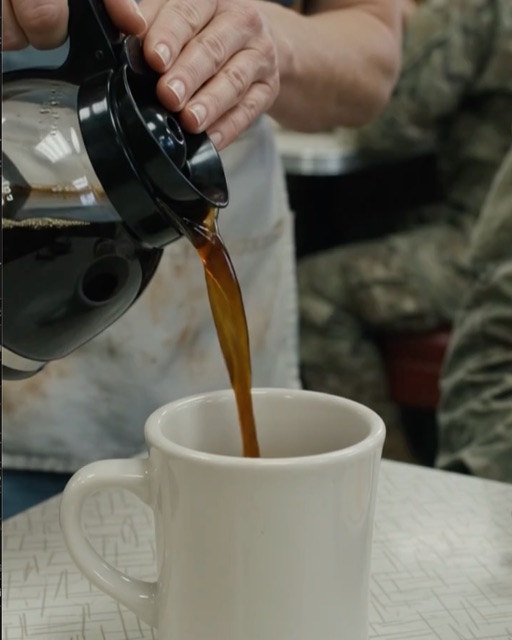
The soldiers came in every Tuesday.
Same booth. Same jokes. Same order.
Black coffee, biscuits, eggs over easy, bacon almost burned.
I served them because I worked mornings at Rosie’s Diner, one mile outside Fort Brenner.
They called me “ma’am.”
Most meant it.
One didn’t.
Private Maddox was new. Fresh haircut. Loud voice. Still carrying basic training like it made him bulletproof.
He watched me refill his cup and nodded toward the old guidon photo over the register.
“You put that up so soldiers tip better?”
His buddy stopped chewing.
“Maddox.”
He kept going.
“Everybody near a fort pretends they were part of the Army.”
The booth went quiet.
I smiled because I had learned a long time ago that grief does not need to defend itself.
“No, honey,” I said. “I was a medic.”
He laughed.
“Figures.”
I walked away before my hands betrayed me.
In the kitchen, I pressed my palm against the stainless-steel counter and breathed through a memory of diesel smoke, wet sandbags, and a lieutenant asking me if his mother would know he was brave.
When I came back out, three Army vehicles had stopped outside.
Not unusual near Fort Brenner.
What was unusual was the colonel stepping through the diner door with two command sergeants major and a soldier carrying a long black case.
Every soldier stood.
The colonel ignored them.
He walked straight to me.
“Captain Hale?”
The coffee pot slipped against my hip.
No one had called me that in twenty-eight years.
Private Maddox’s face changed.
The colonel removed his cover.
“Ma’am,” he said, “the 41st Infantry is retiring the original company guidon today.”
I looked at the black case.
“I heard.”
“We can’t do it without you.”
“I only worked the aid station.”
The older command sergeant major’s eyes went red.
“No, ma’am,” he said. “You kept Alpha Company alive long enough to have an aid station.”
The diner went silent.
Even the grill seemed to stop breathing.
The colonel opened the black case on the counter.
Inside was the old guidon.
Scarlet field. Gold lettering.
And one black ribbon tied under the spearhead.
Private Maddox stared at it.
Then at the smaller black ribbon pinned inside the frame over the register.
The colonel opened a weathered notebook.
I knew the handwriting before I saw the name.
First Lieutenant Darren Whitaker.
Sadr City. 2004.
The first officer I failed to bring home.
The colonel turned the notebook toward the soldiers.
“Before he died, Lieutenant Whitaker wrote the request that became Alpha Company tradition.”
My chest tightened.
He read the line aloud:
“If we ever carry colors again, tie black under the blade for Captain Hale. She held the line after command stopped answering.”
Every soldier in the booth slowly stood.
Private Maddox removed his cap with both hands.
The colonel handed me the guidon.
“Captain,” he said, “will you lead us?”
I looked at the black ribbon.
Then at the boys in uniform who had no idea how young they looked.
And I said something that made Private Maddox sit down hard in the booth.
“The ribbon wasn’t for the dead.”
The colonel’s jaw tightened.
“It was for the radio silence.”
I touched the black silk.
“Command heard us. They just stopped answering because the evacuation route had already been given to another unit.”
The colonel’s hand moved away from the case.
Because the officer who made that call wasn’t dead.
He wasn’t retired.
He was standing in the parking lot right now, waiting to shake my hand at the ceremony.
And his name was already carved into the wall of the new training wing, the one they were dedicating in one hour.
I set the coffee pot down on the counter.
Twenty-eight years of silence had a weight to it, and I had been carrying it through every breakfast shift since I hung up the uniform.
The colonel was watching me carefully now.
He knew.
You don’t make full bird without learning how to read a room, and he had just realized the room he walked into was a minefield he didn’t draw the map for.
“Captain,” he said quietly. “Whatever you need to say, say it at the ceremony.”
I shook my head.
“If I say it at the ceremony, I bury three more soldiers under that wall before sundown.”
Private Maddox looked up from the booth.
“Three more?”
I didn’t answer him.
I looked at the older command sergeant major instead, the one whose eyes had gone red.
He had been there.
He knew which three.
He gave me one small nod, the kind that said I have been waiting twenty-eight years for somebody to finally ask the question out loud.
I picked up the guidon.
The scarlet was faded.
The gold was tarnished.
The black ribbon was newer than the rest, and that was the part nobody outside Alpha Company had ever been allowed to ask about.
I turned to the colonel.
“Sir. Before I walk into that parking lot, I need you to look at one thing.”
I reached under the register.
Taped to the back of the frame holding the old guidon photo was an envelope.
Yellowed. Sealed. Twenty-eight years old.
I had moved it from apartment to apartment, from state to state, from one waitress job to the next, and never once opened it.
Lieutenant Whitaker had handed it to me in the aid station with two words.
“Not yet.”
I held it out to the colonel.
“He said I’d know when.”
The colonel took the envelope.
His hands were steady.
His face was not.
He broke the seal with his thumb and pulled out a single folded page.
He read it.
He read it again.
Then he looked up at the command sergeant major and said four words that made every soldier in the diner go still.
“Get him in here.”
The sergeant major was already moving toward the door.
Private Maddox stood up slowly.
“Ma’am,” he said. “What’s in the letter?”
I looked at the boy who had laughed at me forty minutes ago.
And I told him the only thing that mattered.
“A name. And a coordinate. And the reason Alpha Company never got the order to fall back.”
Outside, I heard car doors.
Voices.
Boots on gravel.
The bell over the diner door rang.
And the man whose name was about to be carved into that training wing walked in smiling, hand already extended, expecting a hero’s welcome.
He didn’t see the guidon yet.
He didn’t see the letter.
He didn’t see the colonel.
He only saw me.
And then he saw what I was holding.
His smile didn’t drop all at once. It folded in stages, like a man watching a bridge collapse from the far side and realizing he was still standing on it.
Brigadier General Thomas Prewitt, retired. Silver hair, pressed suit, American flag pin on his lapel, the whole picture of a man who had spent three decades building a story about himself that fit neatly on a plaque.
He stopped two steps inside the door.
“Ruth,” he said, using my first name like we were old friends. “Been a long time.”
I said nothing.
The colonel stepped between us.
“General Prewitt,” he said, and the word general came out the way you’d say a diagnosis. “Lieutenant Whitaker left written documentation of the radio traffic from the night of April 14th, 2004.”
Prewitt’s eyes moved to the letter in the colonel’s hand.
“I don’t know what you’re referring to.”
“He logged the timestamps, sir. Every transmission Alpha Company sent. Every response that was received at battalion TOC and never relayed.”
Prewitt looked at me again.
This time he didn’t smile.
“You held on to that all this time?”
“I didn’t open it,” I said. “Whitaker told me not yet. I kept that promise the same way I kept every other one.”
The diner was so quiet I could hear the coffee maker dripping behind me, each drop hitting the pot like a tiny heartbeat that didn’t know the world had stopped.
Prewitt straightened his tie.
“Whatever that letter says, it’s twenty-eight years old. It doesn’t change anything.”
The older command sergeant major, whose name was Royce, stepped forward. His voice was the kind of calm that comes right before a detonation.
“It changes everything, sir. Because three soldiers in Alpha Company took their own lives in the years after that deployment, and every single one of them referenced the radio silence in letters they left behind.”
Prewitt’s face went gray.
I had carried those names too. Specialist Fuentes. Corporal Darby. Sergeant Wynn.
They came home from Sadr City alive because I dragged them, stitched them, and lied to them about how bad it was. They survived the firefight. They did not survive the silence that followed, the silence from the Army, the silence from the investigations that went nowhere, the silence from the man who stood in front of me right now pretending he didn’t remember.
“You gave our evacuation route to Third Platoon, Bravo Company,” I said. “Because their commander was your West Point roommate. And when we called in asking where the route was, you told your radio operator to stop answering.”
Prewitt’s jaw worked.
“That is not what happened.”
“Whitaker was standing next to the radio when your operator said, and I quote, Colonel says let them hold, we can sort it out in the morning.” I kept my voice level. “Whitaker wrote it down because he was the kind of officer who believed the truth would matter someday.”
“He was twenty-four years old and he was wrong about a lot of things.”
“He was right about you.”
The words landed like a slap.
Prewitt took a half step back, and for the first time I saw something underneath the silver hair and the practiced posture. I saw a man who had been running from a single decision for almost three decades and had just hit the wall.
The colonel folded the letter and placed it in his breast pocket.
“General Prewitt,” he said, “I’m going to recommend a formal review to the Inspector General based on this documentation. The dedication of the training wing will be postponed.”
Prewitt’s mouth opened but nothing came out.
He looked around the diner, at the young soldiers standing in their Tuesday booth, at the faded guidon in my hands, at the black ribbon that had carried his secret longer than most of these boys had been alive.
Then he looked at Private Maddox.
I don’t know why. Maybe because Maddox was the youngest face in the room. Maybe because Prewitt needed someone to look at who didn’t already know the worst thing about him.
But Maddox wasn’t offering shelter.
The kid who had mocked me forty minutes ago was standing at something close to attention, and his eyes were wet, and he said one word.
“Leave.”
Prewitt left.
The bell rang behind him.
Nobody moved until we heard his car start and the gravel pop under his tires as he pulled out of the lot.
The colonel exhaled.
Sergeant Major Royce pulled a chair out from the nearest table and sat down because his knees had finally given up pretending they were fine.
I set the guidon down on the counter next to the coffee pot and looked at it for a long time.
The scarlet. The gold. The black ribbon.
Twenty-eight years I had told myself that holding onto that envelope was stubbornness. That I was a waitress now and the war was over and some things don’t get fixed, they just get carried.
But Whitaker knew. Even dying, twenty-four years old with a piece of shrapnel in his chest, he knew the moment would come. He just needed someone patient enough to wait for it.
The colonel cleared his throat.
“Captain Hale. Will you still lead us for the guidon retirement?”
I looked at the boys in the booth.
They were watching me the way soldiers watch someone they’ve decided to follow, not because of rank but because of something they can feel in the room.
“On one condition,” I said.
“Name it.”
“We add three names to whatever wall you end up dedicating. Fuentes. Darby. Wynn. They held the line too. They just couldn’t hold it forever.”
Sergeant Major Royce made a sound in his throat that was not quite a word.
The colonel nodded.
“Done.”
I untied my apron and folded it on the counter next to the register.
Then I picked up the guidon.
It was heavier than I remembered, the way anything gets heavier when it carries more than fabric and thread.
Private Maddox stepped in front of me before I reached the door.
He didn’t say sorry. That would come later, and it would be clumsy, and I would accept it because that is what you do with the young ones who are still learning that the world is more complicated than basic training taught them.
What he did was hold the door open.
And as I walked through it, carrying scarlet and gold and a black ribbon that finally meant what it was always supposed to mean, I heard him fall in step behind me.
Then the others.
Boots on tile, then boots on gravel, then boots on pavement, a half-dozen soldiers following a sixty-two-year-old waitress across a parking lot toward a ceremony that had just become something entirely different than what anyone planned.
The sun was sharp that morning. The kind of sharp that makes you squint and shows every scratch on every surface.
I carried the guidon past the line of Army vehicles and toward the road that led to Fort Brenner, and for the first time in twenty-eight years, the weight of it did not sit on my shoulders alone.
Somewhere behind me, Sergeant Major Royce was on the phone. The formal review would take months. Prewitt would lawyer up. There would be hearings and arguments and people who said it was too long ago to matter.
But the letter existed. The timestamps existed. The three names existed.
And the truth, once it finally walks out of the kitchen and into the dining room, does not go back.
Two weeks later, Private Maddox came into Rosie’s Diner on a Wednesday. Not a Tuesday. Alone. No booth, no buddies, no jokes.
He sat at the counter and ordered black coffee.
I poured it.
He wrapped both hands around the mug and stared into it like he was looking for something.
“Ma’am,” he said. “I re-enlisted for medic training.”
I set the pot down.
“Why?”
He looked up at me with the raw, unfinished face of a twenty-year-old who had just discovered that courage sometimes looks like a woman in an apron holding a coffee pot.
“Because somebody has to answer the radio.”
I reached across the counter and squeezed his hand once. Then I let go.
Some people think bravery is loud. They think it’s the charge, the explosion, the moment on the movie screen where the music swells.
But the bravest thing I ever did was tape an envelope to the back of a picture frame and wait twenty-eight years for it to matter.
And the lesson I learned, the one I hope you carry with you, is this. The truth doesn’t expire. It doesn’t rot. It doesn’t lose its power because time passes or because the people holding it seem small. You hold it. You protect it. And when the moment comes, you don’t flinch. Because somewhere, someone is counting on you to finally say what happened, and your silence is the only thing standing between them and peace.
If this story moved you, share it with someone who needs to hear it today. And leave a like so others can find it too.



