My father is a decorated General. Everyone reveres him. To him, my younger brother Tomas is the “real soldier,” the golden boy of the infantry. Me? I’m just his disappointing daughter who pushes paper for the Pentagon.
At my brother’s deployment banquet, my dad actually took the microphone and pointed at me. “Some of us are content in air-conditioned offices,” he boomed. “But Tomas is on the ground. A true hero.”
A few junior officers snickered. I just stared at the ice in my water glass. I didn’t say a word.
Suddenly, the double doors at the back of the banquet hall swung open.
Colonel Hail, one of the highest-ranking commanders in JSOC, marched straight past the dignitaries, ignoring my dad completely. He walked up to my table and slammed a heavy manila folder next to my plate.
The entire room went dead silent.
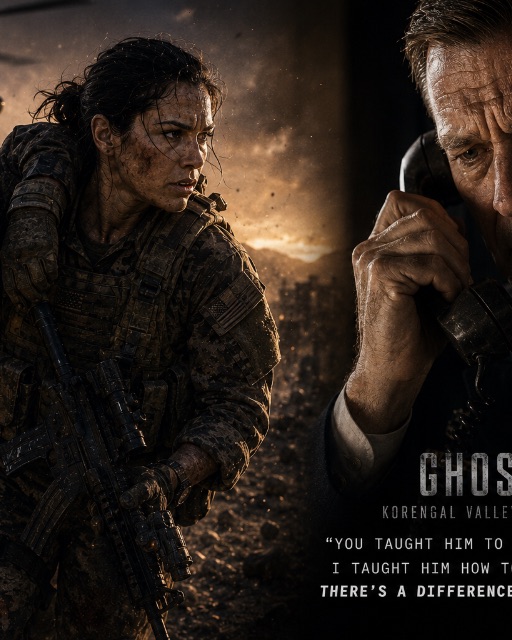
“General,” Hail said, turning to my father, his voice ice-cold. “Your daughter isn’t a secretary. She’s Ghost 13. Seventeen confirmed long-range eliminations. And as of an hour ago, your son’s unit is pinned down in the Korengal, and he is begging for her by name.”
My father’s face turned completely gray. His hands started to shake uncontrollably as he walked over and opened the folder.
I watched his eyes scan the page, his jaw hitting the floor as he looked at the classified surveillance photo of me in a ghillie suit in Kandahar. He looked at me like I was a complete stranger.
“Wheels up in forty, Major,” Hail told me.
I stood up, pushing past my stunned father. “Just bring him back,” my dad whispered, his voice cracking.
Fourteen hours later, I made a sat-phone call to my father from Bagram. He answered on the first ring.
“I have him,” I said over the static. “But you need to understand something before I put him on the bird.”
“What?” he choked out.
I sent him the unedited body-cam footage. “It’s not about the rescue, Dad. It’s about what your hero son did just to survive.”
I heard my father gasp and drop the phone the second he saw what Tomas was doing in the video. I ended the call and tucked the sat-phone away, the cold Afghan air biting at my cheeks. My job was only half-done.
The mission had been hell. Simple as that. We inserted by helicopter under the cover of a moonless night, landing on a ridge over two klicks from Tomas’s last known position. The Korengal Valley wasn’t called the “Valley of Death” for nothing. It chewed up units and spit out bones.
My spotter, a quiet Sergeant named Daniel, set up our position. I settled in behind my rifle, the cold metal a familiar comfort against my shoulder. The world narrowed to the circle of my scope.
Below us, it was chaos. Tracers zipped through the darkness like angry fireflies. The distinct pop-pop-pop of AKs was answered by the deeper bark of M4s. Tomas’s platoon was cornered in a cluster of rocks, a classic L-shaped ambush.
“Got a bead on their heavy machine gun,” Daniel whispered, his voice calm in my ear. “Northeast slope, behind that gnarled tree.”
I saw it. I drew a breath, let half of it out, and the world went still. The crosshairs settled. A gentle squeeze. The rifle bucked against me, a familiar and violent shove.
Through the scope, I saw the machine gun nest go silent. One down. It was like plumbing. You find the clog and you clear it. Except the clogs were people.
Over the next hour, I worked my way through their key positions. A mortar team. A man with an RPG. An officer directing the attack. Each one a quiet exhale, a soft squeeze, a life ended from a mile away.
I tried not to think about my dad’s face. Or Tomas screaming my callsign into his radio. I was a tool, a precision instrument. That’s what they trained me to be.
With the pressure relieved, the quick reaction force could finally move in. Helicopters roared into the valley, ropes dropped, and the battered platoon was pulled from the fire.
I saw Tomas. He was one of the last ones on the ropes. He was unhurt, physically at least. His face was a mask of terror.
We packed up and exfilled, the mission a success by military standards. We got them all out alive.
Back at Bagram, I found Tomas in the medical tent. He was sitting on a cot, wrapped in a blanket, staring at nothing. The other guys from his unit were talking, hugging, a chaotic mix of relief and adrenaline. But they gave Tomas a wide berth. They wouldn’t even look at him.
That’s when I pulled the body-cam footage from one of the other soldiers. He gave it to me without a word, his eyes full of a weary disgust that told me everything.
I watched it right there. I had to see it for myself.
The video showed the ambush starting. The chaos, the shouting. A young private next to Tomas took a round to the leg. He slumped down behind a small boulder, trying to return fire.
Then, a second volley of fire kicked up dust all around them. Tomas, my brave brother, my father’s hero, looked wildly around. He saw the wounded private. He saw the small bit of cover the boy was using.
The camera shook as its owner dove for cover. But it caught the moment clearly. Tomas grabbed the wounded private by his gear and dragged him out from behind the rock, throwing him into the open. He then scrambled into the safe spot himself, curling into a ball as the private screamed.
Another soldier, the one wearing the camera, crawled over and pulled the private back to safety. It was an act of pure, selfless bravery. It was everything my father had always said Tomas was. And it was the exact opposite of what Tomas had done.
That’s the video I sent my father. The raw, undeniable truth.
Now, hours later, the transport plane droned on, carrying us away from the dust of Afghanistan and back towards the world. Tomas was sedated in the medical bay of the C-17. The rest of his unit was in the main cabin, sleeping the sleep of the utterly exhausted.
I sat alone, watching the curve of the Earth from a small porthole. I wasn’t sure what waited for us back home. An angry father? A broken one?
When we landed at Ramstein Air Base in Germany, my father was there. He wasn’t in his crisp General’s uniform. He was wearing civilian clothes, a simple collared shirt and slacks. He looked ten years older than he had at the banquet.
He didn’t rush to the medical ramp where they were taking Tomas off. He walked straight to me as I stepped onto the tarmac.
He stopped a few feet away. His eyes, the same eyes I saw in my own reflection, were red-rimmed. He didn’t seem to know what to say.
“Dad,” I said, my voice flat.
“Sarah,” he finally managed to say. The first time he’d called me by my actual name in what felt like forever. He opened his mouth, then closed it. He just shook his head.
“I saw the video,” he whispered, his voice hoarse. “I saw… I saw what he did.”
“I know,” I said.
“And I saw you,” he continued, looking at me with a terrifying awe. “Colonel Hail showed me the mission logs. Your mission logs. All of them.”
He took a hesitant step forward. “All this time… I thought you were a clerk. I wanted you to be a clerk. Safe.”
I just stared at him. I had no words of comfort to offer.
“Why didn’t you tell me?” he asked, his voice cracking. “All these years, why did you let me believe…?”
“Would you have listened?” I asked, the question hanging in the cold German air. “Or would you have just seen the little girl who was afraid of the dark?”
His face crumbled. He finally understood. I hadn’t kept the secret from him. I had kept it for me. It was the only part of my life that wasn’t touched by his expectations, his disappointment.
We stood there in silence as they loaded a heavily sedated Tomas into an ambulance. My father watched it go, his shoulders slumped in defeat.
“What happens to him now?” he asked.
“He’ll be medically evaluated,” I said, reciting the official lines. “He’ll face a hearing. Dishonorable discharge is likely. Maybe worse.”
My father nodded slowly, absorbing the death of the son he thought he had.
“The soldier he pulled from cover,” my dad said. “The one who was wounded. Will he be okay?”
“He’ll walk again,” I said. “He’s alive because another man was brave. Not your son.”
The words were cruel, but they were true. Sometimes the truth is a hammer.
We flew back to the States on a separate transport. The silence between us was heavy with unspoken things. When we landed, we were taken to a secure wing of Walter Reed Medical Center.
Tomas was there, slowly coming out of his daze. I insisted on being in the room when my father saw him for the first time.
My brother looked small in the hospital bed. The swagger he always carried was gone, replaced by a hollow-eyed shame.
“Dad,” Tomas whispered as our father walked in. He started to cry, big, heaving sobs of a broken man.
My father didn’t go to his side. He stood at the foot of the bed, his face a granite mask.
“I saw the tape, Tomas,” my father said, his voice level.
Tomas flinched as if struck. “I… I don’t know what happened. I was scared. I just…”
“You were a coward,” my father said plainly. There was no anger in his voice, just a profound, empty sadness. “You sacrificed another man to save yourself. Everything I ever thought you were… it was a lie.”
This was the moment. The moment my father was supposed to rage, to shout. To be the General. But he didn’t. He just looked defeated.
And that’s when the second twist, the one I never saw coming, unspooled.
“It’s my fault,” my father said, his voice dropping to a whisper. He finally looked at me, his eyes pleading for me to understand.
“I did this,” he said, gesturing between a sobbing Tomas and me, standing silently by the door. “I did this to both of you.”
Tomas stopped crying, confusion on his face.
“Tomas,” my father said, his voice thick with regret. “I pushed you so hard to be the hero. The infantryman. The man on the ground. I put so much pressure on you because I needed you to be that man.”
He turned his gaze fully on me. “And you, Sarah. I mocked you. I called you a paper-pusher. A secretary. I did it on purpose.”
I was stunned into silence.
“I knew,” he choked out. “Well, I didn’t know you were… Ghost 13. But I knew your assignment was classified. I knew it wasn’t a simple desk job. I just didn’t want to know. I couldn’t bear it.”
He took a shaky breath. “When your mother died, I promised I would keep you both safe. When Tomas enlisted, I was terrified. But I told myself he was strong, that he was made for it. I built him up into this hero in my mind. But you… you were always my little girl. The thought of you in a place like Kandahar… in a ghillie suit…”
He trailed off, unable to finish the thought.
“So I pretended,” he said, tears now streaming down his own face. “I pretended you were safe in an office. I made jokes about it to make it real. To convince myself. I pushed you away, belittled you, because if I acknowledged what you really were, I would have broken. I couldn’t lose you both.”
The room was silent save for his ragged breathing. He had put Tomas on a pedestal so high he was destined to fall, and he had put me in a box so small I had to break out. All of it was born from a twisted, misguided fear. It wasn’t malice. It was love, warped by terror.
I walked over to the hospital bed and looked down at my brother. The boy who’d always tried so desperately to live up to an impossible image.
“It’s true,” Tomas mumbled, his eyes on the white blanket. “Every time I went on patrol, all I could hear was Dad’s voice in my head. ‘Be a hero.’ I was so scared of letting him down. When the shooting started… I just snapped.”
I looked from my broken brother to my weeping father. The anger I had carried for so long, that cold, hard knot in my chest, began to dissolve. It was replaced by a deep, aching sadness for all of us. For the years we had lost to these roles we were forced to play.
I placed a hand on my father’s shoulder. He flinched, then leaned into my touch like a drowning man.
“We’re all still here, Dad,” I said softly. “That’s what matters.”
The road back was long. Tomas was given a general discharge, not a dishonorable one, after several soldiers, including the private he had endangered, testified about the immense pressure and impossible circumstances of the Korengal. He spent a year in therapy, dealing with the crippling PTSD and the shame of his actions.
My father retired. He sold the big house near the base and bought a small cabin in the mountains. He spent his days fly-fishing and trying to forgive himself.
I stayed in the service, but things were different. My father would call me. Not as a General checking on an asset, but as a dad. He never asked where I was or what I was doing. He’d just ask, “Are you okay, Sarah?” And I would tell him I was.
One day, about two years later, I drove up to his cabin. I found him on the porch, mending a fishing net. He smiled when he saw me, a real, genuine smile.
“I have something for you,” I said.
I opened my car trunk and pulled out a long, hard case. I brought it onto the porch and opened it. Inside wasn’t a rifle. It was a framed photo.
It was from when we were kids. Me, about ten years old, with glasses and pigtails, holding up a tiny fish I’d caught. Tomas, a few years younger, was making a silly face next to me. Our dad was behind us, his arms around both of us, laughing. We were just a family. No soldiers, no heroes, no disappointments.
My father picked up the frame, his hands trembling slightly. He looked at it for a long time.
“This,” he said, his voice thick with emotion. “This is my legacy. Not the medals. Not the stars on my shoulder. This.”
Tomas, who was now a civilian instructor, teaching combat lifesaving skills to medics, drove up a few minutes later. He had found his own way to be brave, not with a rifle, but by teaching others how to save lives. He was saving more people now than he ever could have as an infantryman.
We sat on that porch, the three of us, and watched the sunset. We didn’t talk much. We didn’t need to. The silence wasn’t heavy anymore. It was peaceful.
Our lives weren’t a grand military parade. They were messy, and broken, and scarred. But they were real. True courage isn’t about never being afraid or never failing. It’s about what you do after. It’s about facing the ugly truth, finding the strength to forgive, and having the grace to pick up the broken pieces and build something new.