
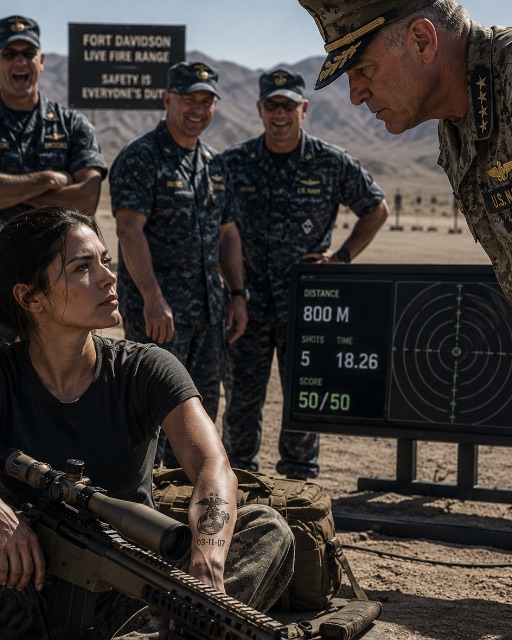
“So tell me, sweetheart… what’s your rank? Or are you just here to polish our rifles?”
Laughter rippled across the dusty firing range.
Six Navy officers. One admiral. All gathered around a quiet woman sitting cross-legged in the shade, methodically cleaning a sniper rifle.
No rank insignia. No name patch. No reaction.
She didn’t even glance up.
The desert air at Fort Davidson hung heavy with heat and the sharp scent of gun oil as Admiral Victor Kane stepped closer, irritation sharpening his tone.
“I asked you a question.”
Slowly, she lifted her head.
Storm-gray eyes. Steady. Unbothered.
“No rank to report, sir,” she said calmly. “I’m just here to shoot.”
That answer only fueled the mockery.
“Just here to shoot?” one officer scoffed. “At what distance?”
For the first time, the faintest trace of a smile touched her lips.
“Eight hundred meters.”
The group burst out laughing.
“Perfect,” Lieutenant Brooks said, grinning. “Let’s all watch this disaster.”
But minutes later… the laughter was gone.
Five shots. Eighteen seconds.
Every round struck dead center at 800 meters. No custom equipment. No specialized modifications. Just a standard-issue rifle – and control that looked almost unnatural.
The range fell silent.
The scoring monitor confirmed it: Five perfect tens.
Even Admiral Kane’s expression shifted. That wasn’t luck. That was precision. Something honed over years in places most people don’t come back from.
Brooks cleared his throat. “Who trained you?”
She didn’t answer. She was already field-stripping the rifle again, fingers moving with the kind of muscle memory that only comes from doing something ten thousand times in the dark.
Kane stepped forward. Not laughing anymore. Not smirking. His voice dropped low enough that only the officers closest could hear.
“I’ve seen shooting like that exactly once. Helmand Province. 2009. A ghost unit we weren’t supposed to know about.”
She said nothing.
“Who are you?” he asked again. Quieter this time. Almost careful.
She set down the bolt carrier and reached for her water bottle. That’s when her sleeve pulled back.
Kane saw her wrist.
His face went white.
It was a tattoo. Small. Black ink, faded the way old service tattoos get. Three lines. A number. And a symbol underneath that wasn’t in any branch manual he’d ever studied – but he recognized it immediately.
Because he’d seen it once before. Stamped on a classified briefing folder that required his signature and a blood oath to open.
The folder was about a unit that didn’t exist. A program that was never funded. Operators who were never deployed – officially.
Kane took one step back.
The officers noticed. When an admiral steps back from someone, you pay attention.
“Brooks,” Kane said, his voice flat and strange. “Holster your sidearm.”
“Sir?”
“Now.”
Brooks obeyed. The others shifted uncomfortably.
Kane looked at the woman. She was watching him now. Not hostile. Not afraid. Just watching – the way someone watches when they’re calculating whether you’re a threat or an inconvenience.
“Ma’am,” Kane said. And the word landed like a grenade.
Every officer’s head turned.
An admiral just called a woman with no rank insignia “ma’am.”
She stood. Brushed the sand off her pants. Picked up the rifle case.
“You weren’t supposed to see that,” she said simply, tugging her sleeve down.
“I know,” Kane replied.
She looked at him for a long moment. Then she said five words that made every man on that range feel the ground shift under their boots.
“Your base has a leak.”
She turned and walked toward a black SUV idling at the edge of the range that none of them had noticed before.
Kane watched her go. His hands were shaking. Brooks opened his mouth to ask a question, but Kane cut him off.
“You didn’t see her. She was never here. And if anyone asks about today, the range was closed for maintenance.”
“Sir, what was that tattoo – ”
Kane turned and looked Brooks dead in the eyes.
“That tattoo means she answers to exactly one person. And it’s not me. It’s not the Secretary of the Navy.” He paused. “It’s not even the President.”
Brooks swallowed hard.
Kane pulled out his phone, dialed a number he hadn’t used in six years, and walked away from the group.
When the call connected, he said only one thing:
“She’s here. And she said we have a leak.”
The voice on the other end was silent for exactly three seconds. Then it said something that made Admiral Victor Kane — a man who’d commanded aircraft carriers through war zones — sit down in the sand like his legs had given out.
What they told him started with two words: “We know.”
But it was the next sentence that changed everything. Because the leak she was talking about wasn’t a secret document or a compromised network.
“The leak,” the voice on the phone said, cold and clinical, “is a faulty alloy in the hull plating for the new Virginia-class submarines.”
The air left Kane’s lungs. That wasn’t a leak. That was a death sentence for hundreds of sailors.
“The contractor is Sterling Defense,” the voice continued. “Your friend, Warren Sterling.”
Kane felt sick. He had championed Sterling’s bid himself. He had vouched for the man’s character.
“But that’s not why she’s there, Admiral. She’s not there for the metal.”
The voice paused. “She’s there for the man who is helping Sterling cover it up.”
“Who?” Kane whispered, his own voice sounding alien to him.
“A congressional staffer named Alistair Finch. He flew in with you this morning, didn’t he?”
Kane’s blood ran cold. Finch was in his guest quarters right now. He was the guest of honor at a dinner tonight.
“What are my orders?” Kane asked, the words tasting like ash. It had been decades since he had asked that question without being the one to give them next.
“Your orders, Admiral, are to do nothing. Host your dinner. Smile for the cameras. Keep everyone, especially Lieutenant Brooks and his curious friends, away from her.”
The message was clear. He was a piece on the board, and not even a powerful one.
“Act as if everything is normal,” the voice finished. “She is handling it. We are simply letting you know so you don’t get in her way.”
The line went dead.
Kane sat there in the desert sand, the sun beating down on him. A four-star admiral reduced to a bystander on his own base.
He stood up, dusted off his uniform, and composed himself. The hardest part wasn’t the order. It was the sudden, gut-wrenching realization that the world he commanded, a world of clear hierarchies and protocols, was just a fragile facade.
That evening, the Admiral’s residence was filled with polite conversation and the clinking of silverware.
Kane played his part perfectly. He smiled, shook hands, and regaled the attendees with stories of his time at sea.
Across the table, Alistair Finch, a polished man in a tailored suit, laughed at all the right moments. To everyone else, he was a key political ally. To Kane, he looked like a ghost.
Kane’s eyes kept darting around the room, searching for her. He saw her only once.
She was dressed in a server’s uniform, carrying a tray of drinks. Her hair was pulled back differently, and she wore glasses.
No one gave her a second glance. She was invisible.
She moved through the room with quiet efficiency, her eyes never stopping on anyone for more than a second. But Kane knew she was absorbing everything. The seating arrangements. The whispered conversations. The way Finch kept checking his phone.
Later, as Kane was giving a toast, he saw Finch slip out onto the veranda.
A minute later, a different server, a young man, approached Kane. “Admiral, your driver asked me to give you this. He said there’s been a change of schedule for the morning.”
He handed Kane a folded napkin. Inside, scrawled in pen, was a single sentence.
“He’s making the exchange in the morning. Hangar 7. 0500.”
Kane crumpled the napkin in his fist. He was being used as a message board.
The rest of the dinner was a blur. All Kane could think about was that hangar and the confrontation that was coming.
He slept for two hours, a restless, dream-filled sleep. He woke long before his alarm, the desert sky still inky black.
He dressed not in his uniform, but in civilian clothes. He wasn’t acting as an Admiral now. He didn’t know what he was. An observer. A witness.
He walked to a vantage point overlooking Hangar 7, a place he knew from his junior officer days. It was a metal catwalk used for maintenance, shrouded in shadows.
At 0455, a black sedan with government plates pulled up to the hangar. Alistair Finch got out, carrying a briefcase.
He looked nervous, constantly glancing over his shoulder.
A few minutes later, another car arrived. A grounds crew vehicle. A man in a mechanic’s jumpsuit got out. He was the contact.
Kane watched, his heart pounding. He had teams on this base that could have intercepted this in seconds, flooded the area with armed personnel. But his orders were to do nothing.
Finch and the mechanic spoke for a moment. Finch opened his briefcase and pulled out a small, encrypted hard drive.
As he was about to hand it over, a shadow detached itself from the side of the hangar.
It was her.
She wasn’t holding a rifle now. She held nothing at all. She simply walked toward them, her footsteps making no sound on the tarmac.
The mechanic saw her first. His eyes went wide with panic. He reached inside his jumpsuit, likely for a weapon.
“I wouldn’t,” she said, her voice calm and even in the pre-dawn stillness. It carried all the way up to Kane’s perch.
The mechanic froze.
Finch turned, startled. When he saw her, just a lone woman in simple dark clothing, his fear turned to arrogance. “Who the hell are you? Get out of here, this is official business.”
She ignored him and kept her eyes locked on the mechanic. “The drive is for Sterling. The data on it falsifies the stress tests. The price was five million. You were going to be paid one hundred thousand.”
The mechanic paled.
“You weren’t going to get a dime,” she continued softly. “Your car has a remotely detonated charge wired to the ignition. You were the final piece of the cleanup.”
The man looked from her to Finch, terror dawning on his face. He dropped the keys he was holding and backed away slowly.
“Now it’s just you and me, Alistair,” she said, turning her attention to the staffer.
Finch scoffed, trying to regain his composure. “You can’t prove any of that. I have powerful friends. You have no idea who you’re dealing with.”
“Oh, I do,” she said. She took a step closer. “You’re a man who trades lives for a summer home in the Hamptons. You’re a man who sends boys to the bottom of the ocean in tin cans so your stock portfolio looks a little better.”
She reached into her pocket and pulled out a small photograph. She tossed it onto the hood of the car.
“His name was Sergeant Michael Davies,” she said, her voice dropping to a near-whisper. “He was my team leader. He died in my arms in Afghanistan because a body armor plate, made by a company just like Sterling Defense, failed.”
Kane watched, mesmerized. This wasn’t an operation. It was a reckoning.
“We don’t send people to prison, Alistair,” she said, echoing the words Kane had imagined in his head. “We don’t deal with courts and lawyers. We take everything else.”
She laid it all out for him. The evidence of his affairs sent to his wife. The proof of his insider trading sent to the SEC and, more importantly, to his political rivals. The full story of his betrayal sent to the parents of every sailor on this base.
“By the time the sun is up,” she finished, “your name will be a curse. The friends you think you have will be the first ones to turn on you. You’ll be a pariah. No money. No power. No one.”
She gestured to the hard drive in his hand. “Or, you can put that drive on the ground, get in your car, and drive until you run out of country. Disappear. Live what’s left of your life as a nobody.”
Tears were streaming down Finch’s face. He was a broken man. He placed the hard drive on the tarmac, got into his car, and drove away without a backward glance.
The woman picked up the hard drive. She turned and looked directly up at the catwalk where Kane was hidden. He knew she had been aware of his presence the entire time.
She gave a slight, almost imperceptible nod. Then she vanished back into the shadows.
The next day, Kane did the hardest thing of his career. He called his friend, Warren Sterling.
He met him in a sterile conference room in Washington D.C., a place devoid of warmth or history.
Sterling was all smiles and back-pats, completely unaware. “Victor! Good to see you! To what do I owe the pleasure?”
Kane didn’t waste time. He placed the hard drive on the table between them.
Sterling’s smile vanished. “What is this?”
“It’s the data from your doctored stress tests,” Kane said, his voice like stone. “It’s evidence that you knowingly sold substandard hull plating that would have cost the lives of hundreds of my sailors.”
Sterling tried to bluff. He blustered, he threatened, he reminded Kane of their long friendship, of the favors he had done.
Kane just sat there and listened. When Sterling was finished, Kane leaned forward.
“The difference between you and the men and women who serve is that they have honor, Warren. It’s a currency you’ve never understood.”
He stood up and walked to the door, where two agents from the Naval Criminal Investigative Service were waiting.
The fallout was immense. The scandal rocked the defense industry. But the faulty plates were replaced. The new submarines were made safe.
Months later, Kane was in his office, reviewing budgets. An unmarked package was sitting on his desk.
Inside, there was a single, spent rifle cartridge, polished to a shine. The one from the 800-meter shot on the range.
Tucked beside it was a single file. DECOMMISSIONED. TOP SECRET.
He opened it. It was about her unit. Project Chimera. The symbol from her tattoo was on the first page. It was an Ouroboros—the snake eating its own tail—with a perfectly balanced scale in the center.
The unit’s purpose wasn’t to fight enemies. It was to hold the system accountable to itself. To be the balance when honor was lost.
The file listed the original members. All killed in action. Except one. Her name was Maria. He saw the report on Sergeant Michael Davies. It matched her story perfectly.
The number on her tattoo, he realized, wasn’t a designation. It was the number of members in her original unit. Seven. The three lines were the promises she made to them. Never forget. Never forgive. Never fail.
The “one person” she answered to wasn’t a person at all. It was a memory. A promise. A code of honor that transcended any rank.
Kane closed the file. He had been mocked that day on the range, but he was the one who had been humbled. He had been so proud of the stars on his shoulders, he had forgotten to check the integrity of his own heart.
That woman, with no rank and no name, had reminded him what true service really meant. It’s not about the authority you are given. It’s about the responsibility you uphold, especially when no one is watching.
He picked up the spent cartridge, its weight feeling heavy and significant in his hand. He had chased prestige and power, but she was chasing something far more important: Justice. And, in the quiet corridors of power and the dusty plains of service, it was people like her, the silent guardians of honor, who truly kept the world in balance.



