
…a photograph.
Not of a mission. Not of a valley.
Of me.
Age nine. Standing in my backyard in Tulsa, holding a popsicle, squinting at the sun. On the back, in my brother’s handwriting: “PROTECT HER. SHE DOESN’T KNOW WHAT SHE IS.”
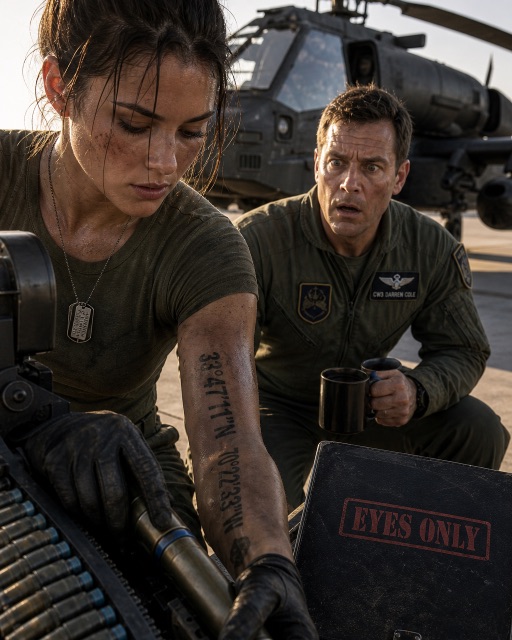
The rotor wash from a taxiing Blackhawk hit us. Darren didn’t flinch. He was watching my face.
“Keep going,” he said.
I turned the photo over. Underneath was a mission roster. Twelve names. Eleven were crossed out in red ink. Killed In Action. Dates spanning thirteen years.
Only one name wasn’t crossed out.
My brother’s.
“He’s alive?” I choked out.
Darren shook his head slowly. “I didn’t say that. I said he wasn’t crossed out. There’s a difference.”
I flipped to the next page. A grainy surveillance photo, black and white, taken from a drone. A man in a dirt-caked uniform crouched beside a child in a mountain village. His face was turned toward the camera like he knew it was there.
It was Shane. Older. Scarred. But him.
The timestamp read: 48 HOURS AGO.
“Tammy,” Darren said, and his voice broke on my name. “The reason he gave you those coordinates as a tattoo… the reason I have them too…”
A Humvee rolled up behind us. Two men in civilian clothes stepped out. No unit patches. No name tapes.
Darren grabbed the folder, shoved it back in his bag, and whispered six words that turned my legs to water:
“They just figured out you enlisted.”
He pressed something small and metal into my palm. A key. Stamped with the same numbers now inked into my skin.
“Get to the hangar bay. Locker 47. Before they reach us.”
I looked down at the key, then up at the men walking toward the flight line.
And I realized my brother hadn’t given me coordinates.
He’d given me a combination.
My feet moved before my brain caught up. Every instinct, every bit of training, screamed at me to obey the last command.
Darren turned his back to me, a solid wall between me and the approaching men. He was buying me seconds.
I ran. Not like a soldier, but like a scared kid. My boots slapped against the hot tarmac, the sound deafening in my ears.
The hangar bay was a hundred yards away. It felt like a hundred miles.
The men picked up their pace. They didn’t shout. They didn’t draw weapons. They just walked with a purpose that was more terrifying than any threat.
I risked a glance back. Darren had met them. He was talking, using his hands, creating a distraction as solid as a barricade.
He was sacrificing himself for me. Just like Shane had asked him to.
I ducked behind a row of fuel barrels, my lungs burning. My heart hammered against my ribs, a frantic drumbeat against the hum of the base.
Hangar Bay. Locker 47.
I moved again, staying low, using the organized chaos of the flight line as cover. A maintenance crew shouted something at me, but I didn’t stop.
The cavernous mouth of the hangar bay yawned open, a promise of shadow and sanctuary.
I slipped inside, the sudden cool air a shock against my sweat-soaked skin. The air smelled of grease, jet fuel, and ozone.
Rows of grey metal lockers lined one wall. I scanned the numbers, my hands shaking so badly I could barely read them.
34… 35…
A shout echoed from outside. They were done talking to Darren.
41… 42…
My breath hitched. My fingers fumbled with the key in my pocket.
46… 47.
It was an unassuming locker, no different from the rest. The key slid into the lock with a quiet click that sounded like a gunshot in the silent hangar.
It turned. The latch popped.
I pulled the door open, my eyes darting toward the entrance. Footsteps. Coming fast.
Inside the locker was a worn leather duffel bag. It wasn’t military issue. It was civilian.
I grabbed it and slammed the locker shut just as the two men in suits stormed into the hangar.
They saw me. For a split second, we were frozen in a tableau of hunter and prey.
Then I ran again.
There was another door at the far end of the hangar, a fire exit. A red sign glowed above it.
I slung the bag over my shoulder. It was heavier than I expected.
The men shouted this time. A formal command. “Soldier, halt!”
I wasn’t a soldier anymore. I was Tammy. Shane’s little sister.
And I was not stopping.
I slammed through the fire exit. An alarm blared behind me, angry and loud.
The door opened onto a service road that ran along the base perimeter fence. There was a gate, unmanned, about fifty yards down.
My military ID wouldn’t work now. They would have flagged it.
I zipped open the duffel bag while I ran. On top was a set of civilian clothes, a cheap burner phone still in its plastic, and a wallet.
Inside the wallet was a driver’s license with my face and a name I didn’t recognize. And cash. A lot of cash.
My brother had been planning this for years.
The footsteps were still behind me, closing the distance. These men were fit.
I reached the gate. A simple chain and padlock.
I thought of Darren, standing his ground. I thought of Shane, staring at a drone camera from half a world away.
I couldn’t let them down.
My eyes scanned the area. There was a dumpster near the fence. It was a risk. A huge risk.
The perimeter fence was topped with razor wire. But next to the dumpster, a section looked… different. Weaker.
A memory surfaced. Shane, teaching me to climb the big oak tree in our backyard. “Always look for the strongest branch, Tammy. Or the weakest link.”
He had planned this too.
I scrambled onto the dumpster, the metal groaning under my weight. The top of the fence was just within reach.
The section I’d spotted was bent downward slightly, the razor wire carefully clipped and rearranged to look intact.
I hauled myself up and over, my arms screaming in protest. A shard of metal sliced my palm, but I barely felt it.
I landed hard on the other side, in a ditch overgrown with weeds. I was off the base.
I was free. And I was hunted.
I didn’t look back. I just ran until the sound of the alarm faded and was replaced by the pounding of my own blood in my ears.
I found a bus station on the edge of town, a dingy place that smelled of disinfectant and despair. I bought a ticket to a city I’d never heard of, a place four states away.
I paid in cash.
In the greasy restroom, I changed into the civilian clothes from the duffel bag. A simple t-shirt and jeans.
Looking in the mirror, I barely recognized myself. The soldier was gone. In her place was a pale, tired-looking young woman with fear in her eyes.
I sat in the back of the bus, the duffel bag on my lap like a shield. As the bus pulled away from the station, I finally let myself breathe.
Tears I didn’t have time for stung my eyes. Tears for Darren’s unknown fate. Tears for the brother I hadn’t seen in a decade.
Deep inside the bag, beneath the clothes and the wallet, my fingers found something else.
A small, leather-bound journal.
My brother’s handwriting was on the first page. “For Tammy. If you’re reading this, I’m sorry.”
The bus rumbled on through the night, carrying me further and further away from everything I had ever known. I found a cheap motel off a highway, the kind with a flickering neon sign and questionable stains on the carpet.
It was perfect.
I locked the door, jammed a chair under the knob, and sat on the lumpy bed. The journal felt heavy in my hands.
For a long time, I just held it. It smelled faintly of Shane. Of sweat, dust, and something that reminded me of our childhood home.
Finally, I opened it.
His writing was rushed, messy. The entries jumped between mission logs, personal thoughts, and frantic, scrawled notes.
He wrote about his unit, the eleven men whose names were crossed out on the roster. They weren’t just a unit; they were brothers.
Then, about three years into his deployment, the tone changed. A new directive had come down. They were to be part of a pilot program for a “performance enhancer” developed by a private military contractor called Aegis Dynamics.
It was supposed to heighten reflexes, eliminate the need for sleep, and suppress fear. The perfect soldier drug.
The men called it “Clarity.”
At first, it worked. They were sharper, faster, more effective than any unit in the theater. They were legends.
But then the side effects started. Paranoia. Hallucinations. Uncontrollable aggression, not toward the enemy, but toward each other.
Shane wrote about finding one of his best friends trying to claw his own eyes out, screaming about “the wires in the walls.”
The official report said he was killed by an IED.
One by one, the men of his unit broke down. And one by one, they were listed as Killed In Action. Accidents, enemy fire, friendly fire. Aegis and the brass had an explanation for everything.
The cover-up was flawless.
But Shane knew the truth. He suspected something from the beginning. Something about the way the Aegis reps looked at them, like lab rats.
He’d been faking it. Palming the pills, pretending to swallow them. He documented everything, collecting data, sworn statements, and blood samples when he could.
He was building a case. A case that would burn Aegis Dynamics and the corrupt commanders who let them do it to the ground.
My hands were shaking as I turned the page. My own name was written there.
“Tammy,” he wrote. “I figured it out. Why I wasn’t affected when I took the first few doses before I got suspicious. It’s in our blood.”
He had pulled family medical records. He had spent his leave time in medical libraries.
Our great-grandmother had a rare, benign genetic mutation. A quirk in her blood chemistry that made her immune to certain neurotoxins. It was passed down through the family.
It was passed down to me.
I dropped the journal. The room spun.
“PROTECT HER. SHE DOESN’T KNOW WHAT SHE IS.”
I wasn’t just his sister. I wasn’t just a soldier.
I was the key.
Aegis hadn’t just created a failed drug. They were still trying to perfect it. They knew the experiment produced a few subjects who were resistant. They had Shane’s DNA on file.
And when I enlisted, when my DNA went into the military database, they found a perfect match.
A living, breathing subject with the exact genetic marker needed to stabilize their formula. To make it work.
They weren’t hunting me to silence me.
They were hunting me to harvest me.
My blood ran cold. This was bigger than a cover-up. This was a hunt for the holy grail of modern warfare, and I was the cup.
The journal wasn’t finished. There were a few more pages, written with an even greater sense of urgency.
Shane had planned to leak his findings to an investigative journalist, a man named Robert Prentiss. But he ran out of time. Aegis moved on him, and he was forced to disappear, to become a ghost.
The last entry was a message directly to me.
“Tammy, if you’re reading this, it means they found you. It means Darren got you out. You have a choice. The bag has enough money for you to disappear forever. Get a new life. Be happy. I’ll spend the rest of my life knowing I kept you safe.”
“Or,” the next line read, “you can finish this. Prentiss is the key. His number is in the burner phone. You have the evidence. You have everything I gathered.”
He didn’t tell me what to do. He just laid out the options. Run, or fight.
My whole life, I had tried to be like my brother. I joined the army to follow in his footsteps, to make him proud.
Now, I understood. Being like him wasn’t about wearing the same uniform.
It was about making the same choice.
I picked up the burner phone. My fingers were steady now.
I scrolled to the single contact saved in the phone. Prentiss.
I wasn’t going to run. I was going to burn Aegis Dynamics to the ground.
I called the number. A gruff voice answered on the second ring. “Prentiss.”
“My name is Tammy,” I said, my voice clear and strong. “My brother, Shane, told me I could trust you.”
There was a silence on the other end of the line. Then, a weary sigh. “I’ve been waiting for this call for three years. Where are you?”
We arranged a meet. A crowded public library in a city two hundred miles away. It felt safe, anonymous. Prentiss told me what to look for: a man in a worn tweed jacket, reading a history book.
I spent the next two days on buses, constantly looking over my shoulder. I felt their presence, a shadow I couldn’t quite see. They were smart. They were patient.
I arrived at the library. It was a grand old building, filled with the quiet rustle of pages and the smell of old paper. I found the history section.
And there he was. A man in his late fifties, with tired eyes and a tweed jacket just as he’d described.
I sat down opposite him. “I have what you need,” I whispered, my hand resting on the duffel bag.
He looked up from his book, and his eyes weren’t just tired. They were frightened.
“It’s a trap,” he mouthed, his face pale. “They’re here.”
My heart plummeted. Two men in crisp suits stood near the end of the aisle, pretending to browse. They were the same type as the men from the base. Aegis.
Prentiss slowly slid a hand into his jacket. “I’m sorry,” he whispered. “They got to my family.”
He wasn’t on my side. He was the bait.
But Shane didn’t raise a fool. And the army had taught me to plan for contingencies.
“I know,” I said, giving him a small, sad smile. “That’s why he didn’t just give me your number.”
Prentiss’s eyes widened in confusion.
From the next aisle over, a book slammed shut. It was a loud, sharp sound that made everyone jump.
One of the Aegis men growled, “What was that?”
He rounded the corner and came face to face with Darren.
Darren, who was supposed to be captured. Darren, who stood there in civilian clothes, holding a thick copy of “War and Peace.”
“Library etiquette,” Darren said calmly, before driving the spine of the book into the man’s throat.
The man collapsed, gagging. The second agent drew a weapon, but before he could aim, a group of four “civilians” moved in. A woman browsing magazines grabbed his arm and twisted it with professional skill. An old man reading a newspaper kicked the back of his knee.
The library wasn’t just full of readers. It was full of Shane’s friends. The ones who had survived. The ones who owed him.
And the biggest twist of all?
Prentiss, the journalist, was indeed compromised. But the man in the tweed jacket wasn’t Prentiss. He was another of Shane’s loyal soldiers, there to test the waters.
The real Robert Prentiss was dressed as a library maintenance worker, pushing a cart. And a tiny camera on his glasses was streaming everything, live, to a server he controlled.
The head of Aegis security, a man named Travers, had been watching from a car outside. When his men went silent, he came in himself, furious.
He found me standing over his two disabled agents, Darren at my side, and the man he thought was Prentiss cowering in the corner. Shane’s friends had already blended back into the library’s patrons.
“You have no idea what you’re doing, girl,” Travers snarled, his eyes dark with rage.
“I’m finishing what my brother started,” I said, holding up Shane’s journal. “It’s over.”
He laughed, a short, ugly sound. “That’s a dead man’s diary. It’s nothing. We have assets in place you can’t even imagine. We’ll erase you. We’ll erase your brother’s memory. He’ll be nothing more than another name on a wall.”
“He’s not just a name,” I said, my voice ringing with a certainty that came from deep within my soul. “And this isn’t just a diary. It’s his legacy.”
And as he stood there, ranting about his power, about how untouchable Aegis was, confessing to everything in his arrogance, he had no idea the real journalist was two aisles over, capturing the performance of a lifetime.
The story broke the next day. It was an earthquake.
Aegis Dynamics, federal contracts, the military commanders involved – it all came crashing down. The hearings were televised. The eleven names from Shane’s unit were cleared. Their families finally learned the truth, their honor restored.
I gave my testimony. I held up the journal. I told them about my brother.
In the end, they asked me what I wanted.
I didn’t ask for a medal. I didn’t ask for money.
I just wanted his file un-redacted. I wanted the world to know he was a hero.
They never found Shane. The officials declared him a ghost, a legend who had disappeared into the war-torn mountains he operated in.
But I knew. The last image I had of him, in that drone photo, was of him crouching beside a child. He was still protecting people. He had found a new family to watch over, a new purpose.
He wasn’t coming home. And for the first time, I understood that was okay. He was where he needed to be.
The tattoo on my skin no longer felt like a brand or a mystery. It was a promise. A connection.
My brother’s life lesson wasn’t just about fighting. It was about what you choose to protect. He protected me by preparing me for the truth, by trusting me to be strong enough to handle it when the time came. He didn’t shield me from the world; he gave me the tools to face it.
My name is Tammy. My brother was a hero. And I am the keeper of his legacy. That is what I am.



