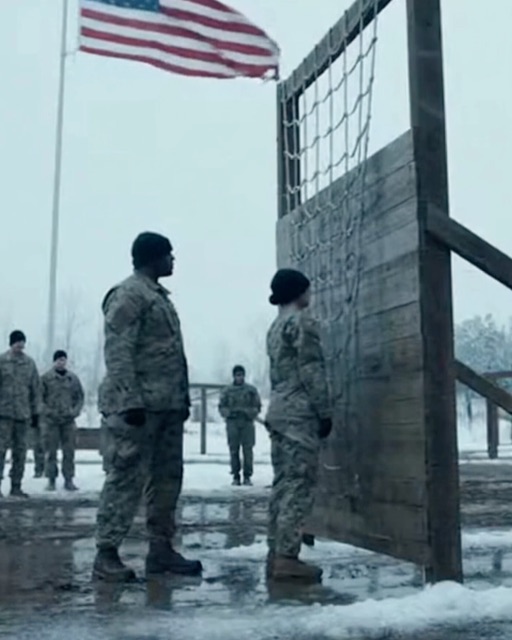
He slammed me face-first into the freezing trench. Water shot down my collar. I tasted mud and copper and swallowed the scream.
“Move, runt,” Private Miller hissed behind me, helmet ramming my boots like he owned the ground.
I didn’t give him a sound. I never did.
Every morning, I cinched my sleeves to the last button. Tight. Precise. Not for looks. For containment. If they didn’t see it, it couldn’t be used against me.
But he grabbed my left arm. Yanked.
“Don’t – ” I choked out, the first word I’d ever aimed at him.
The soaked fabric tore from shoulder to elbow with a sound that cut through the sleet.
I froze.
Cold air hit raw skin. The trench went silent. Boots stopped. Even the barbed wire seemed to hold its breath.
Miller’s smirk collapsed as he stared. My arm – shiny, ridged, ruined—told a story I’d buried under uniform cloth and silence.
He dropped the torn sleeve like it burned him.
Footsteps. Heavy. Drill Sergeant Hayes shoved through the circle, ready to bark.
He saw my arm. His jaw locked. No sound. Just this… recognition that made my stomach flip.
I shook, not from cold, but from being… seen. I reached to cover myself, fingers slipping in the mud. I braced for pity. For a lecture. For anything but what came next.
Hayes stepped closer, voice low, not a shred of performative thunder left. He looked at the scar, then at my face like he was measuring years.
“Private,” he said, careful. “Where did you—”
He stopped. His eyes flicked to the faded line near my wrist, the one even I try to forget.
He swallowed.
Then he spoke one word. A name I hadn’t heard since the night the sirens drowned out my mother’s voice.
“Maren.”
My stomach hollowed like the trench had opened under me. The syllable hit soft, not shouted, not questioned, just set down between us like an old photograph.
Behind me, someone whispered, and someone else muttered “What?” like they’d been jerked awake from a nap. The wind bit the wet skin of my arm and for a second, I was six again.
The world tilted and the trench was a hallway, and the sleet was heat, and the sirens were back. My mother saying, “Hold on to me, Wren,” except that wasn’t the name on my birth certificate, and someone’s boots thundered and then black smoke made the ceiling crawl.
I blinked and Fort Moore bled back in, gray and cold and very present. My face was burning anyway. I pushed up to my knees and tried to drag the torn fabric back over the mess, but mud made it slide.
“Eyes front,” Hayes said to the platoon, the steel returning to his voice like a shutter slamming. “Miller, back three paces. Everyone else, move it to the berm, now.”
No one argued. They peeled off, boots sucking at water, eyes dragging over me like I had grown horns. Miller slid away, pale under the grime, mouth half-open like a fish.
Hayes crouched so we were level. He didn’t reach for me. He kept his hands to himself like he was on a firing range.
“I shouldn’t have said that here,” he said, voice checked like he was on a narrow road. “I’m sorry, Private.”
I pulled my sleeve up as far as it would go and tucked it, the cold cutting deep, the scar humming like a wire. I stared at the mud and watched water carve little roads around my knee.
“I go by Rae,” I said, because that’s who I had made myself be. “Private Collins.”
“Understood,” he said softly. “Rae.”
The word in his mouth twisted something in me, because he said it like it fit, and part of me wanted to snap that it wasn’t a nickname or a borrowed shirt, it was me. He breathed in like he was about to ask more, then leaned back and motioned toward his own sleeve.
“Medical needs to check that,” he said. “I’ll walk you.”
“I’m fine,” I lied, because pain was clean and attention was not.
He studied me for a half-slow count, eyes not drifting to the scar again. He looked at my face like I was a puzzle he could work without touching. He stood and held out a hand, and I pretended not to see it and got up on my own.
When we climbed out of the trench, the platoon made a lane like a street, no one quite looking at me, no one quite not. The rain needled and I felt the weight of twenty people recalculating who I was.
Halfway to the aid tent, Hayes said, low enough that it didn’t have to exist if I didn’t want it to, “I was there.”
He said it like someone telling you he had been at a storm. Not claiming it. Just naming it.
I stumbled for half a step because I had worked very hard not to attach faces to that night. Boots. Coats. Hands. A voice on a radio I’d prayed to like a god. But there had been a street and glass and a row of squad cars that made the rain look theatrical.
“At the fire,” he said, as if I might think he meant something else. “Maple Court. March. Twelve years ago.”
The number landed like a cup put back in its proper place. It was exact. It was ordinary and it was my whole life rerouted.
I swallowed and kept my eyes on the tent. “I don’t remember faces,” I said, because that was true. “Just… noise.”
“You had a blue band,” he said, more to the ground than to me. “From the school carnival, one of those cheap ones they tie on your wrist until they cut it. The plastic melted and left a line, right there.”
My hand clenched without my permission, thumb rubbing the line like it was a worry stone. The rain, the mud, the chill, all fell away for a second and I smelled soap flakes and smoke.
“I kept the charm,” he said, then exhaled like he had been holding his lungs since I’d fallen in the trench. “Your mother had another one. They matched.”
I stopped under the aid tent flap and stared at him, because keeping something like that for a dozen years was not nothing. He was older than that night, the edges of his anger worn into patience, the haircut strict as doctrine.
“You carried me out,” I said, and it came out flat because if I put feeling in it, the ground would tilt again.
He nodded once. He didn’t say I carried out a lot of kids or I did what anyone would do or I’m not a hero. He just stood there and let that fact sit between us, plain as rain.
The medic cleaned my arm with gentle swipes that still felt like grit. He pulled the torn sleeve back down and taped it. He offered me a dry thermal top and a blanket and pretended not to notice when I chose the top and refused the blanket.
Hayes waited just outside, back to the wall, hands at his sides. When I stepped out, he flicked his eyes to the sky like he was checking for incoming.
“You’re cleared,” the medic called after me. “Keep it dry if you can.”
We both almost laughed because everything was wet. Hayes didn’t say I should sit it out. He didn’t say much of anything as we headed back, just matched his pace to mine like it was obvious.
The platoon pretended to be watching a distant tree line. Miller pretended not to exist. Everything had shifted an inch, but we kept running the drill because the Army didn’t pause for anyone’s ghosts.
At chow that night, no one sat too close to me at first. There are rules about respect and there are rules about gravity, and in the beginning, I had been small enough for the orbit to push me away.
Reyes, who always had pepper flakes in his pocket, slid onto the bench after a beat. He didn’t look at my sleeve. He said, “You want the hot sauce or what,” and pushed a packet over without any ceremony.
I nodded at him like a favor could hold up a sky. He smiled at his mashed potatoes and kept eating.
After lights out, the sound of twenty people settling into metal racks filled the emptiness. Rain ticked on the roof. The stale smell of boots and soap and human tiredness hung over everything. When fatigue pushed me toward sleep, images jolted me back hard and sharp.
I got out of bed so the springs wouldn’t creak and woke my rack-mate. The bay was a long rectangle of dark, red exit lights bleeding slow. The clock’s second hand clicked like the smallest metronome.
Fire guard duty had posted two hours earlier. I found both privates at the far end, heads bent over a contraband deck of cards, whispering laughter through their teeth.
“Switch with me,” I said softly.
They blinked like I’d interrupted a movie. One of them said, “I got an hour left,” and looked over my shoulder to see if a drill sergeant had grown there.
“I know,” I said, and held out my hand for the log. “Take my bunk.”
They didn’t argue. No one wanted extra minutes of staring at a quiet building in the dark with nothing but thoughts for company. They passed the log like it was heavy, and I wrote in the column with small letters, Precinct clean, no anomalies.
The night bled into itself in long bands. My arm ached with the kind of pain that is just a reminder that you are a person inside of skin. Twice I circled the bay, once I paused by the exit doors because the air there was colder and smelled like rain.
Which is why I smelled it first when it changed.
It wasn’t smoke, not at first. It was the ghost of it, a sour metal whiff of something different. I followed it like an animal and found it stronger by the laundry room door.
Heat bled through the seam like a secret trying to get out. The handle was warm, then hot. I didn’t waste a second.
“Up,” I said, voice hard as a hatch shutting, louder than I’d ever dared in my life. “Up! Evac now, now, now!”
Everything exploded into movement at once. Sheets fell. Feet thumped. Someone knocked a metal cup off a locker and the sound rang like a bell calling church.
“Exit B,” I shouted, one hand pushing the door alarm so the siren would carry, the other hand at my side like it might keep the scar from throbbing off. “Grab nothing. Move!”
The laundry room door boomed once like a fist had hit it and smoke pushed out from the edge in a black sigh. Heat crawled along the floor, slow and awful, a beast spreading arms.
My mouth said the things I had learned that I hadn’t wanted to learn. “Stay low. Hand on the shoulder in front of you. Do not run. Do not speak.”
Bodies poured past me, bent and quick. Between hacks of coughing, Reyes said, “What about fire extinguishers,” because he remembered training and wanted to be good.
“Extinguishers are not for that,” I said, because I had learned those red cylinders lie to you when you need them most. “Get out.”
Miller wasn’t in the stream of faces. Some people you keep track of because they’re loud or cruel or both, and he had been all three. I turned, every neuron trying to calculate how much time I had and how much time he had and how much both of us had together.
He stumbled out of the restroom in a fog of shampoo and confusion, one sock on, one bare foot, eyes not believing what they were seeing. Mid-shout, the laundry room door gave up and a blossom of black smoke poured in low, hugging the floor like a bad friend.
“Private,” I said, reaching for his shoulder while my lungs tried to remember how to work. “We have to go.”
He didn’t argue, which told me he wasn’t stupid, just used to testing the world like it owed him explanations. He dropped to the ground without me having to say it and I crouched next to him, arm burning like a brand.
We moved, low and fast, around the corner, where the exit light smeared red over walls and one recruit’s bare legs. The smoke followed us like hunger.
Outside, cold slammed us like a correction. Air scoured my lungs raw and sweet. The platoon clumped into a shivering line, heads counting heads in that blind way groups do when they want to be whole.
Hayes came at a run, wearing an old green jacket and sweatpants, hair slightly trashed by the interruption of sleep. He didn’t look surprised to see me by the door, dirty and breathing hard.
“Everyone out?” he barked, and I said, “All accounted for,” with a certainty I wouldn’t have had a year ago.
He didn’t ask how I knew, but his mouth did a quick thing like he wanted to smile it and wasn’t allowed.
Fire trucks arrived, fast and bright, sirens cutting through the cold. The sound reached down into my bones and shook loose a few old things, but I stood where I was and my feet didn’t run anywhere because there was nowhere to go but back into my life.
It turned out a dryer motor had decided to retire spectacularly, lint packed in like kindling. It burned hot and then it was out because the building had more safety gates than it used to, and there were sprinkled heads ready to break like glass.
In the evaluation room after, wrapped in a blanket I didn’t remember taking, I stared at a poster about hand hygiene and breathed in and out like a person with lungs on rental. Hayes stood in the doorway like the room might bite if he got too close.
“You did good,” he said, after the checklist of Did you hit your head and Did you inhale too much and Were you the idiot with the candle. “You did more than good.”
“I was on fire guard,” I said, because the other truth was big and I wasn’t ready to say it out loud.
“You could have panicked,” he said calmly. “You didn’t.”
He leaned a shoulder against the doorframe, noting things I probably didn’t know I was doing. I was rubbing the faded line near my wrist slow and steady, round and round, and he let me.
“You saved my life,” he said, voice quiet enough that the wall tile had to lean in. “Back there. Twelve years back.”
I looked up because that made no sense and he knew it.
“You gave me the focus to do it,” he added, seeing my face. “It sounds backwards, but it’s true.”
I stared at his chest because looking at eyes felt like standing too near a cliff. He wore a T-shirt from a 10K run in a small town I’d never heard of and I wondered what day he had gotten it and if he’d been proud then.
“I had a choice,” he said, not dramatic, just stating the thing. “Your mother was at the window, and you were at the door, and it took me half a second too long to notice you were small enough to get stuck in the frame.”
My chest turned into a drum. He breathed like the air was on a leash.
“I chose the door,” he said, because he was always going to tell the truth once he started. “I don’t know if I could have changed anything if I had gone the other way first. I think about it when it’s quiet.”
There was a version of me that could have taken that gift and turned it into a blade. There was a version of me that could have made a cathedral out of rage. I looked down at my arm instead.
“She told me to go,” I said, and my voice shook the tiniest amount, like a flag you only notice is moving if you really stare. “She pushed me. I think she knew the door.”
He closed his eyes once, quick. When he opened them, they were normal again.
“I kept the charm,” he repeated, and the room tilted not in a bad way but like someone had put a different floor under my feet. “I don’t know if you want it.”
I didn’t answer, because there are some questions that have to sit like a stone in your hand for a while so you know what kind of rock it is. He nodded like he understood that too.
Back in the bay, Miller found me by my locker like I had a sign that said I am available for confessions. He hovered, shoulders too tight, hands empty for once.
“I’m sorry,” he said, and the words looked weird coming out of his mouth.
“Okay,” I said, because it’s what you say when someone puts a real apology next to you like a sleeping baby and you don’t know what to do with it.
“I didn’t know,” he said, like that fixed anything, but then he cleared his throat and did something unexpected. “I was wrong either way.”
He stared at the floor for a second like he was surprised by himself. He shrugged, awkward like his jacket didn’t fit.
“My dad,” he said finally, never looking up. “He was mean to everyone smaller than him. He liked it. I told myself I was just doing what he did to make sure I wasn’t the one it was being done to.”
He looked at my left sleeve then, fast, like checking if it was a bomb. His face went ashamed and stubborn at the same time.
“I can’t take it back,” he said. “But I can carry your ruck tomorrow.”
“You can carry your own tomorrow,” I said, and something that had been jammed in my throat for days loosened a little. “That’ll be enough.”
He barked a laugh that wasn’t happy but was honest. He nodded and walked away and didn’t turn around to see if I was watching him.
Rumor had done what rumor does, and by lunchtime, everyone knew that Private Collins had pulled a whole bay out of a simmering laundry room and made a bully follow orders with his hair still wet. They looked at me differently, but this time it felt like sunlight instead of a spotlight.
At mail call, a small padded envelope made a dry whisper when it landed in my hands. The return address was the unit office with a name scrawled in pen blockier than it needed to be.
Inside, wrapped in tissue, was a charm. Cheap plastic, once blue, now melted into a shape almost wrong but still right. The word MAR printed on one side, the rest gone to heat.
My stomach dropped to my knees and then slowly floated back into place. It wasn’t everything. It didn’t have to be.
There was a paper too, a note in writing that had tried and failed to camouflage itself as official. It said, If you want to talk, my door isn’t locked. If you don’t, that’s fine too.
I held the charm in my palm in the dark for five whole minutes that stretched long as noodles. Then I slid it into my pocket and went to the latrine and pressed it under warm water and watched grit wash away.
That night, under my pillow, the charm made a small, thin bump. It felt like sleeping on a pebble at first. It felt like sleeping on a promise after.
Training tightened in. The long ruck march loomed like a city at the horizon. We shouldered our packs at oh-dark-thirty, the cold sticking to us like plastic wrap. Reyes tucked pepper flakes into his sock and I laughed because of course he did.
Halfway through, the hill broke some people like twigs. Bodies bent. Breaths hitched. Miller’s mouth set in a line so hard it could cut fruit, and then his left knee betrayed him like a cheap friend.
He stumbled, pack rocking, arms windmilling. Without thinking like a hero, my hands were already on his straps, shifting weight, squaring him up. He grunted something that might have been Go away or might have been Thank you, and I decided I didn’t need to translate.
“Three on your six,” Reyes puffed out, coming up like a man on a mission, shoulders under Miller’s right strap before the rest of us could blink. “Team lift.”
We moved as one awkward animal for a few yards. Then Miller shook his head and straightened as far as it would go.
“I got it,” he panted, like a dare to himself more than to us. “Don’t—don’t make me weak.”
“You’re not weak,” I said, and meant it. “You’re just human.”
He snorted and set his feet and the world clicked once and kept going. He finished that hill with his pride dented enough to maybe fit other people in it.
Graduation day rolled over us clear and cold. We stood straighter not just because we’d been told to but because we knew we had earned being upright. Parents cried. Strangers cheered. Boots thumped. Flags made that shh of fabric that always makes my throat tight.
Hayes stood off to the side, not big in the field but steady like a fencepost. When my name was called, the one I had chosen and fought for, I walked like I had grown into it. I took the certificate and the coin and the handshakes and the way the world felt a little different with my hair tucked up and my sleeves neat and my heart louder than it had ever allowed itself to be.
After, he found me near the bleachers where I was pretending to look at my shoelaces while my stomach did gymnastics. He tilted his head like he could see the circus going on inside me and wasn’t going to comment.
“You going to keep that charm,” he asked, nodding like it might be in my pocket, and I nodded back.
“I think I will,” I said. “I think I needed proof that the beginning wasn’t a ghost.”
He smiled, small and real, and his eyes did that thing where they get soft around the edges. He stuck out a hand and when I took it, he pulled me just enough to put a fatherly arm on my shoulder for one second.
“You made something good out of something that tried very hard to make you disappear,” he said, and I had to concentrate so I wouldn’t cry into my own victory.
Miller wandered over like a man with a debt he was going to pay even if it wiped him out. He scratched the back of his neck like a teenager and looked at the floor and then at me and then at the sky.
“My mom says I need to thank you for making sure I didn’t light up like a match,” he said, halfway to a smile, halfway to bolting. “And also for kicking me in the sense.”
“I didn’t kick you,” I said, and he grinned.
“You did, kind of,” he said. “With words.”
He looked at Hayes then, maybe thinking about how far to go in front of someone he still thought could turn him into gravel.
“I’m going to try to be better,” he blurted, and then he laughed at himself like that was too big a thing to say out loud. “I mean, not just here. At home, too.”
Hayes nodded like he had been waiting to hear that exact line. I nodded because there wasn’t anything smarter to do.
Later, when the field was a scattering of wrappers and footprints and whatever gets left when something good is over, I walked to the memorial tree by the admin building. It was small, like it was still learning how to be a tree, bark smooth and pale.
I pressed the charm into the dirt at the base, not to bury it but to let it rest in a place that had room for both the before and the after. I didn’t want to keep carrying it like a rock in my shoe. I wanted it in the ground where strong things grow from.
A breeze moved like someone exhaling a secret. I stood there a minute and thought about my mother’s hands and the way she had said my name when she was half-asleep making pancakes on a Saturday. I thought about the blue band, melted into a line I had spent years hating and hiding.
I touched my left sleeve, smoothed it down, buttoned to the last button like I always did. Then I unbuttoned one and rolled it twice, not all the way up, just enough that the light could touch what the world had given me to carry.
People like to say scars make you strong, but that makes it sound like they do the work by themselves. The truth is, you do the work, and the scars just make sure you remember.
On the way back, Reyes jogged to catch up, holding two ice creams like contraband. He passed me one with a grin and said, “You ready for the next thing,” like all this had been a prologue.
I licked cold sugar and shrugged like I didn’t want to jinx it. “Yeah,” I said after a second. “I think I am.”
The truth is, the world will always have its Millers and its fires and its nights where you can’t tell if you’re waking up or still inside of something. But it will also have people who show up when you’re small and carry you out even when it hurts.
It will have drill sergeants who remember, and friends with pepper flakes, and apologies that don’t sound like excuses. It will have laundry rooms that don’t burn all the way down, and knees that keep going, and graduation days under a clear sky.
If you’re lucky, it will give you a chance to turn the worst thing into the beginning of something you can walk toward without hiding. And if you’re paying attention, you’ll take that chance and hold it with both hands, scars and all.
Be easy with people whose sleeves are always buttoned, because you have no idea what keeping it all in has cost them. Be firm when you need to be, soft when you can be, and always, always grab someone’s shoulder in the smoke.
In the end, this is what I know that I didn’t before I fell into that trench and the cold and the whole world stopped breathing. Nothing you survive is wasted if you use it to pull someone else into the light.