“YOU’RE SALUTING HER? DO YOU EVEN KNOW WHO SHE IS?”
The line cracked through the heat like a shot.
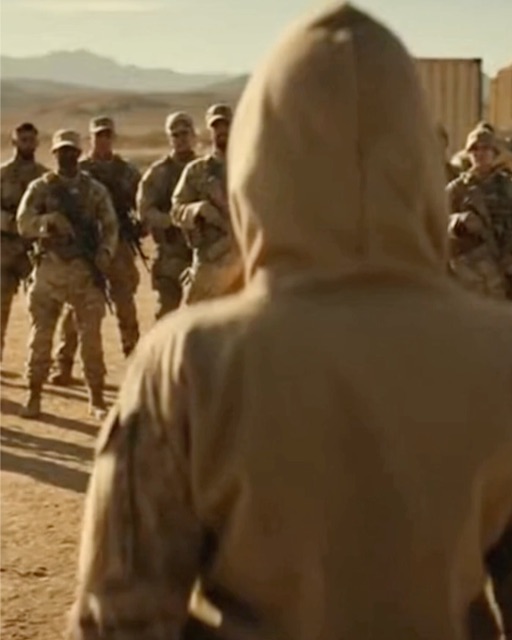
I kept my hood up and my mouth shut.
The range shimmered. Sweat stung my eyes.
I could feel all of them staring – Tier 1 candidates who thought they’d seen it all – waiting for me to flinch.
I didn’t.
I’m Lt. Rowan Hale. Fort Bragg. Joint assessment week.
I wasn’t there to compete. I was there to evaluate them.
The first laugh came when Mason Creed noticed the coordinates at the base of my neck.
He read them out loud like a game show host.
“What is this, the GPS to her favorite spa?”
More snickering. A few head shakes.
Someone muttered, “Cute ink.”
I swallowed it. Silence is a weapon. Discipline is the trigger.
We ran cold-bore drills. Wind was twitchy. Mirage bounced.
Creed peacocked his way onto the line and blew two shots high and left, then announced my wind call was wrong.
“Switch,” I said.
He scoffed. “You can’t handle my rifle.”
I took it anyway.
Settled. Heartbeat. Breath. The world narrowed to glass and steel and numbers. Squeeze.
The gong at 900 rang clean. Then 1,100. Then 1,350.
Three hits, quick, surgical.
The laughter died.
Out of the corner of my eye, the team lead—Shane Rourke—straightened.
He’d doubted me all morning. Now his jaw was tight.
He stepped forward, boots crunching, and did it without a word.
He saluted.
That’s when someone behind him barked, “You’re saluting her? Do you even know who she really is?”
A few guys snorted. A couple rolled their eyes.
My blood ran cold—not from fear, but from the same old ache that never left.
Colonel Mercer watched me. “Your call, Lieutenant,” he said quietly. “Tell them, or don’t.”
I pulled my hood back.
The sun hit the scars that spiderweb my hairline and the inked numbers running down my neck.
The range went so still I could hear the flags on the berm cracking in the wind.
“These aren’t mall coordinates,” I said, voice steady. “They’re six places I learned what strength costs. And who paid.”
Mason laughed once, thin and nervous. “Oh please. Coordinates to what, exactly?”
I unhooked the chain from under my shirt.
The metal was warm against my skin. Old. Heavy.
I placed the dog tags in Rourke’s palm, my hand shaking now for the first time all day.
“Start with the top line,” I whispered. “The reason you think you know what legacy looks like.”
He flipped the tag over, squinted, and then his face drained of color as he read the name stamped there.
His thumb shook over the letters. His lips moved. He didn’t make a sound.
A little muscle in his cheek ticked, and then his eyes lifted to mine like the earth had shifted under him.
“Patrick Rourke,” he breathed. “You were with him.”
I nodded once and then nodded again, because sometimes the simple truth needs help making it past the throat.
A couple of candidates angled in to see. Mercer lifted a hand and they froze.
Rourke looked like the guy the fight had been taken from, and for once it didn’t make him smaller.
He closed his fist around his brother’s name and backed up a step, as if the air around us had gotten thin.
Creed’s grin had gone stiff. He didn’t know where to put his eyes.
“Nine-line practice in twenty,” Mercer said, voice firm again. “This isn’t story hour. Suit up.”
The spell broke. Cloth rustled. Boots thudded away.
Rourke stood there with my chain in his hand like a man holding something alive.
“You shouldn’t have these,” he said finally. “They should be with my mother.”
“They will be,” I said. “When they’re ready. When you are.”
He looked at me like he wanted to argue, but his chest rose and fell and he swallowed it.
“Was it Kunar?” he asked, voice almost a whisper. “Everyone says he died in Kunar.”
I pointed at the first set of numbers at my neck. “That’s Mano Gai,” I said. “March twelfth. The ridgeline where we almost made it out clean.”
He closed his eyes and nodded, and then he handed the chain back like it was a fuse and I was the only one trained to handle it.
“Nine-line,” I called, louder now. “We’re done playing.”
The assessment moved like a machine when it wanted to.
We ran casualty drags and litter carries until the grass stained and hands tore.
We made radios sing in the static and flagged bad calls before they turned fatal.
Creed was quick, smart, and fast with a joke when the light hit him right, but he rushed judgment like a man who thought he could bluff physics.
Rourke was methodical and carried the room by not trying to carry it at all.
He didn’t say much. He didn’t need to.
He caught the little things and let the big things catch themselves by the time his hands were on them.
At chow I sat alone with a lukewarm cup and a view of a rusted bleacher.
Rourke slid onto the bench opposite me and set a sealed envelope between us.
“I never got to read anything,” he said. “We were not… talking at the end.”
I watched his hands instead of his face. They were steady until he noticed me noticing, and then they weren’t.
“I wrote your mother,” I said.
“I know,” he said. “She kept it in a drawer for a year. Then she read it and cried for five hours.”
Guilt moved between us and did not need words.
“I wasn’t there when they knocked,” he said. “Bad timing. Bad choices.”
He looked at the envelope, then at me.
“Did he suffer?” he asked.
I shook my head because I could give him that at least, even if it was a mercy story trimmed of edges.
I could tell him about the ridge and radios that coughed and the way dust can taste like copper.
I could tell him how his brother’s hand had been the last physical thing that tethered me to the world when the blast hit.
I could tell him that in the smoke I had pulled the tag chain and promised to carry it until I found a Rourke who chose others over himself.
But I didn’t, not like that, not then.
“He made it easy for the rest of us,” I said instead. “He made it possible for the rest of us.”
Rourke tapped the envelope once and stood up with his jaw tight again, but in a different way than before.
“Assessment resumes at 1900,” he said. “Thanks for not making a movie of it.”
At 1900 the night navigation course opened like a book someone left in the rain.
The pines went dark. The air turned sharp.
The only light came from stars, tritium, and the thin green glow of nods when they dropped their tubes.
We gave them points and a clock and no margin for guesswork.
I paced the net with Mercer, listening to calm voices try to pretend they weren’t winded.
Creed’s voice sounded clipped like he was choosing each syllable and trying to win on diction.
Rourke’s sounded like he was talking to his brother over a fence he’d climbed a thousand times.
At the creek crossing one of the smaller candidates lost his footing and went in hard.
Water under cold skies will take a body quick if you let it.
Creed swung a light in a flash and started to step off the bank when he saw the clock and spun back instead.
“Your problem,” he said to his partner. “Rotate him forward. I’ll log the point.”
He moved like a man who hears applause in his head.
Rourke’s voice came through a minute later, calm and a little annoyed.
“We’re off pace,” he said to his team, “but no one’s dying for time. Halt. Get him stripped and wrapped. Put him in the middle and move.”
His compass didn’t lie and neither did his gut.
We logged it. We didn’t say a word.
An hour later I cut across a tangle of briers and met Creed on a firebreak.
His chest was heaving. His face was cocky and red.
He flashed his punch card and his light too bright, and the point marker shone back with an X.
“Wrong flag,” I said. “That’s a land nav class marker from a different course.”
He swore under his breath and then grinned like that would make it all better.
“No big. It’s close enough,” he said.
I didn’t smile.
He dropped his gaze and tried to step around me.
“Put your card away,” I said. “And your mouth too.”
Back at the rally point just before dawn, Mercer poured dark coffee into paper cups and handed them out like penance.
A stray dog nosed at a trash bag and then decided we weren’t interesting.
Rourke’s team came in dirty and one man short on time, but not short on anything else that counted.
They all still had their humor. They all still had each other’s weight.
Creed came in fast with two points stamped wrong and a buddy who looked like he’d been dragged rather than led.
He slapped his card down and smiled at the colonel like charm was a tool issue.
Mercer looked at me and I looked at the sky.
By midmorning we were back on the flat range with a bank of pop-ups and a wind that kept changing its mind.
I set a stress shoot that wasn’t in the packet because real life doesn’t care about the packet.
Start with burpees to put your lungs in your ears.
Then shoot from awkward, from stupid, from where you find yourself and not where you would have preferred to be.
Reloads in the dirt. Malfunctions on purpose. Targets that don’t pop when you expect them.
Creed tried to out-shoot the problem and ran his bolt like it owed him money.
He took a shot before his lane was cold and put a round into a mechanism that had no business taking one.
I snapped the ceasefire call so hard it felt like it cracked the air.
The range went silent as a church and everyone heard their own heartbeat.
He stood there with his rifle hot and his eyes wide and for a second he looked like a kid with a rock and a broken window.
“You’re done for the morning,” I said. “Go find the range chief and apologize with your hands.”
He bristled like a dog. He almost said something stupid.
He didn’t.
He peeled off and stomped away, and I exhaled like maybe that wind had been inside my ribcage all day, not just out over the berm.
At lunch, Mercer flipped a page in his folder and set his thumb on a line I knew too well.
“Want to tell them about the reprimand?” he asked quietly when the candidates scattered.
I looked at the smear of mustard on the colonel’s thumb and then at the page with my name on it and the word “loss” climbing up the margin.
“You can,” I said. “It’ll save me a breath.”
He didn’t, so I did.
“Before any of you got here,” I said to the circle of men who were trying not to look like a circle, “I took a ding on my record for misplacing a radio in a country whose mountains you only know from maps.”
A couple of eyebrows went up. A couple of mouths were careful.
“I took it because the beacon on that radio would have made a phone I gave to a schoolteacher the worst gift she ever received,” I said. “We put skin in the game or we don’t play.”
Silence tucked itself into the shade with us and did not feel like an enemy.
Rourke’s eyes had gone far away and soft.
Creed sat on a cooler and watched a fly map out a ham sandwich like the whole world was down to two moving parts.
In the afternoon we ran a scenario about an HVT that had nothing to do with the reality of lunch or the nap some of them wanted.
I placed a laptop on a crate and told them its camera belonged to a child’s toy across the street from the building they were supposed to plaster with a missile when the countdown hit zero.
“PID or no shot,” I said. “You see what you need to see, you do what you need to do, and you live with it when it follows you home.”
Creed’s plan was aggressive and clean on paper the way lies often are.
He shaved seconds off calls and moved collateral calculators like they were made of rubber.
Rourke built slack into the timeline with an eye for things that would break at the worst time.
He stacked his team on the command that if one man was unsure, the shot didn’t go.
He took the hit when the clock beat him. He didn’t blame the man who doubted.
By the hour’s end it was the first time I saw two candidates smile at each other and mean it while taking two opposite roads.
“Wrap it,” Mercer said. “Storm’s coming.”
We checked our phones and watched a band of red and yellow slither toward us and shrugged like the sky hadn’t done that every summer since the base learned to say its own name.
By the time we hit the motor pool the first drops were fat and hot and loud.
Range Control crackled with a voice we didn’t recognize and urgency we did.
A brush fire had jumped a line in the far training area, eating pine straw and attitude.
They’d evacuated the civilian range but were missing a maintenance contractor named Ben who’d gone to check a drainage issue and hadn’t come back on the net.
Mercer looked at me. I looked at our men.
I didn’t ask if they were tired. It wouldn’t have mattered either way.
We grabbed line packs and water and moved like a handful of ants in a world that had gotten too big.
Heat speaks a language you can’t ignore.
It licked low at first and then clawed up.
We fanned out with radios hissing and a ground so dry it felt like tinder on a toothpick.
Creed made a play for the head of the wedge. He wore urgency like a cape.
He punched through brush fast and smart and then stepped in a dip that wasn’t there until it was, and the wind shifted and turned theatrics into bad math.
Smoke swallowed him like a hand closing.
Rourke cursed under his breath and cut sideways with two others on his hip and no one told him to do it.
I heard coughing and a voice that had a lot less pride in it and a lot more air hunger.
“Stay put,” I said into the mic. “Three beats, cough, three beats, cough. Let us chase the sound.”
Creed’s cough answered like a metronome that was losing its patience.
We hauled him out by his vest and dumped water down his shirt and across the face he’d tried to make into a mask.
He tried to say thanks like it cost him and then nodded like maybe he’d heard his own heartbeat in there and it didn’t sound like the drum he’d expected.
We didn’t stop to debrief it. We still had a man out there who hadn’t called in.
When we found Ben he was pinned under a chain-link gate that had peeled off its hinges in the heat and fell like a sheet of welding rod.
The ground under him smoked. The gate sang when the metal talked to fire.
He was sixty if he was a day, and he was calm like people who already know what matters.
“My radio’s dead,” he said when he saw us. “Figured someone would come or I’d work out how to grow younger.”
Creed looked at the gate, looked at the wind, and looked at the smoke coiling higher.
“We don’t have the tools,” he said, eyes hot. “We can mark and egress and bring trucks.”
Ben didn’t say anything because he didn’t need to. His eyes did it for him.
Rourke found a fence post and a rock and a strip of webbing like he was walking through a hypothetical.
Lever. Fulcrum. Weight. Direction.
He didn’t ask the fire to slow down. He asked the world to obey the laws it always had.
We lifted the gate just enough to slide Ben’s leg clear.
He screamed once and bit his lip hard and then started to laugh for reasons only men who thought they weren’t going to laugh again can tell you.
We half-carried him out, and the rain hit like the sky had remembered it loved us after all.
Back under a canopy that had seen worse, we let the adrenaline degrade in peace.
Mercer’s jaw unclenched. He made a note and didn’t tell us what it said.
Ben sat on a cooler with his leg wrapped and looked around like we were all his grandkids who needed to call more often.
When he saw Creed he squinted and then snapped his fingers like a magician.
“You the one with the fancy rifle who asked me how to override a lockout last week?” he said. “The one I told not to mess with it in case the range gods were listening?”
Creed’s face went all shapes and then back to the first one it had been when he showed up on day one.
“Yeah,” he said.
Ben nodded like the weather.
“Just making sure we’re all the same story,” he said. “Glad you’re breathing.”
The debrief that night was quieter than the ones before it.
People who have heard the crackle of brush fire up close don’t have a lot to add to arguments about who’s tougher.
Mercer nodded to me. I stood and felt my knees complain and told them to write their names somewhere else.
“Performance,” I said. “Not bravado. Not family name. Not rumor. Performance, and who you are when no one is pointing a camera at it.”
Creed watched his hands. Rourke watched my mouth.
I read the list and let my gut and my notes do equal work.
Some passed. Some did not. Most fell in between and would move to a different train that fit a different body.
When I said Creed’s name, the room raised its collective eyebrows an inch and waited for the fun part.
“Recycle,” I said. “You’re smart, faster than you can handle, and you think your charm is a plan. You’re going to a place where the only thing anyone will laugh at is a man who doesn’t own the mistake he just made.”
He chewed that like it had bones in it.
He nodded once. He didn’t argue.
He looked at Ben across the room and tapped the cooler twice with the side of his hand like a man making a promise to an inanimate object.
When I said Rourke’s name, he didn’t move.
I met his eyes and let them say what my mouth didn’t want to make a show of.
“Pass,” I said. “With a note. You carry two packs—yours and your brother’s. The second one isn’t real baggage unless you make it. Put it down when it keeps you from reaching for someone else’s.”
His chin lifted like he was going to nod and then didn’t.
He swallowed and then he nodded.
We broke it up like we break up everything. With a few claps. With someone making a joke that wasn’t funny but did its job.
When the room was almost empty, he came to me with the envelope again.
“I want you to have this,” he said. “I read it. He said to tell you something I don’t get to decide whether you hear.”
My hands didn’t shake, but they wanted to.
I took the letter and slipped it under my shirt like it was another kind of dog tag.
“My mom would like to meet you,” he said suddenly. “Not because of these,” he added, nodding at my chain, “but because of what you did with them.”
“Not yet,” I said. “But yes. Soon.”
He looked disappointed in a way that didn’t come with pride.
He understood timing the way a man who has stood outside a door with his hand hovering over a knock understands it.
After lights out I walked the motor pool and listened to the night talk to itself.
I pulled my hood up and then pushed it back down because I was tired of hiding my own scalp from the air.
In my pocket was another envelope I hadn’t given Creed and wasn’t sure I should.
It was printed with the name of a rehab facility in Fayetteville where I’d done volunteer hours my first year back on feet.
He had been there once after a stateside incident that scratched a man but carved a career.
He’d signed up to teach kids about safety and ended up teaching himself how to look his own mess in the mirror.
He’d done fine for a while and then drifted and it wasn’t my job to fix him then any more than it was now.
But it was my job not to confuse a man’s worst day with his only day.
In the morning, Creed came to find me before I could decide.
He stood like men do when they don’t know where to put their hands and the answer is nowhere you can see.
“I know I’m not a bad guy,” he said. “I also know I can be the guy who makes a good story bad.”
He half laughed and then didn’t.
“I keep thinking I’ll grow out of it,” he said. “Maybe I grow through it. I don’t know how to do that without somebody ripping me a new one every time.”
I handed him the envelope and said nothing.
He looked at the return address and blew out a breath like something had been squeezed.
“You knew,” he said.
“I saw you there once,” I said. “You were making a kid laugh with a magic trick that wasn’t very good. It helped.”
He barked a laugh he didn’t expect and then got sober again so fast it made him look younger.
“I’ll go back,” he said. “I don’t want to get good at apologies. I want to get good at not needing them.”
“That’s a plan,” I said. “Stick to that one.”
Out on the range, the brass glittered where the sun was doing its best.
Mercer walked up beside me with his hands in his pockets like a man trying to pretend he was on a stroll and not on duty.
“You sure about the Rourke handoff?” he asked, chin on my tags.
I touched the chain and shook my head once.
“They’re not mine to keep,” I said. “He’ll get them when he understands that ‘Rourke’ is not a standard to impress, it’s a responsibility to relieve.”
“Write that down,” Mercer said dryly. “Put it in a manual. Save me thirty years.”
He walked off without waiting for me to laugh.
That afternoon I drove off post to a cemetery that always feels like a meeting I’m late to.
Arlington is clean and quiet and loud in a way that only marble knows how to be.
I didn’t go to his stone because I don’t do that every time.
I walked to one of the names of a man no one remembers on purpose and sat with him instead.
The coordinates on my neck itched like old weather.
First one is the ridge where Pat made a joke about my shooting that was so dumb it kept me from crying.
Second one is the school where the radio I didn’t leave would have found a woman who taught kids to write their names without fear.
Third is the burn unit where I learned the smell of my own skin and stayed long enough to realize it wasn’t the worst place to be alive.
Fourth is the doorstep where his mother made me tea without asking my name because she already knew it and didn’t need to use it.
Fifth is a strip mall where a man who’d been my enemy shared a cigarette with me and we both agreed the sky didn’t care which team had it that night.
Sixth is this. The place where everything feels closer and farther at the same time, and it reminds you you’re not the only one carrying a story.
I said what needed saying and didn’t make a speech.
When I stood up, Rourke was three rows over with his mother on his arm.
He didn’t look surprised to see me.
He lifted a hand and she stared like she’d been staring at these stones so long that seeing a living person made her eyes adjust.
He led her to me like a man who asked for permission at each step with a glance.
“Ma,” he said quietly. “This is Rowan.”
She didn’t reach for my hand first. She reached for my face.
She touched the scar on my hairline with the same care she must have used brushing hair off her sons’ foreheads when they were small.
“Thank you,” she said. “For carrying him a little longer.”
I wanted to tell her I’d failed her boy on a Tuesday that still lives in my mouth like a stone.
I wanted to tell her he’d made me promise to carry the weight that was his and then share it when it started to hurt.
I wanted to tell her I was tired of being a collage of places and pain stitched together with willpower.
Instead I said, “He carried me first.”
She nodded because mothers tend to already know the ending when we’re still living the middle.
We stood there among names that meant whole worlds to people and swapped the little stories that sit in your pocket and make a day go by.
He hated raisins. He could fall asleep in five seconds and hated being woken.
He once turned a patrol into a scavenger hunt because he needed to get a young private’s head out of yesterday.
We laughed the way you do when your body knows tears won’t help.
When we left, she didn’t ask for the tags and I didn’t offer them.
On the drive back, the sky cleared in strips and the world felt arranged again.
Near base, I pulled into a gas station where the coffee burns and the cashier is always reading a paperback that has a dragon on the cover.
Creed was at pump four with his hood up and a new look on his face like a man who isn’t sure if he can learn to walk without swagger.
He raised a hand like a guy who knows the rules about not taking up space.
“See you next time,” he said.
“Earn it,” I said.
He grinned a real grin for the first time in a week and I let myself like him for a second.
Back at Bragg, Mercer signed off on packets and sent names up into the machine.
He looked across his desk at me like he wanted to ask a question and knew he shouldn’t.
“Ask,” I said anyway.
“Why do you do it?” he said. “Come back. Take the hits. Let them take swings at your ink and your face and your story.”
I thought about my six places and the noise they make when I touch them in my mind.
“Because somebody needs to put a hand on the scale when it starts to tilt the wrong way,” I said. “Because I know what it looks like when the wrong guy gets through and the right one gives up. Because paying forward is the only kind of interest that won’t bankrupt you.”
He grunted like a man who’d eaten something that didn’t go down as easy as it should.
He slid a paper across the desk.
“Commendation for the fire,” he said. “Don’t argue.”
I didn’t. It would have been stupid.
I walked out into a sun that had decided to cool it and let people breathe.
On my way to the lot, Rourke fell into step with me without making a thing of it.
He reached into his pocket and came up with my chain.
He pressed it back into my palm with a look that felt like a line catching a fish and letting it go.
“Keep carrying him,” he said. “But don’t forget to let someone carry you sometimes. He’d be mad at both of us if we forgot that part.”
I laughed and didn’t mean to.
“Deal,” I said. “And when you find the next person who needs the weight, you know what to do.”
That night I sat on my couch with my shoes off and my head against a wall that had needed repainting for a year.
I opened the letter from Pat Rourke and let my brother’s handwriting talk to me from a place we keep losing the coordinates to.
He didn’t write like a soldier. He wrote like a guy who’d sing karaoke if you dared him.
He thanked me for always carrying too much water and said he’d watched me outshoot a man in Colorado who later bought me a beer and said sorry to the target.
He said if I was reading this it meant he’d cashed a check and wanted me to know it had been worth writing.
He said to give his brother hell and then grace in equal measure and to stop using coffee as a meal.
He told me not to let anyone make my story for me and to forgive myself faster than I’d been practicing.
When I finished I didn’t cry, which is not the same as saying I didn’t want to.
I put the letter in the drawer where I keep a map of a place I never want to go again and a hotel card key that has no hotel left to open.
In the next weeks, life got back to the thing it always is, which is stubborn.
Creed sent me a text with a picture of him in a classroom with ten teenagers frozen in various states of disbelief around a CPR dummy.
He said it was easier to keep them alive than keep their attention.
He said he was trying to get good at both.
Rourke sent me a photo of his mother’s hands holding a mug with a chip in it, because some images don’t need faces to tell the truth.
He said she asked if I liked lemon cake and then baked one anyway.
He said I could say no but it wouldn’t help me.
I said yes and left early and stayed late and went home with a container wrapped in tin foil that made my car smell like a kitchen I didn’t know I’d missed.
Sometimes the twist that matters is the one where the person you thought wanted to be the hero chooses to be human first.
Sometimes the reward doesn’t feel like a medal. It feels like a slow breath where there used to be a knot.
If there’s a lesson you can carry without ink, it’s this.
Legacy isn’t a last name or a rumor or a salute on a hot day.
It isn’t a target you hit when everyone’s watching.
It’s a choice you make in the smoke when only the small voice inside you can hear it.
It’s knowing when to hold a gate and when to lift it.
It’s learning to put down the weight that was never yours and pick up the one that was, and then share it before it breaks your back.