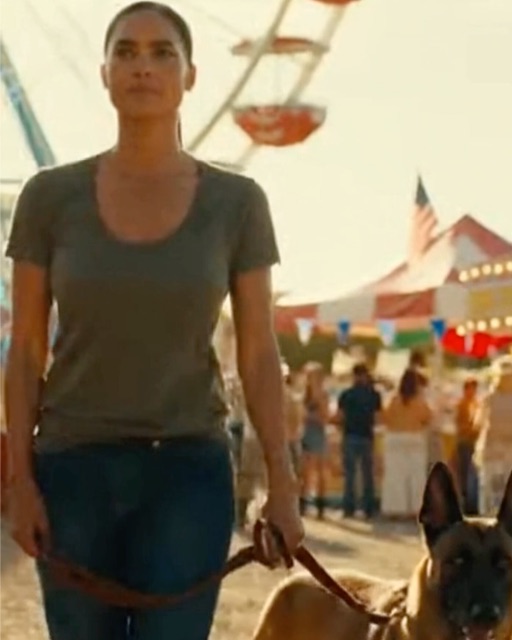
He slapped me so hard my ear rang. Beer on his breath. Metal in my mouth. Phones went up like a forest of black mirrors.
Rook didn’t bark. He didn’t lunge. He got smaller – coiled. Like a spring.
“Die now,” the tall one hissed, shoving me again. “Your dog can’t save you.”
I kept my hands low, two fingers hooked on the leash, voice barely above a whisper. “Last warning. Step back.”
He smirked. “Make me.”
From the flag line, I heard an old Marine mutter, “That’s a Malinois.” Someone else said, “Don’t – just don’t.”
He reached for Rook’s collar.
Rook’s pupils went black. Ears forward. Jaw tight. I felt the leash go tight like a live wire.
“Control your mutt,” he spat, stepping in so close I could count the stitches on his fake-looking unit patch.
My blood ran cold. Wrong patch. Wrong boots. Wrong everything.
He didn’t notice me clocking the details. He just smiled and flipped his wrist.
The blade flashed.
I leaned to Rook, breathed one word into his ear, and watched the man’s grin split into panic as every muscle in my dog locked like a loaded weapon on the softest target in reach—his wrist.
Rook’s jaws clamped where the veins ran pale under hard skin, right on the knife hand, clean and precise like he’d drawn a dot there hours ago.
The knife pinged to the asphalt and spun out, sparking once as it hit a bottle cap.
The big man screamed and twisted and tried to yank back, but Rook sank lower and pulled him off his hips, the way we’d drilled in dry fields and quiet barns and borrowed parking lots at 3 a.m.
I never raised my voice. I just said, “Hold,” and planted my heels.
People around us gasped, but no one ran in, because the old Marine raised a palm and barked, “Back up, give ‘em room,” with a tone that cut through the phones and the murmurs and the squeal of a distant bus.
Someone yelled, “He had a knife,” and another voice, higher and shaking, said, “Oh my God, I got it on video.”
The man tried to kick Rook, but his balance was gone, and it looked less like a fight and more like a puppet jerking his own strings.
I felt my heart banging, but my hands were steady on the leash, low and firm and steady like Rook’s breathing.
The tall one had that slur that sounded like swagger until your ears remembered fear, and then it just sounded like a little boy in his father’s boots.
He wriggled, eyes rolling to the flags lined up on their poles like ribs, and I could smell the old denim jacket I’d left in my truck, and the hot oil from a food truck, and the bleach from the brick restrooms down the block.
“You’re done,” I said softly to him, because it was true and because saying it did something to the buzzing in my ear.
He spat again, tried to arc the spit at my shoes, and the old Marine’s cane thumped beside us, light and ready, not threatening, just present.
I lifted my left hand high and open so the crowd could see it, like we teach in the courses, because when people see one empty hand and one hand on a leash, it reads like control.
“Call 911,” I said, but someone already had, and I could hear somewhere a dispatcher’s flat caution through a thin speaker.
A police siren grew into the scene in pieces, like you hear it in your chest before your ears, and the tall man made a last-ditch lunge to get his wrist free.
Rook just shifted, small and mean as water flowing into a crack, and bit down a little more until the man quit.
No tearing. No shaking. Just a clamp and a hold like a vise, which is what people never believe until they see it.
Two uniforms jogged in with their hands hovering near their own sights, but they didn’t draw, because the old Marine was already talking to them in that same calm parade voice.
“He had a blade,” he said, nodding at the gutter. “Kid’s dog took his wrist. She’s got it.”
The shorter cop had sweat on his lip and a sunflower tattoo peeking under his sleeve, and he nodded at me like we’d met before, and maybe we had at a county K9 event where I let kids pet Rook’s ears.
“Ma’am, that your dog?” he asked, even though it was obvious.
“Yes,” I said, and swallowed because I could taste copper, and my molar ached from the slap.
“He’s trained?” he asked, eyeing Rook’s set jaw and the slack in the leash between my fingers and the dog.
“Certified,” I said. “Not police. Private protection, therapy cert too. He’s holding on command.”
“Okay,” he said, and he looked down at the guy who was panting and whining and, now that the knife was out of the picture, looking a lot less like a bull and a lot more like a drunk in a jacket.
“Let me go,” the drunk bleated, and then he looked around at all the lenses catching him from every angle, and he sneered again because he remembered he had an audience.
“He attacked me,” he said, red spittle on his teeth. “This psycho set her dog on me for no reason.”
“Sir,” the older cop said, voice flat. “They have you on video producing a blade.”
The old Marine toed the knife with his shoe and slid it closer to the younger cop without touching it, because you could tell he understood evidence and chain of custody like he understood flag folding.
“Step off the line, folks,” the older cop called to the crowd, who shuffled like a tide, some going, some angling for a better shot.
I kept breathing and counted in my head, not for me, but for Rook, because the feedback loop between us went both ways after three years of walking and working and failing and trying together.
I said, “Out,” like I was telling a secret to someone across the pews, and Rook released at once and swiveled to sit on my boot, eyes still up and hard, but his mouth closed like the door on a bank vault.
The tall guy yanked his hand back and cradled it against his chest, moaning like the wound was worse than it was, because Rook’s bite looked like a tidy row of pink, not a massacre.
“Hands behind your back,” the older cop said, pulling cuffs from his belt with a little clatter that made the tall one flinch.
“I’m a veteran,” the tall one said, wobbling, and the false pride slid over his face like a cheap Halloween mask.
“You’re a clown,” the old Marine said, not angry, just tired in a way I had heard in ward hallways at 3 a.m., and in the way the flag line had broken today when the wind took the edge of the banner.
There was a stir from the far end of the row of pop-up tents, and a slim woman in a volunteer tee jogged over with both hands on a plastic donation jar.
“Somebody cut our lock,” she said, breathless. “He—he tried to grab the jar earlier, and I told him to get lost.”
My head snapped, and for a second the sound of my pulse drowned the rest, because the jar was for the K9 retirement fund we’d put up today so the old boys and girls could have soft beds when their hips went.
“He was pushing people at the flag line for ten minutes,” a teen in a flat-brim cap said, voice high with the thrill of finally being in a real thing. “Said he was 82nd something, but his patch was upside down.”
“It’s not upside down,” the tall man snapped, face flushing, and you could tell he didn’t even know which side was up.
The younger cop got on the radio and asked for EMS for a dog bite and for a unit to check the volunteer tent for damage, and he said it with the quiet embarrassment that comes from having to say “dog bite” about a thing that saved somebody.
Rook’s nose brushed my wrist once, asking a question he didn’t need an answer to, and I let my fingers tick his ear for half a second like a blessing.
“You okay?” the older cop asked me, and I nodded, and then I shook my head, because I wasn’t, not entirely, but I would be.
“He hit me,” I said, and I touched my lip and my ear and came away with a smear I didn’t show anybody.
“We’ll get you checked,” he said gently, and he tilted his head toward Rook like he wanted to say more about what he’d just seen.
The old Marine stepped closer and took a breath like he was getting in line to confess to something he’d carried too long.
“Name’s Henley,” he said to me. “Saw that patch from the curb and knew it was wrong from the color alone.”
“Thank you,” I said, and meant it, and he gave me a short nod like we had both done our duty for the day and could go back to our coffee.
The EMTs took their time, like they always do when the bleeding isn’t dramatic, and in that space there was a shift in the crowd, a low wave of people whispering and turning as a woman with a stroller pushed through.
She had the look of someone halfway between fight and flight, cheeks blotchy, eyes pinched, ponytail frayed at the edge.
“That’s my brother,” she said to the cops, voice tight. “He’s been clean almost six months.”
The tall man flinched at that, shame moving across his face like a cloud crossing a field, and then he rolled his eyes and laughed mean as if to throw off the feeling.
“Your brother pulled a knife,” the older cop said calmly, and the woman swallowed, lips flattening.
“Please don’t let them take my kid’s dog,” she said, and it took me a heartbeat to realize she meant Rook and not some dog of her own.
“No one’s taking the dog,” the younger cop said, and a muscle in my neck unclenched I didn’t know was tight.
The EMT with the soft voice checked the tall man’s wrist first and wrapped it, more for his ego than his flesh, and then dabbed at my lip and handed me a little cold pack I stuck under my ear.
“You’re going to have a ringing for a day,” she said quietly, and I almost laughed because I’d had ringing in different ways for years.
They took the tall man to the cruiser, and for a moment he looked back at me with eyes that were sober as a stone.
“You think you’re a hero,” he said to me, in a voice without the swagger or the poison, and it was just sad.
“I think you got lucky,” I said, because if he’d gone for someone without a dog, without training, without an old Marine’s voice slicing the air, it could have been a morgue instead of an ambulance.
He turned his head away, and they slid him in, and the door shut with the blunt thud of an ending.
The crowd thinned in the sudden heat that comes after something big, like rain on hot pavement, all sharp and then gone.
Henley tapped his cane on the sidewalk and looked down at Rook, who still had that laser gaze locked not on the cruiser but on me.
“How old is he?” Henley asked, and his voice held a softness now like an old blanket.
“Four,” I said. “Three years since I got him out of a shelter off Route 9.”
Henley’s mouth ticked up at one corner, and he scratched his eyebrow and didn’t look surprised at all.
“Always the quiet ones,” he said, and then he glanced at my lip and winced like it was his own.
By then, the woman with the volunteer tee had her jar tucked under her arm like a baby, and she walked up and held out a sticker that said K9s Retire With Love.
“Thank you,” she said to me, and I shook my head and pointed at Rook.
“Thank him,” I said, and she did, with the right tone and the right distance.
The younger cop came back with a clipboard and a form and the good pen, the kind that doesn’t scratch, and I signed where he pointed and gave my number and Rook’s certificated ID like a parent giving a birthdate.
“That video’s going to go up,” he said, not warning, just sharing a fact, and I could feel the throb of the internet like a storm sitting on the horizon.
“I know,” I said, and then I looked at Rook and back up at him. “I’ll handle it.”
The donation jars got put behind the table with the quilts and the T-shirts, and the flags fluttered and then fell still as if the air had decided to be kind for five minutes.
Rook took a long sip from his squeeze bottle and then leaned his warm weight against my shin as I sat on the curb and let the cold pack hiss against my ear.
Henley stuck around longer than he had to, and then he tipped two fingers at his brow and made for the bus stop with his cane and his folded paper and a can of something fizzy in his other hand.
I thought that would be it, a small-town blip that disappears into the next fair, the next summer storm, the next soccer tournament in the adjacent field.
But the clip hit that night, and it didn’t blip.
It burned.
By morning there were headlines and think pieces and comments from strangers who thought they knew my life from six seconds of phone wobble and a dog’s jawline.
People cheered Rook and called him a hero and called me brave, and then other people said I was a monster and that Rook was a weapon and dogs shouldn’t be in crowds and women shouldn’t carry leashes like that.
My inbox had love letters and death threats with the same emoji at the end, and my phone vibrated itself off the nightstand twice.
I turned all that noise into a little box in my head and put Rook’s head on top of it like a paperweight.
On the second day, a man I’d never met knocked on my door and said he was from a morning show and wanted to put me and Rook in a studio at dawn.
Rook looked at him like he’d look at a squirrel outside the fence, polite interest and no great desire to engage, and I said no, because bright lights weren’t what Rook or I owed anyone.
Instead, I went to the shelter where I’d found Rook three summers ago, when he was skinny and scared and already coiled, and I sat on the floor and let six pairs of curious eyes and wet noses check the bruises on my leg.
They did a little party with a banner the volunteers had painted in Sharpie and paint pens, and the old kennel manager brought out a sheet cake and a jug of lemonade.
It felt homemade and right, and Rook got a peanut butter cone and ate it so slowly you’d think it was a test.
A local paper sent a reporter with a notepad and a haircut that made him look younger than he probably was, and he asked for my name and my rank and my unit, and I said, “No rank, no unit, just a girl with a dog and a mouth that still aches.”
He laughed and then looked apologetic, and I told him it was okay to laugh, because otherwise all of this was just a coil of tension that nobody could hold forever.
A week later, a letter came certified with a crest on it that made my stomach drop and my hands go cold.
It was from the city attorney, asking me to attend a hearing about the incident in the square and to bring Rook’s certifications and my own training logs.
It wasn’t a lawsuit, not yet, but it was the whisper that becomes a storm if you don’t take it seriously.
I sat at my kitchen table and ran my hands down the training binder I kept like a bible, dog hair caught under the plastic pockets and old grass stains in the margins.
I had dates and times and videos and signed forms from trainers with names that mattered to people who mattered in court rooms.
I also had little notes to myself, like “Rook nailed the double down today” and “Remember to breathe at the line,” and an old polaroid of him sleeping belly-up with his head on my boot.
When the day came, the city attorney had kind eyes and a crisp blouse and a pin at her collar that looked like a lighthouse.
She asked polite, pointed questions about commands, about control, about what I saw and what I feared and where my body was in space when the knife flashed.
I answered with calm words and slow breaths, because that’s what Rook would want if he were sitting beside me, and at my feet he was, curled like a comma, his head on my shoe.
On the other side of the room, the tall man sat with a court-appointed lawyer who looked like he wanted to be anywhere else but in that chair.
The tall man looked different sober, smaller and younger somehow, without the beer and the bravado puffing him out like a winter coat.
He kept his eyes on the table until I said “blade” again, and then his jaw worked and he looked at me with a flash of old defiance.
The city attorney cleared her throat and spoke about community safety and public events and the laws governing use of force by ordinary citizens and trained animals, and then she slid a USB drive across the table with ten videos from that day.
In each, the same thing happened, and in each, the timing changed by a sliver, and if you watch enough times you start to understand that truth is a mosaic, not a selfie.
The panel asked me to step out while they watched, so I sat on a plastic chair with Rook’s warm shoulder leaning into my knee and counted the breaths it took to get from the humming vending machine to the cough in the hall.
When they called me back in, the verdict was short and clean.
Findings: justified defense against imminent threat of serious harm, appropriate use of a trained K9 to neutralize specific weapon hand, exemplary control before and after engagement.
They said it like a recipe, but it felt like the slam of a gate dropping off my spine.
Then something I didn’t expect happened, a twist the size of a comma but with the weight of a chapter.
The city attorney cleared her throat again and said there was a condition, not for me, but for him.
The tall man had agreed to plead to assault, attempted theft, and impersonation of a veteran at a charitable event, and in addition to probation and counseling, he had asked for and been granted permission to complete a chunk of his community service at the shelter off Route 9.
I stared at her for a second, because that was not how these stories went in my head when I lay awake at night replaying every beat.
“Shelter?” I said, slow like the word had extra syllables.
“He said he wanted to do something that mattered,” she said, and the way she said it told me she didn’t buy it yet, but she wasn’t going to shut the door on it either.
Out in the parking lot, he caught up to me and Rook at a distance that was either smart or decent, and he lifted both hands like I might sic the dog on him for breathing wrong.
“I signed up for the shelter,” he said, and his voice was hoarse, like he’d been yelling at a game or crying in a bathroom stall.
I looked at Rook and then back at him, and I could see a slash of pink on his wrist under the bandage where the bite had healed into something that would be a thin white scar by winter.
“Okay,” I said, because there was not a lot else to say without making it about my own righteousness, and I was tired of that kind of heavy.
“I’m not a soldier,” he said, quietly, almost like a confession into a late-night call to an empty voicemail.
“I know,” I said, and Rook huffed in a way that could have been agreement or just a fly bothering his eye.
“I wanted to be something,” he murmured, eyes on the blacktop. “My sister’s kid thinks heroes carry flags and wear boots and talk loud, and I just—”
I held up a hand, not to stop him, but to pause the spiral that was winding him tight.
“You could be the guy who cleans kennels at 6 a.m. without complaining,” I said. “Some mornings that’s more heroic than a uniform.”
He blinked at that and then laughed once, a bark without joy but without bitterness too, like a cough clearing something out.
“See you Tuesday,” he said, and then he walked off, hands in his pockets, shoulders less hunched than they had been in months if the weight of his jacket was any sign.
He showed up on Tuesday.
I wasn’t there that first day, because I didn’t want to be the ghost in the room, but Mari from the front desk texted me a photo of him in a blue apron, head bent over a metal bowl, rinsing kibble dust, eyes focused like a man threading a needle.
Week by week, word filtered back in a way that felt like gossip if you didn’t listen to the softness under it.
He was early more days than not.
He didn’t talk much, but when a dog cowered he folded himself small and sat on the concrete like a rock until the dog’s breath slowed.
He took the big shepherd mix with the storm fear out in a drizzle and walked him under an awning until the dog realized rain wasn’t a hand.
He fixed the handle on the leaky mop bucket.
He cried once in the office when a long-timer finally got adopted, and then he laughed at himself and said he didn’t even know the family, and Mari handed him a tissue and said that was not how love worked.
I went in on a Saturday a month after the square, because Rook needed his nails clipped and because I was ready to see if the scar on a wrist and a blue apron had made a man into something else.
He looked up when I came in, and the look was complicated like these things are, sorry and proud and a little braced.
Rook walked past him without a glance because his heel command is good and he had other ideas, like seeking out the jar of dehydrated liver treats he knows lives in the second drawer.
I waited until he finished scooping food and put the scoop back where it belonged instead of letting it clatter, and then I stepped closer.
“How’s your sister?” I asked, because that was the root of it, not the patch or the beer or the knife or me.
“Good,” he said, surprised, and then he swallowed and smiled small. “She brings the little one to read to the kittens on Thursdays.”
I nodded and watched Rook catch a reflection of himself in the glass of the adoption room and decide he was not a threat.
“You want to say hi to him?” I asked, and the man shook his head fast.
“He remembers me,” he said, and his voice shook like a plucked string.
“He remembers everything,” I said. “But he also remembers commands.”
We stood in that clean, lemon-and-bleach space with the whiff of wet fur and kibble dust and old fear, and we let it be.
By fall, the video had drifted down the list of what this country was angry or overjoyed about, and the fairgrounds had turned into a pumpkin patch with a hay maze and too much cinnamon in everything.
Henley came by the shelter on a day the rain made the sky the color of a bruise and the dogs were barking in a way that said they felt the pressure drop in their bones.
He sat in the lobby with a cup of coffee he didn’t drink and watched Rook demonstrate a “place” command on a damp towel, and then he cleared his throat like he kept finding himself in rooms he hadn’t planned on.
“My boy did three tours,” he said, not as an opening to a story, but as if he needed to say it aloud to place it somewhere that mattered.
“I’m sorry,” I said, because that is what you say, and because I meant it, though sorry and thanks sit too close in my mouth sometimes.
“He made it back,” Henley said, surprising me, and then he looked down at his hand like it had moved on its own. “But part of him didn’t, you know.”
I nodded, because I did.
Henley looked at the man in the blue apron who was scrubbing out a crate with more care than you give a bathtub at the end of a bad day.
“Lot of folks don’t come back whole,” he said softly, and I understood that the fake patch had lit something in him that day in the square that was not just anger, but grief with no chair to sit on.
“Maybe we help them come back a little,” I said, and Rook sighed, long and odd and perfect, like punctuation.
On the first snow, the shelter’s heater went out, and we all crowded in with space heaters and extra blankets, and the man in the blue apron brought in his sister’s old duvets and moved dogs into the office to keep them warm.
Rook wore a goofy sweater Mari had knit out of boredom during jury duty, and he tolerated it like a saint for an hour and then peeled it off with his teeth and laid on it like a pillow.
News of the heater mess faded under a fresh pile of online outrage about something else, and nobody offered to put us on a morning show for this quiet, ordinary saving.
The city attorney came by with two big bags of food and a smile that made the lines around her eyes look like someone had drawn the map of a coastline there.
“How’s everybody?” she asked, and I told her.
She asked about the tall man, and I said he kept coming back even after the papers said he could stop.
She nodded like she’d expected as much and then left without fanfare, just a wave at Rook and a hello to the cat asleep on the iPad that checked in volunteers.
Spring came around like a coin flipping to the other side, and the square filled with kids and chalk art and a band that did covers of songs my parents liked.
I took Rook down on a Thursday afternoon when it was quiet, and we walked past the spot where the bottle cap had pinged and the knife had spun, and we didn’t stop.
Henley waved from a bench where he was arguing kindly with a chess player about whether a knight is better than a bishop, and Rook nosed my calf, and I said, “Later, we’ll say hi.”
The tall man was there too with his sister and her little one, buying a lemonade and not wearing a patch and not trying to be anything other than a guy with a plastic cup and a paper straw.
He saw me and nodded once, and I nodded back, and then we both looked away, not out of coldness, but because sometimes you don’t need to stare straight at a wound to know that it healed.
That night, I lay on my couch with Rook’s weight heavy across my shins and thought about all the twists a simple day can take and how a dog can keep something straight when humans bend it all out of shape.
People think the snap and the bite is the miracle, the teeth on the right spot, the knife falling to the sidewalk.
It is not.
The miracle is the “Out” and the “Sit” and the way a dog puts his head on your boot at the end of a day when you did not feel like a person worthy of that kind of faith.
The miracle is restraint dressed like strength instead of fear.
The miracle is an old Marine with a cane and a soft voice stepping into a mess and not making it bigger, but clearing a line so the next good thing can get through.
And the twist that felt the most like grace was seeing a man who tried to be loud and hard learn to be useful and quiet.
Rook is still a coil when he needs to be, and he still flattens like a piece of shadow under the table when little hands come around him fast with jam on their fingers.
He still looks like a predator and moves like a ghost and smiles with the side of his mouth when I drop a tennis ball on purpose and pretend I don’t know where it went.
He saved me that day, yes, but not in the way the comments or the headlines said.
He saved me by reminding me that you can choose control over chaos, that you can be a hinge instead of a hammer.
He saved me by giving me something to hold onto when my own mind wanted to go bright and loud and useless.
If you ever find yourself in a place where the world asks you to pick violence or mercy, remember that there’s a thin third line you can walk with your jaw locked on the real danger and your ears open for the word that means let go.
It isn’t always neat.
It isn’t always pretty.
It isn’t always fair.
But it is always better to be the person who listened first and struck only as far as it took to stop the harm, and then stepped back when the work was done.
Because in the end, the most heroic thing sometimes is not what you do in the snap-second when the blade flashes.
It’s what you teach yourself and those around you to do in the long, slower hours when nobody is filming and the world has moved on.
Heroes can be found in uniforms, yes, but sometimes they’re in blue aprons in a shelter at dawn.
Sometimes they’re a man with a cane telling the truth to the air.
And sometimes they’re a dog with a head on your boot, waiting, always, for the next right word.