
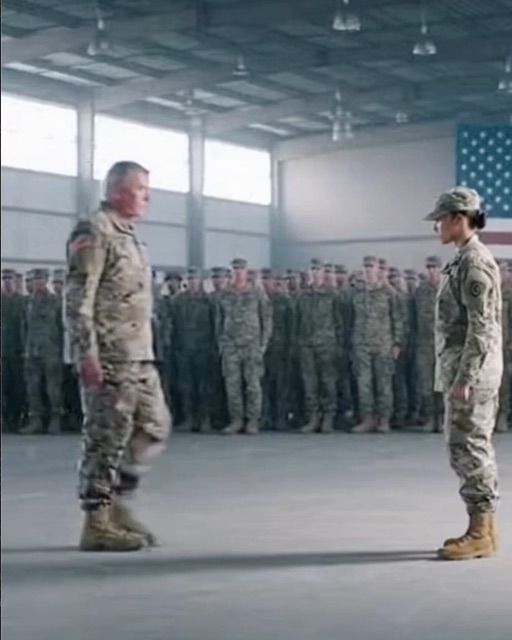
“GENERAL GRABS “WEAK” PRIVATE – THEN HER SLEEVE SLIDES BACK
His fingers lock around my wrist in front of three hundred soldiers. The room is dead quiet. Boots planted. Eyes forward. Just like he likes it.
I don’t fight him.
I don’t flinch.
I breathe.
For weeks, I’ve been the example. The slow one on runs. The one who “needs correcting.” He picks me every time because I don’t talk back. Because I keep my head down. Because he thinks silence means scared.
He leans in close, voice low. “You don’t belong in my unit.”
My pulse doesn’t move. I count in my head. Five. Four. Three.
His grip tightens. My sleeve slips just enough to show the thin band on my wrist he never knew I wore here. The one that doesn’t beep until contact is made.
Two.
He smiles for the crowd, like this is another lesson. “Look at me when I’m speaking to – ”
One.
The back doors swing open. The sound bounces off concrete. Footsteps. Not marching. Purposeful. Every head turns except mine.
I don’t look up. I don’t have to. The air changes before the words do.
“General Halverson,” a woman’s voice calls, steady as steel. “Hands off the private.”
He freezes. The hand on my skin goes cold. He knows that voice.
I finally lift my eyes.
She’s holding a black case and a folder with his name on the tab. The badge inside catches the light as she opens it, and the color drains from his face when she says, “As of this moment…”
“…you are relieved of command pending investigation under orders from the Department of the Army Inspector General,” she finishes. “Step away from the private and present your hands.”
No one breathes again until he lets go. The warmth leaves my skin like a secret.
Two MPs move in from either side like they had been waiting behind the door for an hour. Their boots don’t hurry, but they don’t stroll either.
He squares his shoulders like cameras are watching, which they are. He stares her down with the same eyes that cut me open on the track.
“When did we start letting lawyers run training?” he sneers. “This is a show.”
“It’s a lawful order,” she says, calm like gravity. “Comply or add obstruction.”
He looks at the case again and sees the blue seal. He blinks once and breathes like he’s swallowing something he doesn’t like.
He lifts his hands.
The MPs don’t cuff him yet. They don’t have to. The room itself is a lock.
“Troops,” the woman says, louder now but still controlled. “You will remain at attention until dismissed by your company commanders. Training resumes on schedule.”
Her eyes meet mine for a second, and then they move on like nothing special passed between us. It feels like a match blown out by a careful breath.
Across the formation, I see a few mouths barely open. One kid on the end shifts like he’s going to faint.
General Halverson tries for the last word because that always worked for him. “Don’t let them make you soft,” he says, pitching his voice to the rafters. “They’ll break this place if you let them.”
She doesn’t answer him. She nods at the MPs instead, and they guide him toward the back.
The room stays large and silent as he leaves. The echo of the door is louder on the way out than it was when it opened.
As soon as he’s gone, a captain clears his throat like he’s returning to a script he didn’t practice. He makes a few calls and tells first platoon to break to PT.
I’m still standing in front, hands loose at my sides, the thin band on my wrist cooling in the AC. A flicker of green that only I can see.
She walks toward me through the rows like she never worries about tripping. Her pace is steady and unhurried.
“Private,” she says when she gets close enough that her voice won’t carry. “You okay.”
It takes me a second to make my mouth choose words. “Yes, ma’am,” I say. “Good timing.”
“That band worked like a charm,” she says, glancing at my sleeve so quick no one would notice. “We got a clean read.”
I nod once, because my stomach has been clenched for so many weeks I forgot how to uncurl it. I flex my fingers and they feel like they’re really mine.
“Report to Classroom C after PT,” she says. “We’ll debrief.”
“Yes, ma’am,” I say again. “Thank you.”
She gives the kind of smile that doesn’t break her face. It’s more like a switch flicking inside her eyes.
She turns and walks to the officers waiting at the far wall. They fall in around her with clipboards and uncertainty.
My squad leader, Specialist Barnes, drifts by as if he’s not drifting at all. He doesn’t look at me, but his voice brushes my ear.
“You’re either the luckiest private on Earth,” he murmurs. “Or the bravest.”
“Neither,” I whisper. “Just tired.”
He huffs something that might be a laugh. “Fall in after PT.”
When the first formation breaks, sneakers smack the track and the heavy doors swallow us. The air outside is humid and honest.
I run like my life isn’t under a microscope anymore. I run like my legs are mine and nothing else is required.
I’m still the slow one on paper. I’m still the one they point to when a lesson needs a body. But it feels different without his eyes in my back.
Sergeant Vargas jogs alongside me at one point, and he doesn’t call out my time. He just runs there, like a shadow that doesn’t make you colder.
“You’re steady, Private,” he says between breaths. “I like steady.”
“Working on fast too,” I say, breath scraping a little.
“Fast gets you headlines,” he says, easing ahead. “Steady gets you home.”
By the time PT ends, my shirt is soaked and my hands shake in a way that has nothing to do with the run. It’s like my body just found out it can stand down.
I shower quick and change into a fresh uniform. The mirror throws back a face that looks both older and lighter.
Classroom C is small with too many chairs. The blinds are half-open like the room is trying to act casual.
She’s already there with the black case on the table. A recorder sits next to it with a little red eye.
“Have a seat, Private Ivers,” she says, looking up as I enter. “Water?”
“Yes, ma’am,” I say, sinking into a chair that creaks in protest. “I’m good.”
She slides a bottle to me anyway, because she knows better than to trust a soldier’s first answer about water. Her hands are careful with the lid of the case.
“I’m Special Agent Kincaid,” she says. “Department of the Army, Office of the Inspector General.”
The title sounds heavy but her voice doesn’t wear it heavy. It wear it like a tool she knows how to use.
“Thank you for what you did today,” she adds, and there’s no script in those words. “It matters.”
I look down at the bottle and take a sip that tastes like chlorine and dignity. I set it down and nod.
“What happens now,” I ask, because I need steps I can walk on. “For him.”
She opens the folder with his name on it like it might break. Inside there are tabs and highlights and too many pages.
“He’s relieved of command,” she says. “He’ll be escorted to quarters under supervision and ordered not to contact anyone in the unit.”
“What are the charges,” I ask, the word feeling big in my mouth. “If you can say.”
She taps the top of a list with the metal point of a pen. “Allegations,” she corrects, gentle but precise. “Unlawful assault, abuse of authority, falsification of training records, and interfering with safety protocols.”
The words don’t fix anything yet, but they stick to the air like glue.
“Today gives us the on-the-record contact we needed,” she adds, glancing at my sleeve again. “The band activated a set of cameras and time stamps.”
“I held still,” I say, like a child showing her coloring book. “Like you said.”
“You did perfect,” she says, and the word perfect doesn’t feel like a trap in her mouth. “We also have sworn statements and a whistleblower from contracting.”
My heart skips once like a bad step on stairs. “Contracting.”
She nods and flips a tab to a section that’s mostly emails. “He directed a vendor to cut corners on safety gear to meet a deadline,” she says. “Nothing flashy, but it adds up.”
“What about the heat,” I ask, before the thought can run past my teeth. “The water.”
Her eyes sharpen like she’s aligning a lens. She sees I’m not asking by accident.
“We’re looking at that,” she says. “If you have something more, now is a good time.”
I take a deep breath that smells like dust and government paper. I press my palms flat on my thighs.
“My brother died during a field exercise three summers ago,” I say, voice steady in a way I don’t expect. “Heat casualty on the report.”
Kincaid doesn’t move much, but the air around her gets more still. She doesn’t fill the space with sorry.
“He was in a battalion under Halverson’s command back then,” I say. “It was a hot day, but the reports from his friends said they were water-hazed.”
“Water-hazed,” she repeats softly, like trying on a term. “Explain.”
“Officers were pushing them to go without until they hit a time,” I say. “Saying it would make it sweeter.”
Her jaw ticks once, and I notice then that she keeps her own wrists covered. Maybe to remind herself of something.
“I joined after,” I add, because this is the part that doesn’t feel like a choice, even though on paper it was. “I thought service would make his name mean something real.”
Kincaid slides a fresh form toward me and a pen that writes smooth. “Write down everything you heard and who said it,” she says. “Take your time.”
I write names that my family never heard out loud. I write the way the stories didn’t line up, how the letters sounded like they were copied and pasted.
I write about the day the recruiter shook my hand and didn’t know I was there for more than a career. I write about the day Halverson noticed me.
Kincaid doesn’t interrupt. She drinks her own water like an example, and the recorder ticks softly.
When I finish, my hand aches and the room looks a touch different. Like the light shifted even though the blinds didn’t move.
“Thank you,” she says, taking the pages with a care that makes the paper heavier. “This will go to the case file.”
“Will any of it change,” I ask. “What happened to him.”
“It can change how we tell the truth about it,” she says. “And sometimes that changes everything else.”
After the debrief, I walk past the drill field and the motor pool smells like grease and sun. The day looks like any other, which makes it strange.
At chow, conversations find their own levels. Some people talk too loud about football, and some don’t talk at all.
I sit with McCord and Haines because I always do. They don’t ask anything, and I don’t tell.
Halfway through my eggs, Haines nudges my elbow very gently. “You did good,” he says, eyes on his plate. “Just wanted to say.”
“Thanks,” I say, because that’s all the words I need for that.
McCord shoves his tray like it offended him. “He grabbed you like we weren’t there,” he says. “Like we’re furniture.”
“He thought we were,” I say. “Until he wasn’t in the room anymore.”
Word travels fast here, even when people swear it doesn’t. By evening, the rumor has names and dates and courtrooms.
The next morning, a different general briefed us. She was smaller than Halverson but the room made more space around her.
“I’m acting in place until a permanent appointment is made,” she said. “We will train hard and we will train right.”
She said the word right like it could hold you up.
We ran again and did combatives on the mats that still smelled like last year. No one put hands where they didn’t belong.
When the sun went down, I lay in the barracks with my damp towel over my eyes and let quiet be loud. I hadn’t heard quiet in weeks.
Three days later, I was called to a building with a seal on the door and no windows you could open. This time it wasn’t Kincaid waiting inside.
A man in a suit with no rank on his chest nodded at me. His hair was trying not to gray and losing.
“Ms. Ivers,” he said, like the uniform didn’t matter in this room. “I’m Counsel Hendry. I’ll be asking you some questions on the record.”
Kincaid sat at the end of the table with a notebook closed. She didn’t smile, but she didn’t frown either.
Hendry asked me to tell the story with times and no adjectives. I did my best to give him clocks and nouns.
He asked me about the band on my wrist, which looked like a fitness tracker. I told him Kincaid’s team had issued it and briefed me on it at a coffee shop off-post so no one would see us in an office.
He asked how many times Halverson had put hands on me in formation. I said three in two weeks, and his pen slowed only once.
He leaned back at the end and looked tired in a way I trusted. He thanked me and told me not to talk about this with anyone else.
It became a rhythm after that. Train, eat, sleep, remember.
Sometimes I wondered if the room would turn on me. Not with fists, but with distance.
But most people did something else instead. They stood a little closer at chow, and they kept their voices level when they corrected each other.
Sergeant Vargas pulled me aside after land nav and said something I didn’t know I needed. He said he believed me before anyone in a suit did.
“How,” I asked, because I had to ask. “Why.”
“I’ve seen eyes like his,” he said, not looking at me because looking at me would make it heavy. “And I’ve seen people like you.”
“What am I like,” I asked, a small smile trying to find a place.
“You’re the kind who knows the difference between pain and harm,” he said. “And you don’t confuse the two.”
He clapped my shoulder like he meant it, and then he told me to hydrate like any other day. It felt like grace.
Weeks rolled the way they do in the Army, both slow and fast, and then there was a notice on the board. Article 32 hearing open to limited attendance.
My name was on a list for potential witness testimony. My stomach did the funny slow roll it did on the obstacle course.
Kincaid met me in a small room with bad coffee and told me everything that would happen. Where I would sit, where he would sit, where the judge would stand.
“Do I have to look at him,” I asked, because I wanted to know if my eyes could choose.
“No,” she said. “You can talk to the person asking you questions and the judge.”
“What if I freeze,” I asked, and that felt like the softest thing I had admitted so far. “What if the words hide.”
“You can pause,” she said. “You can drink water. You can ask them to repeat the question.”
She leaned in a little then, elbows on the table like a friend in a kitchen. “You don’t have to be a hero on the stand,” she said. “You just have to be honest.”
That was the first time I realized that those could be different.
The hearing day smelled like dust and air-conditioning and the kind of nerves that don’t go away with push-ups. I sat on a bench outside and counted my breaths again for the first time in a while.
When they called me in, Halverson was already seated with a civilian attorney in a suit so sharp it looked like it might cut its owner. He didn’t look at me.
I kept my eyes on the judge and the counsel. I said my name and my rank and answered the questions with clocks and nouns.
When I said he grabbed my wrist and squeezed, I felt it for a blip and then I didn’t. When I said I wore a tracker, I lifted my sleeve like I had in the gym.
His attorney asked me if I had a grudge. He asked if I had been coached to antagonize the general.
I said no to both, because the truth fit into two letters that day.
He asked about my brother, because he had read the file. He said maybe I came in here already looking for a villain.
Kincaid’s jaw flexed and let go.
“I came here looking for the truth,” I said, my voice not angry but not shaking. “Sometimes truth isn’t pretty.”
That wasn’t a clock or a noun, but the judge didn’t ask me to take it back.
They released me after twenty minutes that felt like an hour and a half. I stepped into the hall and Kincaid handed me a bottle of water with the cap already off.
“You did fine,” she said. “Go eat.”
I went to the snack bar and ate the worst turkey sandwich I’ve ever had. It tasted like victory anyway.
The next day, something I didn’t expect happened. A contractor named Brock Leland walked into the hearing and asked to speak.
He had a belly like a proud dad and hands with ground-in grease. He looked like the kind of man who never liked suits.
He swore in and his voice shake only once, right at the top. He said he had worked with Halverson’s staff on training equipment.
He said he had been asked to delay delivery of replacement canteens to make it look like the unit was using old gear because “real soldiers improvise.” He said he had been told to put that in writing so it would look like a joke later.
He said he had a daughter who just enlisted. He said he couldn’t keep his mouth shut when she might end up under a man like that.
Then he took out his phone and played a clipped call. On it, a voice that sounded like Halverson’s said, “If they’re thirsty, they’ll run faster to the coolers at the finish.”
The room didn’t gasp, not really. But something shifted that hadn’t before.
The defense counsel objected and argued about chain of custody and edits and context. The judge allowed it as part of the investigative record.
Kincaid didn’t smile, not even then, but the notebook in front of her had so many tabs now it looked like a fan.
When the hearing closed for the day, she caught me in the hall again. “This helps,” she said. “Maybe more than you think.”
“What about the old cases,” I asked, because the present wasn’t enough. “The ones that already ended.”
“We can’t redo everything,” she said, and the honesty didn’t feel like a door closing. “But we can tell the truth about them, and we can change policies.”
It turned out she wasn’t just saying that to make me sleep better. In two weeks, the acting general issued updated heat protocols with more checks and no room for chest-thumping.
I saw them posted on the board like a promise. Water break frequency increased. Squad leaders authorized to call them without asking up the chain.
It felt like a small thing and a big one at the same time.
The weeks to follow were a slow slide back into what the Army is supposed to be. Hard, fair, demanding without being cruel.
My run time shaved down by a minute and a half, which felt like someone giving me a new pair of legs. My rifle grouping tightened because my hands stopped shaking.
I didn’t stop being quiet. I just stopped mistaking quiet for small.
One morning after we finished an obstacle course that had eaten my lunch the first week, Sergeant Vargas tossed me a canteen with a grin. “Look at you, Private,” he said. “Walls don’t scare you anymore.”
“I realized they’re just taller steps,” I said. “And I brought water.”
Graduation day caught me the way storms catch you when you’re busy bragging about sunshine. It was early and crisp and smelled like cut grass and starch.
My mother stood in the crowd with a red scarf he bought her once, and I felt my heart pull in a way that wasn’t pain. She kept rubbing the edge of it like a rosary.
After we tossed our caps in a way that wasn’t nearly as graceful as movies make it, I walked over and hugged her so tight she squeaked. She didn’t tell me I was too strong.
“You look like you,” she said, pressing her cheek to my chest where the name tape sits. “And also like him.”
“We both made it here,” I said. “Just different.”
We took a photo under the flag because that’s what you do, and because I wanted a picture that didn’t hurt when you looked at it.
Across the field, Kincaid stood with a coffee like it might be the first one she’d had in weeks. She had her sleeves rolled down even though it was not cold.
I walked over and she didn’t make me salute. She just nodded like we were at a bus stop.
“Heard from the board,” she said, like we were talking about weather. “Referral to court-martial recommended.”
My throat felt tight in the way that means it wants to laugh or cry and can’t decide. “For what,” I asked, not trusting dreams yet.
“Assault, falsifying records, dereliction of duty,” she said. “The contracting stuff will be handled by another office.”
“And the heat,” I asked, because it was the ghost at every party.
“We recommended a formal inquiry,” she said. “The Leland testimony forced that door open.”
We stood there for a second with the noise of families and soldiers and a brass band that had decided it was still 1944. It was loud and peaceful.
“I’m being reassigned in a month,” she said after a while. “New base, same job.”
“You ever get tired,” I asked. “Carrying all this.”
“Every day,” she said, and the answer didn’t make me sad. “But it’s lighter when you don’t carry it alone.”
She pulled a small envelope from her pocket and handed it to me. My name was written on it in her careful hand.
Inside was a letter on official paper with an apology that sounded like it had been written by a human and not a template. It had Halverson’s name in it and my brother’s.
It said the Army would review the circumstances and notify our family of any updates. It said his service mattered.
I held the letter and realized I had been waiting not just for justice, but for someone to say his name out loud without flinching.
“Thank you,” I said, because sometimes the oldest words are the truest. “For coming through that door.”
“You opened it,” she said. “I just walked in.”
When she left, the spot she had been standing in didn’t feel empty. It felt like a marker I could always see.
I took my mother to the small memorial by the chapel before we left post. It was quiet there in the way that makes you breathe softer.
I touched a name that wasn’t his because his wasn’t carved in this place. But the metal was cool and honest and for a second it felt like all the names were one.
My mother held my hand and I felt her squeeze on the third beat like she used to when I was little and scared of thunder. It said I’m here.
We drove home with the smell of my uniform filling the car. We didn’t talk as much as we used to, and that felt okay.
At a stoplight, my phone buzzed with a message from Barnes. He said the platoon had a slot for a team leader and my name was on a short list.
I stared at the words and felt my stomach flip like a new recruit. Leadership sounded like a weight and a gift.
“Do it if you want,” my mother said, not looking away from the road. “You like to build things.”
I thought about walls and steps and water breaks. I thought about quiet and how it holds a room together without anyone noticing.
“I think I will,” I said, and it felt like stepping onto a moving sidewalk that you chose.
The court-martial didn’t happen for months because the Army runs on clocks that don’t care about feelings. But the news came like rain in August.
He had taken a deal that stripped him of his command and rank. He lost part of his retirement and all of his quiet swagger.
Some people said it was too light. Some said it was too heavy. None of those voices were mine.
Because he faced something he thought he never would. He had to sit in a chair and listen while people told the truth about him and it stuck.
The inquiry into the heat protocols did more than anyone thought it would. They tied training timelines to real weather data and gave more power to the lowest rank to stop an event.
For the first time, it felt like the Army believed that speed isn’t the only way to count.
I pinned on team leader orders two weeks after the hearing. The paper was crisp and the ink brand new.
My first day in the role, I handed out water before I handed out ammo. I told my team their bodies weren’t spare parts.
We ran hard anyway. We ran like people who liked each other.
At the end of that month, I went to my brother’s grave with the letter Kincaid had given me. I read it out loud even though no one except me could hear it.
When I finished, the trees didn’t clap or anything dramatic. But a breeze moved through and felt like approval.
I placed a small stone on top of the headstone because I read somewhere that it means you visited and planned to come back. It felt like a promise I could keep.
On the way back to the car, my mom asked me what my favorite day had been so far. Not the biggest, just the favorite.
I told her it was a Tuesday when we ran in the rain and no one pretended it wasn’t hard. We just smiled with water in our eyes and mud on our knees.
I realized then that this is what service looks like most of the time. It’s not about salutes and speeches.
It’s about showing up when no one is looking and doing it the right way. It’s about quiet people holding the line.
That night, I put the tracker band in a small box with my brother’s old field knife. I wrapped it in a piece of my first unit T-shirt.
I kept it not because I wanted to remember the pain. I kept it because it reminded me that silence can be a tool, not a surrender.
Sometimes the bravest thing is to keep your head when everyone wants the show. Sometimes the loudest thing you can say is nothing until the right moment.
I’m not the fastest in my unit even now, and I don’t need to be. I’m the one they send to talk to the kid in the corner.
I’m the one who knows when to keep a secret and when to open a door. I’m the one who counts down when my hands shake and goes anyway.
The twist they didn’t see was that the “weak” private was never weak. She was a dam holding back a flood until it could be aimed where it needed to go.
And the twist I didn’t see was that justice doesn’t always look like a headline. Sometimes it looks like a policy changing on a bulletin board and a cup of water you didn’t have to ask for.
I think about Kincaid sometimes when I roll my sleeves down. I think about how some people are built like anchors and some like sails.
I think about how both are needed to make a ship go anywhere at all.
If you’ve ever been quiet in a loud room, I hope you know this. Quiet is not the same thing as scared.
Silence isn’t always surrender. Sometimes it’s strategy that waits for the right knock on the right door.
And when that knock comes, you get to speak once and be heard all the way to the back row. You get to change the temperature in the room.
Don’t mistake noise for strength and don’t mistake calm for carelessness. The ones who breathe, stand, and count are often the ones who move mountains one inch at a time.
We didn’t topple a giant that day. We made him sit down and face what he’d built.
And we kept building something better with our hands and our names and our water breaks, one steady day after another.



