
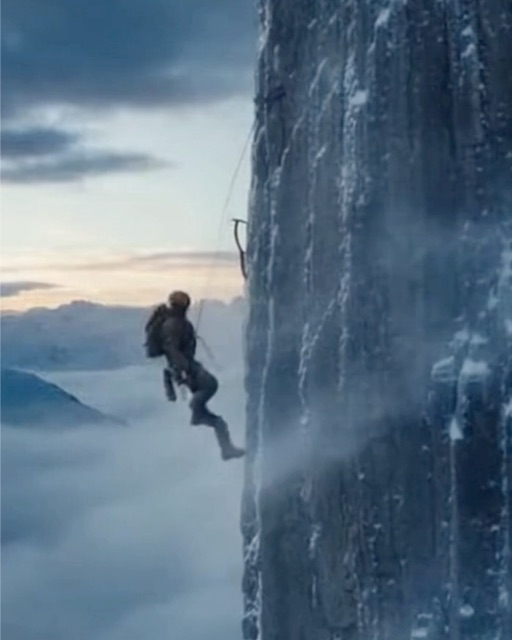
“LEFT TO FREEZE ON A CLIFF – AND THEN I HEARD MY NAME FROM ABOVE
“Viper 3 is down… you’re on your own.”
The radio died in my ear the second the rotor burst. Fire rained. Metal screamed. I slammed into ice so hard my teeth rattled.
No gear. No team. Twelve hours till anyone could even think about getting to me.
I didn’t go downhill.
Three klicks away was the objective. If I turned back, my friends died for nothing.
So I climbed.
Hands numb. Boots slipping. Breath burning my throat. I kept my chest to the rock and moved like a machine.
Halfway up, shots cracked from below. Chips of stone slapped my face. I tasted grit and copper. I didn’t look down.
Then I heard them above me – boots scuffing the lip. Voices. Different language, but close. Too close.
Trapped. Rifles beneath, rifles above. A sheer face. No rope. No second chance.
I pressed flat, fingers in a seam no wider than a coin. The wind tried to pry me loose. Someone up top stepped closer. Shadow fell over me. A barrel nosed into view.
I had one hand free, one second tops. If I moved wrong, I’d cartwheel into the dark.
I went anyway.
I lunged, slapped the muzzle, shoved off the wall, and hooked my forearm over the edge. My ribs lit up. A hand grabbed my wrist – strong, calloused.
And then, over the roar in my ears, I heard it.
My nickname. The one only one person on earth still uses.
I looked up, ready to fight—and froze when I saw what was stitched on his sleeve.”
It was the rook we used to wear on our sleeves overseas, black thread on dark gray.
The face above it had more lines and a beard, but the eyes were the same.
“Rook,” he said again, voice low, like he didn’t trust sound anymore.
“Mason,” I said, though my mouth barely worked and the name felt like it belonged to a ghost.
He yanked me up and shoved me down on the snow so hard it knocked the air out of me.
Then he swung the barrel past me and barked something in Russian at the men gathering to his left.
I recognized pieces of the language from briefings and a few bad nights in far places.
The tone was clear enough—stand down, I’ve got him.
He turned just enough for me to see him without the others reading his lips.
“Play prisoner,” he muttered, and the old edge in him cut straight through the wind.
My hands went behind my back on instinct, even if there was nothing to tie them with.
He jammed a zip-tie around my wrists anyway, loose enough I could slip it if I had to.
Then he dragged me to my feet and walked me toward a line of bundled figures with rifles and plastic goggles crusted with ice.
“Where did you go?” I said, breath hidden in a cough, because my brain hadn’t caught up with my feet yet.
“Not now,” he said, and I could feel the heat of his hand through the glove on my arm.
We were high in the Kenai range, nothing but rock and frost in every direction.
The crash site was a smear of black smoke below, licking sideways in the wind.
Above us, the ridge flattened into a saddle dotted with cases and crates half buried in drift.
A prefab hut hunched against the gale, and behind it rose the thing we’d come for.
It wasn’t a bunker or a cache of guns like the rumor mills had loved.
It was a weather mast, tall as a church steeple, with a microwave dish shining dull in the gray.
The dish wasn’t for weather today.
It was the backdoor someone had cut into a string of state telemetry stations, and it was how stolen numbers and names were slipping out of Alaska on a beam nobody looked for.
We had been sent to pull the plug, and then pull the proof.
At least, that’s what Command had said, in the last sane minutes before the rotor shook apart.
Mason shoved me down by a crate, then stood with his rifle slung on his chest and scanned like a bored guard.
One of the men walked up, big shoulders, a red scarf wrapped where a neck should be.
He spoke fast at Mason and pointed his chin at me, and I caught “who” and “how” and “alone.”
Mason shrugged with a little laugh and tapped the rook on his arm like a joke.
The man grunted and moved off, and for a second it was just me and the wind again.
My ribs hurt like they were made of broken keys.
“Listen,” Mason whispered, never looking at me, eyes on the sky like he was counting birds.
“You’re not crazy, the helo didn’t just quit.”
“What?” I said, and the word was flat from the cold.
“They cut you loose,” he said, and I wanted to stand up and break the air, but he shook his head.
“Later,” he said. “Right now we get you to that mast.”
“What about the others?” I said, seeing Tommy’s grin for half a second before the smoke ate it.
Mason didn’t answer, which said everything.
He pulled me up and walked me like a dog along the drift ridge, our boots squeaking in the dry cold.
We passed a snowcat half covered, its windshield webbed with frost and a stack of fuel cans strapped to its bed.
“Who are they?” I murmured, because the accents were thicker than simple imports.
“Freelancers,” he said. “Some of them think they’re here for a survey job.”
“And you?” I said, looking at that rook like it was a lie.
“Undercover,” he said, and the word looked like it hurt him.
Three winters back, he had bled out on a road in Helmand if you believed the email.
I had worn the black band and sent the flowers and watched a flag fold like it was folding time.
Now he was here on an Alaska ridge wearing our old sign and my nickname on his tongue.
Whatever had happened between those two points, it wasn’t small.
He steered me toward the hut with the dish shadow hanging over it.
My heart rode my ribs as we passed two more men smoking through their balaclavas.
Inside the hut was warmer by a boiled degree.
The air smelled like wet wool and old wires, and there was a humming under my boots that felt like the belly of a ferry boat.
A woman sat on a crate in the corner, hands wrapped in a scarf, cheek split and taped like she’d hurt herself and nobody had asked how.
She wore a NOAA parka with the patch half ripped, and she looked at me like she was trying to see through frost.
“This him?” said the red-scarf man behind us, shouldering in and fogging the whole room with his breath.
Mason nodded and kicked the door shut with his heel.
“Make your call,” the man said in English, like he was tired of pretending.
“Tell your people we’ve got one, they can come pick up the pieces.”
“I don’t have people,” I said, and my mouth made a smile it didn’t believe.
The man snorted and leaned on the rack that held the comm gear, old army green boxes dressed up like civilian dirt.
He pointed at a handset and tossed a set of keys on the floor where they hit with the sound of metal on cheap plywood.
Mason watched with a calm that used to belong to someone I trusted when rounds started to walk toward us and we had to go right not left.
I picked up the keys without the wrists, which is a trick they beat into you for reasons like this.
“Line’s dirty,” I said, buying a second, my eyes skimming the panel labels and the small things no one who hadn’t been here would notice.
The microwave transmitter was humming, just like I’d felt, and there was a bypass light blinking that meant they’d made their own lane through the dish.
The woman on the crate had a name stitched on her chest that the tape hadn’t ripped through yet.
WARD, it said, and she watched me like she was memorizing the way my hands moved.
“You’re the one,” she said, her voice small under the red-scarf man’s breath.
Mason didn’t look at her, which told me he didn’t want them to look at her either.
“The burst is set for zero seven-hundred,” Ward said, and I saw the red-scarf man’s eyes flick to her like a dog checking a rabbit.
“Don’t,” Mason said, and there was something in his voice that made everyone hold still for half a beat.
I worked the keys with my fingers behind my back and felt the plastic give.
The zip-tie slid and I coughed to cover it, and the red-scarf man looked at me and then at Mason like he was trying to do math with a glove on.
Outside, the wind shoved the wall and the dish creaked like a giant shrugging.
I had one more thing to do and a dozen different ways it could turn bad.
We had come for proof more than we had come for a machine.
Numbers, names, shipments, times—things too neat to live just in someone’s head.
They were supposed to be on the local buffer in this gray box with its happy blinking light.
We were supposed to pull them down, stuff them in the pocket of a man who wasn’t dead, and walk out.
I popped the face of the panel with the keys and reached with both hands, nice and slow, like someone changing a bulb.
The red-scarf man shifted his weight and Mason said something in Russian that sounded like a joke about frozen coffee.
Inside the panel was a card the size of two of my fingers stuck together, with a fuzzy felt edge from someone jamming it in too fast.
I had been told it would be there, and someone who liked me had made a map with words a child could follow.
I slid the card out and turned it like I was checking for dust.
Then I curled my hand and palmed it into my sleeve, and pulled a dead one from the rack above that looked like its twin.
“Buffer’s fried,” I said, which was true enough if you believed in miracles and rotten luck and people who didn’t know how to use grounding straps.
The red-scarf man cursed and kicked the rack, which made everything rattle like a box of forks.
Mason leaned past me and tapped the rack to quiet it like he’d worked here all his life.
“Then we do the burst,” he said to red-scarf, like he was tired and wanted a coffee and a chair that didn’t tilt.
The man nodded, because everyone on a ridge in the dark wants a chair.
He looked at Ward and jerked his chin and she stood and moved to the console like her bones were older than she was.
“I’m hitting it on the hour,” she said, then looked down, then added soft like it hurt, “If it doesn’t blow first.”
“What?” I said, and she flicked her eyes at Mason and then at the floor by the door.
There was a lump under a drop cloth that didn’t belong with the rest of the room.
It had wires that didn’t lead to the shelf, and tape that wasn’t tape, and a smell like cheap fertilizer and bad hopes.
“We’re wired,” Mason said, like telling me the time.
“They want the ridge to come down and take the mast with it.”
I took a breath that found nothing to hold on to.
“Who?” I said, and I wanted a name I could bite and break and swallow.
Mason didn’t give me one.
He didn’t have to.
Only a handler with too much reach and not enough conscience cuts you loose and then wipes the ridge you died on.
Only a man who signs his name on paper in heated rooms decides ice and rock can wash together and call it an accident.
We didn’t say Hart out loud because the wind already knew it, and saying it would make it true in a way words shouldn’t.
Mason brushed snow off the console with his glove like he was cleaning a dinner table.
“After,” he said to me, and the word wrapped around a promise that looked like a road back to a place I didn’t expect to see.
The red-scarf man’s radio crackled with a burst of syllables and a laugh, and then something like a warning tucked in a joke.
He looked at Mason and said they were moving the other crates down to the cat and that the charge tech wanted eyes at the east cornice.
Mason nodded and told him to go and he’d bring the prisoner when he felt like walking.
He snapped cuffs on me for show and kicked the door open with his boot.
We stepped into air that wanted to take your breath even if you were sharing.
The sky was a paper the color of old milk, heavy and full of promises.
We walked twenty steps and turned behind the hut like we were going to pee.
Mason shoved me into the lee of the dish and my back met steel and I hissed because the cold bit straight through.
“Seven minutes,” he said, counting without a watch.
“When it bursts, it pings your failsafe and it pings a few others.”
“Like who?” I said, and he gave me a look that said stop needing to know everything.
“The Guard for one,” he said. “Folks who don’t owe Hart money for their jobs for another.”
He reached under the dish and pulled a package I wouldn’t have seen if I’d had an hour and warm hands.
He cracked it and handed me a radio with its cover taped in black to look like everything else up here.
“Old net,” he said. “The only place I still talk like myself.”
“You’ve been up here long,” I said, and he smiled for a second like ice breaking on a stream.
“Long enough to see who asks for salaries paid in secrets,” he said.
“Long enough to watch the wrong men get warm.”
“We do the burst, we pull the charge, we get Ward, we get down,” I said, like stacking cans on a shelf.
“We won’t pull all the charges,” he said. “They’ll pop some anyway.”
“If they do, this whole side goes,” I said, seeing the cornice split like bread under a knife.
“We tuck under and pray to whichever god likes liars,” he said, and put his hand on my shoulder and squeezed like a father, a brother, and a sergeant all at once.
We went back inside with the radio in my sleeve and the card in my cuff and a plan like a fence made of sticks.
Ward’s hands moved over the console with a care she might have used at home on a piano.
“Ready,” she said, and her voice shook like a road on the thaw.
The red-scarf man came back in and whistled like he had found a pretty song in his pocket.
“Two minutes,” he said, peeking through the tiny window and spitting a cloud that froze on the sill.
He was smiling because he thought he was about to be done.
Mason stood by the door and smoked nothing, just breathed slow and kept the line of his shoulders soft.
I stood where a prisoner with a bruised rib would stand and tried not to think of the rotor coming off like a lid in my ear.
“Sixty,” Ward said, and nodded to herself like she was about to jump in cold water.
I looked at the wires under the cloth by the door and then at Mason, and he gave me the smallest shake of his head.
It was set on a drop, not on a button, and none of us had the fingers for careful work now.
We would ride it or we wouldn’t, and I was tired of not riding things all the way out.
“Thirty,” Ward said, and then the wind hit the hut so hard the wall bent in and popped back, and the light swung and drew a wobble on the ceiling.
Red-scarf laughed like he was braver than weather.
“Ten,” Ward said, and I felt the whole ridge hold its breath.
Then she hit a key and the dish groaned and a blue light kissed the room like a match in a church.
The buffer in my cuff got warm like a secret waking up.
My sleeve buzzed and the radio in the dish spat a code I had learned in a tent with a coffee that tasted like pennies.
We had it, and it had us back, and a signal jumped a dozen towers and landed in a box in Juneau and a box down south where men with different bosses read it and didn’t return it.
Red-scarf straightened like a string had pulled him up, and Mason opened the door like a man leaving a dentist.
“Time to go,” he said, and the red-scarf man shouldered him aside and stepped into the wind and looked left.
There was a hole where the east cornice used to be, and an edge where there used to be drift.
He said something in a language that is just air when you’re scared.
The radio on his chest coughed and a voice in a hurry yelled in words you didn’t need to translate—now, now, now.
Mason didn’t wait to be smart or right.
He grabbed Ward with one arm and me with the other and yanked us like we were children and he was the only adult on the block.
We ran past the snowcat and the crates and the mast and the little needle of a flag someone had put in the drift like they thought the mountain needed a title.
The first boom came low and long like someone closed a huge door a few ridges over.
Then the close one hit and my teeth knocked together so hard I bit my tongue and tasted metal again.
The east side went first, just like he’d said, a tearing and a sliding and a noise like a thousand trains taking one step forward.
We cut right, not left, and found the scooped out lip of a cleft that would be a creek in summer.
Mason shoved Ward down on her front and rolled me against her like we were wood and he was making a fire.
“Breathe into your jacket,” he said, and lay on top of us and made himself wide as a table.
I heard men yell and I heard radios go to static and I heard the ridge put on a different face.
The snow came for us like a wave, but we weren’t its main thing.
It powdered over our backs and the dish screamed and the hut went quiet and some of the crates went by and then stopped being crates and started being nothing.
The cold went through my clothes and under my skin and found the places it liked best.
Under me, Ward’s fingers dug into my sleeve like she was counting.
Mason’s weight pressed us into the little scooped place, and the air we had hid in our hoods got shallow and sweet.
The heavy stuff went past, and then there was quiet so big it felt personal.
He rolled off slow and looked over the lip like a hunter checking a field.
His beard was white now with frost that wasn’t his.
The dish was still there and the mast had tipped two degrees but kept the beam like a spine.
The hut had lost a wall, and red-scarf was a splash in the drift thirty yards away, moving and then not.
We got to our knees and put our heads over and didn’t see the rest of his men.
They were under or over or gone or calling someone else’s god.
“We have to go now,” Ward said, and her voice had the tone of the one who sees the next thing very clear.
She pointed down the creek cut, where snow had polished a track and frost smoke lifted like breath from a sprint.
“There’s a maintenance ladder down there,” she said. “Leads to the old cable hoist.”
“Can you walk?” Mason asked, and she nodded like her will dragged her legs one at a time.
He looked at me and I nodded because I didn’t know how to say no anymore.
We slid into the cut and let the mountain carry us.
Snow worked down my collar and up my sleeves and hit the back of my neck in itches that promised frostbite if I stopped to argue.
After fifty yards, Ward stopped and kicked at a hump and metal pinged under her boot.
A grate lifted an inch and then stuck with a screech that made me think of bad days.
Mason wedged his knife under and levered, his forearms bunching like in the old days when the weight had been ours, not a machine’s.
The grate came up and cold air hit my face from below, sharp and wet like water you can’t drink.
We dropped feet first and found a ladder that bit through our gloves.
The shaft was tight and dark and the sound of our boots was small and close, and the quiet outside went away and another kind of quiet took its place.
We went down two levels to a chamber that had cables in nests and a control panel older than three presidents.
On one wall someone had written a date and a name in pencil, and it made my throat tight for reasons I didn’t have time to hold.
Ward moved to the control like she’d drawn it for someone once, and flipped a breaker and shook her head and flipped another.
A light came on that didn’t have to, and the room felt like a basement in a home where the heat still works.
“Is there a way out?” I said, and my voice sounded less like a saw.
“Service tunnel,” Ward said. “It dumps near the treeline if the door isn’t frozen shut.”
We heard a thud above like a boot on the grate and then a cough of someone who needed to spit and couldn’t find enough spit to do it.
Mason killed the one light with a flat palm and we stood in the kind of dark that makes you count.
A boot scraped again and a voice said something in Russian that sounded like counting too.
He was alone in a way that men who have lost the sound of their friends get alone.
Mason reached into his jacket and gave me a pistol small as my hand, slick blue and cold.
“Just in case,” he said, and I took it because my hands like to hold something when the dark talks.
The boot scraped again and moved away, and we stood like statues made out of things no one would sculpt.
When the sound of it turned into no sound at all, Ward led us by her fingers and her memory to a door that opened on square hinges.
The tunnel tilted down and our breath made clouds we could walk through.
I touched my sleeve and felt the chip still there and for some reason that felt like a prayer answered.
After twenty minutes that took ten years, the tunnel tilted up and the door at the end was there, with frost spiked all over like someone had grown glass.
Ward pressed her scarf to the metal and Mason leaned his shoulder and I put my ribs to it and we pushed until my head felt like it would split.
The door blew out with a crack like a bat on a ball and we fell into a drift and then into trees.
The trees made the wind smaller and the snow less hungry.
We lay in it like people who have just gotten out of bad news.
Then we got up, because the thing hadn’t finished.
Through the trees we saw smoke forming and then fading as the wind chewed it.
There was a sound far away that everyone in this part of the world knows, the steady chop of rotors that don’t belong to thieves.
Mason pulled the radio from his pocket and breathed into it like he was warming a baby bird.
“Juneau, this is Rook’s plus-one on legacy net,” he said, the old stilted way you talk when you don’t want to say too much.
There was a pause and then a voice came back from a place that had coffee and chairs and light bulbs.
“We read you,” the voice said, and I hadn’t known I was ready to cry until my throat decided to try.
“Package burst sent, ridge compromised, survivors en route,” Mason said, and looked at me like he was asking for consent.
I nodded, because I didn’t care if my name came with any of it anymore.
If Hart had wanted it quiet, he had picked the wrong men to put on a mountain.
Ward sat on a log and wrapped her arms around herself and tried to stop shaking with a will that should be taught in school.
“Tell them I’m here,” she said, and Mason did, and the sound on the radio changed like someone sat up straighter.
We made our way down as the light shifted from gray to something that thought about being daytime.
The pilots found a patch where pine claimed the space and the snow didn’t argue and they danced the bird in like music.
We climbed on and the door slid and the world got small under us.
Up there, the ridge looked like a back scar and the dish looked like a broken match, and I realized a piece of me was still up there and always would be.
In Anchorage they took Ward away for tea and questions and blankets.
They took me into a room with no windows and just enough heat and coffee that didn’t taste like pennies.
Mason sat on the table edge like we still had forty guys outside and a plan that fit on one page.
He told me about the day he died and how a man named Hart had helped him be dead.
He talked about a debt Hart had created in a country nobody in this room would ever see and how he’d asked him to work it off in favors that didn’t have flags.
He told me about sitting in trucks with men who used three languages to lie and one to laugh.
He told me about trying to get a message to me last spring and how the man he trusted to pass the word had a car that went off an easy road.
He told me about Ward, and how she had come up here with a hope to fix a busted uplink and found a camp full of gun hands and a list of names someone had asked her to carry in her brain.
He didn’t cry and I didn’t either because some things you do in other rooms.
But there was wet at the corner of his eyes like melted frost and I think mine had the same.
When the agents came in, they had that look men get when they realize the thing they told their boss they could contain just got out on a leash with its own idea of where to walk.
They listened to Mason and they didn’t argue when he said which net to call and who to leave off the cc line.
They asked me if I’d testify to the piece of what I knew.
I said yes because you don’t climb a mountain to say no to a hard thing.
They asked if I could describe the rotor sound before it quit.
I told them it was the sound of someone cutting a link instead of losing one.
They asked if I had proof Hart had cut the rope.
I said not yet, not my proof, but wait ten minutes and check your inbox and maybe your boss’s and maybe the Attorney General’s.
Sometimes justice doesn’t need you to drag it into the light so much as hold the curtain open.
The burst had gone to more places than Hart could plug in one night with one set of hands.
It had the kind of details people who like paper trails enjoy.
Dates typed in by men who thought the world would always be theirs.
Later I saw Hart on a screen in a hallway under letters that spelled out a department and a seal that meant old promises.
His face looked like it had been left out in the sun too long, and there were men behind him who weren’t his friends.
He saw me when I was only there through glass, and he didn’t nod and neither did I.
We had both picked our days, and the mountain had picked for us.
I flew home after the part where they asked me more questions in rooms with more lights.
I called my sister and told her I was coming back late and she said dinner would hold and that was enough.
At home in a little two-story near a line of firs that held snow like lace, I learned to sleep with the window cracked again.
I learned the sound of the local plows and the quiet at three a.m. when foxes come to look at the bins.
When the bruises turned the color of ripe fruit and then the color of old paper, I drove out to a volunteer meeting at the search and rescue barn south of town.
They needed hands that knew what cold does to a person after the brave goes away.
I showed up the next morning and learned the names of ropes like they were new friends.
I found a jacket in a bin that had someone else’s stories in the pockets and I added mine to them.
Mason came by after he had signed papers and told the men with seals everything they needed.
His beard was shorter and the rook on his arm was clean, no blood on the thread.
We drank coffee in my kitchen in mugs that don’t need to be washed a certain way.
He told me he was moving to Homer to run a dock for men who don’t mind good work and cold mornings.
He said Ward was back with NOAA and had a team around her that didn’t let her go places alone anymore unless she wanted to.
He said he’d send me halibut big enough to feed a squad, and I said I’d send him a picture of the first kid we pulled off a bad slope alive this winter.
We didn’t talk about the ridge for long.
We had other things to learn to say out loud.
Sometimes I wake up and feel the weight of a man on my back and the sound of a mountain about to move.
Then I remember the hand on my wrist and the word I heard when I was sure I would run out of words.
Rook, he had said, like some part of me that had fallen in a country far away had been put back where it belonged.
There are people who will leave you on a cliff and call it strategy, and there are people who will lean over the edge and haul you up because that’s how they were raised.
The lesson I pulled from the snow is small and fits in a pocket.
Keep going toward the thing that matters, even if it’s cold and stupid and lonely and you’re sure no one can see you.
Sometimes the person you trusted most comes back when the wind says they shouldn’t.
Sometimes the proof you need sits humming in an ugly gray box until you’re brave enough to put your hands where they can be broken.
I didn’t go downhill when it would have been smarter and easier.
I went up, and I found an old friend in a new coat and a truth that didn’t look at the weather before it walked out.
We didn’t get everyone home, and I don’t dress that up, because loss doesn’t like makeup.
But we carried what needed carrying, and we put down what needed leaving on a ridge that had already decided what it was going to be.
When you get cold enough, you learn to count the hands that pull.
When you get warm again, you thank them the only way that lasts—you become one of them for somebody else.



