
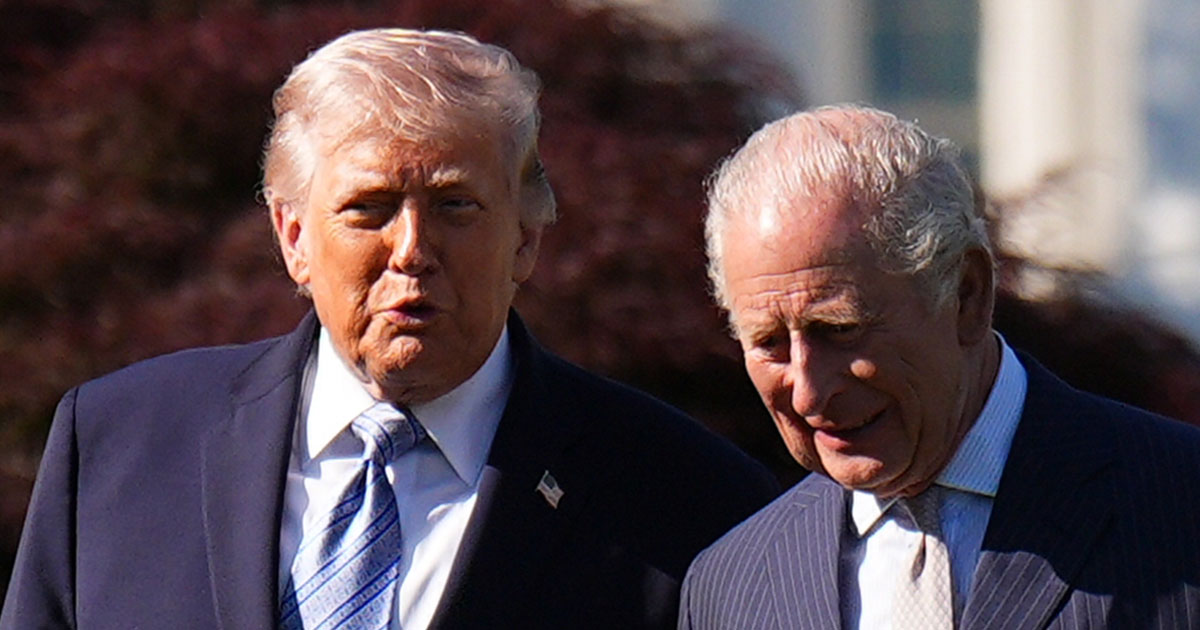
President Donald Trump and First Lady Melania Trump welcomed King Charles and Queen Camilla to the White House on Monday, setting a cordial tone for a high-profile state visit. Cameras captured brief exchanges as the two couples greeted one another on the steps and moved across the South Lawn. Now, a professional lip-reader has suggested that a more serious aside may have taken place between the President and the King, including a pointed warning after Vladimir Putin was mentioned.
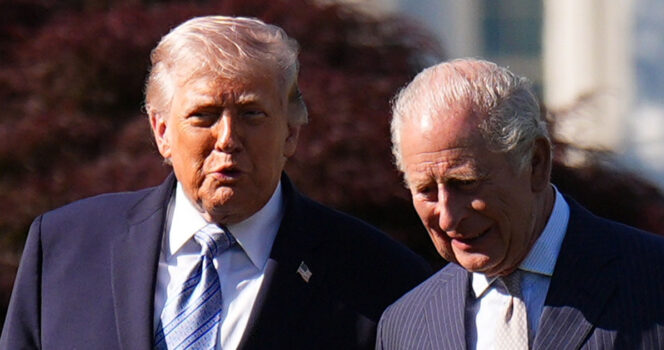
The royal couple’s arrival marked a noteworthy moment. This is the first official state visit to the United States by a British monarch since 2007, and it comes during a time of careful diplomacy between the two countries. The day began with photographs outside and a short walk across the South Lawn, where Melania Trump showed the guests a recently unveiled beehive, a personal project that adds a gentle touch of nature to life at the White House.
After the outdoor greeting, the four stepped indoors for a quiet cup of tea, a time-honored way to settle into conversation and pause between engagements. Later, they headed to the British ambassador’s residence for a garden gathering, a familiar kind of event during state visits that allows guests and hosts to speak informally in a relaxed setting.
A warm welcome with delicate undertones
State visits often blend pageantry with careful conversation, and this one is no different. The United Kingdom and the United States share a long history and many common interests, yet the backdrop to this visit is challenging. Global tensions and debates about security and alliances have led to a more watchful tone on both sides of the Atlantic. Officials on both teams hope that the royal visit will underline what remains steady and strong in the relationship, even as leaders address areas of strain.
Against that background, it is natural that every moment on camera attracts attention. While members of the royal family do not take positions on political issues, the moments when they are near political leaders can carry symbolic weight. Body language, facial expressions, and even a few words exchanged in passing become part of how the public understands the meeting.
What the lip-reader says was exchanged
Lip-reading expert Nicola Hickling has shared her interpretation of the short exchange between Donald Trump and King Charles as they paused for the cameras. According to her account, King Charles appeared to signal a wish to move along, while President Trump offered concern and then shifted to weightier topics that have dominated recent headlines.
In Hickling’s reading, King Charles seemed to say, “I’d rather not stand about here too long. I feel I shouldn’t be here.” The President, appearing to check on the King’s comfort, asked if he was all right and added, “It’s not a good thing. I wasn’t prepared, but now I am prepared.”
Hickling further claims that President Trump went on to reference a recent incident at the White House Correspondents’ Dinner and the conflict in Iran. She says he then mentioned ongoing conversations with Vladimir Putin, reportedly remarking, “So right now, I am talking to Putin. He wants war.” According to the lip-reader, the King signaled that a fuller discussion would be better saved for later. The President, she adds, did not immediately let the subject go, saying, “I’ve got a feeling… if he did what he said, he will wipe out the population.” At that point, King Charles appeared to try to turn the conversation to a different topic, indicating, “Another time.”
It is worth remembering how these moments typically work. Short greetings at official events rarely allow for detailed exchanges. The participants know they are being filmed, people are moving in and out of frame, and there is a schedule to keep. Whatever the precise words may have been, the scene suggests that the President was referring to serious global concerns, and that the King, in keeping with royal practice, preferred to hold any political discussion for a more suitable moment, if at all.
Royal protocol and a monarch’s careful footing
One of the reasons this brief exchange has drawn so much interest is that British royal protocol is clear: members of the royal family do not wade into political debate. They meet world leaders, represent the United Kingdom at home and abroad, and host or attend ceremonies of great significance. Yet they remain politically neutral. That tradition explains why King Charles would be quick to set boundaries around certain topics in a public setting.
For many observers, the King’s apparent suggestion to talk “another time” fit this understanding perfectly. It reads as a courteous way to keep the social moment light, move the schedule along, and honor the long-established rule that politics and monarchy do not mix in the open.
The mood around the visit
When a state visit takes place during unsettled times, every handshake and look is scrutinized. In recent months, the overall relationship between Washington and London has been marked by both cooperation and points of tension, with the conflict in Iran and wider international security concerns casting a long shadow. Friends can disagree, and allies sometimes see the path ahead differently, but visits like this one are designed to highlight common ground and keep conversations productive and respectful.
From a public perspective, the events are reassuringly familiar. There is the formal welcome, the quiet tea, the garden reception, and the gentle tour of a household project, like the beehive. These traditions are not just for show. They provide space to build rapport and to remember that partnership is made not only in meetings behind closed doors but also in moments of hospitality.
About lip-reading and what it can and cannot tell us
When an expert lip-reader offers an interpretation of a conversation, it naturally piques curiosity. It can also help explain why a moment felt tense or intriguing to viewers who watched it live. At the same time, professional lip-readers themselves often note that their work is an informed reconstruction, not an official transcript. Camera angles, lighting, partial views, and the speed of speech can all make certainty difficult.
With that in mind, the reported comments give a possible window into the mood of the exchange. They suggest that President Trump, reflecting on recent events and international concerns, may have wanted to underscore the gravity of the moment with a stark warning. They also suggest that King Charles, mindful of his role and the public setting, sought to move forward without engaging in political detail on camera.
What a state visit entails
State visits blend symbolism with substance. The symbolism includes ceremonial welcomes, thoughtful gifts, formal meals, and cultural moments that say, in effect, we see you and we value this relationship. The substance includes meetings where officials, and sometimes principals, compare notes, share assessments, and look for practical ways to cooperate despite differences. Even a simple cup of tea can offer a pause in a busy day that helps both sides connect more personally.
Monday’s schedule reflected that balance. There was time outdoors, time for conversation inside, and an evening reception where guests could mingle. The White House beehive added a charming detail, the kind that resonates with many people who enjoy gardening or caring for pollinators at home. These touches are small, but they are not trivial. They remind everyone that institutions are made of people, and that goodwill grows in everyday gestures.
The 250th anniversary and why it matters
This visit carries special meaning because it coincides with the 250th anniversary of American independence. Milestones like this are opportunities to look back and to look ahead. Two and a half centuries ago, the United States declared a new path. In the centuries since, Britain and America, once adversaries, became close partners who have stood together through peace and war, prosperity and hardship, change and continuity.
For a British monarch to mark this anniversary in Washington is a powerful symbol of how relationships evolve. It honors history without being trapped by it. It speaks to shared values and to the practical reality that, on many of the world’s hardest problems, the United States and the United Kingdom are most effective when they work side by side.
The royal couple’s plans during the trip
King Charles and Queen Camilla are expected to spend four days in the United States. During that time, they will take part in several events designed to highlight community, memory, and service. The couple is set to visit the 9/11 Memorial in New York City, a solemn tribute to lives lost and to the resilience of those who rebuilt and remember. They are also scheduled to travel to Virginia for community engagements that emphasize the daily work of neighbors helping neighbors.
Along the way, there may be additional meetings with President Trump and senior U.S. leaders, and there has been talk of a possible address to Congress. Nothing about a visit like this is accidental. Each stop is chosen with care, each message is calibrated to be respectful and forward-looking, and each interaction aims to reinforce the idea that partnership is renewed one conversation at a time.
Reading the moment without rushing to conclusions
It is human nature to focus on a candid aside that hints at private worries. The lip-reader’s account certainly does that. It suggests that President Trump spoke in stark terms about the risk of war and potential devastation if threats were acted upon, while King Charles gently deflected further discussion. That contrast reflects the different roles the two men play. One is a political leader who addresses policy and security matters directly. The other is a constitutional monarch who represents his nation’s unity and continuity, staying above the political fray.
In the coming days, what will matter most is less a few seconds of conversation and more the broader tone and outcomes of the visit. Are the two countries speaking frankly yet respectfully? Are their leaders finding practical ways to work together when it counts? Do the people watching at home feel that their concerns are being heard? State visits can help answer those questions, even when the answers emerge quietly over time rather than in one headline-grabbing moment.
A visit that blends ceremony and substance
Beyond the headlines, this trip is also about the steady comforts of ceremony done well. The respectful welcome, the careful choreography, and the mix of public and private moments are part of how democracies and monarchies maintain goodwill. It is reassuring, in a world that can feel hurried and unsettled, to watch leaders greet one another politely, share tea, and offer thanks to their hosts.
For many, the image of the royal couple walking with their hosts across a spring-green lawn, or pausing to learn about a beehive, will stick in the mind as much as any whispered words. Those scenes remind us that relationships are nurtured patiently. They grow stronger when people take time to listen, to show interest, and to meet one another with kindness.
Looking ahead
As the visit continues, attention will likely shift from the brief exchange caught on camera to the themes the royal couple highlight and the messages both sides send. Visits to places of remembrance such as the 9/11 Memorial carry their own quiet power, encouraging reflection on sacrifice and unity. Community events in Virginia can shine a light on local service and the everyday ties that hold society together.
By the time the four days conclude, the hope is that the symbolism will be matched by a sense of common purpose. Even if differences remain on certain policies, the broader partnership between the United States and the United Kingdom tends to endure. It has done so for generations because it is rooted in more than headlines. It is anchored in shared history, shared interests, and, just as important, in the habit of showing up for one another in both celebrations and challenges.
A final thought
Moments like this can stir a range of feelings. Some will view the lip-reader’s account as a glimpse into the gravity of our times. Others will see it as a reminder that public figures must often keep difficult subjects in their proper place, especially in front of the cameras. Either way, the day held both warmth and seriousness, hospitality and caution. That blend feels true to life, and it is one reason these visits continue to matter.
As the schedule unfolds, many will watch with interest and with hope that the conversations taking place honor the past, steady the present, and help shape a safer future. If nothing else, the images of two couples sharing tea, strolling a lawn, and pausing to admire a beehive will stand as a gentle statement that civility still has a role to play, even when the stakes are high and the world is watching.
What are your thoughts on the royal visit and the brief exchange caught on camera? Do moments of ceremony help bring people together, even when the issues are complex? We would be glad to hear what stands out to you most about this meeting.



