Part 2
I need you to understand something before I go any further.
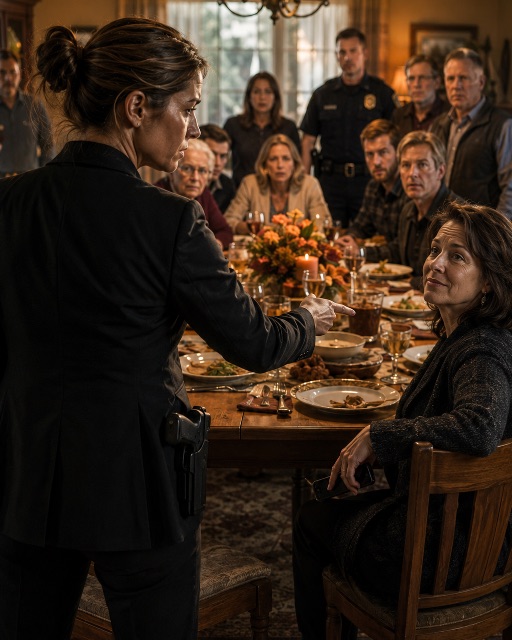
When they said my name – my real name, not “Clare,” not the cover – the room didn’t gasp. Nobody screamed. There was just this horrible, sucking silence, like all the air got pulled out through the walls.
My mother’s wine glass hit the hardwood and shattered. Grandma Whitmore pressed both hands over her mouth. James just stood there with his jaw open, the handcuff key still dangling from his fingers like a stupid little pendulum.
And me? I didn’t move. I didn’t blink.
Because I understood exactly what had just happened.
She’d burned me. Right there, at the table, in front of every person I’d ever loved. She said my classified cover name – the one assigned to me by the agency, the one that exists in exactly four files on the entire planet – and she said it like she was reading a recipe off the back of a soup can.
Calm. Bored, almost.
“That’s right,” she said, folding her napkin. “Your daughter has been running under a foreign handler designation for eleven years. And every single leak that got those people killed? Exposed under that cryptonym.”
She turned to James. “You were right to arrest her, sweetheart. You just didn’t know how right.”
My brother looked at me. Then at her. Then back at me.
“Clare,” he whispered. “What is she talking about?”
I couldn’t answer him. Not yet. Because my brain was doing what it does in the field – running the math, four moves ahead, stripping emotion out of the equation.
She’d flipped the play.
She’d taken her own handler designation — the one Rock’s team had spent two years tracing through embassy dead drops and encrypted satellite bursts — and she’d laid it on me. In front of witnesses. In front of a federal agent.
My own brother.
And the worst part? It was elegant. It was the kind of move you’d study at the Farm. Because who was the room going to believe? The woman who’d been gone for a decade, who couldn’t explain where she’d been, who’d just been dragged back in by a military helicopter?
Or the one who’d been here the whole time? Hosting Easter. Driving Grandma to dialysis. Bringing potato salad to every cookout since 2019?
She picked up her coffee cup again. Took a sip. Didn’t even look at me.
“Donna,” I said.
My sister-in-law. James’s wife. Mother of my two nephews. The woman who taught Sunday school at Immaculate Heart and organized the block party raffle every July.
She raised her eyebrows like I’d asked her to pass the salt.
“Donna,” I said again. “Put the phone down.”
Because while everyone had been staring at me, her left hand had slid that phone off the table and into her lap. I’d watched her thumb move three times. Three taps. She’d already sent something.
Rock stepped forward. “Ma’am, we have a signal burst. Outgoing. Encrypted. Thirty seconds ago.”
The room erupted.
James grabbed Donna’s arm. “What did you send? Who did you send it to?”
Donna looked at him — at her husband, the father of her children — and I watched something pass across her face that I recognized because I’ve seen it in interrogation rooms in countries I can’t name.
Relief.
The relief of someone who’s been holding a mask against their face for so long that the muscles have gone numb.
“You really want to know?” she said softly.
James was shaking. “Yes.”
Donna reached into the pocket of her cardigan — the oatmeal-colored one Grandma had knitted her last Christmas — and pulled out a second phone. Not the smartphone. A burner. Matte black. No case. The kind you buy at a gas station and throw in a river when you’re done.
She set it on the table between the cranberry sauce and the bread rolls.
“Eleven years ago,” she said, “a man approached me in the parking lot of the Kroger on Route 9. I was twenty-six. I was drowning in student loans. James and I had just gotten engaged, and I couldn’t afford my half of the deposit on this house.”
She gestured around the dining room. At the crown molding. At the china cabinet. At the family photos on the wall — photos I wasn’t in.
“He said he worked for a consulting firm. He said all he needed was small things. Publicly available things. Troop rotation schedules that were already in the news. Nothing classified. Nothing dangerous.”
She laughed. It was the emptiest sound I’ve ever heard.
“And then it wasn’t small things anymore. And then people started dying. And by then I was in so deep that the only way to survive was to make sure someone else took the fall.”
She looked at me.
“You were perfect, Clare. You were already gone. Already a ghost. Your own family didn’t know what you did. All I had to do was nudge James toward asking the right questions. ‘Doesn’t it seem strange that Clare never calls? Doesn’t it seem strange she missed Dad’s funeral? What is she hiding?’”
My mother made a sound. Not a word. Just a sound, low and broken, like something tearing inside her chest.
“I didn’t want to hurt you,” Donna said. And God help me, I think she meant it. “But I had two boys upstairs. And the people I work for don’t give severance packages. They give shallow graves.”
I took one step toward her.
“The signal you just sent,” I said. “What was it?”
Donna’s eyes flicked to the window. Just for a second. But I caught it.
“Rock,” I said.
He was already moving. “Perimeter team, eyes on the tree line. Eastern approach. NOW.”
Through the dining room window, past Grandma’s trampled rose garden, past the tire swing, out where the property line meets the county road — headlights.
Two sets. Cutting through the dark.
Coming fast.
Donna stood up. She wasn’t calm anymore. For the first time all night, she looked scared.
“You need to let me go,” she said. “Right now. You don’t understand what’s coming.”
“Who did you signal, Donna?”
“People who don’t negotiate, Clare. People who will burn this entire house to the ground with everyone in it if I’m not at that road in four minutes.”
My mother grabbed my nephew — little Terrence, he’s six, he was still holding a turkey leg — and pulled him behind her.
James drew his weapon. His hands were shaking so bad the barrel was making little circles in the air.
“Donna,” he said. His voice cracked on the second syllable. “Donna, the boys are upstairs.”
And that’s when we heard it.
The crunch of gravel. Car doors. And then, carried by the wind across the flat Ohio nothing:
A voice, amplified by a bullhorn, speaking in a language that nobody in that dining room understood.
Nobody except me.
And nobody except Donna.
Because it wasn’t a rescue team.
It wasn’t her handler.
The voice on that bullhorn said seven words. I translated them in my head before the last syllable landed, and every hair on my body stood up.
The message was: “Confirm the package. Is the daughter inside?”
They weren’t coming for Donna.
They were coming for me.
And Donna hadn’t signaled for extraction.
She’d signaled my location.
I looked at her. She was crying now. Real tears. Shaking.
“I’m sorry,” she whispered. “They said if I gave them you, they’d let my boys live.”
The headlights were getting closer. Rock was screaming into his headset. James was trying to herd the family toward the basement. Grandma wouldn’t move from her chair.
And me?
I walked to the kitchen counter. Picked up Grandma’s old rotary phone — the one she refuses to replace, the one that still has a cord, the one that runs on a copper line that can’t be jammed or intercepted.
I dialed a number I’d memorized twelve years ago. A number I was told to never, ever use unless the world was actually ending.
It rang once.
A voice answered. No greeting. Just silence.
I said four words.
“The nest is compromised.”
The line went dead.
Thirty seconds later, the lights in the house — every light on the entire road — went dark.
And then came a sound from the sky. Not a helicopter. Something much, much bigger.
Donna looked up at the ceiling. Then at me. Her face went white.
“What did you do?” she breathed.
I straightened my jacket. Looked her right in the eyes.
“I called in a favor.”
The windows started rattling. Grandma’s china clinked against itself in the cabinet. Little Terrence covered his ears.
Outside, the approaching headlights stopped. Then reversed. Fast.
But not fast enough.
Because whatever was up there — whatever I’d just summoned with those four words on Grandma’s rotary phone — it was already here.
Rock grabbed my arm. “Ma’am, we need to move the family to the cellar. Now.”
“No,” I said. “They stay right here. I want everyone in this room to see exactly what happens next.”
I turned to the window.
And what came out of that sky…
What landed in Grandma Whitmore’s back field, crushing the last of her rose bushes, flattening the tire swing, and sending a wall of wind through the dining room that blew out every candle on the Thanksgiving table…
Changed everything.
Not just for me. Not just for Donna. Not just for James.
For every single person sitting at that table.
Because the door of that aircraft opened.
And the person who stepped out — into the floodlight, boots hitting the frozen mud — was someone we all recognized.
Someone who’d been dead for nine years.
Someone whose funeral we’d all attended.
Someone whose headstone sits in the cemetery three miles down Route 9, right between Grandpa Whitmore and Uncle Teddy.
Donna dropped to her knees.
James lowered his gun.
My mother grabbed the back of a chair and whispered a name none of us had spoken out loud since 2015.
“Thomas.”
And the figure walked through the ruined garden, up the porch steps, and into the light of the dining room doorway.
He looked older. Thinner. A scar ran from his left ear to his jaw.
But his eyes were the same.
He looked at every face in that room, one by one. Slow. Like he was counting us. Making sure we were all still here.
Then he looked at me.
“Hey, Clarebear,” he said. The childhood nickname. The one only he ever used.
And I — the woman who’d held steady through eleven years of black-site interrogations, jungle extractions, and three gunshot wounds — fell apart.
I didn’t sob. I didn’t scream. A single tear just escaped and ran a hot track down my cold cheek.
My father was alive.
My father, Thomas Whitmore, looked at Rock and his team of operators, who now stood frozen. “Secure the hostiles. Silent protocol. No transmissions.”
Rock just nodded, his own professionalism dwarfed by the sheer authority my father commanded. He and his team melted back into the darkness.
Then, my father’s gaze fell on Donna, who was still on the floor, a mess of tears and cashmere.
“Get up, Donna,” he said. His voice wasn’t angry. It was just tired. Bone-tired.
James finally found his voice, a choked gasp. “Dad? But… how? We buried you.”
My father walked over to my mother, who hadn’t moved. He gently took her hand. “Helen, I am so sorry. For all of it.”
She just stared at him, then at her hand in his, as if seeing a ghost’s touch.
“I never really left,” he said, his eyes scanning the room, landing on each of us. “I just went deeper.”
He turned back to James. “The man you buried was a John Doe. A tragic accident victim with no family. We used a closed casket for a reason, son.”
“Used? We?” James said, his FBI training clashing with the emotional chaos in his head.
My father looked at me. “Your sister and I work for the same people, James. We just work in different basements.”
He then pulled out a dining room chair and sat down, right where he used to sit for every holiday meal. He looked at Donna.
“The man who approached you in that Kroger parking lot,” he started, his voice low and steady. “He didn’t work for a consulting firm. He worked for a man named Matheson.”
He paused, letting the name hang in the air.
“Matheson was my partner,” he continued. “My best friend. We came up through the agency together. But he started to believe the fight was more important than the rules. That the ends always justified the means.”
The house was silent, save for the hum of the aircraft outside and the wind whistling through the broken shards of my mother’s wine glass.
“He built a network inside the agency. A shadow organization. He started selling assets, trading secrets, not for money, but for influence. He was building his own private intelligence empire, accountable to no one.”
He looked at me. “I was tasked with bringing him down from the inside. The only way to do that was to disappear completely. To become a ghost. Faking my own death was the only move I had left.”
I finally understood. My entire career, the reason I was recruited right out of college, wasn’t a coincidence.
“You steered them to me,” I said, the realization hitting me like a physical blow.
He nodded, a flicker of pain in his eyes. “I needed someone on the outside I could trust implicitly. Someone who had the skills. I knew they would recruit you after I was ‘gone.’ You were my emergency brake. My lifeline.”
“You used your own daughter as bait,” my mother whispered, the first words she’d spoken to him.
“I used my daughter as a soldier, Helen,” he corrected gently. “The best one I’ve ever known. It was the hardest decision of my life, but Matheson was a cancer. And he was getting close to all of you.”
He turned his attention back to Donna. “He knew who I was. He knew who my family was. Recruiting you wasn’t random, Donna. It was a message to me. He was showing me he could get to my family anytime he wanted.”
“He said it was just small things,” Donna sobbed. “Just news reports.”
“That’s how it always starts,” my father said. “A little compromise. Then a bigger one. He owned you from the moment you took that first envelope of cash. He targeted you because you were vulnerable, and because you were marrying an FBI agent. A perfect combination of access and leverage.”
James sank into a chair, his own gun now resting on the table like a useless paperweight. The man who upheld the law his entire life was watching it crumble into a million shades of gray.
“So the leaks,” James said, looking at me. “The ones I was investigating… the ones that pointed to you…”
“All came from Donna,” my father finished. “Fed to her by Matheson’s people. She was the cutout. They’d leak the intel through her, then use their internal network to point the suspicion at a ghost agent they knew was my daughter. It was all a game to him. A way to hunt me, using my own children as the hound and the hare.”
The bullhorn crackled outside again, but this time it was Rock’s voice, calm and clear. “Perimeter secure, sir. Packages are wrapped.”
My father nodded once. “Hold them.”
He then looked at Donna, whose face was a mask of sheer terror. She knew what came next. She knew what happened to traitors.
“They said they would hurt my boys,” she whispered, a desperate, final plea.
“And I believe they would have,” my father said, and for the first time, I heard real ice in his voice. “The signal you sent wasn’t for extraction, Donna. I know their protocols. That signal placed a kill order. On this entire house. On you, on James, on my grandchildren.”
The air left the room. James stared at his wife, the mother of his children, and the last bit of light in his eyes died.
“They weren’t coming for Clare,” my father explained. “They were cleaning house. Matheson is getting sloppy, tying up loose ends. You were a liability, and after you framed Clare, your job was done. They were coming to erase the whole problem.”
Donna’s relief at my arrest hadn’t been about her mask coming off. It had been the relief of someone who thought she’d just bought her own life back, trading mine for hers. But she’d miscalculated. She was just another pawn to be sacrificed.
My father stood up. “But that’s not going to happen. The call I got from Clare, the phrase ‘The nest is compromised,’ it does more than call for a ride. It initiates the Matheson Protocol. My protocol. It means the game is over.”
He walked to the doorway and looked out into the night. “For nine years, I’ve been a ghost, hunting a ghost. Tonight, you led me right to his door.”
He turned back, and his eyes found Donna’s. There was no anger. No malice. Just a profound, hollow sadness.
“You have a choice,” he said. “The woman who betrayed her family and her country can disappear tonight. She can face a military tribunal and spend the rest of her life in a very dark room, and your boys will be told their mother died.”
He let that sink in.
“Or,” he continued, “you can help me. You were Matheson’s direct point of contact for this region. You have names, dead drop locations, banking information. You can give me everything you have. You help me finish this, once and for all.”
“And then what?” James asked, his voice raw. “She just… comes back to Sunday dinner?”
My father shook his head. “No. Then Donna Whitmore disappears too. She and the boys will enter a different kind of program. New names, new city. A new life, far away from all of this. You will never see her again, James. But your sons will have their mother. And she will have a chance to be only that.”
It was a cruel kind of mercy. A karmicly perfect dead end. She wouldn’t be punished in a way the law recognized, but she would lose everything she had built her life around. The house, the community, the husband she claimed to love. She would get to be a mother, but that’s all she would ever be. A ghost of a different sort.
Donna looked from my father’s unforgiving face to James’s shattered one. She looked toward the stairs, where her sons were sleeping, blissfully unaware.
Slowly, she nodded. “I’ll help you,” she whispered. “I’ll give you everything.”
One year later, it was Thanksgiving again.
The big dining room table felt too large. There were empty seats. A space where Donna’s potato salad used to be. A silence where little Terrence’s older brother, Mark, would have been arguing with him.
After Donna cooperated, my father was true to his word. She and the boys vanished overnight. James got a heavily redacted letter a month later, postmarked from a city he didn’t recognize, with a single school photo of the boys, smiling. No return address.
My father—Thomas—was officially brought back from the dead. The official story was a botched witness protection placement. He was retired now, for real. He and my mother were… rebuilding. It was slow. Awkward. Like learning to dance with a partner you haven’t seen in a decade.
James had transferred to a desk job in Quantico. He needed to be away from the field. He was quiet, but he was healing. He spent his weekends taking Terrence, who now lived with my parents, fishing at the lake.
And me? I took a leave of absence. My cover was blown, but more than that, my life was. For the first time since I was twenty-one, I was just Clare Whitmore. Daughter. Sister. Aunt.
I was the one who brought the potato salad this year.
We sat at the table, a smaller, wounded version of the family we once were. My dad raised his glass of sparkling cider.
“I know this year has been… difficult,” he said, his voice thick with things unsaid. “We’ve lost things we can’t get back. But we’re here. We’re together. And we’re safe.”
He looked at each of us. At Mom, her hand now resting comfortably in his. At James, who managed a small, tired smile. At me.
“Family isn’t about perfection,” he said. “It’s not about keeping score or hiding your scars. It’s about showing up. It’s about forgiveness. It’s about choosing to rebuild, even when the foundations are shattered.”
He raised his glass higher. “To rebuilding.”
“To rebuilding,” we all echoed.
The silence that followed wasn’t heavy or broken. It was quiet. It was peaceful. It was a start. The lies that had poisoned us for a decade were finally gone, and in their place, a difficult, painful, but honest truth had begun to grow.