
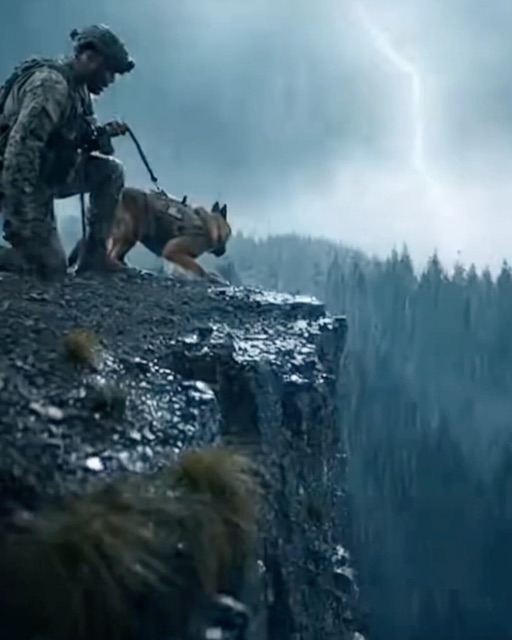
“The patrol climbed into the lightning.
I’m a K9 handler for an Army recon team. We were trying to reach an observation shelf above the valley when the sky opened up, turning the ridgeline into flashes of silver and black. My Malinois and I were soaked to the bone, moving low.
Then my dog locked up on the hill.
I froze with him. The whole line behind me halted like a zipper closing.
Our squad leader, Clifford, slid up beside me. “What’s he got?”
I didn’t answer. I watched his ears, the tilt of his head, the pressure in his front paws. No sniffing. No searching.
“He’s not on scent,” I whispered. “He’s on movement.”
Lightning stitched the ridge. My dog pivoted six inches left and exploded, barking at a low, broken shelf below our route.
We crept to the edge and looked down.
A soldier was wedged under the lip of rock. Radio smashed. Ankle twisted. His reflective panel was pinned under a choke of muddy debris, invisible in the storm. The guy from our advance team who missed his check-in – had to be.
Clifford started down. Lightning cracked so close the mountain turned pure white.
A dead sapling split and slammed across the path. The shelf under the trapped man groaned and shifted. He was about to slide off the mountain.
I dropped to my knees, sliced my dog’s lead free from a snag, and went over the edge. The rescue wasn’t later. It was now.
I got a fist on the back of his vest and hauled. The slab tore away and roared into black.
We fell back into the mud, gasping. My dog didn’t calm. He lunged at the man we’d just saved, snarling so hard I had to throw my shoulder into him.
“Down!” I barked, voice shaking. I reached for the man’s helmet, yanked it off to check his head.
Lightning lit his face.
My stomach turned to ice. He wasn’t from our advance team. He wasn’t a stranger. He was familiar in a way that made my skin crawl.
The man wearing our uniform was –
I wiped the mud off his name tape and felt the ground tilt as the letters came into focus.”
HARROW.
He was wearing my name.
Grit lunged again like he wanted the man off the mountain, off the map, off the planet.
Clifford stared from me to the name tape and back, rain running off his nose in sheets.
“Talk,” he snapped at the guy. “Who are you?”
The man tried a smile that didn’t reach his eyes, mud and blood worming into his stubble.
“Private… Harrow?” he said, and that shaky laugh told me he knew he was cooked.
“My name is on your chest,” I said, and I heard myself like a stranger.
He looked at the ground, then up through the rain. “Look, man, I can explain.”
Grit’s hackles were up so high they were a second spine.
“Save it,” Clifford said, cutting the distance and putting a knee in between the guy’s shoulder blades like he was pinning a snake.
We weren’t arresting him. We were keeping him from doing something stupid near a drop that went to nowhere.
I pulled Grit close and clipped his short lead to the front of my kit. He vibrated like a cable.
“Where’d you get that blouse?” I asked, throat tight, because I recognized the frayed thread under the last R.
Two weeks back, one of my spare tops had vanished from the unit laundry, and I’d chalked it up to supply purgatory.
“Motor pool,” he said too fast. “Blew off a truck. I was cold.”
“Don’t lie,” Clifford said without heat. “You don’t move till we say so.”
The shelf made a sound like a ship hull flexing, long and low, and the whole team slid lower into the muck.
We didn’t have time for a full argument, and the mountain didn’t care either way.
I pressed my hand to Grit’s chest and felt his heartbeat kick, and I tried to match mine to his.
Thunder walked away across the ridge, and in its backwash we heard something faint.
It was small and tinny and weak, and for a second I thought it was rain talking to rock.
“Did you hear that?” I asked, and Grit’s head snapped down the slope like someone had yanked it.
Clifford raised a fist, then motioned, and we fanned on our guts toward the sound.
The man wearing my name lay quiet now, eyes flicking from our faces to the edge and back like a trapped fox.
“Don’t move,” Clifford told him again, voice like a windbreak.
We slid to the edge and peered into the torn dark.
There was a curtain of roots and grass hanging free where the slab had let go, and behind it the mountain had opened a mouth.
Something in that mouth made a scratch that was almost a word.
“On me,” I said to no one and everyone, and Grit pulled so hard my shoulder screamed, begging me to let go and drop.
I passed my spare line around a boulder and clipped in one-handed, fingers thick with mud, mind ticking through the math.
“Sandoval, take my brake,” I said, and Sandoval’s hands closed on my rope like they were built for it.
Clifford nodded once, and I went over, Grit dancing at the edge and whining like a siren.
Cold crawled between my plates and down into my spine as I pushed through the roots and into the pocket.
The smell in there was wet rock and iron and old leaves, and under it something sharp that meant pain.
“Talk to me,” I called low, voice getting swallowed by the storm, and then I saw him.
He was there on a ledge the size of a desk, twisted under a mat of brush that must have slid with him, head against a rock, mouth blood-dark.
He wore our patch. He wore the advance team’s identifier. He wore the world’s worst luck.
“Tolliver,” I whispered, and his eyelids twitched at his name like someone had pulled a string.
“I’ve got you,” I said, because sometimes you have to say it even before it’s true.
I cinched a loop under his arms and checked his leg and wished I could unsee the angle of it.
“Cliff, got him,” I called up, and my voice came back damp and thin.
“Copy,” Clifford yelled. “Quick and clean.”
The man wearing my name breathed behind me at the edge like a presence you don’t want to turn your back on.
Grit put his front paws on the lip and whined a note that hit me right in the bones.
I tightened the sling and counted down, and Sandoval took the weight and Tolliver came up slow, brush peeling from him like the mountain was reluctant to let go.
His head lolled and his chest stuttered, and I kept one hand on his vest the whole way, because I needed to feel his life.
We got him flat on the trail above, and Patel slid a pressure bandage under his helmet and wrapped his head like he was wrapping a gift he couldn’t afford to lose.
The rain made paste of the blood and the mud, and Tolliver blinked at me like he was waking up from a strange dream.
“Boss?” he whispered, and Clifford laid a hand on his shoulder that said, Not today.
While we worked on Tolliver, the man with my name tried to inch away, thinking maybe no one would notice in the chaos and the rain.
Grit did.
He hit the leash like a train, jaws snapping inches from the guy’s calf, and the man froze, palms up, eyes white.
“Stay,” I said to Grit, and to the man too, without saying it.
Clifford looked at me over Tolliver’s shoulder and nodded at the imposter.
I took a knee beside him and saw him for real.
He was my age or near it, lines around his eyes that weren’t from laughter, jaw tight from a lifetime of chewing on nails.
“You owe us a straight line,” I said, and the storm softened a hair like it was listening too.
He swallowed hard and looked past me to Tolliver, who was trying to find breath that didn’t hurt.
“I heard him go,” the man said, voice soft as rain on moss. “I didn’t know if he was dead. I couldn’t get to him.”
“Name,” Clifford said, moving over with that patience that doesn’t hide the steel.
The man let out a long breath that had a life in it.
“Reese,” he said after a beat. “Lyle Reese.”
“Not Harrow,” Clifford said without looking at me.
“No,” Reese said, and his eyes met mine and slid away.
“Where’d you get the uniform, Reese?” I asked, because the storm had cut us back to essentials, and a lie was useless in this weather.
“From a bin outside supply,” he said, shrinking half an inch, and that matched the way the hem was cut and the way the cuffs were. “I got frozen up there. Didn’t want to die.”
He glanced at the broken tree across the trail, the slick rocks, the lightning.
He wanted us to see a scared man who put on a soldier’s skin because he was cold, because he was lost, because he was human.
Grit showed all his teeth like saved knives and told me what he smelled wasn’t simple.
“What were you doing up here?” Clifford asked, and when Reese didn’t answer quick enough, he added, “Your answer decides if you walk.”
Reese licked rain off his upper lip and stared at the black drop where the slab had fallen.
“Look, man, I do odd jobs for this guy who moves scrap,” he said finally, and it came out like a cough. “He pays cash. He said there’s copper and line and junk cable up here after training cycles. He said all I had to do was tag it for him and he’d know where to pick.”
Patel’s head snapped up at that, eyes going to our route map in his mind.
“Tag it how?” Patel asked, voice like a fence post.
Reese fumbled in his blouse, fingers slick with rain, and came up with a little black puck like a fat coin.
It blinked once, blue, then went dead as water.
“Plant those in easy places,” he said. “Under rocks, near trail marks. He maps them with an app.”
“And my name on your chest helps you walk through gates later,” Clifford said, and it wasn’t a question.
Reese didn’t deny it, and that told me everything.
“We found him above the access road two nights back,” Sandoval muttered to me low, like he was putting a ghost into the world. “Guy in uniform that didn’t walk right.”
I looked at Reese and tried to fit him into that frame.
“Did you know Tolliver was there?” I asked, voice soft, because even a liar can be ashamed.
Reese’s jaw worked, and a bit of grit stuck to his lip.
“He called out,” he said finally, voice rough. “I panicked. The shelf gave under me too. I grabbed and held. I tore my radio trying to get it out. When you came, I yelled, I swear I yelled.”
Grit’s ears twitched at swear like it was a mouse running under leaves.
“You yelled,” I said, not letting myself make him into a monster entirely. “And you didn’t stick your neck out farther than it was.”
He lifted his hands a fraction, palms out again, eyes asking for a shape in the rain that looked like mercy.
“We’ll sort it after we get off this ridge,” Clifford said, and that was a promise and a warning in one.
He signaled, and we packaged Tolliver in a sked we’d hauled up for contingencies and rigged a belay along the trail.
Patel called medevac on the hill line that worked when the regular net was all static, and the answer was if the lightning dropped and the wind didn’t eat the bird, we’d have rotors in twenty.
Twenty minutes is another lifetime in a storm.
We started moving in a slow, ugly crawl, every foot measured, every boot placed like it was worth money, because it was Tolliver’s whole future.
Grit took point beside me, eyes flicking to every tremor like he was reading a book written in rain.
Reese shuffled three feet ahead of Clifford, a hand looped through a sling so he couldn’t forget who held the line.
The trail pinched at a rock tooth, and Grit stopped again and stared off into the heather to the left like someone had put a voice in it.
I felt my skin do that cold wave thing again, and I listened.
Over the sound of the rain and the wind playing the trees like dirty violins, I heard a cough.
It was not Tolliver.
It was lower. It was where the hillside folded down to the drainage.
“Another one,” I said, and my chest went hollow. “There’s another one.”
“Everyone hold,” Clifford said, and we did, because in a storm your priorities can change five times in a minute.
“Reese,” I said, and he looked like a kid picked in class. “You heard two calls earlier, didn’t you.”
His eyes flicked left, then back to my face, then down.
He nodded once, like he was confessing to maybe stealing a pack of gum.
“Down there,” he said, and pointed with his chin, because his hands were tied to a promise we’d made to ourselves about trust and risk. “I thought it was an echo.”
It wasn’t.
“Sandoval, with me,” I said, and we slid into the heather like seals, Grit crawling between us, nails quiet on the spongey ground.
The cough came again, and there was metal in it, the sound of a man whose lungs had been squeezed and let go.
He lay in a little basin where the runoff had cut a new channel, gear torn, one boot missing.
He was smaller than Tolliver, freckles mud-gray, eyes that clear shade you only see when someone’s body is deciding if it’s staying or going.
He wasn’t ours.
His patch said he was a reservist from the unit training to the east, rat-f – bad luck had rolled him into our lap tonight.
He’d been out alone stupid, or with two men stupider, or his squad had been stripped down to skin and left by the storm, and we didn’t ask which yet.
“Easy,” I told him, and he looked past me to the dog and relaxed by a quarter of an inch, because dogs speak a language even men in pain can hear.
“We got you,” Sandoval said, and for the second time in ten minutes we made something that could hold a life out of straps and rope and a stubborn refusal to let people go in the dark.
We hauled him up to the trail and added his weight to our slow train.
By then the rain wasn’t coming in walls anymore, just bad curtains.
In the pause, we heard something that was not thunder. It was low and far and had a pulse.
“Bird’s up,” Patel said, ears tilted like a fox.
We maneuvered to the one stretch that could maybe take a skid.
It was a rectangle of scrub where lightning had clipped a tree last year and left a flat wound we used as a hover point when we got lucky.
We got lucky.
The Black Hawk came in from the west riding dirty air, blades grabbing at a sky that didn’t want to be grabbed.
We popped smoke and prayed to small gods about wind and angles and all the things cartographers don’t draw.
The crew chief leaned out like he’d been born in the open door and took Tolliver first, then the reservist, and each of them looked ten years younger the second they were inside that metal belly.
“One more,” I yelled, jerking a thumb at Reese without commitment, because I didn’t know yet if I wanted him flown off my mountain.
The chief pointed at the sky and made a cutting motion, then held up three fingers. Three minutes.
We dropped back from the rotor wash and crouched under the pines while the helo carved space out of the rain.
Reese looked at me like a man looking at a bridge that may or may not hold his weight.
He kept darting looks at Grit, the way people do when they know the truth lives in muscle and fur.
“You gonna cut me loose?” he asked, and a bolt hit somewhere up the valley and answered with a flat no.
“Not yet,” I said.
He nodded like that was fair.
“That guy,” he said, chin to the reservist inside the bird. “I didn’t hear him. I swear.”
“I believe you,” I said, and meant it for once.
We waited for the bird to come back, lungs full of wet pine, hands steady because the work had focus to it again.
When the Hawk dropped in the second time, rain like nails on its skin, I touched Reese’s arm and guided him forward.
The chief gave me a look that could mean ten things and two of them were We’re full and one of them was I trust your judgment.
“Go,” I told Reese, and he didn’t move.
He stood on the skid, then turned and looked at the heather and the little canyon and the trail and then at Grit.
He set his jaw like a man making a choice that would be a different life either way.
“I ain’t runnin,” he shouted over the blades. “I need to finish telling you who pays me.”
It wasn’t what I expected.
Clifford took two fast steps and hooked a hand in Reese’s vest and hauled him in the bird anyway, because storms make you pick safe over noble nine times out of ten.
“Tell me up there,” Clifford yelled, and he jumped in after, because leadership is sometimes just going first into noise.
They left me and Sandoval and Patel and Grit on the mountain, standing under the dripping pines feeling about ten pounds lighter for reasons I couldn’t count yet.
We beat it off the ridge ahead of the next squall and humped it to the trucks while the Hawk took our people to the pad where white light and calm hands live.
By the time we rolled through the gate at the training area, the storm was a bruise on the horizon, and the world was washed clean and mean.
We wrote our statements under a buzzing light and drank coffee that tasted like campfire and tin, and someone handed Grit a towel and he hated it and loved it at the same time.
When Clifford came in from the pad, he didn’t say anything at first. He took a seat on the edge of the table and looked at us like he was taking an inventory of bones and souls.
“Reese sang,” he said finally. “He gave us a name and a truck and a storage unit and a bank account that looks like a mistake.”
“Who’s the name?” Patel asked, pencil tapping like a tiny metronome.
“A contractor out of the motor pool,” Clifford said, and his mouth bent like he’d bit a lemon. “Denton. You’ve signed his forms. So have I.”
That hit like a new kind of thunder.
Denton was the sort of guy who knew everyone’s birthday and showed up with a sheet cake that tasted like flour and care. He also knew the serial numbers on everything you could carry.
“He ran a side business,” Clifford went on, voice calm in a way that meant don’t interrupt. “Junk out the back, copper here and there, cable now and then. A little nod to some guys who think uniforms are hall passes when they’re not.”
“Reese in deep?” I asked, not sure what answer I wanted.
“He’s a foot soldier who fell in a hole,” Clifford said, and we both looked at the door where rain ticked like a soft clock.
“Doesn’t mean he walks,” Sandoval said, and his jaw had a new tightness.
“Doesn’t mean he hangs,” Clifford said back, and he dug his knuckles into his knee like maybe that spot hurt.
Tolliver would live.
That was the thing that steadied the table under our arms and put the coffee taste back in our mouths.
They’d pinned and plated his tib-fib and kept the swelling in his head from doing the worst, and he had a list of jokes forming already in his file.
The reservist had a pneumothorax that the flight medic had popped with a kit the size of a candy bar and a steadiness that could stop a hurricane.
They’d both write us bad thank-you notes next month and mean every misspelled word.
I went to see Reese the next day, not because I had to, but because I needed the knot in my chest to turn into something I could name.
He sat in the holding room at the MPs’ office in a hoodie someone had found that smelled like fifteen old smoke breaks.
His hands were cuffed, but the tension in his shoulders had moved from flight to something like acceptance.
He looked up at me and at Grit, who sat like a carved thing by the door, and he smiled a little at the dog.
“You gonna let him eat me?” he asked, like we were all on the same side in a joke now.
“Only if you stop talking,” I said, and he laughed a sound that didn’t have any edges on it for once.
We talked.
He told me about the way dented people find each other in parking lots, how guys like Denton wear kindness like a jacket over a closet of poor choices.
He told me he’d been working odd jobs since his dad left, which is what he called prison without calling it prison, and that he thought a uniform might be a bridge over some water he didn’t know how to swim.
He told me when he slid onto that shelf and heard Tolliver cry out, he felt like all the bad he hadn’t meant to do had finally mailed itself to his doorstep.
I told him if he’d crawled over and put a hand on Tolliver’s shoulder, I would have still thanked him, and he would have still come here.
He nodded and didn’t argue.
“You pulled me up,” he said finally, shaking his head like he hadn’t ordered that meal. “And then your mutt tried to rip my shin off.”
“Grit is a good judge of character,” I said, and I said it like a line, but that little twist of relief under it was real too.
“I ain’t good or bad,” Reese said, and he looked me right in the eye. “I’m a guy who does what’s in front of him.”
“Then keep putting the right things in front,” I said, because it was simple and it wasn’t, and sometimes simple is the only way it lands.
He testified.
Denton ran for about six hours and then walked into the MPs office with a look on his face that said he thought this could go different.
It didn’t.
What went different was how the judge looked at Reese when the DA stood up and said he’d helped put a broken chain back together and that he hadn’t meant for men to die.
He got time, because you don’t wear a soldier’s mask and walk away with a hug, but it was months, not years, and it came with conditions that sounded like a plan instead of a punishment.
Tolliver rolled into the company area two months later on crutches with a smile so crooked it made you feel like you were seeing a kid again.
He kissed Grit on the head and Grit complained like he hated it and ate it up anyway.
We didn’t make a speech.
We did what you do.
We slapped his shoulder and said stupid stuff that meant love, and he said stupider stuff back.
When I took Grit out to the ridge a month after that storm, it was a day so clear it looked fake.
The ridge still had that bite where the slab had gone, but the mountain had smoothed the edges with time and grass.
We moved slow because you don’t walk a place like that fast, even when the sun is out.
I stood at the edge and put my hand on Grit’s collar and thanked whoever needed thanking for a dog that says no when your whole body wants to say yes.
Clifford came up beside me and stood quiet for a long time.
“He knew your name before he saw your tape,” he said finally, chin at Grit like he was paying a debt.
“He knew everything important,” I said, and Grit leaned against my leg like he was embarrassed for us both.
People like to make the world into big capital letters.
They want heroes and villains and they want the storm to mean something long and neat.
But the mountain taught me that day that truth is smaller and heavier.
The man you pull out of the mud can be wearing your name and not be you at all, and you can still be responsible for what happens next.
Your dog might love everyone and still tell you when it’s time to bare teeth, and if you’re smart, you listen.
If you slow down when the lightning says hurry, you might hear the second voice in the dark, the one that doesn’t get a second chance if you miss it.
I wrote Reese a letter after his sentencing, and I don’t write letters often.
I told him Tolliver was back telling the same jokes and breaking the same rules and that sometimes when we tell the story now, Grit is the only one who looks serious.
He wrote back on paper that smelled like the kind of soap every government building buys, and he said he was learning to cook in the kitchen and that when he got out he’d got a line on work that didn’t need uniforms, just hands.
He said he taped our unit patch drawing on the inside of his locker because he wanted to remember that he’d been pulled up once and that he’d tried to pay it forward with the truth.
It wasn’t a movie ending.
It was better, because it was alive.
Three months after the storm, we got a letter of commendation in a frame that made it look fancier than it felt, and Grit got a medal that he did not care about and a steak that he did.
I hung the frame on a nail in the ready room and didn’t look at it much.
What I looked at was Grit when he paused at doors no one else noticed, and what I listened to was the wind when it moved wrong, and what I trusted was the part of me that quieted down when the dog said we were okay.
The night after we hung the frame, we sat out back of the barracks and ate delivery pizza that tasted like salt and relief, and the sky was all stars and no trouble.
Patel told the storm story loud for the new guys and got half the details wrong and it didn’t matter.
Sandoval threw a crust for Grit and Grit ignored it and then pounced like it had talked smack to his mother.
Clifford sat with his boots on the rail and didn’t say much, but every now and then he smiled at nothing.
I thought about a man wearing my name sliding on a shelf and reaching up into the rain, and I thought about how close it all runs on a night like that.
I thought about how the thing that saves you might not be the thing you think you came for.
And I thought this, and I will tell you now so you don’t have to wait for your own mountain to teach you.
Trust the one who can’t lie, even when the truth is uncomfortable.
Listen when something in you freezes, and don’t bully yourself past it because it’s messy or slow.
Slow down when it matters, and you might hear the person who needs you most and isn’t loud.
Do the next right thing, even if the person in front of you doesn’t fit clean in the box your brain wants to use.
Mercy and caution can be neighbors if you let them, and when you step out of the storm, let them both sit beside you in the dry.
If this story gave you something to hold on to, share it with someone who might need it too, and if you liked it, let me know so I can keep bringing you more like this.



