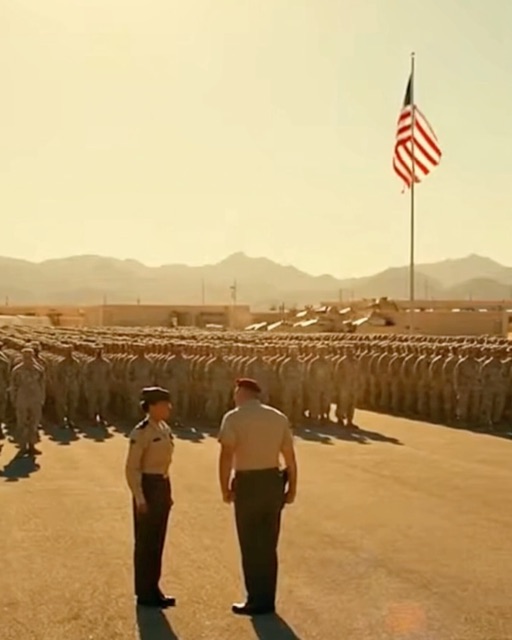
The sting hit before the sound. Metal in my mouth. Sun burning my neck. Boots locked, eyes forward.
He stood so close I could see a thread loose on his collar. “Insubordinate,” he hissed, loud enough for the whole parade ground. “Proof standards are slipping.”
I answered by the book. Calm. Short. Precise.
He raised his hand and cracked it across my face.
I didn’t move.
That was what rattled him. Not the blood. The stillness.
By afternoon, Rear Admiral Curtis Harlan had a complaint on paper and a punishment dressed up as a “performance review.” Seventy-two hours. The same evolution used to squeeze Force Recon candidates until they break. He wanted a file that said I failed. Not the truth.
I signed.
Day One: forty-two miles under sixty pounds. Heat that cooked the brain, mud that sucked boots off, river current trying to eat me alive. I finished early.
Day Two: cold that bit to bone, no sleep, stress positions until muscles sang with fire. A clipboard shadow followed me, waiting to catch a wobble. I gave them nothing.
Day Three: time shrank to breath and task. Hunger stopped mattering. Pain turned into information. My father’s rule ran like a metronome in my head: Stay cold.
When it ended, I looked like hell and clocked in miles past the standard. The instructors knew it. The command team knew it. And Harlan finally stopped smiling.
That night, he tried to make it formal. “Unfit for combat,” he said, sliding a typed memo across a polished desk. My lip had scabbed. My hands didn’t shake. I asked for legal. I asked for a superior review. He laughed.
Then the door opened.
A civilian in a gray suit walked in without knocking, set a black case on the desk, and handed Harlan a key he wasn’t supposed to have. No words. Just a look that turned the room ten degrees colder.
Harlan swallowed. Unlocked his safe. Pulled a red-tab folder he’d never seen and should never have touched. Clearance stamps everywhere. A photo paper-clipped to the front that shouldn’t have been mine.
He flipped the first page and I watched the color drain out of a man who thought a slap could define me – because the name at the top wasn’t the one he knew, and the title beneath it would end his career the second he read it.
The name on the file said Rainey, Morgan A., and the title below read: Field Officer (TDY), Naval Inspector General, Protected Duty Assignment under Title 10, Section 1034.
He looked up at me like I had become a different species. “This is a joke,” he said, but his voice didn’t fill the room anymore.
The man in gray didn’t smile or blink. “It’s not,” he said, his tone plain and almost bored. “And you assaulted him on duty. In front of a formation.”
“I didn’t know,” Harlan said, and then stopped because he heard himself, and it sounded as thin as paper.
I kept my hands folded in my lap. I felt my face throb where his palm had found bone. I wasn’t interested in the look on his face, but I didn’t look away either.
The man in gray turned to me without moving the rest of his body. “Officer Rainey,” he said. “You’ll give a statement now, and then you’ll go see medical, and then you’ll go home.”
“I can see medical,” I said, and the words felt like gravel. “Home comes later.”
Harlan reached for bluster and came up with air. “I won’t be read my rights in my own office by some – ”
“Sit down, sir,” the man in gray said, and there was a kind of silence that only comes from practiced power. “Your security manager will be here in five minutes to collect your credentials pending inquiry.”
He sat.
The room smelled like old coffee and lemon cleaner. My boots left a fine line of mud where I had cut across the parade ground to get here. I watched a fly crawl across the corner of the desk calendar and then lift and buzz toward the window light.
The gray man set a small recorder on the desk and hit a button. “Date and time,” he said, and gave them. “Present: Rear Admiral Curtis Harlan, Field Officer Rainey, and myself, Deputy Inspector Clarke.”
I didn’t know the gray man’s name until then. Clarke. It fit him.
He asked questions like a carpenter tapping along a wall to find where it was hollow. He didn’t look at me when I answered, and he didn’t look at Harlan when the answers made him flinch.
It took ten minutes to cover what had happened on the parade ground. It took another ten to step through the paperwork that followed. It took two to surface the ugly part under it all.
“He told me to mark that candidate as failed,” I said, and the clip on the side of the recorder vibrated against the desk. “Before the evolution even started.”
“On whose order?” Clarke said.
“He didn’t use a name,” I said. “He said, ‘We’re cleaning house.’ He said, ‘I need the right people on my ships, not the ones who argue.’”
Harlan tried to smile like it was banter. “Candidates washing out is not news,” he said, and his hand pressed flat against the desk as if the wood could anchor him.
Clarke didn’t stop the recorder. “Not when the failure is earned,” Clarke said. “But you tried to fabricate one.”
“You think this kid is a saint?” Harlan snapped, and the word kid showed more than he meant it to.
Clarke let it hang. He glanced at me, then at the clock, then back at the file like it was giving off heat.
“We’re done here for tonight,” Clarke said, and clicked off the recorder. “Admiral, you are not to contact any potential witnesses. You’re not to speak with Officer Rainey. You will await further instructions.”
Harlan stared at the safe like it had betrayed him. His mouth worked and then didn’t. He nodded once like a man in a storm who has seen the wave and knows he can’t outswim it.
Outside, the world felt too big for a moment. The base noises folded in around me, jets and boots and distant laughter and the wind flexing the flag.
Clarke walked beside me without trying to fill the space. He handed me a plain white card with a number that only had six digits. “Call if he breathes wrong in your direction,” he said. “Call if anyone does.”
“I wasn’t trying to set him up,” I said, and I didn’t know why I needed to say it, but I did.
“I know,” he said. “We were looking at him long before you got here.”
We passed a young seaman who tried to salute and then got tangled in his cover. Clarke didn’t laugh. I didn’t either.
I slept on a foam mattress in base lodging that smelled like other people’s detergent. My face had swollen in a way that made my eye feel heavy. I put a pack of ice on it and watched a water stain on the ceiling turn into a map.
My phone lit up with texts that changed tone with each ping. Some were straightforward. Heard what happened. You good. Others were sticky with gossip. They said you lunged at him. They said he barely touched you. One made me turn my phone face down.
It was from a number I didn’t recognize. It said, If you like your career, keep this quiet.
I breathed in through my nose and out through my mouth and set the phone on the table like it could explode. Then I wrote the number on the back of Clarke’s card and circled it until the pen tore the paper.
Morning came like it always does, plain and without promise. I stood in front of a mirror and saw a bruise coming up like an oil slick. Then I put on the same uniform I’d worn yesterday because it still felt like mine.
The clinic doctor was gentle and tired in the way of all base doctors. He touched my jaw with two fingers and said, “You don’t need stitches, but you need a day to let your body do its thing.”
“I’ve had worse,” I said, which was true and also not the point.
He looked at my chart and paused. He looked at my file like Harlan had, like he was seeing something he hadn’t expected. Then he looked up and said nothing about it.
“Take the day,” he said again. “Eat something that isn’t brown and square.”
The base cafeteria served brown and square in ten shapes, so I walked off base and found a diner with red vinyl booths and a waitress who called me honey without irony. The coffee was bad and perfect. The eggs tasted like the ones my father used to make on Sundays when he wasn’t on duty.
He worked the night shift when I was a kid, and he’d come home with his knuckles raw and his patience held together with duct tape. He’d pour batter into a pan and talk about calm like it was a discipline. “Staying cold isn’t about being numb,” he said once, flipping a pancake that landed perfect. “It’s about choosing your heat.”
He died on a road slick with rain because somebody took a corner like rules were for other people. I learned about grief in a room that smelled like hospital soap and linoleum. I learned about anger in the silence that came after.
Clarke called around noon. He didn’t ask how I was because he knew that question has no answer you can give over a secure line.
“Your chain of command has been notified,” he said. “You’re still TDY under IG. You go where I tell you until this is finished.”
“Where am I going?” I said.
“To talk to the clipboard shadow,” he said, and I could hear the faint scrape of a chair on his end of the line. “His name is Petty Officer Lyle Hart.”
“I know him,” I said. “He followed me like I owed him money.”
“He told someone last night that you stumbled,” Clarke said. “That you cut corners. That you laughed during a briefing.”
“I didn’t,” I said, and my spoon clicked against the mug like a metronome.
“I know,” he said. “We have footage.”
There was a camera mounted on the range tower that wasn’t supposed to work that day. It did. It showed a man performing past the standard with a face that looked like it belonged to a statue. It showed the clipboard shadow write before I moved, like he had been told what to see.
I met Hart in a conference room that had seen more coffee than sunlight. He sat stiff and small at the same time. He looked like a boy who had borrowed his father’s suit.
“You lied,” I said, and I didn’t dress it up with anything softer.
He swallowed. “I wrote what I saw,” he said, but he didn’t meet my eyes when he said it.
“You wrote what you were told to see,” I said. “It’s on the footage.”
The word footage put a crack in whatever he had built inside himself. He flinched and then deflated. The truth wanted out and he was tired of keeping it pinned.
“He told me to,” he said, and his voice shook not with fear but with a kind of relief that hurt to watch. “He said I didn’t understand the big picture. He said we had to weed out the ‘wrong attitude.’”
“Who told you?” I said, and I leaned in without thinking.
He looked at the door like the name might knock and enter the room if he said it too loud. Then he said it anyway. “Admiral Harlan’s aide. Commander Vale.”
I knew Vale in the way you know the current under a surface looks calm. He smiled a lot and said the right words in the right rooms. His shoes always shined like black ice.
Clarke stood in the corner like a shadow that belonged to the table. He didn’t speak. He didn’t need to. Hart kept talking like a dam gone.
He told us about meetings where numbers were “managed” to fit the narrative. He told us about after-hours calls that slipped into threats when he balked. He told us about names written on a whiteboard months ago with a red marker next to certain ones.
“There were notes next to some,” he said, and he stared at his own hands like they weren’t attached to him. “Things like ‘asks why’ and ‘too by-the-book.’”
“By-the-book is a problem now?” I said, and I didn’t bother to hide the heat that crept into my tone.
Hart shut his eyes. “He said we didn’t need thinkers,” he said. “He said we needed ‘yes.’”
I went back to base and watched a sky that had turned the color of steel. The air tasted like rain. I thought about all the names I had seen on walls and how none of them had died so someone like Harlan could make the job smaller on purpose.
The next day, the tide started to turn in a way you could feel even if you didn’t know the reasons. Rumors on a base move like wind through a canyon. People anchor themselves to what they hope is true.
I walked to the gym and three people who had watched me get hit couldn’t meet my eyes. One did. A corporal with a British accent who had crossed with a joint exercise months ago and stuck around because love or orders or both brought him here.
He said, “That wasn’t right,” and his jaw flexed like he had chewed nails that morning.
“It’s being handled,” I said.
He nodded. “Good,” he said. “Because if it had been my old man who saw that, he would’ve jumped a fence he couldn’t clear.”
I smiled because that sounded like my father. Then I went in and put weight on a bar and pushed it until my arms shook like I was the only thing keeping the ceiling from collapsing.
Clarke called again and told me to meet him near the harbor. The air smelled like salt and diesel and old rope. He didn’t bring a folder this time. He brought a paper bag with two sandwiches and handed me one without ceremony.
“You’re not special because of the title,” he said, and he talked around a mouthful of turkey like a normal person. “You’re special because you didn’t move.”
“I moved plenty,” I said. “After.”
“You know what I mean,” he said. “I’ve seen men with bars on their shoulders fold like cheap chairs when someone hits them where there aren’t stripes. You didn’t give him that.”
“I didn’t do anything grand,” I said. “I just didn’t feed his fire.”
Clarke took a breath that looked heavier than the one before it. “There’s more,” he said. “You should see it because it started before you ever set foot on this base.”
He showed me records that had nothing to do with me and everything to do with patterns. He showed me a contract awarded to a company with a name that sounded like three words thrown in a blender. He showed me how that company did business with a golf buddy of Harlan’s.
He showed me evaluations that had been changed after signatures. He showed me career tracks kinked like bent pipe because someone didn’t laugh at the right joke.
I felt tired in a way that didn’t come from lack of sleep. I felt like I had been holding my breath since the slap and that even when I exhaled, nothing cleared.
“You’re not going to fix the whole ocean,” Clarke said, as if he could hear what was moving in my head. “You’re going to drop a rock in the right place and let the ripples do work.”
The Board of Inquiry convened faster than anyone expected, which is to say, it didn’t take a year. They held it in a room where the carpet looked like money and the chairs tried to tell you how to sit.
Harlan came in stiff and pale and angrier at gravity than at any person. Vale sat two chairs behind him with his face arranged like he had been born composed.
I wore my uniform like armor and sat at the table with Clarke on my left. He had a legal pad he didn’t need. I had a glass of water I couldn’t keep my hand off.
They called me first. They asked about the parade ground. They asked about the seventy-two hours. They asked about father and rule and how calm is learned.
They asked if I had hit Harlan. I answered no, and that felt like the easiest answer I had given in weeks.
They asked if I had tried to get anyone fired. I said I had tried to get the truth down on paper. I said if the truth fired someone, that was on the truth, not me.
Then they called Hart. He came in looking like a man who had slept better since telling the truth. He didn’t hedge. He didn’t try to make himself the hero. He said he had done wrong and that he was done doing it.
Vale took the stand and smiled like the lights were his and the room was an audience. He said words like context and morale and unit cohesion. He said he had never told anyone to lie.
Then Clarke cleared his throat and played a recording that Vale didn’t know they had. It was his voice on a phone he thought was private telling Hart to mark me down with phrases that would look more objective than petty.
Vale sat very straight and didn’t smile for the first time since I had met him. He sipped water like it could wash the sound out of the air.
Harlan took the stand last. He tried to sit like power. He answered questions like a man using a map made out of fog. He said no one was out to harm anyone. He said high standards are hard and not everyone makes the cut.
He said I was “combative” because I had asked for legal counsel. The panel looked at him like he had used the wrong word in the wrong church.
The silent twist came when Clarke set a photograph on the table without saying a word. It was a photo of me standing in a line years earlier next to a woman shaking hands with the Secretary. The caption was from a base paper nobody read.
The woman was my mother. She had been a civilian analyst who took a bullet in a parking lot outside a base trying to talk a kid with a gun down, and he had listened just long enough for someone else to end it.
My last name in the caption was hers. The one my father had made me promise I would add back once I joined because he believed in the names that carry.
Harlan saw it and frowned because the pieces weren’t ones he thought mattered, and they did. He had mocked the son of a man who had taught half his staff what quiet looked like without ever stepping on a stage.
It didn’t sway the case because it shouldn’t have. It just put weight where it already belonged. It reminded the room that people are not files and roles and rumors. They are a chain of days that made them.
The panel retreated and returned. The clock on the wall pretended every minute is the same. The verdict required few words.
Admiral Curtis Harlan was relieved for cause. He would be pending demotion, removal from command, and referral to federal authorities on the contracting angle. Commander Vale was suspended and recommended for separation.
Hart got a letter of reprimand and an offer to transfer far from this storm with a chance to rebuild where the air didn’t taste like other people’s mistakes. He cried and then laughed at himself for crying and then thanked no one and everyone.
The next day, I stood where the slap had happened and watched morning PT fold across the field like a tide. A young sailor with freckles stopped and said, “Sir, my sister called me after watching that clip on someone’s page, and she said I was brave just for being here.”
I didn’t like that the clip was out there passing from hand to hand without context, but I liked that his sister’s voice had made him stand taller. So I said, “You are,” and meant it.
Clarke didn’t do a victory lap. He turned in more forms than I knew existed and then left as quietly as he had arrived. Before he went, he handed me my own red-tab folder and said, “Burn it in your mind and then put it in a drawer.”
“Is this done?” I said, and I knew better than to think any story ends clean.
“This chapter is,” he said. “The book goes on.”
He paused like he was weighing something heavier than advice. Then he said, “Your father and I served adjacent once, at a field hospital in Helmand. He kept a kid from bleeding out with his hands and with his voice. He didn’t do that by yelling.”
My throat went tight in a way that surprised me. I nodded because words wouldn’t have held up right then anyway.
The base moved forward the way a body heals. It didn’t forget. It made a scar. It learned where it had been cut and where to guard better.
I went back to training two weeks later because there was still work to do and because if I didn’t put my hands on something solid, my head would wobble.
The new oversight team visited classes and sat in the back like quiet farmers watching their fields after a storm. They didn’t speak much. They wrote down what mattered.
Two things changed that looked small and were not. One, the ranges started every day with a safety brief that felt like someone cared and not like someone was checking a box to be covered later. Two, instructors rotated so no one person could mold a whole day with their mood.
At the end of a long Friday, a Master Chief named Morales with the kind of eyes that had seen the inside of too many dawns called me over. He had a face like an old ship that had never sunk.
“You could have torched the whole place and danced around the fire,” he said. “You didn’t.”
“I wanted to,” I said, and it was true and it wasn’t shame.
He nodded. “Good you didn’t,” he said. “Means the next kid gets a fair shot and not a pile of ashes to stand on.”
That night, I sat in a bar off base where the music was low enough to hear a conversation without shouting. A woman at the end of the counter read a book with a cracked spine and nursed one beer like it was an old friend.
I thought about talking to her and then didn’t. I wanted quiet more than I wanted anything else. I ordered soup and bread from a menu that spelled chowder with a u and tasted like the ocean had told a story and someone had listened.
A man slid onto the stool next to mine and looked like he’d slept in his truck and liked it that way. He stared at the TV without seeing it and said, “You the kid from the parade ground?”
I didn’t like the word kid, but I liked the way he said it. Like he could still be one sometimes.
“Yeah,” I said.
He held up his glass like we were toasting or mourning or both. “My boy is in boot,” he said. “He’s got a mouth like his old man and a heart like his mama. I worry he’ll aim the mouth at the wrong person.”
“He might,” I said, and I thought about the board and the slap and the day after.
He nodded. “But if there’s someone like you around when he does, maybe someone will say, ‘He asked why,’ and mean it like a good thing.”
We sat there and let the night be quiet. That felt like something I had earned.
The next morning, I ran by the water until my lungs sent up flares. I turned at the pier where the fishermen curse and laugh in the same breath and a kid drops a net and his uncle pretends to be mad and really isn’t.
On the path back, I saw Hart sitting on a bench with a duffel at his feet. He had a train ticket sticking out of his pocket like a flag. He looked lighter.
“You leaving,” I said, and made it a sentence instead of a question.
“Yeah,” he said. “Heading to a small place where the coffee is bad and the people are better than they think.”
“You’ll do fine,” I said, and shook his hand. “Tell the truth when it’s small, and it won’t be so hard when it’s big.”
He laughed. “Stealing your line?” he said.
“Steal it,” I said. “It wasn’t mine to start.”
Weeks grew into a month. I got a letter with a header that made my stomach flip. It offered a billet in a unit that didn’t bother with patches. It promised work that would be quiet and heavy.
I stared at the words like they might change if I blinked. I could take it. I could vanish into work that would chew me up in the right ways. Or I could stay and stand in rooms where new kids asked the same old questions and deserved better than the answers they sometimes got.
I took a day. I walked through the training fields and listened. The wind moved through the grass and the crows argued and someone cursed because they dropped a canteen on a toe.
I went to the office where paperwork pretends to be life and filed a form declining the billet with a note no one asked me for. It said: This place needs a person who won’t clap when a slap happens. I can do that here.
The woman at the desk read it and looked up with eyes that had seen everything come across that counter. She smiled without showing her teeth.
“Good,” she said. “We need a few of those.”
Three months after the board, I was in the chow line when a man with silver at his temples and a gait that said he had given his knees to the job stepped in beside me. He had a tattoo on his forearm that told me what wars he had carried home.
He said, “I taught your old man how to tape his hands so the rope wouldn’t eat them on the shipyard detail.”
“I didn’t know anyone taught him anything,” I said, and he barked a laugh that people at other tables turned and smiled at without knowing why.
“He learned everything the hard way,” he said. “But he learned it, and he taught it sweeter than he got it.”
We ate outside at a metal table that burned my palms when I forgot and touched it without thinking. The sun made everything honest.
He told me stories that sounded like lies and were not. He said my father once broke up a fight between two men without touching either and without telling them they were wrong. He told one to go cool a coffee down that was already cold. He told the other to count every bolt on a stair and report back. By the time they were done, they’d forgotten why they were mad.
“You did him proud,” he said, and I didn’t answer because what do you say to that that doesn’t turn it into a Hallmark card.
That night, I wrote a letter to myself I would leave in a drawer and forget and then find on a day I needed it. It said:
Strength is quiet when it can be. Loud when it has to be. Choose quiet first.
It said:
Don’t confuse staying cold with being alone.
It said:
If the choice is between comfort and fairness, pick the one that lets you sleep.
Months rolled over each other like waves. We trained. We argued in ways that made the thing better and not bitter. We said no to shortcuts that saved time but cost souls.
The kids coming in started to look like people and not numbers. They asked better questions because they had seen what happens when someone stands in his boots and doesn’t flinch.
The day I felt it had settled, Harlan’s name came up again, but not like it had. It came up in a line in a newsletter that said he had retired at a rank down from what he had held and had moved back to a town that had more cows than people.
He would teach boating safety at a community center on Saturdays if they let him, the blurb said, and I felt something I wasn’t ready for then. It wasn’t victory. It wasn’t revenge.
It was relief that he would be somewhere he couldn’t hurt many. It was sadness that someone with that much chance to do good had sold himself cheap for control.
The last twist was the kind that lands soft. I got a call from a number with more digits than usual. Clarke’s voice was the same dry cloth it had always been.
“There’s a vacancy at a training command up north,” he said. “We want someone who can build a culture instead of managing a mess.”
“Why me,” I said, and didn’t pretend I didn’t want to hear the answer.
“Because you stayed cold when you were burning,” he said. “Because you’re not in love with your own story.”
I said yes because sometimes the right thing lines up with the thing that scares you, and that’s how you know it’s alive. I packed a bag. I packed the kind of patience you can’t fold.
I went up to a place where the air bites your face in winter and the trees hold their shape even when the wind tries to write them into another language. I walked onto a base that didn’t know my parade ground and didn’t need to. They would have their own storms.
On my first day, a kid with a scar on his chin from a bike wreck when he was nine looked at me like he needed to know if I was another Vale or someone else. I looked back and put my hands on the table and said, “Questions aren’t crimes here. Make them good ones.”
He smiled slow like something unclenched in his shoulders.
We built a place that would keep building long after I left. We didn’t make it perfect. We made it honest. We made it so a slap would be met with a dozen pairs of still eyes that said no before any word came out.
When I think about that day on the parade ground now, my face doesn’t burn. Sometimes it warms, but only because that was the start of a line I can trace with my finger across a map of choices.
The lesson is simple enough to fit on a coin. Hold your ground without hate. Let the truth speak and stand close to it when it does.
Systems can fail, and people can fail inside them, but dignity doesn’t ask for permission to show up. It walks in on its own feet and sits down where it needs to sit.
If you have to choose between being the person who swings hard because you can and the one who absorbs it because you must, pick the one who doesn’t make the room smaller.
Stay cold when the heat comes for you, and warm when the cold gets into someone else’s bones. That’s how we keep a place worth serving.
And if a day comes when your stillness rattles someone who needs rattling, don’t move until the work is done.