“Commander.”
The word dropped like a stone. Kendra’s champagne flute tilted in her hand, a thin line of gold spilling onto the white tablecloth. She didn’t notice.
“Commander?” she repeated, laughing that sharp, nervous laugh she does when she’s losing control of a room. “Commander of what? The copy machine?”
Nobody laughed with her this time.
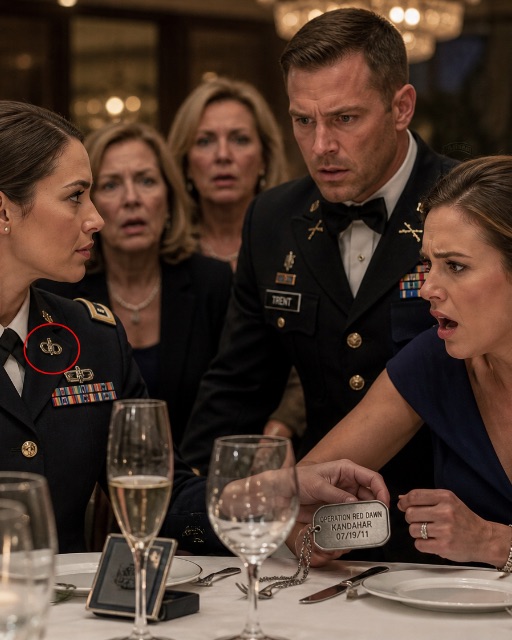
Trent was still standing. His eyes hadn’t left the piece of metal on the table – a small challenge coin, blackened on one edge where the fire had kissed it three years ago in a valley I’m not allowed to name.
“Kendra.” His voice cracked. “Sit down. Please.”
“Don’t tell me to sit down – ”
“SIT. DOWN.”
She sat.
My mother’s hand flew to her mouth. She knew. She’d always known something, but I’d never told her the full shape of it. Classified has a way of eating the parts of you that families usually get to keep.
Trent turned the coin over with one finger, like he was afraid to touch it. His other hand was pressed flat against the table to stop the tremor.
“Eleven men,” he said to the table. Not to me. Not to Kendra. To the tablecloth. “Eleven of us walked out of that valley. The bird came in low, under fire, on a window nobody believed was possible. The call came from an operations officer stateside. A voice on the radio. We never saw her face. We only ever heard her call sign.”
He finally looked up at me.
“I’ve been carrying this coin in my wallet for three years. Waiting to find the person it belonged to. To say thank you.”
Kendra’s mouth opened. Closed. Opened again.
“Colleen…” she whispered. “What… what do you actually do?”
I didn’t answer her. I looked at Trent instead, and gave him the smallest nod – the one that meant at ease, soldier, you’re home now.
He sank into his chair. And then he did something I will never, as long as I live, forget. He picked up the coin, pressed it to his forehead, and his shoulders started to shake.
My uncle cleared his throat. My aunt set her fork down very, very quietly.
And Kendra – Kendra who’d spent twenty-nine years being the louder sister, the prettier sister, the sister who got the good china and the good boyfriend and the good story – Kendra started to cry.
Not the pretty kind.
“Why didn’t you tell me?” she choked out. “Why did you let me say those things – for years—why did you let me—”
I reached across the table and took her hand. Because she’s still my sister. Because that’s what the job teaches you: you bring everyone home. Even the ones who didn’t know they were lost.
“Because I couldn’t,” I said softly. “And because you needed to be the hero of something, Kendrie. I didn’t want to take that.”
She broke completely then.
But here’s the part nobody at that table saw coming. The part that made my mother stand up so fast her chair hit the floor. Because Trent wasn’t done. He wiped his eyes, reached into his jacket pocket, and pulled out a folded envelope — worn soft at the creases, addressed in handwriting I recognized instantly.
“There’s one more thing, ma’am,” he said. “I was told to deliver this in person. If I ever found you.”
I took the envelope. I saw the name in the corner.
And my hands started to shake for the first time all night.
The name in the corner was Sergeant Matthew Davison. Matt. He was the comms specialist on the ground that day. He was the one feeding me the coordinates, his voice unnervingly calm even as I could hear chaos erupting behind him. He was point of contact until the very end.
He was also one of the three who didn’t make it onto the bird.
His handwriting was a steady, neat block print. It was the same script I’d seen on countless reports he’d filed. Seeing it now, on a personal envelope, felt like seeing a ghost.
The entire restaurant had faded away. It was just me, the worn paper, and Trent’s heavy breathing across the table.
My fingers fumbled with the seal. It was old, the glue barely holding. Inside was a single sheet of paper, folded twice. There was something else, too. Something small and rectangular. A photograph.
I unfolded the letter first.
The words were written in the same steady hand.
“To the voice on the radio,” it began.
“I don’t know who you are. I don’t know your name or your face. But I know your voice. You’ve been our angel for six months, an invisible shield. We call you the Commander. I hope you don’t mind. It feels right.”
My throat constricted. We’re told not to get attached. We’re told to be a function, a call sign, a clear and decisive presence. We are not angels. We are not commanders. We are cogs in a machine.
But Matt hadn’t seen it that way.
“The situation here is getting worse than they told you it would be,” the letter continued. “I have a feeling about this one. The kind you don’t ignore. So I’m writing this on the off-chance it finds its way to you.”
“I’m not scared of what might happen to me. I made my peace with that a long time ago. But I have a son. His name is Adam.”
“He’s seventeen. He’s a good kid, but he’s carrying a lot of anger I don’t know how to fix. The only time he isn’t angry is when he’s drawing. He’s brilliant. He can see the world in lines and colors I can’t even imagine. He dreams of going to art school.”
“His mom, my wife Sarah, she passed from cancer two years ago. It’s just been him and me. If I don’t come home, he’ll have nobody. He’ll go to my sister, but she doesn’t understand him. She doesn’t understand his art. I’m scared that fire in him will go out.”
“So I’m asking an impossible thing from a stranger. If you’re reading this, it means I’m gone. And it means someone from my team, probably Trent—he’s stubborn like that—managed to find you. If you can, would you check on my boy? Just once. Tell him his dad was proud of him. Tell him not to let the fire go out.”
“I’ve enclosed a photo of him, and one of his drawings he sent me. So you’ll know him.”
“Thank you, Commander.”
“Godspeed. Sgt. Matthew Davison.”
A single tear hit the paper, smudging the ink of his name. I didn’t realize I was crying. I slowly picked up the photograph. It showed a lanky teenager with a defiant thatch of dark hair and his father’s kind eyes, though his were clouded with a familiar teenage sullenness.
Behind the photo was a small, folded piece of paper. I opened it. It was a charcoal sketch, incredibly detailed, of a bird in flight. An eagle, maybe. But its wings were made of tangled wires and circuits, and its eyes were camera lenses. It was both beautiful and unsettling. It was genius.
I looked up from the letter. My family was frozen, watching me. Kendra’s face was streaked with tears, her makeup a mess. Her expression wasn’t envy or shock anymore. It was a deep, gut-wrenching shame.
“Colleen?” my mother whispered, her hand still over her heart. “What is it, honey?”
I couldn’t speak. I just folded the letter, carefully, and slid it back into the envelope with the pictures. I looked at Trent.
“He was a good man,” I managed to say.
Trent nodded, his eyes glistening. “The best.”
“His son,” I said, my voice gaining a little strength. “Adam. The letter is about his son.”
Kendra made a small, wounded sound. She pushed her chair back and practically fled the table, heading for the restroom. My dad made a move to follow, but my mom put a hand on his arm.
“Let her go,” she said softly. “She needs a minute. We all do.”
The rest of the dinner was a quiet affair. The celebratory mood was gone, replaced by something heavier, more real. We ate in near silence. Trent told a few sanitized stories about Matt, about his dry humor and his obsession with getting the perfect cup of coffee, even in the middle of nowhere.
Every story felt like a stone being laid on a memorial.
When we got home, Kendra went straight to her room without a word. I could hear her muffled sobs through the door.
I went to my own room, the one that still had posters from high school on the walls, a relic of the person I was before my life split into two separate worlds. I sat on my bed and took out the letter again.
I had a new mission now. It wasn’t classified. It didn’t involve satellites or encrypted channels. It involved a boy who had lost his father and maybe himself.
The next two days were strange. A thick fog of unspoken things hung in our house. Kendra actively avoided me. She’d leave a room when I entered. I’d catch her staring at me with a look of utter confusion, as if seeing me for the first time.
The sister who had defined herself by being my opposite—the social one, the successful one, the one with the glamorous life—was suddenly adrift. Her reference points were gone.
On the third day, there was a knock on my bedroom door. It was Kendra.
She stood in the doorway, chewing on her lip. She wasn’t wearing her usual impeccable makeup. Her hair was just pulled back in a simple ponytail.
“Can I… can I come in?” she asked.
I nodded. “Of course.”
She sat on the edge of my desk chair, twisting her hands in her lap.
“I’m so sorry, Colleen,” she said, her voice barely a whisper. “I’ve been… I’ve been awful. For years.”
“Kendrie, you didn’t know.”
“That’s not an excuse!” she said, her voice rising with frustration. “I should have known. I should have seen… something. I saw a quiet sister with a boring government job. I was so wrapped up in my own little world, in being the ‘interesting’ one, that I never really looked at you. I just made up a story about you that made me feel better about myself.”
Her honesty was brutal. And it was exactly what we needed.
“I’m the one who should be sorry,” I said. “I let you believe it. It was easier than trying to explain.”
“What you do… it’s… important,” she stammered, like the word was foreign in her mouth when applied to me. “You saved people. I plan parties for people who want to sell expensive watches.”
The self-loathing in her voice was raw.
“Your job isn’t stupid, Kendra. You’re good at it. You connect with people.”
She just shook her head, tears welling up again. “Not in any way that matters.”
I took a breath. It was time to bridge the gap.
“I need your help,” I said.
She looked up, startled. “Help with what? Filing? Making coffee?” The joke fell flat, and she winced.
“No,” I said seriously. “With my new mission. With Adam.”
I spent the next week doing what I do best: gathering information. It wasn’t hard to find Adam Davison. He was living with his aunt in a small town two hours away. He had graduated high school six months after his father’s death. He had not gone to art school.
He was working at a tire shop.
I drove out there on a Saturday. The shop smelled of rubber and motor oil. I found him in the bay, wrestling with a lug nut wrench. He was taller than in the photo, and the sullenness in his eyes had hardened into a flat, impenetrable anger.
“Adam Davison?” I asked.
He grunted without looking up. “Yeah?”
“My name is Colleen. I… I worked with your father.”
That got his attention. He dropped the wrench with a clatter and straightened up, wiping his greasy hands on a rag. He looked me up and down.
“You’re a soldier?” he asked, his tone laced with disbelief.
“Not exactly. I was an operations officer. I was on the radio with him. On his last day.”
His face shuttered. The anger was back, stronger this time. “Oh. So you’re the one he was talking to when he died.”
The words were a punch to the gut.
“I’m so sorry for your loss, Adam. Your father was a hero.”
“Yeah, well, heroes don’t come home,” he spat. “What do you want?”
I was losing control of the situation. This wasn’t a tactical scenario I could analyze. This was raw grief.
“He… he left a letter,” I said, my voice faltering. “For me. He wanted me to check on you. He told me about your art.”
A bitter laugh escaped his lips. “My art. Right. There’s no art. Not anymore.”
“He said you were brilliant.”
“He’s dead,” Adam said coldly. “It doesn’t matter what he said. Now if you’ll excuse me, I’ve got tires to change. They don’t change themselves.”
He turned his back on me. The conversation was over.
I drove home feeling utterly defeated. I could guide a helicopter through enemy fire, but I couldn’t get through to a grieving teenager. My skills were useless here.
That night, I told Kendra what had happened. I showed her the sketch Matt had sent me. She held it carefully, her eyes tracing the intricate lines of the mechanical bird.
“Wow,” she breathed. “He’s really good.”
“He doesn’t draw anymore,” I said, slumping onto my bed. “He’s just… angry. And I made it worse.”
Kendra was quiet for a long time, just looking at the drawing. Her mind, the one I’d always dismissed as being focused on frivolous things, was working. I could almost see the gears turning.
“This marketing company I work for,” she said suddenly. “We do a pro bono project every year. Last year it was a fundraiser for an animal shelter. This year… the slot is still open.”
I looked at her, confused. “What are you talking about?”
“I’m talking about Adam,” she said, a spark in her eye I hadn’t seen in weeks. But this time, it wasn’t about her. “What if we hosted a small art showcase? For undiscovered local artists. Young ones. We could feature him.”
“Kendrie, he won’t even talk to me. He said he doesn’t draw anymore.”
“Then you don’t go,” she said, her voice firm. “I do.”
And here came the twist I never saw coming. It wasn’t a betrayal or a secret revealed. It was my sister, Kendra, stepping into a role I never could have imagined for her.
The next weekend, Kendra drove out to the tire shop. She didn’t mention me. She didn’t mention the military. She walked in there as Kendra, the bubbly, confident marketing exec.
She told me later that she just talked to him. She complimented the pinstriping on an old hot rod in the corner of the shop. She asked him about design. She didn’t push. She just opened a door.
She left her card for the “Young Artists’ Showcase,” and told him if he ever picked up a pencil again, he should give her a call. She didn’t expect him to.
But two weeks later, he did.
Kendra went into overdrive. She used every bit of her social savvy, every contact, every ounce of the charm I used to resent. But this time, it wasn’t for her own glory. She secured a small gallery space for free. She convinced a local print shop to do the programs at cost. She charmed a food blogger into covering the catering.
She was a commander in her own right, marshalling forces I didn’t even know existed.
She worked with Adam. She didn’t coddle him. She gave him deadlines. She gave him feedback on how to frame and present his work. She treated him not as a grieving boy, but as a professional artist.
And he responded. He started drawing again, first tentatively, then with a frantic energy, as if making up for lost time. He was getting the anger out, not with words, but with charcoal and ink.
The night of the showcase arrived. The small gallery was buzzing. My mom and dad were there, beaming. Trent came, too, standing quietly in the corner, his gaze fixed on Adam’s section of the wall.
Adam’s work was breathtaking. There were more mechanical birds, but also haunting landscapes and portraits full of raw emotion. In the center of it all was a large charcoal portrait. It was of his father, Sergeant Matthew Davison, smiling.
I found Kendra by the drink table, directing a volunteer. She looked happy. Genuinely, peacefully happy. She wasn’t the center of attention. Adam was. And she was glowing.
“You did this, Kendrie,” I said, my voice thick with emotion.
She smiled, a real, soft smile. “No. We did. You got the mission. I just handled the logistics.”
Later, I saw Trent talking to Adam. He was pointing at the portrait of Matt, sharing a story. Adam was listening, and for the first time, I saw the anger in his eyes replaced by something else. Understanding.
He looked over at me and nodded, a small, grateful gesture that meant more than any words. Mission accomplished.
On the way home, Kendra and I sat in the back of our parents’ car, just like when we were kids.
“Thank you,” she said quietly.
“For what? You did all the work.”
“No,” she said, shaking her head. “Thank you for letting me help. For a long time, I thought being a hero meant being the loudest one in the room, the one with the best story. Tonight, I realized that’s not it at all.”
She looked out the window at the passing city lights.
“Sometimes, being a hero just means helping someone else find their own voice. Making sure their fire doesn’t go out.”
I reached over and took her hand. She was right. My job was to bring the soldiers home. But we had both just learned that some missions are different. Sometimes, the mission is to bring a part of them home, too—their legacy, their hope, their son’s future.
We all have a role to play. Sometimes it’s on a battlefield you can’t see, and sometimes it’s in a brightly lit art gallery. Both are important. Both can save a life.