The satellite feed cut out at 0300 hours local time. I was crouched behind a collapsed wall in a country the State Department swears we’ve never operated in, three men under my command waiting for the green light, when my earpiece clicked twice.
Two clicks meant home.
Two clicks had never happened before in eighteen years.
“Colonel.” The operator’s voice was tight. “Priority patch. Your wife. Authentication confirmed.”
I held up a fist. My team froze.
Then I heard Amelia’s voice, and the war I was in stopped mattering.
“They hurt her, Walter. Three boys. Behind the school. The mayor’s son.”
I closed my eyes. Sand blew against my cheek. Somewhere over my left shoulder, the target we’d been hunting for fourteen months was sleeping in a concrete building, and I no longer cared if he lived another fifty years.
“Did you call the police?”
“I did.” Her voice cracked. “Chief Grant answered. He laughed, Walter. He laughed and said boys will be boys and I should teach our daughter to dress better.”
The man next to me, Sergeant Doyle, had known me for twelve years. He had never seen my face do what it did then. He told me later it was like watching a door close on a room that had a body in it.
I keyed my radio.
“Mission scrubbed. Wheels up in six. We’re going home.”
“Sir,” Doyle whispered, “that’s not your call to – ”
“It is now.”
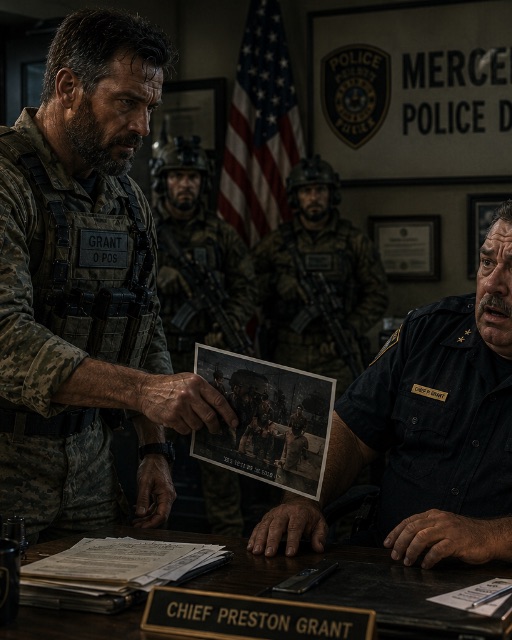
Forty-eight hours later I stood in the lobby of the Mercer Ridge Police Department in civilian clothes that didn’t fit right because I hadn’t worn them in two years. A folder under my arm. A photograph inside it.
The desk sergeant told me the chief was busy.
I waited.
Chief Hollis Grant walked out at 2:14 PM, laughing into his cell phone about a golf score. He saw me. He didn’t recognize me. Why would he. Truck drivers don’t come to police stations in pressed shirts.
“Help you, sir?”
I set the folder on the counter. I opened it. I slid the single photograph across the wood toward him.
He looked down.
His face went the color of milk left out in summer.
The phone slipped from his hand and hit the tile floor, and the voice on the other end kept saying “Hollis? Hollis?” while the chief stared at the photograph and his mouth opened and closed like a fish drowning in air.
“How did you get that,” he whispered.
I didn’t answer.
Because the photograph wasn’t of Preston. It wasn’t of my daughter. It wasn’t of anything that had happened in the last week.
It was a photograph from 1994. A photograph of Hollis Grant standing next to a body in a drainage ditch outside Fort Bragg. A photograph that three federal agencies had spent thirty years pretending didn’t exist.
A photograph I had been carrying in a safe deposit box since the day I married Amelia.
Because Amelia’s maiden name wasn’t Carter.
It was Grant.
And the body in that ditch wasn’t a stranger.
It was her brother. His son.
“Where,” Grant choked out, his eyes still glued to the image of his younger self. “Where did you get this?”
I leaned forward, keeping my voice low so only he and the sweating desk sergeant could hear me. “The better question, Chief, is what you’re going to do about my daughter.”
His eyes darted up, finally connecting me to the phone call from my wife. The call he had laughed at. Understanding dawned, followed by pure, animal terror.
“You’re her husband,” he rasped. “The soldier.”
“I am,” I said. “And you have one hour to make a public statement. You’ll be announcing the immediate arrest of the mayor’s son, Preston, and his two friends for aggravated assault.”
“I can’t just – ”
“You will also be announcing your immediate resignation, effective today, pending a full state-level investigation into corruption and obstruction of justice in this department.”
He shook his head, a pathetic, jerky motion. “You can’t prove any of that.”
I tapped the photo. “This isn’t about proving what you did today, Hollis. This is about what I can prove you did thirty years ago.”
I pulled the photograph back and turned it over. There was writing on the back, in my own hand, from years ago. A name and a number.
“What’s that?” he whispered, his voice hoarse.
“Insurance,” I said. “On the back of this photo is the name ‘Corporal Henderson.’ Remember him? The guy you framed for your son’s ‘accidental’ death? The one who got a dishonorable discharge and disappeared?”
Grant’s face, which I thought couldn’t get any paler, somehow did.
“I imagine the State Police and the Army’s Criminal Investigation Division would love to talk to him. I bet he’d have a lot to say about the night Michael died.”
I slid the folder closed. I turned to leave.
“You have fifty-five minutes,” I said over my shoulder, not breaking my stride.
As the heavy door closed behind me, I didn’t need to look back. I could feel the weight of his past crashing down on him. I could almost hear the sound of his world shattering.
The drive home was quiet. My hands were steady on the wheel. This wasn’t a war fought with guns and satellites. This was a different kind of battle, for a piece of ground far more important than any foreign soil. It was for my family.
I had been a young lieutenant back at Bragg in ’94, leading a night-time training exercise. We’d been off course, deeper in the woods than we were supposed to be. That’s when we heard the voices.
Two men arguing. One was a young man, pleading. The other was older, angrier. A politician’s son, powerful even then. The argument was about drugs, money. A deal gone wrong. There was a third man there, a Captain in the MPs named Hollis Grant. I didn’t know his name then.
I saw Grant try to break it up, but it was too late. I saw the politician’s son strike a blow. I saw the young man, Michael, fall and hit his head on a concrete culvert. Then there was silence.
Grant panicked. But not in the way a civilian would. He went cold. He took control. He sent the politician’s son away. My team and I were hidden, silent observers. We were just kids, really, terrified of the Captain who was now fabricating a crime scene.
He couldn’t hide the body, so he changed the story. He must have known someone else was nearby. He created a new narrative right there in the dark. An accident. A fall.
I was too scared to come forward then. I was twenty-two and he was a Captain. It would have been my word against his. But I had a secret weapon. A small, pocket camera I wasn’t supposed to have. I took one picture. Just one. Of Grant, standing over the body, his face illuminated by his flashlight. A moment of quiet contemplation before the cover-up began.
Years went by. I rose through the ranks. I never forgot. I put the photo and a small roll of film in a safe deposit box.
Then, at a military ball in DC, a decade later, I met a congressional liaison named Amelia Carter. She was smart, funny, beautiful, and she had a sadness in her eyes I recognized. The sadness of loss.
We fell in love. It was only when I was preparing to ask her to marry me that she told me her full story. Her last name wasn’t Carter; she used her mother’s maiden name for work. She was Amelia Grant. Her father was in law enforcement back in her hometown. Her brother, Michael, had died in a tragic training accident at Fort Bragg when she was a teenager.
The world stopped spinning.
I almost told her then. I almost showed her the photograph. But what would that have accomplished? It would have destroyed the memory of her brother and shattered the already fragile relationship with her father. He was a bad man, but he was her only living parent.
So I made a choice. I would protect her from that truth. I would keep the secret, carrying it like a stone in my gut. I married her. I put the photograph, now with a new purpose, back in the safe deposit box. It was no longer evidence of a crime I’d witnessed; it was a shield to protect my future family from the man who should have been its protector.
When I walked through my front door, the silence in the house was heavy. Amelia was sitting on the sofa, her arms wrapped around our thirteen-year-old daughter, Lilly. Lilly’s face was bruised, her eyes swollen. She looked so small.
My own daughter. And he had laughed.
The rage I had kept packed down tight in a box threatened to break free. But seeing Lilly, it wasn’t rage that won. It was a profound, aching sadness.
I knelt in front of them. “Lilly,” I whispered. “Hey, sweet pea.”
She wouldn’t look at me. Her shame was a wall between us.
“It’s not your fault,” I said, my voice thick. “None of this is your fault. Do you hear me? You did nothing wrong.”
Amelia looked at me, her eyes asking the question she was afraid to voice. “Walter? What did you do?”
“I went to see your father,” I said softly.
A flicker of the old disappointment crossed her face. “It won’t do any good. He doesn’t listen.”
“I think he’ll listen this time,” I said. I pulled her into the kitchen, out of Lilly’s earshot.
“What do you mean?” she asked, her voice trembling. “Walter, what did you do?”
I took a deep breath. The secret I had carried for over fifteen years felt like a physical weight. “Amelia, there’s something I should have told you a long time ago. About your brother. About that night at Fort Bragg.”
I told her everything. About being in the woods. About hearing the argument. About the politician’s son. About her father’s choice to protect a powerful man’s kid instead of getting justice for his own.
She listened, her face a mask of disbelief, then dawning horror, then heartbreaking understanding. The sadness I first saw in her eyes all those years ago deepened into a vast, dark ocean.
“The photo,” she whispered. “You have a photo?”
I nodded. “He saw it today.”
Her hand flew to her mouth. The tears she had been holding back finally came, not for Lilly’s bruises, but for a thirty-year-old betrayal. For the brother she’d lost and the father she never really had.
“He protected him,” she said, aghast. “He let the man who killed Michael walk away, and he ruined another soldier’s life to cover it up.”
“Yes,” I said.
Just then, my phone buzzed. It was a news alert from the Mercer Ridge local news station. I held it up for Amelia to see.
The headline read: “Police Chief Hollis Grant Announces Arrest of Mayor’s Son, Cites Immediate Retirement for ‘Health Reasons’.”
A second alert popped up moments later. “State Police Announce Full Investigation into Mercer Ridge PD.”
Amelia stared at the phone, then at me. The tears were still on her face, but something new was in her eyes. It wasn’t relief. It was a kind of searing clarity. The final, painful piece of her life’s puzzle had just clicked into place.
We went back into the living room. Lilly had fallen asleep on the sofa, her face still puffy. I picked her up and carried her to her room, tucking her in. She was safe. That was all that mattered.
The next few weeks were a storm. Chief Grant disappeared from public life. The mayor’s son and his friends were charged, and with the full weight of the state behind the prosecution, their entitled smirks vanished. They were just scared boys facing the consequences of their cruelty.
My old friend Sergeant Doyle, using channels I could only guess at, got me the last known address for the man Grant had framed: Corporal Henderson. I found him living in a run-down apartment three states away, a bitter, broken man.
I didn’t tell him who I was at first. I just sat with him, bought him a coffee, and listened to his story. He told me about being in the wrong place at the wrong time, about a powerful captain who needed a scapegoat. He’d lost his career, his reputation, his future.
Then, I told him who I was and what I knew. I gave him the name of a lawyer, a very good one, whose fees I had already paid. I told him the Army CID was reopening the case. For the first time in thirty years, a flicker of light appeared in his haunted eyes.
Two months later, Henderson was officially exonerated. He received a formal apology, his full back pay, and had his honorable service record restored.
The biggest twist, however, came from Amelia. One evening, she sat down next to me on the porch as I watched the sunset.
“I called him,” she said.
I knew who she meant. “You didn’t have to do that.”
“I did,” she said, her voice firm. “For me. I called my father.”
She told me he had answered, his voice weak and old. She didn’t yell. She didn’t scream. She just told him that she knew. She told him that she was sad for the brother she lost, and even sadder for the father who had lost his soul that night in the woods.
Then she told him about Lilly. She told him about his granddaughter, a girl he had never bothered to know. A girl who was strong and resilient and kind, who was healing from the wounds inflicted by a world he had helped create through his own cowardice.
“He just listened,” Amelia said, a tear rolling down her cheek. “When I was done, I told him goodbye. And I meant it.”
She had cut the final cord. Not with anger, but with a quiet, powerful grace. That was my wife.
My time in the field was done. After that call, I knew my place was here, not in some forgotten corner of the world. The wars at home are the ones that matter most. They are fought not with weapons, but with truth and commitment, with the courage to stand up when it’s easier to stay hidden.
Sometimes, all it takes is one person to say, “No more.” It might be a hushed command in the desert, or a single photograph placed on a counter. It is the simple, unwavering act of protecting your own. That is a mission that never ends. And it is the only one worth fighting.