
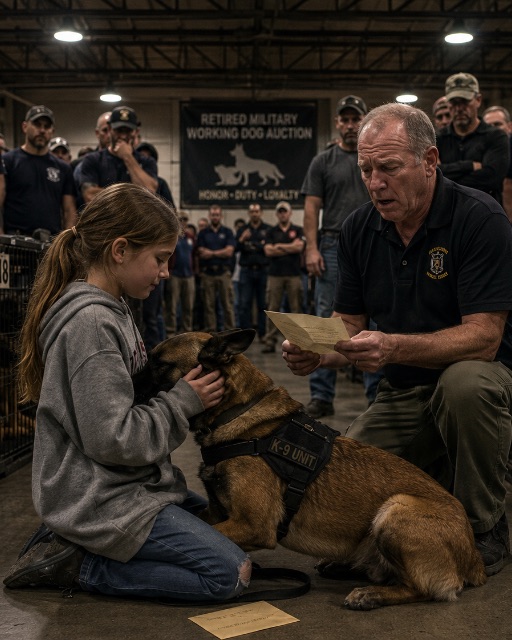
The name at the bottom wasn’t Garrett Kowalski’s.
It was Dale Petrocelli’s.
And underneath his signature, in blocky military shorthand, were six words I will never forget:
“KEEP HER AWAY FROM THE HANDLER.”
I looked up. Dale wasn’t locking the doors to protect us.
He was locking them to keep someone inside.
My eyes darted across the room. Every handler had frozen – except one. A stocky man near crate 27 was already moving toward the back exit, his hand sliding into his jacket.
Ringo saw him first.
The Malinois didn’t bark. Didn’t growl. He just stood – placed his body directly between the man and the girl – and bared every tooth he had in absolute silence.
The man stopped.
Thirty-one other dogs rose to their feet at exactly the same moment. Not one of them made a sound. They just faced the same direction, like a formation they’d never forgotten.
The girl didn’t flinch. She didn’t even turn around.
She just whispered, “Dad said you’d try to run, Mr. Colvin.”
The man’s face twisted. He lunged for the exit.
He made it four steps.
Ringo hit him like a freight train—seventy pounds of precision and fury trained by a man everyone in that room thought was dead.
Dale grabbed the mic. His voice was barely holding.
“Nobody moves. Federal agents are already en route. This auction is now an active crime scene.”
I stood there, shaking, staring at this ten-year-old girl who hadn’t shed a single tear. Who walked into a room full of combat veterans and war dogs with nothing but two pieces of paper and a dead man’s patch.
I knelt beside her while Ringo pinned Colvin to the concrete.
“Sweetheart,” I said. “Who brought you here today?”
She looked at me with her father’s eyes—steady, dark brown, completely unafraid.
“Nobody brought me,” she said. “I took two buses.”
“But who told you to come? Who gave you the patch three days ago?”
She reached into her hoodie one final time.
She pulled out a phone. A cheap burner, the kind you buy at a gas station.
“He calls every Tuesday,” she said. “He always calls. He said this Tuesday was the last time.”
I looked at the phone’s call history.
One contact. No name. Just a number.
The last incoming call was logged at 0300 hours, three days prior.
The same morning a classified extraction team touched down at a black site in eastern Syria that officially doesn’t exist.
Dale saw the phone. He closed his eyes. His lips moved, but no sound came out.
Then he pulled up his own phone. Dialed a number. Waited.
I watched his face shift from grief to confusion to something I can only describe as terror mixed with hope.
Someone answered.
Dale said one word: “Garrett?”
The room was so quiet I heard the voice on the other end.
It said: “Get my daughter out of there, Dale. And don’t let her open the third note.”
Dale’s eyes dropped to the girl’s hoodie pocket.
It was bulging slightly.
There was a third piece of paper.
The girl’s hand was already reaching for it.
Dale grabbed her wrist—gently, but firm.
“Not yet,” he breathed. “Not here.”
She looked up at him, and for the first time, her composure cracked. Her chin trembled.
“Is my dad coming home?”
Dale couldn’t answer.
Because the phone had already gone dead.
And when he tried to call back, the number didn’t just go to voicemail.
It no longer existed.
I left that auction four hours later after giving my statement to men in suits who never showed me a badge. They confiscated my phone. They made me sign something I wasn’t allowed to read.
Ringo left with the girl. That much I know. No one stopped them.
I still don’t know what was on that third piece of paper.
But last Tuesday, at exactly 0300, my new phone buzzed.
Unknown number.
One text. No sender.
“She opened it.”
I haven’t slept since. Because every night at three in the morning, my porch camera picks up the same thing—a Belgian Malinois sitting at the end of my driveway, facing the road, perfectly still.
Waiting for someone.
For three nights, I just watched the camera feed. My heart hammered against my ribs like it was trying to get out.
Ringo never moved, except to turn his head whenever a car passed.
He was a living statue carved from shadow and loyalty.
On the fourth night, I couldn’t take it anymore. The waiting was worse than any action.
I pulled on my boots, grabbed my keys, and walked out the front door into the cool, damp air.
The moment I stepped on the porch, Ringo’s head snapped in my direction. He didn’t get up, just watched me.
I walked slowly down my driveway. The asphalt was cold under my feet.
When I reached the end, I stopped about ten feet from him.
“Hey, boy,” I whispered. My voice was shaky.
Ringo just looked at me with those intelligent, amber eyes. He gave a low whine, a sound so full of meaning I couldn’t even begin to decipher it.
Then he stood up.
He didn’t come to me. He turned and looked down the street, then back at me. He took a few steps, then paused, waiting.
It wasn’t a request. It was an instruction.
My mind was screaming at me to go back inside, to forget I ever saw any of this. To live my quiet life training dogs for civilian work.
But then I thought of that little girl. And I thought of Garrett Kowalski, a man I’d only known briefly during a training op years ago, but whose reputation for honor was unshakable.
I got in my truck.
Ringo started a slow, steady trot down the road. I put the truck in drive and followed, keeping a respectful distance.
We moved through the sleeping suburban streets. My headlights cut through the darkness, illuminating the silent dog leading the way.
He wasn’t just wandering. Every turn was deliberate. Every stop at an intersection was precise.
After about fifteen minutes, he turned into the driveway of a small, forgettable ranch house. The kind you’d pass a thousand times and never notice.
He went straight to the back gate and sat down.
I parked across the street and killed the engine. The silence was absolute.
What was I supposed to do? Knock on the door at four in the morning?
As if he read my mind, the back porch light flicked on.
The door opened, and Dale Petrocelli stepped out. He looked ten years older than he had at the auction.
He saw Ringo, then his eyes found my truck in the darkness. He gave a slight nod.
I got out and crossed the street, my heart pounding with every step.
Dale let me in through the back gate. “Knew you’d come,” he said quietly. “Garrett said you were a good man.”
“Garrett?” I asked, my voice barely a whisper. “But I hardly knew him.”
“He knew you,” Dale replied, leading me inside. “Knew you loved your dogs more than the money. That’s all that mattered.”
The kitchen was small and clean. Sitting at the table, wrapped in a blanket and sipping a glass of milk, was the girl.
She looked up at me, her eyes just as steady as before.
“Hi,” she said.
“Hi,” I managed to say back.
Dale gestured for me to sit. He looked exhausted.
“So,” I began, not knowing where to start. “The text…”
Dale nodded. He reached into his pocket and pulled out a folded piece of paper. The third note.
He slid it across the table toward me.
“She opened it an hour after the feds let us go,” Dale said. “Her hands were shaking. She said her dad told her if he ever missed a Tuesday call, she was to open it with me.”
My hands trembled as I unfolded the paper.
It wasn’t what I expected. There was no complex code, no list of targets.
It was a key. A simple, brass key for a safe deposit box, taped to the paper.
Beneath it was a handwritten address for a bank downtown.
And under that, two short sentences in Garrett’s familiar script.
“To Samuel Wright. For my Maria. Take care of her until I get back.”
My name. He wrote my name. Samuel Wright.
I stared at it, completely stunned. Garrett had planned for me to be part of this. He’d put his daughter’s fate in my hands as a contingency.
The little girl, Maria, was watching me.
“My dad trusts you,” she said, as if it were the simplest fact in the world.
I looked at Dale, speechless.
“The Handler, Colvin, he wasn’t just trafficking dogs,” Dale explained, his voice low and urgent. “That was a cover. He was using the K-9 transport network to move sensitive military tech. Prototypes. Intel chips. Selling them to the highest bidder.”
It all started to make sense. The secrecy, the feds in suits, the need for an outsider.
“Garrett found out,” Dale continued. “He tried to go through channels, but he was shut down. He realized the rot went high up. Very high up. So he had to go dark.”
“He faked his death,” I pieced together.
“Made it look like a training accident. He’s been feeding me information from the inside for six months, building the case. The auction was the endgame. He knew Colvin would be there, and he knew most of the handlers in that room were loyalists who would follow his lead.”
That was the first twist. The silent, coordinated movement of the dogs wasn’t just a surprise. It was planned. Garrett had his own silent army in that room, and I’d been completely oblivious.
“But something went wrong on his end,” Dale said, his face darkening. “The extraction team that was supposed to bring him in after the call… they were compromised. He’s stuck. Incommunicado. And whoever is behind Colvin knows Garrett is alive.”
My blood ran cold. “So they know about you? About her?”
Dale nodded grimly. “We’re loose ends. They’ve been watching my place. That’s why I had Ringo bring you here. We can’t stay.”
I looked at the key on the table. “What’s in the box?”
“Everything,” Dale said. “The proof. Hard drives, transaction logs, names. All the evidence Garrett compiled. It’s our only leverage.”
“And he wants me to get it,” I said, the weight of it all settling on my shoulders.
“He wants us to get it,” Dale corrected. “He knew you were the only other handler from the old unit they couldn’t touch, couldn’t blackmail. Clean record, no family they could threaten. Just you and your dogs.”
Suddenly, my quiet, solitary life made me the perfect candidate.
Maria finished her milk and put the glass down. “My dad has a plan for that, too,” she said.
She pointed to the third note again. To a part I had overlooked in my shock.
There was a series of numbers under my name. Not a code. A phone number.
Dale looked at it. “I never saw that. She must have been covering it with her thumb.”
I pulled out my burner phone, the new one the feds had given me, and dialed.
It rang once.
A gruff voice answered. “Wright?”
“Yes,” I said. “Who is this?”
“Doesn’t matter. Garrett said you’d call when you were ready to finish the job. The bank opens at nine. Be at the corner of 4th and Main at 0845. Come alone.”
The line went dead.
The next few hours were a blur of hushed planning. Dale explained that the people after us were likely private contractors hired by the corrupted officials. They were professionals.
We couldn’t just walk into the bank.
At 8:00 AM, Dale drove me to a dog park on the other side of town. Standing by the entrance were three familiar faces from the auction. Handlers Garrett trusted.
One of them, a man named Tom, handed me a change of clothes. “Dale and the girl are secure,” he said. “We’ll create the diversion. You just get the package.”
The plan was simple, and that’s why it was brilliant. It used what they knew best: their dogs.
At 0845, I was standing on the corner of 4th and Main, dressed in a plain jacket and baseball cap.
Exactly on time, three blocks away, a commotion started. One of the handlers and his Shepherd started a loud, public training drill, drawing a crowd.
Two blocks in the other direction, another handler “lost” his dog, a fast-moving retriever that began darting playfully through traffic, causing cars to stop and horns to blare.
It was controlled chaos.
Men in dark sedans, the ones I knew were watching the bank, were distracted. Their attention was split.
A beat-up van pulled up beside me. The side door slid open.
“Get in,” the gruff voice from the phone said.
Inside was a man I’d never seen before, with a face that looked like a roadmap of old fights.
“You’re the wheelman?” I asked.
“I’m the solution,” he said, and drove. He didn’t take me to the front of the bank. He went around back, to a private entrance for an investment firm on the top floor.
“Safe deposit box is a decoy address,” he grunted. “The box is here. Under an account name Garrett set up.”
This was the second twist. The note was intentionally misleading. If we were captured and the note was found, it would send them to the wrong place. Garrett had planned for every failure point.
We went in. The man showed a badge that looked real enough, and we were buzzed into a high-security lobby.
Ten minutes later, I walked out with a heavy briefcase. The man drove me two blocks and let me out.
“Take this phone,” he said, handing me another burner. “When you’re ready to release the information, call the number programmed in it. It’s a journalist Garrett vetted for years. She knows what to do.”
Then he drove off, vanishing into the city. I never saw him again.
I met Dale at a pre-arranged spot—a crowded food court in a mall. Maximum witnesses.
We found a table. Maria sat between us, Ringo under the table at her feet.
I opened the briefcase. Inside were three hard drives and a sealed envelope.
My name, Samuel Wright, was on the envelope.
I opened it. It was a letter from Garrett.
He explained that if I was reading this, it meant he was compromised, but his plan had worked. He thanked me for my courage and honor.
At the bottom, he wrote, “The last drive isn’t evidence. It’s for Maria. Don’t give it to her until you know it’s safe. It’s all she has left of me if I don’t make it.”
We used the burner phone. We called the journalist. We gave her the location of the two evidence drives, hidden in a bus station locker.
The story broke forty-eight hours later.
It was an earthquake. It shook the Department of Defense to its core. The dog trafficking ring was just the tip of the iceberg. A deep-state corruption scandal involving a two-star general and several high-level contractors was exposed.
Colvin, facing life in prison, sang like a canary. Arrests were made. Investigations were launched.
For weeks, we laid low. I stayed with Dale, Maria, and Ringo. We became a strange, temporary family, bound by a secret.
I watched Maria with the third hard drive. She knew it was from her dad, but she never asked to see what was on it. She was waiting.
Then, one night, Dale got a call.
It was from a secure government line. Garrett Kowalski, along with two other operatives who had been declared “lost” with him, had been “found” during a raid on a hidden compound.
He was coming home.
Two weeks later, I stood on a private tarmac. Dale was beside me. Maria stood a few feet ahead, holding Ringo’s leash.
A gray government jet landed and taxied toward us.
The door opened.
A man in military fatigues walked down the steps. He was thinner, with a thick beard and eyes that held the weight of everything he’d seen. But it was him.
Maria let go of the leash.
Ringo was a blur. He cleared the fifty yards between them in seconds, launching himself into Garrett’s arms in a frenzy of pure joy.
Garrett hugged his dog, burying his face in his fur.
Then he looked up and saw his daughter.
He walked toward her slowly, kneeling when he reached her. He didn’t say a word. He just opened his arms.
Maria, the girl who hadn’t shed a tear in the face of danger, finally broke. She ran into his embrace, and for the first time, she cried.
He held her, whispering, “I’m home. I’m home now.”
After a long moment, he looked over her head at me and Dale.
“I owe you everything,” he said, his voice thick with emotion.
“You don’t owe us a thing,” Dale said.
I just nodded, unable to speak.
Later that evening, we all sat in Dale’s backyard. We put the third hard drive in a laptop.
It wasn’t a final message. It was a film. Hundreds of little videos Garrett had recorded for his daughter while he was deployed.
Him reading her bedtime stories. Him singing her favorite songs off-key. Him promising her he’d be home soon. Him telling her, over and over, how much he loved her.
It wasn’t a goodbye. It was a lifeline. It was a father making sure his daughter never, for one second, felt like he was gone.
Watching them, I finally understood. The story wasn’t about a conspiracy or black-ops mission. It was about loyalty. Not just the loyalty of a soldier to his country, or a dog to his handler, but the fierce, unbreakable loyalty of a father to his child.
It taught me that hope is not a passive thing you wait for. It’s a plan you execute. It’s a promise you keep, even from the other side of the world, armed with nothing but belief in the goodness of others. True strength isn’t about the fight you can win alone; it’s about the trust you place in the people who will stand beside you when you can’t.



