
When Jolene Whitfield stepped off the transport truck at Fort Iron Crest, the first thing that hit her was the heat.
It came off the blacktop in thick, wavering sheets, blurring the edges of the barracks and motor pool beyond the reception yard. The second thing that hit her was the silence. Not the peaceful kind. The watchful kind. The kind that falls over a crowd when someone unfamiliar walks into a place where everybody already knows the rules.
She carried one olive duffel bag in her right hand and a slim intake folder under her left arm. No rank on her chest. No unit patch. No ribbons. No tabs. Nothing that explained her.
A corporal with a clipboard squinted at the manifest and then up at her.
“Jolene Whitfield?”
She nodded once.
He looked back down. “No rank listed.”
“No, Corporal.”
“No previous duty station listed.”
“No, Corporal.”
He flipped the page. “No service record listed.”
Jolene met his eyes. “That’s what your paperwork says.”
A few men unloading the truck nearby let out short, amused laughs. The corporal’s ears reddened. He jabbed a finger toward the admin building. “Inside. Reception platoon.”
She picked up her duffel and walked.
The whispers started before she even reached the door.
“Disciplinary transfer.”
“Bet she washed out somewhere.”
“Probably dumped here because no one else wanted her.”
“Look at that file. Blank as hell.”
Fort Iron Crest was the kind of installation that liked to call itself hard. Hard terrain. Hard standards. Hard men. Hard leadership. The slogans were painted on walls, stamped on training pamphlets, barked across parade fields. Behind the signs and mottos, though, it was a place with a reputation that never made it into official brochures.
People got broken there.
Not in the dramatic, heroic way. They got broken in smaller, uglier ways – public humiliation, petty cruelty, selective enforcement, leadership by intimidation. A thousand cuts disguised as discipline.
That was why Jolene had come.
But nobody in the reception building knew that.
Inside, the air-conditioning rattled like it was losing a fight. A framed poster near the entrance read WELCOME TO IRON CREST: EXCELLENCE IS EARNED.
A tall man in a pressed uniform stood at the far table reviewing files. His first sergeant diamond caught the fluorescent light.
First Sergeant Dean Rourke.
Even before he looked up, Jolene recognized the type. Broad-shouldered. Neck thick as a cinder block. Face carefully blank in the way of men who believed emotion was weakness unless the emotion was anger. His reputation had reached Washington three weeks earlier in the form of complaints, statements, and an anonymous packet thick enough to start an inquiry.
He finally raised his head.
His gaze moved over her slowly, lingering not with interest, but with calculation.
“You Whitfield?”
“Yes, First Sergeant.”
He held out his hand. “Folder.”
She gave it to him.
He opened it, flipped through the sparse papers, and frowned. “What is this?”
“My intake file, First Sergeant.”
He tossed it on the table like it offended him. “This is empty. No MOS. No orders. No chain of command signature.” He leaned forward. “Where’d you come from, Whitfield?”
“Processing, First Sergeant.”
“Processing where?”
She didn’t answer.
The room went still. Every recruit froze. You could hear the fluorescent tubes buzzing overhead.
Rourke’s jaw tightened. He stepped around the table. Slowly. He stopped close enough that she could smell the coffee on his breath.
“I asked you a question.”
“And I’m not authorized to answer it, First Sergeant.”
Someone in the back of the room inhaled sharply.
Rourke’s lip curled. He turned to his staff sergeant. “Get me a chair.”
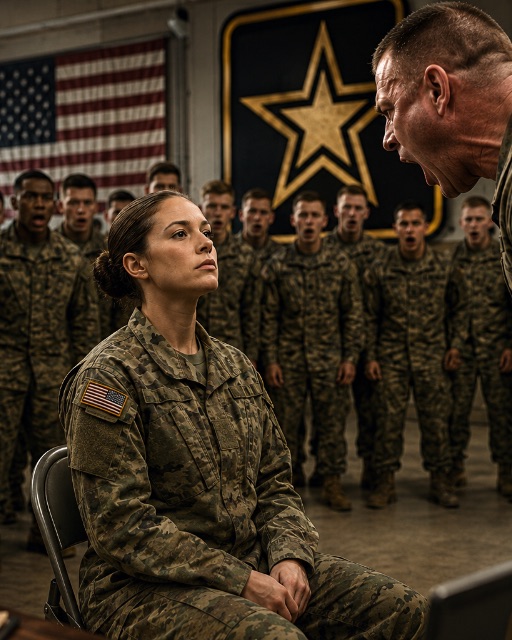
The metal folding chair scraped across the concrete floor. Rourke pointed at it.
“Sit.”
Jolene sat.
“You’re going to stay in that chair until you tell me who sent you, what unit you belong to, and why your file is blanker than a dead man’s diary.”
She folded her hands in her lap. Said nothing.
He leaned down. “I run this post, Whitfield. Not whoever stamped your little folder.”
She looked straight ahead. Didn’t blink.
Twenty minutes passed. Then forty. Recruits were processed around her like she was furniture. Rourke kept glancing over, waiting for her to crack. She didn’t shift. Didn’t ask for water. Didn’t speak.
At the one-hour mark, Rourke stormed over. “You think this is cute?”
Silence.
“You think someone’s coming to save you?”
Silence.
He grabbed the back of the chair and dragged it – with her still in it – to the center of the room. The metal legs shrieked against the floor. Every head turned.
“Look at this,” he announced to the room. “This is what happens when someone shows up to my installation without respect.”
A few nervous laughs from the younger recruits. Rourke fed on it. His chest puffed.
“Nobody comes to Iron Crest and plays games with me. Nobody.”
Jolene looked up at him for the first time since sitting down. Her expression hadn’t changed. But something behind her eyes shifted—something patient, something that had been waiting.
She said, quietly: “You should check your email, First Sergeant.”
Rourke blinked.
His staff sergeant was already at the desk, staring at a computer screen. His face had gone white.
“First Sergeant,” the staff sergeant said. His voice cracked. “You need to see this.”
Rourke marched over. Read the screen. Read it again.
His hands gripped the edge of the desk so hard his knuckles went yellow.
The email was from the Pentagon. Flagged urgent. Marked with a classification header he’d only seen twice in twenty-two years of service.
He turned back to Jolene.
She was still sitting in the chair, hands folded, watching him with the same quiet expression she’d worn since she walked through the door.
“That email,” he whispered. “It says you’re—”
Jolene stood up. Slowly. Brushed off her uniform.
The room had gone dead silent.
She reached into her breast pocket and pulled out a single laminated card. She held it up so only Rourke could see it.
His face didn’t just go pale. It collapsed. Every muscle in it went slack at once, like a man watching his career walk off a cliff.
Because the card didn’t just have her real rank on it.
It had his name on it, too. And next to his name, in red block letters, it said one word that made every man in that room understand exactly what had just walked through their door.
SUBJECT.
Rourke stared at the card, then at Jolene’s face. The nameplate on the card simply read “J. Whitfield,” but the rank insignia above it was a silver oak leaf. A Major.
She wasn’t a recruit at all. She was a field grade officer.
“My name is Major Jolene Whitfield,” she said, her voice still quiet but now carrying the unmistakable weight of authority. “I’m with the Soldier Advocacy and Integrity Directorate.”
No one in the room had ever heard of it. That was the point.
“First Sergeant Rourke,” she continued, slipping the card back into her pocket, “you are hereby relieved of your duties, pending the outcome of a full command climate investigation.”
Rourke’s mouth opened and closed, but no sound came out. The man who had built an empire on shouting was suddenly speechless.
“Staff Sergeant,” Jolene said, turning to the pale NCO at the computer. “Miller, is it?”
He swallowed hard and nodded. “Yes, ma’am.”
“Secure First Sergeant Rourke’s computer, his desk, and his personal effects. He is restricted to his quarters until further notice. I’ll need a temporary office. An empty one.”
“Yes, ma’am,” Miller repeated, a daze of shock and something else—maybe relief—spreading across his face.
Rourke finally found his voice, a ragged, desperate whisper. “You can’t do this.”
Jolene turned back to him. The quiet patience was gone from her eyes, replaced by cold steel. “The email from the Pentagon says I can. The authority comes directly from the Vice Chief of Staff of the Army. Your post commander has been notified. He’s waiting for my call.”
She paused, letting the reality sink in. “You had your hour to show me who you are, First Sergeant. Now it’s my turn.”
Rourke looked around the room, at the faces of the young soldiers he had planned to mold through fear. They were all staring at him, not with fear, but with wide-eyed shock. His power had vanished in less than five minutes.
Two military policemen entered the building, their movements calm and professional. They flanked Rourke without touching him. The message was clear.
As they escorted him out, the myth of Fort Iron Crest began to crumble.
Jolene’s temporary office was a small, dusty room that had been used for storage. Staff Sergeant Miller helped her clear a desk. The entire reception building was still humming with the news.
“Ma’am,” Miller began, his voice hesitant. “What exactly is the… Soldier Advocacy Directorate?”
Jolene looked up from the blank folder she’d carried in. “We’re new. We exist because places like this exist.” She looked him in the eyes. “We investigate leadership environments that the old systems miss. Places where official reports look fine, but the soldiers are telling a different story.”
Miller was quiet for a long moment. He looked down at his own hands. “A lot of stories, ma’am.”
“I know,” she said gently. “That’s why I’m here. But I can’t do it alone. The fear here… it’s thick. People won’t talk to an outsider.”
He understood immediately. She needed a bridge. She needed someone who knew where the bodies were buried, figuratively speaking.
“They’re afraid of what happens after you leave,” Miller said. “Rourke has friends. This whole place was built on his style of ‘leadership’.”
“Change is hard,” Jolene acknowledged. “But staying the same is worse. I need to see the files. Specifically, separation packets. Anyone who was discharged for ‘failure to adapt’ or any other subjective reason over the last two years.”
Miller nodded slowly. He knew exactly which filing cabinet to go to. This was his twist of the knife, his moment to finally do something. He pulled a key from his pocket that he wasn’t supposed to have.
For hours, Jolene sat in that dusty office, reading stories of broken careers. Young men and women full of promise, flagged for trivial infractions, publicly humiliated on training ranges, and driven to mental and emotional breaking points. Rourke’s name appeared in statement after statement, always as a witness, never as the cause. He was a master of a paper trail that protected him.
Then she found it. The file of Private First Class Samuel Williams.
His photo showed a bright-eyed kid of nineteen with a lopsided grin. An expert marksman. Stellar physical fitness scores. Glowing reviews from basic training. He should have been a star.
But at Fort Iron Crest, his record was a nightmare. A series of minor counselings became a cascade of negative reports. Late to formation by two minutes. A scuff on his boot. Answering a question too slowly. Each incident was documented meticulously by Rourke himself.
The final report was a medical separation. A mental breakdown during a field exercise. “Unsuitable for military service.”
Jolene closed the file. This was the one. This was the story that would unlock everything else.
The next morning, she signed out a vehicle and drove two hours off-post to a small, quiet town. The address from Williams’ file led to a modest house with a neatly kept lawn.
An older woman with kind, tired eyes answered the door. “Can I help you?”
“Mrs. Williams? My name is Jolene Whitfield. I’m with the Army. I was hoping I could speak with Samuel.”
The woman’s face tightened. “The Army has done enough to my boy.”
“That’s why I’m here, ma’am,” Jolene said softly. “I’m not here to take anything. I’m here to try and make things right.”
She was led to a back patio where a young man sat staring at a bird feeder. It was Samuel, but the lopsided grin from his photo was gone. His eyes were vacant.
He barely looked at Jolene as she sat down. She didn’t press him. She just sat with him, in the quiet, for a long time.
Finally, she spoke. “I read your file, Samuel. I read what happened at Iron Crest.”
He flinched at the name of the fort.
“It wasn’t your fault,” she said.
A man’s voice came from the doorway. “No, it wasn’t.”
Jolene turned. A tall, gray-haired man in a crisp polo shirt stood there. He carried himself with a posture that never truly went away. He was ex-military, and high-ranking at that.
“I’m Robert Williams,” he said, extending a hand. “Sam’s father.” He looked at Jolene’s plain uniform. “You’re the one they sent.”
Jolene froze. “Sir?”
This was the first twist she hadn’t seen coming.
“The packet,” Robert said, his voice hard as granite. “The one that landed on a general’s desk at the Pentagon. You think it was anonymous?”
He shook his head. “I sent it. And I signed it. Command Sergeant Major Robert Williams, Retired.”
Jolene felt a piece of the puzzle click into place. A retired CSM would know exactly who to send a complaint to, and how to frame it so it couldn’t be ignored. He knew the system’s weaknesses because he had lived in it.
“I tried the normal channels,” he continued, his gaze drifting to his son. “Inspector General, chain of command. They all got stonewalled. Rourke has too many people who owe him, too many people who think his way is the right way.”
He looked back at Jolene. “So I went a different route. I heard about a new initiative. A quiet little directorate designed to handle cancers like Rourke. I made some calls to old friends. I asked for the best. They sent a ghost.”
Jolene finally understood. She wasn’t just an investigator. She was an answer to a father’s prayer.
“He targeted my son because he saw potential,” Robert said bitterly. “Rourke likes to break the strong ones. It makes him feel powerful. He did it to Sam until my boy didn’t know who he was anymore. He came home a shadow.”
Jolene looked at Samuel, who was now listening, a flicker of something in his eyes for the first time.
When she returned to Fort Iron Crest that afternoon, she wasn’t just an officer on a mission. She was an agent of karmic justice.
She didn’t confront Rourke in an office. She had Miller call a surprise formation for the entire reception and training battalion.
As hundreds of soldiers stood in the blazing heat, Jolene walked to the front, a single folder in her hand. Rourke was brought out, standing off to the side with his MP escort, looking confused and defiant.
“My name is Major Jolene Whitfield,” she began, her voice carrying easily across the parade field. “I’m here to talk about leadership.”
She didn’t shout. She just spoke.
“Good leadership builds people up. It finds their strengths and forges them into something even stronger. It creates soldiers who are resilient, confident, and proud.”
She paused. “Bad leadership does the opposite. It breaks people down. It uses fear and humiliation as tools. It creates soldiers who are afraid, uncertain, and broken.”
She then opened the folder and told the story of PFC Samuel Williams. She didn’t use military jargon. She used simple, human terms. She described a hopeful nineteen-year-old boy, his love for his country, and how every bit of that hope was systematically crushed by one man’s ego.
She told them about the scuffed boot, the two minutes late, the endless small cuts that led to a deep wound. She told them about his father, a retired Command Sergeant Major.
A murmur went through the formation. They all knew what that rank meant.
“First Sergeant Rourke didn’t just push a soldier out of the Army,” Jolene said, her voice ringing with conviction. “He stole a part of that young man’s soul. He did it because he could. Because he confused cruelty with strength.”
She turned and looked directly at Rourke. “This is not strength. This is cowardice.”
In that moment, under the gaze of every soldier on that field, Dean Rourke finally broke. His shoulders slumped. His face, once a mask of hard authority, crumpled into the face of a pathetic bully who had just been exposed.
The investigation was swift and brutal. Rourke’s court-martial was a formality. But Jolene didn’t stop there. She and her team stayed for two more months, dismantling the entire culture he had built. His cronies were reassigned or forced into early retirement. New leadership was brought in, handpicked for their integrity.
Staff Sergeant Miller received a commendation and a promotion. He was put in charge of the new reception platoon, tasked with ensuring that what happened under Rourke would never happen again.
On her last day at Fort Iron Crest, Jolene received a package. Inside was a simple wooden plaque. On it was a small brass plate.
It read: “For the Ghost Who Gave Us Back Our Son. – The Williams Family.”
A few weeks later, she got a call from Robert Williams. He told her Sam had enrolled in a local college. He was smiling again. The lopsided grin was back.
Jolene hung up the phone, a quiet satisfaction settling over her. Her job was often invisible, fought in dusty back offices and quiet conversations. There were no medals for what she did.
But the real reward wasn’t a piece of ribbon to be worn on a uniform.
It was in the healed lives of the people the system had forgotten. It was in the knowledge that true strength isn’t about the power you hold over others, but the power you use to lift them up. It’s the quiet, steady courage to stand for what’s right, even when you have to stand alone, and to be the voice for those who have been silenced.



