THEY TOLD HER TO TAKE OFF THE JACKET – THEN THE ROOM WENT SILENT.
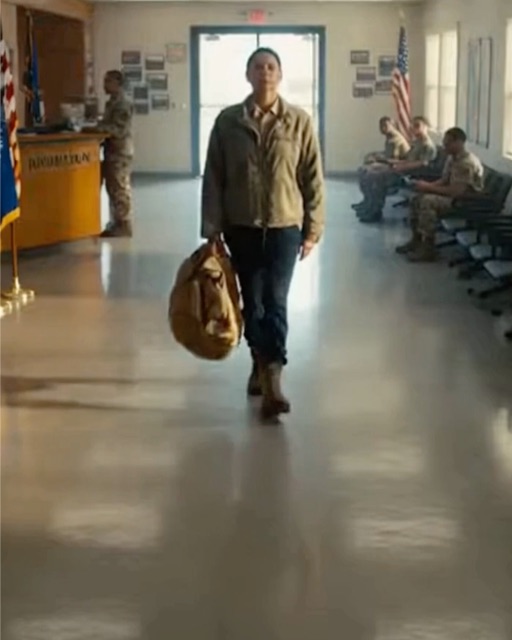
I was on duty at the Fort Blackhawk admin desk when she walked in, faded BDUs, scuffed boots, duffel over one shoulder like she belonged there. Contractors come and go, but we’ve got rules.
No utility uniforms for non–active duty.
“Ma’am, base policy doesn’t allow – ” I started, already reaching for the laminated sheet.
She didn’t argue. She just gave a cool nod.
“No problem,” she said.
But instead of heading to the restroom, she reached for the zipper.
Zip.
The jacket slid off her shoulder and I froze. Ink across her back – a combat medic cross with angel wings.
Beneath it, dates, stitched into the design like a quiet roll call. My mouth went dry.
Conversations died. Even the copier in the corner sounded too loud.
A sergeant against the wall straightened without thinking. Muscle memory kicked his spine like some old drill was still marching.
Footsteps came from the hallway. They were slow and certain, like someone was letting air fill the silence.
“Laura West?” a woman’s voice called, steady but low enough to pull every eye.
A full-bird colonel stepped into the lobby. She looked at the tattoo, then at the woman in front of me.
For a second, nobody breathed. The building felt like it was holding its own chest.
Then the colonel came to attention. And saluted.
I swear I heard a coffee cup clink to a halt midair.
The woman—Laura—didn’t move. She just blinked once, like she hated being seen.
The lieutenant next to me fumbled the policy sheet back into the tray. It looked suddenly radioactive in his hands.
“Ma’am,” the colonel said, voice tight, “it’s been a long time.”
I had no clue what was happening. Twenty minutes earlier, I’d gotten a memo about a “special guest” at 0900.
I thought it was some contractor briefing. My hands were shaking so hard I almost dropped the pen.
The colonel stepped closer, eyes never leaving Laura’s face. “With respect,” she said quietly, “I need you to remove that jacket all the way.”
Laura hesitated, then slid it off. The air in the room felt colder on my skin, like her jacket had been keeping all of us warm.
That’s when I saw them. Not just dates.
Coordinates, tucked under the wings like secrets. A scar, pale and mean, running just under the ink.
“Attention!” the sergeant on the wall barked before anyone told him to. Half the room snapped to it like muscle and memory overruled protocol.
The colonel turned, crossed to the wall by my desk, and took down a shadow box I’d dusted a thousand times without ever really looking. She set it on the counter.
Her hands weren’t steady now. The glass clicked against the wood.
She lifted the glass and said, almost in a whisper, “This belongs to her.”
Then she tilted the box toward me. My blood ran cold when I saw the medal inside—and the name on the brass plate underneath it.
Specialist Laura A. West. Silver Star.
The plate said Killed in Action. The room seemed to lean in and then tilt under my feet.
Laura didn’t look at the medal. She kept her eyes on the colonel like there was a weight between them no one else could see.
“Colonel Oakes,” Laura said softly. “You didn’t have to do this in the lobby.”
“We did,” the colonel said. “They should see you.”
Nobody knew where to put their eyes. The lieutenant stared at the floor like it might open.
Laura glanced at me, and it felt like a door had been propped open to a place I’d never been. There was sand in it, and the smell of burned cordite.
“Can we talk somewhere quiet,” she asked. “I won’t take more of your time than I have to.”
The colonel nodded. “Conference room B,” she said. “Now.”
I wasn’t sure if I should move, but the colonel looked at me and jerked her chin. I grabbed my notepad because it was what I did when I didn’t know what else to do.
The sergeant who’d called attention swallowed hard, then reached toward Laura like he might touch her sleeve. He let his hand fall and stepped back.
We walked down the hallway with the shadow box tucked against the colonel’s side. The floor made that hollow sound it does when traffic builds up in a building with old bones.
Inside the conference room, the colonel shut the door. The room had that stale coffee smell, and the blinds were half closed against the morning sun.
“Sit,” she said. “Please.”
Laura sat on the edge of the chair like it wasn’t hers to take. I stood by the credenza, feeling like I was watching a movie spill out of its frame.
Colonel Oakes set the shadow box on the table. She rested her hand on it like it might run away.
“I kept it up there to remember,” she said. “Not to bury you twice.”
Laura rubbed the heel of her hand over her left forearm. It was a quiet movement, like a habit she didn’t even feel.
“I know why you did it,” Laura said. “I also know I didn’t make it easier.”
The colonel looked older up close. She had silver at her temples and the kind of lines you see on people who don’t sleep.
“I read your last statement again last night,” she said. “I should have listened the first time.”
“It wouldn’t have changed much back then,” Laura said. “They had bigger things to hide than me.”
I felt my mouth open, then close. I had questions piling up like jets on a runway.
The colonel finally looked at me. “What’s your name again,” she asked.
I told her. My voice sounded thin in the air, like it wasn’t wearing shoes.
“You can stay,” she said. “You’re not supposed to be the one guarding secrets.”
I nodded and didn’t know what to do with my hands. I put them in my pockets and pulled them out again.
“Alright,” the colonel said to Laura. “Tell me how you want to do this.”
Laura let out a breath that had edges. “I didn’t come for a ceremony,” she said.
“I came to sign some papers,” she added. “And to ask you to fix a record.”
The colonel’s eyes softened. “We can fix more than one today, if you want,” she said.
Laura looked at the shadow box then, for the first time. Her eyes found the medal and didn’t flinch.
“They declared me KIA because the blast did a number on our truck,” she said. “The tags left on what was left of my vest confused things.”
She spoke with no drama, like she was reading a list of MREs. It made the room feel heavier.
“We got hit at dusk by Route Finch,” she said. “You remember Route Finch, ma’am.”
The colonel nodded without looking up. I remembered the name from a briefing slide once.
“I took shrapnel and got thrown clear,” Laura said. “I woke up behind a stone wall with someone’s voice in my ear.”
She smiled without her eyes. “It wasn’t English.”
There was a pause where I could hear the buzz in the light fixture. Somewhere a copier started up again like it was nervous.
“He was our terp’s older cousin,” Laura said. “He pulled me out through a goat pen and hid me in a storage room with sacks of grain.”
“By the time I could move, our QRF had already pushed through,” she said. “They found what they found and made a call that made sense on paper.”
Colonel Oakes rubbed her brow with her thumb and forefinger. That kind of rub comes from old pain.
“I got handed off up north by some folks who didn’t wear patches,” Laura said. “They told me to keep my head down if I wanted to keep breathing.”
“They needed me to help find the ones who laid the pressure plates,” she added. “They liked that I knew the routes better than their map book.”
I felt heat flush under my collar. We live around this machine and only hear the clean version.
By the time she made it back stateside, more than a year had moved by like a slow truck on a one-lane road. Papers had been printed, plaques mounted, emails sent with those official lines nobody knows who wrote.
“They told me to sit tight,” Laura said. “They said it’d get cleaned up when a few cases closed.”
“It never does by itself,” she added. “You know that by now, ma’am.”
The colonel’s mouth drew tight. “I know,” she said. “I know better than I want to.”
Laura reached into the duffel bag she’d carried in like it weighed nothing. She pulled out a dog-eared folder with hand-scrawled notes wedged inside.
“I’m not here to blow anybody up,” she said. “I’m here because the last thing I promised a couple of faces was that I’d tell the truth when I could.”
There’s bravery in shooting and there’s bravery in standing still. I watched that second kind sit across the table.
The colonel slid the shadow box toward Laura. “This was the bandage,” she said.
“I want the wound closed,” Laura replied. “Bandages turn into flags when no one looks.”
“Who else knows you’re here,” the colonel asked.
“Two people at JAG,” Laura said. “And a woman at the VA with a voice that could stop a hurricane.”
The colonel nodded. “We can work with that,” she said. “But we’ll also need to work with everyone who thinks you’re a ghost.”
Laura half laughed, and it wasn’t unkind. “I can deal with being a ghost for one more day,” she said.
“I have a letter,” she added. “I’ve carried it for a long time.”
She looked at me then, and something about her eyes made me feel like my ribs were a book she could read. I shifted my weight and my throat clicked.
“What’s your brother’s name,” she asked me. “If you had one on that wall.”
I felt my knees weaken in a way that had nothing to do with standing. I swallowed and said it anyway.
“Caleb,” I said. “Caleb Cline.”
Colonel Oakes looked at me. The room tilted again, slower.
Laura’s hand tightened on the strap of her bag. “Route Finch, June,” she said softly.
“Your brother was in the line behind us,” she added. “We shared a shade tarp behind a wrecker.”
It was like someone had unscrewed the light and dropped it into a bucket of water. I could hear my own breath.
“He shoved a folded paper at me and said if things went south, to make sure someone got it,” she said.
“He shouldn’t have given it to me,” she added. “But people do dumb things when they love someone.”
She set a single envelope on the table. The edges were bent soft.
My name was on it in Caleb’s blocky pen. For a second I saw him with summer sun on his shoulders and mud up to his knees, laughing like he had no idea there was a count on his days.
“I tried twice to deliver it,” she said. “The first time, the house was dark and for sale.”
“The second time, I decided I had to come back with my own name,” she added. “It didn’t feel right to knock as nobody.”
My hand shook when I reached for it. I didn’t open it right then because more felt like it would break.
Colonel Oakes cleared her throat, pulling us back into the room. She glanced at the clock like it had changed speed.
“We have a scheduled event at ten,” she said. “A quarterly casualty review.”
Laura’s lips pressed together. “You always did like hard mornings,” she said.
“I want you in that room,” the colonel said. “I want them to have to put a face to the ink.”
Laura nodded once. “Fine,” she said. “But not for me.”
“For the others,” she added. “For the names without medals.”
I watched Colonel Oakes make a decision with her whole face. It was like someone clicked a switch behind her eyes.
“We’re fixing your record,” she said. “Also, your award’s getting upgraded.”
Laura’s brow lifted a fraction of an inch. “That isn’t necessary,” she said.
“It is when the paperwork says the guy who left you took contact for you,” the colonel replied. “And it is when an interpreter bled out because a certain contractor didn’t want to use their radio batteries.”
There was a second where no one moved. I realized I had my hand half closed into a fist.
“Ma’am,” Laura said. “You’ll burn bridges you still have to cross.”
“I’ll lay planks as I go,” Colonel Oakes said. “I did a thing years ago because it was easier than telling folks they failed.”
Laura looked like she was trying to find a window in an empty wall. Then she let her shoulders drop.
“I won’t run,” she said. “You made me a promise once that if I held, you’d hold.”
“I’m holding,” the colonel said. “Let’s walk in.”
We left the conference room with the box and the envelope tucked in different hands. The hallway had the soft hush of a Sunday even though it wasn’t.
In the casualty review, there were boards with photos, and a projection screen that threw cold light over good suits. Someone clicked a laser pointer like it would make the right words behave.
Heads turned, whispers ran, then ran out. Colonel Oakes moved like she owned the storm and put the shadow box on the table at the front.
“This is wrong,” she said. “I know because she’s standing behind me.”
She stepped aside. Laura stood still like a tree in wind, and all the leaves in the room rustled.
The chaplain covered his mouth with his hand. A man from PAO blinked fast and then blinked again.
Someone at the back made a skeptical noise that tried to be a laugh and failed. Then the sergeant from the lobby pushed in through the door and said, “If you don’t believe it, ask my ribs.”
He stepped up and pointed to a pale line near his left side. “She put my blood back where it belonged while rockets fell around us,” he said.
“Sergeant Ruiz,” Colonel Oakes said softly. “Good to see you again.”
Ruiz nodded but didn’t stop looking at Laura. He swallowed and his Adam’s apple bobbed hard.
“Ma’am,” he said, voice rough. “I left a mess out there I never said thank you for.”
“You didn’t leave it,” Laura said. “It was left to us.”
“Thank me by not letting them talk about it like it was the weather,” she added. “Please.”
The JAG major in the corner shifted his files into a new stack. He had a look like a man who just understood his whole afternoon was gone.
“This needs to be recorded,” he said. “Accurately.”
“Start with this,” Colonel Oakes said. “Contract 14-B for Ridgefield Support pulled off Route Finch thirty minutes before the ambush when they were tasked to stay with the convoy.”
“They called comms black to save juice,” she added. “They returned when it was safe to take photos.”
I’d heard that name before, Ridgefield. It had come up during budget season like it was a savings vehicle.
A man in a crisp gray suit shifted in his chair. He didn’t wear a uniform, and he didn’t meet anyone’s eyes.
“You’re making allegations you can’t back,” he said. “This is reckless.”
Laura reached into her bag and slid a cheap plastic thumb drive onto the table. It looked small and ordinary.
“I brought their own dispatch logs,” she said. “The terp’s cousin had a brother at the company’s subcontractor yard, and he liked to copy things he wasn’t supposed to lose.”
She slid a stack of photocopies after the drive like playing cards. They were covered in time stamps and shorthand that smelled like dust and boredom.
Colonel Oakes didn’t smile, but her voice warmed a degree. “Now it’s backed,” she said.
The gray-suit tried another tack with a hand raised in a lawyerly way. “Even if that’s true,” he said, “why was this soldier listed as KIA.”
“Because we found what we needed to move on,” Colonel Oakes said. “And because it is easier to honor someone in a box than a woman who might tell you you’re wrong.”
The chaplain lowered his hand. He said a tiny amen like a cough.
From the corner, a woman from the VA who had stepped in late raised a hand. I recognized her from the morning calls by her voice.
“If this is what it is,” she said, “then she’s owed back pay, benefits, and quite a few apologies.”
Laura shook her head. “I don’t need back pay,” she said. “I need a name added to that wall.”
“Shah Wali,” she added. “Interpreter, unpaid, uncounted, and braver than most of the folks who signed my check.”
Silence dropped like a curtain made of water. The words rippled through it.
The colonel looked down like she was reading something that had been there a long time. Then she nodded.
“We’ll add him,” she said. “We’ll call his family today.”
“His family’s in Tulsa under parole because they came through a pipeline we built for folks who helped,” Laura said. “They work at a pizza place and send $50 a month back home so his sister can go to school.”
The woman from the VA wrote something down with purpose. Her pen scratched like a promise.
I stood very still with my arms pressing the envelope to my side like a raft. In that room, the wind shifted.
They agreed on things like next steps and who would write what, but it felt less like a meeting and more like a room remembering what it was for. People stopped staring at the suit and started looking at Laura’s face.
Afterward, we went back into the hallway and the light felt warmer. The sky through the slice of window looked like it remembered it was August.
Ruiz hung back. His eyes stayed on the floor until they ran out of places to look.
“I carried your helmet for a week,” he said to Laura. “I didn’t know where else to put my hands.”
“You put them where they belonged,” she said. “On the next thing.”
She dug in her bag again and pulled out something wrapped in a rag. It was a ring with a flattened edge and a scrape on one side.
“Your ring got torn off when the truck flipped,” she said. “I meant to give it back to you wherever I found you.”
Ruiz blinked again, then took it and slid it over a finger that looked different than it once did. He closed his fist around it like closing a door.
Laura looked at me. There was a question in her eyes I didn’t know the answer to yet.
“Do you want to read it here or later,” she asked about the letter. “There isn’t a right way.”
“Later,” I said. “If I start now, I won’t stop right.”
She nodded. Her eyes moved like she was counting the exit signs without turning her head.
Colonel Oakes checked her watch and then checked the hall. She was pulling herself into a new shape with every step.
“Public Affairs is going to want to do something,” she said. “We’ll keep it simple.”
“They can take a picture of the box without the glass,” Laura said. “Don’t make me do speeches.”
“We’ll do a small thing this afternoon in the clinic,” the colonel said. “That way the people who patch us up see who patched them first.”
Laura smiled for the first time in a way that touched her eyes. It was brief, but it felt like someone opened a window.
In the clinic, the air smelled like disinfectant and coffee that had been burned since seven. A few of the nurses stopped moving when they saw Laura’s back.
One of them reached out and traced the air above the coordinates without touching her skin. She whispered a date like a prayer.
We gathered in the waiting room by the fish tank that needed cleaning. Colonel Oakes set the medal on the counter and removed the glass completely.
“This belongs to her,” she said again. “But she’s lending it to all of you.”
Laura shook her head. “It belongs to a bad day we all got through,” she said. “Keep it where people trip over it so they have to look.”
A doctor with tired eyes came forward. He had tape on his shoe where the sole had given up.
“My first day out there, I couldn’t stop a kid from dying,” he said. “I kept seeing him every time I closed my eyes.”
Laura looked at him and didn’t try to fix anything with words. Then she put a hand on his shoulder in a way that said, we carry them together or we don’t carry them at all.
After the clinic gathering, the colonel asked Laura to meet her in the small chapel. It was a quiet space with stained glass that made the room yellow.
There was a wall in there, too, but this one had smaller names. Some had tiny metal stars next to them, and some had nothing.
Laura stood in front of it and touched three of the names, one after the other. She didn’t say them out loud.
“You’re not taking the job,” the colonel said from the back row. “Are you.”
“What job,” Laura said without turning around. “The one where I sit at a desk and pretend to belong.”
“We could use you in training,” the colonel said. “The new medics need to see somebody who’s seen the bad days and still shows up.”
Laura kept looking at the wall. The afternoon light came through slow, like it had charges to place.
“I’d show up,” she said. “But I won’t put a uniform on again.”
“Then don’t,” Colonel Oakes said. “Show up anyway.”
Laura didn’t answer for a breath or two. Then she nodded once.
“I’ll show up,” she said. “But you’ll have to meet me where I am.”
I found a bench by the door and finally opened the envelope. The paper made a soft sound like a wing brushing a wall.
Caleb’s handwriting looked like it always had, stubborn and a little messy. He’d written about the dog we had growing up and how our old neighbor still mowed crooked.
He said I was braver than I pretended, and that I should be the one to remind Mom to water her plants. He told me not to be mad if he missed my birthday because he was saving up for something dumb and neon to put on his truck.
He said if I was reading, it meant he didn’t get to tell me in person that he was proud of me for going back to school. The page blurred and I let it.
At the bottom he’d drawn a little box and written, “Open only if I didn’t get to say goodbye.” I touched that box and then didn’t open it, because I wanted to keep one thing still for one more hour.
Laura sat down beside me like she’d always known where to sit. She didn’t ask what he wrote.
“It’s weird what you remember,” she said. “I can still taste the dust from that night.”
“I hate the way blood smells in the cold,” she added. “It’s too clean.”
I nodded because I couldn’t make my voice behave yet. Sometimes company is the only thing that calms a room.
Outside, the day kept going like it never knew we paused it. You could hear forklifts somewhere and a truck backing up with that relentless beep.
By late afternoon, the colonel called us into her office. Her desk was clean in that way that means someone went to war against paper.
“We updated the record,” she said. “Your status is corrected and backdated.”
“The award upgrade’s in process,” she added. “It should have been a Distinguished Service Cross from the start.”
Laura didn’t look impressed. She put her elbows on her knees and leaned forward.
“Do something for the terp’s family first,” she said. “Call the pizza place and ask for Farid.”
Colonel Oakes smiled without showing teeth. “Already did,” she said.
“They cried and then asked if it was okay to send me a picture of Shah Wali on a good day,” she added. “I said please do.”
Laura lowered her gaze and nodded. There was a softness in her jaw that looked like grief finally finding a chair.
“Also,” the colonel said. “I made an appointment with the IG.”
“My name needs to be on the thing that hid too many truths,” she added. “If they take my rank, they take it with a story.”
Laura stared at her. “You’re the only one who could have kept your hands clean,” she said.
“Turns out I like them better dirty if I can sleep,” the colonel replied.
By evening, word had blown around the base like a sheet taken off a line. People you don’t see for months came by the lobby to look twice at the box on the counter and then to look away.
A young private asked if he could take a picture, and Laura said sure but make it about the nurses. He did, and she laughed when one of them hid behind the coffee pot.
At the end of the day, the colonel came out to the lobby with a simple frame. Inside was Laura’s jacket.
She’d clipped the sleeves up and pinned a small card next to it that only said, “Not all uniforms look alike.” It was both a joke and not one.
Laura reached out and touched the sleeve. She smiled like saying goodbye to something that had ended a long time ago.
“You’ll come back tomorrow,” Colonel Oakes asked. “We have that class with the new medics.”
Laura glanced my way. “Can I bring coffee,” she asked me.
“Only if you don’t make me drink that burnt clinic stuff,” I said. “I know a place off post.”
“Then it’s a date,” she said. “A coffee date with a classroom full of kids who don’t know how much good they can do yet.”
Ruiz came through one more time and stopped dead when he saw the jacket in the frame. He shook his head like trying to clear water from his ears.
“Feels right,” he said. “Looks like it’s staying to keep an eye on us.”
Laura smiled. “It always was.”
We closed out the day with fewer people in the lobby and more air in the halls. It was like the building had finally exhaled.
When I got to my car, I sat with the letter again. I opened the little box at the bottom because I couldn’t carry curiosity another minute.
Caleb had drawn a dumb little stick figure of me with giant shoes and wrote, “Don’t try to fill mine. Buy your own and run how you run.”
I laughed and cried at the same time, and it came out sounding like relief. The windows fogged just a little.
Before I drove off, I looked back at the building. Through the glass, I could still see the shape of the jacket in the frame.
The next morning, Laura showed up in jeans and a plain gray T-shirt. She had a box of donuts and the kind of coffee that makes a room wake up for real.
The medic class sat in a circle with their sleeves rolled and their faces open. They stared at her tattoo and then at her eyes.
She told them about tourniquets and about not making promises the body can’t keep. She told them about laughing when you can and crying when you need to.
Then she told them a story about a kid with a construction nail in his thigh and a smile like a sunrise, and how saving him felt like somebody handed you a new piece of your own heart. They listened like kids at a fire.
Afterward, one of them came up and said his name was Mo and that he got sick to his stomach at the thought of blood. Laura told him that throwing up is a reaction like sprinting, and that both can get you through a moment if you learn to breathe again.
She made some of them try tying a tourniquet with their off hands and told them to write their initials on the strap. She told them names matter more when things spin.
When class ended, she leaned against the wall in the hallway and let the noise of young boots wash over her. She looked tired in a different way, like a run had smoothed her edges.
Colonel Oakes walked up with a folder under her arm and that same clean-desk look. She gave one to Laura and handed another to me.
“Yours is a copy of the corrected file,” she said. “Yours,” she said to me, “is a letter from the Department of the Army recognizing your brother for a specific action that got lost on a battlefield and stayed lost in a drawer.”
I opened it and read the words with my heart pounding in my ears. It said he’d dragged a man two lengths of a truck while fires burned, and that he’d done it with no thought for himself.
It felt like someone had drawn a line from a night on Route Finch right here to this hallway and put my feet on it gently. It didn’t change the ending, but it made the middle make more sense.
Laura took my hand and squeezed it once. It was the kind of squeeze that says, we’re in the same story even if our chapters are different.
That afternoon, word came that someone from Ridgefield had quietly stepped down. Nobody cheered in the hall, but you could feel the door open a bit wider.
Colonel Oakes sent an email to the whole base that simply said, “Today we corrected a line. Tomorrow we correct another.”
It didn’t have any fancy language, but it hit like a drum heard through a wall. People started forwarding it to each other with small comments like “about time” and “good.”
In the days that followed, Laura kept her promise and showed up without a uniform. She wore a worn baseball cap and an old pair of boots.
She sat with a young private after he had his first bad call and helped him drink a glass of water. She visited the chapel and left a single coin under the photo of the interpreter when they found one with a smile that matched the story.
She met the pizza family in the lobby and hugged them one by one. They brought oily boxes that made our whole admin area smell like Friday night.
We added Shah Wali’s name to our memorial with a star that was smaller in metal but not in meaning. His little nephew laughed and patted the glass with both hands.
Colonel Oakes went to the IG and told them everything, and the base watched a rumor turn into action. It wasn’t quick, but it was real.
People kept stopping by the frame with the jacket and the small card that didn’t try to be bigger than it was. Some days someone stuck a Post-it note there that said thank you, and it never stayed long before someone folded it and put it in a pocket.
One morning, Laura walked in with a new tattoo forming under thin plastic. It was another date next to a little set of numbers that looked like a coordinate.
She didn’t say what it was for right away. Later she told me it was the day she got her VA card updated with her own name spelled right.
We laughed until we both snorted at that, and then we didn’t. Sometimes you laugh hardest at the things that once would have broken you.
A few weeks later, Colonel Oakes took her leafs off and put them in a drawer. She’d chosen it.
She came by the lobby in a plain sweater and looked younger. She walked to the frame and tapped the glass twice with her knuckle like knocking on a door.
Laura saluted her, and Oakes saluted back. It looked less like goodbye and more like a promise not to let go.
I still dust the frame sometimes out of habit. Every time my hand passes the glass, I think about how easy it is to clean a surface and how hard it is to polish a truth.
I read Caleb’s letter again on a Sunday when the sky felt heavy. I’d memorized the part about the shoes and found it felt like a bell I could ring when my steps got weird.
The day he told me to buy my own shoes, he probably didn’t know I would, but I did. I bought shoes that fit my run, not his.
Here’s the thing I keep coming back to, standing under the soft hum of a building built to carry secrets and spit out forms. Our lives are held together by the people who show up when there isn’t any glory in it.
It isn’t paint and plaques that make a place honorable. It’s truth told where it hurts and hands laid steady where it counts.
Rules matter, and so do uniforms. But sometimes the bravest thing we can do is take off a jacket and stand there with our scars and our coordinates and say, this is who I am.
I used to think the work at the front desk was just papers and appointments. Now I know it’s an airlock where people step through carrying whole worlds on their backs.
I’m glad I was there when Laura walked in with dust in the folds of her memory and a letter in her bag. I’m glad the colonel put the glass down and dared us all to look at what was behind it.
Sometimes you try to keep things quiet because it feels safer that way. But truth has its own legs, and when it walks in, the best thing we can do is make space.
I don’t think the room went silent just because of a tattoo. I think it went silent because we all felt a changing wind, and we all wanted it to blow clean.
If there’s a lesson baked into that day, it’s this. Don’t assume the neat story on the wall is all of it, and don’t be scared to fix the record if you find out you were wrong.
Another thing I learned is small, but it stays with me. The right thing doesn’t just sit by itself on a shelf; it gets passed hand to hand until it’s real.
So if you ever find yourself standing in a quiet room with your rules in one hand and a person’s story in the other, choose the story and then write better rules. That’s how we grow up, all of us together.