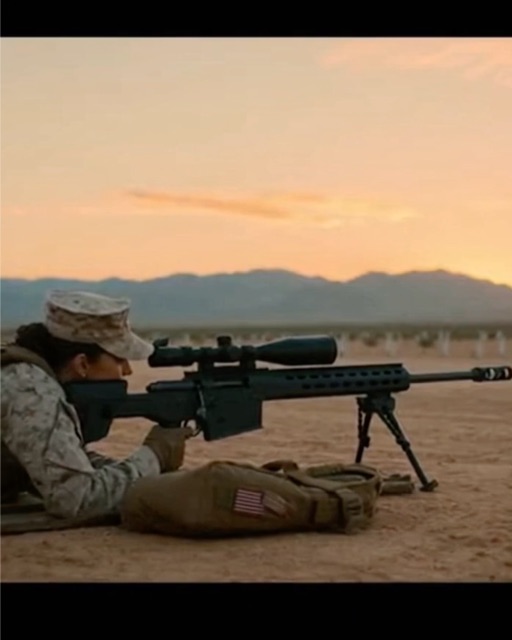
The boot hit my gear bag so hard the zipper popped. Brass skittered across the concrete like marbles.
I didn’t flinch. I’d just punched ten holes into a target so far out it danced in heat haze. My hands were still steady.
“Range is for real operators, sweetheart,” Staff Sergeant Darren Riggs drawled, closing in. Four shadows fanned behind him. One kid – Casey Ward – grinned like he’d been waiting his whole life to be part of a pack.
“I’ll clean my brass,” I said. “After I log my shots.”
“How about now?” Casey said, toeing a magazine toward the edge. “Unless lifting’s too hard.”
I stood. Slowly. “Lieutenant Kendra Morales,” I said, tapping my name tape. “And you’re crowding my lane.”
Riggs’ smile didn’t reach his eyes. “Lane’s reserved. Not for paper champions. For warriors.”
My heartbeat climbed into my throat. My jaw ached from keeping it shut. The quartermaster’s laugh from last week flashed in my head – Too small, too light, too female—and I reminded myself to breathe.
Then he kicked my bag again.
Something in me snapped. “Watch your men,” I told him, voice low. “Last time I checked, intimidation isn’t a MOS.”
He took one step closer. Close enough to smell the coffee on his breath. “Make me.”
The range horn blared.
“Freeze,” a voice barked from behind us. Boots. Authority. The kind that rearranges a room without touching it.
Major Mitchell Crane walked through the doorway, cap tucked under his arm, eyes like razors. He didn’t look at me. He looked straight at Riggs.
“Staff Sergeant,” he said, every syllable a warning. “At ease—no, on second thought, stand at attention. Now.”
Riggs’ jaw worked. He snapped up, fists flexing by his sides.
The Major set a small black case on the bench. Clicked it open. His voice dropped to ice. “Before you dig this hole any deeper, we’re going to look at something together.”
He lifted out a thumb drive, bright red, labeled in block letters: LANE 4 – 0538.
Then he turned the monitor toward us and slid the drive in—and when the first frozen frame filled the screen, my blood ran cold.
The timestamp glowed pale in the corner. It was the same morning, before range hours, the sky outside still blue-black.
The camera angle faced down my lane from above, the way they mount them on the safety awning for all the lanes.
Riggs was in the frame, alone, sleeves shoved up, moving like he owned the place.
He wasn’t supposed to be there before sunrise. None of us were.
He lifted my rifle from its case like he was picking up his own toothbrush. He looked down the optic, then smirked.
Casey slipped into the frame next, hat backward, chewing gum like a kid at a ball game. He did a little dance. He thought he was invisible.
Riggs twisted my turrets. Slow. Deliberate. He cranked my elevation two full mils and then my windage three to the right. My stomach dropped.
I remembered my first three warm-up shots drifting way right, like the world had shifted. I’d thought it was wind.
The video rolled. I watched my own bag on the floor, zipper intact. Then Riggs drew his boot back.
I almost said something, but I felt Major Crane’s gaze tick like a metronome between the screen and Riggs’ face.
The next moments were worse. The two of them lined up at the bench and lifted a spare steel plate, dragged it across the concrete, and leaned it outside the berm line.
Casey nodded toward something off frame, then hoisted my ammo can into his lap. He popped the lid, pinched a cartridge, and whistled.
Riggs shook his head. He grabbed a loose round from somewhere else in his pocket, a different color tip, and held it up to the camera like a dare. It wasn’t our standard match load.
They laughed. He slid the odd round into a mag and sent the bolt home on my rifle with a smack that made the microphone crackle.
Then he welded onto my cheek rest, took aim not at the paper downrange but over the right side of the berm toward the old utility road we’d shut down last year, and squeezed.
The video glitched an instant from the shock wave at the firing line, then froze on an empty lane and a drifting wisp of smoke.
Major Crane paused the footage there. He didn’t raise his voice. He didn’t have to.
“Range opens at 0600,” he said, eyes on Riggs. “This shot logged at 0541.”
Riggs’ stare didn’t move, but I saw his neck pulse throb.
The Major toggled to a second clip. A different angle. Another camera watched the utility road past the berm, white gravel and weedy grass. Something fast blurred left to right and a small puff leapt from the gravel like a flea.
He didn’t play any more. He pulled the drive, set it by his wrist, and leaned into the space between Riggs and me like a man setting down a weight.
Riggs opened his mouth. Nothing came out.
Casey’s gum stopped moving. He looked smaller with each breath.
The Major spoke without heat, like he was reading off weather. “Unlawful range access. Tampering with another soldier’s equipment. Firing out of lane. Possible round outside the safety fan.”
He glanced at me for the first time, just a flicker. “Lieutenant Morales, step back behind the line, please.”
I did. My hands were steady, but my fingers felt like someone else’s.
Then Major Crane’s radio came alive with a hiss. The range safety net crackled. “Control to all ranges, immediate cease fire and account for all personnel. Unknown round reported near sectors Echo-Foxtrot. All training halt. Repeat, all training halt.”
The horn screamed a second time and then cut to a solid wall of quiet.
You don’t think silence can be loud until it is. It rolled over the base like a wave.
No clatter of steel. No crack of rifles. No hum of forklifts in the motor pool. Even the birds seemed to hold a breath.
“Base is cold,” the Major said, not looking away from Riggs. “And it’s going to stay cold until we find where that bullet went.”
He nodded to the range safety NCO hovering inside the doorway. “Sergeant Coates, secure this line and walk these men to the admin room.”
Coates was a square bulldog of a man who didn’t ask questions. He gestured with two fingers in a way that suggested options were few.
Riggs stared at me as he passed, and I felt the heat of it. He didn’t spit. He didn’t snarl. He just carried a quiet rage like it was body armor.
Casey took half a step behind him, then hesitated. His eyes met mine for a heartbeat that stretched, and something like shame cracked across his face. He looked fourteen.
The Major told me to wait by the duty desk. He called Range Control and the MPs. He used clipped sentences and codes that smoothed the edges off everything.
I heard phrases float like dust motes in the air. Chain-of-custody. Suspend privileges. Safety sweep. Notify the XO.
When the MPs came, they weren’t in a rush. That scared me more than sirens ever have.
They took notes. They took the thumb drive. They took the weapon and sealed it in a bag I signed.
I wrote my statement at a metal desk with a pen on a string. It was weirdly quiet, like the building was holding its own breath.
Major Crane stood with one shoulder to the wall and a hand under his chin. He watched the door, not me.
When I finished, he walked me outside. The morning had snapped crisp and clean. In the distance, you could see the sun peel up over the motor pool, all orange edges and promise.
“Lieutenant,” he said, voice back to low normal. “You handle this professionally.”
I didn’t know what to say, so I didn’t say anything.
He nodded once. “Get some water. Go to your office. No talking about this with anyone until we clear you to. Range Control has your qualification packet and your score logs. You’ll get another lane when we reopen.”
“Sir,” I said. My voice wasn’t as steady as my hands.
He turned to go, then paused and looked back, like something just clicked. “By the way,” he said. “Good shooting out there before the circus.”
I blinked. It was the first kindness of the day, and it landed harder than I expected.
The base stayed quiet for hours.
It was eerie walking through a place built on noise when all you could hear was your own boots.
I sat at my desk and arranged my pens in a line and rearranged them again. I sipped water. I texted my dad a picture of the sky because he likes those and added thumbs-up and no words.
He taught me to shoot on a hill by the river when I was eleven. He told me then that the rifle magnifies what you already are. If you’re impatient, it shows. If you’re steady, it shows.
I thought about telling him what had happened, then followed orders and didn’t.
Around noon, the lock screen on my computer flashed a base-wide email. All stops extended until further notice. Safety teams reported a hit on a disused maintenance shed two clicks outside the range sector. No injuries. One small hole through a pane of corrugated plastic.
My breath went out slow. I pictured the little puff on the camera and imagined it sliding through sunlight into a shed nobody had used in a year.
I still saw the rifle in Riggs’ hands like it was a betrayal.
By midafternoon, Range Control reopened one small lane for admin checks. Not for training. For inspection. The base started breathing again, soft at first.
I found myself in the chow hall picking at a protein bar and staring out a window at a truck backing up to a dock.
Casey slid onto the bench across from me without asking. He looked worse. There was stubble on his jaw like he’d slept in a car. He sat with his hands flat, like he wanted me to see them empty.
“I’m sorry,” he blurted, keeping his voice below the hum around us. “I didn’t think it would—” He swallowed and tried to start over. “I messed up.”
I stared at him and let the silence put a weight on the table.
He rubbed his palms on his trousers. “He said it was just a joke. Said he’d turn your scope a hair, make you miss two shots, nothing that would matter.”
“You fired the round,” I said. It wasn’t a question.
He flinched. “No. No, that was him. He wanted to mark you as…what’s the word…a problem. He said if he made you mad, you’d show your teeth and prove his point.”
“This isn’t high school,” I said. “Nobody cares if I’m mad. They care if you fire over a berm.”
He ran a hand through his hair and watched it fall. “He’s been on me since I got here. I owe him…not money, exactly. Favors. He covered a thing for me when I first got here and he’s been calling it back ever since.”
“You owe him your career now,” I said. “And maybe more.”
He nodded like I’d slapped him because maybe that would have hurt less.
He glanced over his shoulder. “I need to tell you something else. But I want to do it right.”
“Right is in a statement to the MPs,” I said.
He winced. “I’ll do that. Will you…will you tell the Major I’m willing to talk?”
“He’s not hard to find,” I said.
He lowered his voice to a whisper I barely heard over the dishwashers. “There’s more. Riggs is running bets on quals. He takes percentages. He’s swapping out ammo in people’s cans. Selling the good stuff out the back of supply.”
My fingers curled around the edge of the table. The base rumor mill had spun that story before, but rumors are a dime a dozen in a place where the days blur.
“You have proof,” I said.
He nodded once. “I have texts. And I know where he keeps a ledger. It’s not smart. He writes everything down like he’s going to turn it into a book.”
“Why are you telling me?” I said. “Tell them.”
“Because you looked me in the eye this morning,” he said, cheeks flushing. “You didn’t flinch. And when he leaned in, you didn’t shrink. I…I’ve been telling myself it’s easier to play along. It isn’t. I want out.”
I stared at him, and then did a thing I didn’t plan. I reached into my pocket, slid my phone across the table face down, and gave him a name and a number. It was the IG rep for our brigade. She’d given a briefing two months ago that most people forgot before they finished their coffee.
“You call her,” I said. “Right now. You tell her what you told me.”
He stared like the thing in his hand would burn him. Then he nodded.
He walked away and I finished my protein bar and tasted metal the whole time.
The next morning, the air had that post-storm scrape to it even though it hadn’t rained. Everyone moved a bit softer. That happens after a base-wide scare. Even the folks who act like they don’t care remember that luck is fickle.
Major Crane found me at my desk and said we were headed to a briefing with the battalion commander. He didn’t smile. He didn’t frown. He carried the day like a rucksack.
The room smelled like dry erase marker and coffee you can stand a spoon up in. The Colonel sat at the head of the table and the XO stood just behind his shoulder the way the moon hangs near a bright horizon.
They ran through the findings so far. The round trajectory. The path it took. The way a slight shift in angle could have made yesterday a different kind of day.
When they finished, the Colonel turned to me. “Lieutenant Morales,” he said. “Your equipment was tampered with. You did nothing wrong. You kept your bearing.”
I nodded because anything else would have made it about me, and this wasn’t.
He lifted a folder and slid it toward Major Crane. “We’re going to formal proceedings with Staff Sergeant Riggs. Multiple charges pending. The Quartermaster’s office is under audit.”
My eyes flicked up. “Sir?”
He tapped the folder. “This didn’t start with yesterday. We’ve had separate complaints. We didn’t have proof. Now we do.”
I thought of Casey’s pallor and the way his voice shook and wondered if he found a courage he thought he didn’t have.
The Colonel set his hands flat. “The range will reopen in phases. You will complete your qualification this week. And you will lead a training block next month on range safety and respect.”
I nodded again. My throat had a knot the size of a golf ball in it and the only way through was to swallow hard.
As we were dismissed, Major Crane touched the folder like he was checking it for a pulse. He waited until the room cleared, then turned to me.
“I didn’t come to the range yesterday for you,” he said. “I came because of a tip about a missing case of match rounds.”
I remembered the quartermaster’s laugh, the one that had carried too far for comfort.
“I didn’t give that tip,” I said.
“I know,” he said. “But you reported what he said last week. It’s in writing. You put the first thread on the table. We pulled, and things started to show.”
I let that settle into the space between us. It felt like justice didn’t always move like a hammer. Sometimes it moved like a seam coming apart with patient fingers.
“Major,” I said slowly. “Casey Ward wants to talk.”
His eyes narrowed. “To me or to someone higher?”
“To anyone who can help him get unhooked,” I said. “He says there’s a ledger.”
He exhaled like air leaving a tire. “Good. Make sure he has counsel. We don’t sacrifice kids to fix the sins of men who should know better.”
There was more to do than there were hours for. There’s always more to do.
The range reopened on a Wednesday. The air felt bent after the silence, like the sound had to find its shape again.
I walked down Lane 4 like it was a prayer aisle. I checked my optics. I checked my torque. I checked my soul.
Sergeant Coates nodded at me from the safety table with a tiny shift of his chin and an even tinier ghost of a smile.
“Send it when ready, ma’am,” he said.
I did.
The first shot broke clean and found center. The second kissed its edge. By the fifth I was in that place where the world narrows to one small circle and a steady rise and fall of air.
When I finished the string, I cleared and flagged and stepped back. Coates looked at the monitor. The corner of his mouth kicked up.
“Paper champion, huh,” he said, dry as chalk.
I laughed then, just once, and the sound surprised me with how light it was.
Two days later, the mess got messier in the way messes do when you drag them into daylight. MPs went into the Quartermaster’s office with a warrant. They came out with a box and a red-faced Specialist who could no longer pretend he didn’t know where things went at night.
They went into Riggs’ locker. They came out with a spiral notebook that had dollar amounts and initials and dates. It looked like a diner order pad. My initials weren’t there. I wasn’t flattered. I was tired.
They found text chains on Casey’s phone that read like a bad movie. He didn’t delete anything. It might have been ignorance. It might have been a part of him that had wanted to leave breadcrumbs all along.
When they cuffed Riggs, it wasn’t dramatic. There were no shouts. There was a quiet cough and the rattle of metal and the whisper of a thousand eyes not looking away.
He didn’t look at me when they led him past. He kept his gaze over the horizon like he was watching a bird he was sure would come back.
He asked for a lawyer. He got one. He got due process. He got what he never gave.
Casey sat in an uncomfortable chair across from a woman from JAG and told the truth in a voice that cracked. He didn’t ask to be the hero. He asked for a shot at not being the villain forever.
He got a deal. He still took his lumps. That’s how balance works.
I finished my qualification with a score that felt like it belonged to me and not to a fight.
When I pinned the paper to the board in the admin hall, a few people clapped in that small, polite way military people do when emotions scare them. It was enough.
Major Crane asked me to draft the agenda for the training block on safety and culture. He told me to make it real, not pretty.
I spent a Saturday at the range with a mop and a notepad and two privates with good hands. We scrubbed the corners nobody sees and took notes on every process that creaked.
We added a sign above the ammo cage that said Respect Is A Safety Requirement. It wasn’t fancy. We printed it on laminated card stock and taped the edges with a strip of green that looked like hope in a fluorescent world.
When I stood in front of a room full of people two weeks later, it wasn’t loud at first. You don’t fix culture with a PowerPoint. But you can start a conversation that makes someone check himself before he opens his mouth at someone smaller, newer, or different.
I told them about how small shifts become big problems. How turning a scope click as a joke is the same muscle you use when you decide the rules protect you more than they do your neighbor. How silence is convenient until it isn’t.
I didn’t mention Riggs by name. I didn’t have to. Everyone knows names. I talked about the morning the base went quiet and how we all felt our hearts climb into our throats.
I said, “Watch your men,” and Major Crane, who sat in the back and pretended to check his phone the whole time, looked up for just a second and nodded.
After the session, a corporal with a sleeve of bad tattoos and kind eyes came up and said his sister boxed in Newark and the first time she beat a guy in a gym the roof almost shook from the quiet, not the noise. I didn’t know what that meant exactly, but I liked it.
A week after that, I walked past the motor pool and saw Casey pushing a broom by a Humvee with a steady rhythm. He caught my eye and tapped his temple two times in a small salute.
I gave him one back and didn’t hold it too long.
My dad called that night while I was heating up ravioli in a pan that didn’t really want to clean. He asked how things were and I told him there’s messy and there’s right and sometimes they’re holding hands, but we were trying.
He told me sometimes the moment after the shot is louder than the shot. He meant you live with what you do.
The court-martial took months because the machine of justice is heavy. In the end, Riggs lost his stripes and more. There were other charges, beyond the range. The ledger was a Rosetta Stone for other things we wouldn’t have known if a bullet hadn’t whispered through a plastic wall.
The Quartermaster got reassigned to a place where paper has teeth. Maybe that was mercy. Maybe it was the best they could do.
Major Crane got a letter of commendation he folded in half and slid into a drawer without ceremony. That’s how some men use praise. He also got the quiet respect that comes when people believe you’ll show up before the horn sounds and stand where it’s hardest.
I got tapped to serve as OIC of our company’s marksmanship program. It wasn’t a grand title, but it meant kids with wide eyes and soft hands came to me to learn to make small circles where they wanted and breathe when the wind told lies.
That first day, I lined them up and said the thing I needed to hear on the day my bag split and brass danced like marbles. “You belong here,” I told them. “Your size, your voice, your walk. The rifle doesn’t care. It only knows truth.”
They nodded without knowing what it meant yet. You only learn by doing.
In the months that followed, the base noise returned to normal. The trucks sang their diesel hymns. Boots beat time on concrete. The horn blared and stopped and blared again.
But there were pockets of new quiet too. The kind where someone opened his mouth to make a joke and then shut it with a click because he remembered a morning and a horn and a line of still bodies thinking about what almost was.
The biggest twist of all came one evening when Major Crane asked me to step outside after a command group meeting and handed me a worn photo.
It was a picture of a young infantryman in desert tan, holding a rifle in front of a building that could be anywhere in a part of the world that smells like dust.
“That’s me at twenty-two,” he said. “I learned to shoot from a sergeant who used to say the rifle magnifies what you are.”
“My dad says that,” I said.
He smiled, a real one this time. “I know. He taught me, Lieutenant.”
I stared at the photo and then at him and back again like I could force the math to show its work. “What?”
“River range,” he said. “A long time ago. He had a mustache then and hands like a pair of wise old birds. He taught a bunch of us who’d never seen anything but video games and bravado. He taught us quiet. I didn’t know you were his until I saw the way you set your shoulders and breathe.”
I laughed because sometimes the world is weird and kind. “He’ll like hearing that.”
“Tell him I said thanks,” he said. “And tell him his line stuck.”
I called my dad that night and told him, and he didn’t say anything for a long beat. When he did, his voice sounded like a scraped knee and a sunrise. He said, “Be kind, kiddo. Not many folks remember their teachers in war or in peace.”
Before the next quarter rolled around, I got an email that said my packet for a long-range reconnaissance school had been approved. The one that had been “full” for two cycles.
I didn’t ask who signed it. Some doors you walk through without looking too hard for fingers on the hinges.
On my way to the barracks that evening, I paused at the range. Lane 4 sat empty in the slant of late light. A gust lifted a little slip of paper and sent it skittering until it caught under the leg of a bench.
I picked it up. It was a corner of a target with one clean hole through the white just kissing the ten ring.
I tucked it into my pocket like a receipt. Proof of purchase for a day I paid for with patience and fire.
There’s a rhythm to life on base that can make you think nothing changes. You see the same faces, hear the same jokes, stand in the same lines.
But small things shift if you push your thumb against them in the right place. Someone speaks up. Someone else backs him. A third person thinks twice and swallows a comment. A kid with wide eyes hears “You belong” and believes it enough to keep going when a loud voice tells him to quit.
On the morning I shipped for the course, Casey met me by the bus with a paper bag and a grin that had lost its edge and found a real smile. He handed me the bag.
Inside was a stack of jerky sticks and a cheap key chain shaped like a bullet that was much too shiny to have ever seen a chamber. He said, “For luck,” and then, quieter, “For starting over.”
I squeezed his shoulder and felt bones I hoped would hold.
He’s going to be okay, I thought as I stepped up and found my seat by a window smudged with old worry.
The bus rumbled and the base rolled by like a film. The range flashed past and the motor pool and the flag that never stops telling you where the wind is headed.
I leaned my head against the glass and closed my eyes and let the hum settle into me.
The worst days test our edges, but they also show us who stands at our shoulder when the horn sounds and who tries to push you off your lane.
I learned that courage can be quiet. That power can be a phone number shared across a table. That justice sometimes walks in on two legs with a thumb drive and a stare like a scalpel.
I learned that “watch your men” cuts two ways. Leaders must protect people from the parts of themselves that like chaos. And we, all of us, have to watch ourselves too, because the line between a joke and a bad day is just one thought held a beat longer.
Mostly, I learned that respect isn’t something you demand with volume. It’s something you earn with steadiness, shared air, and clean shots when no one’s cheering.
If this story hit home for you, pass it along and tap the heart so someone else who’s steady and quiet knows they’re not alone.