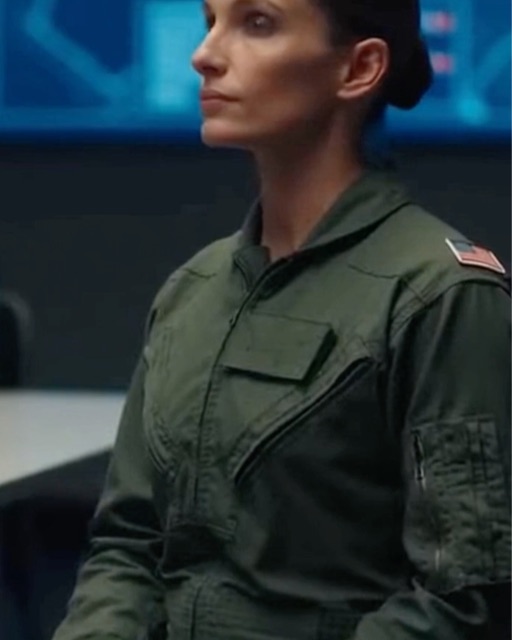
Red Flag, day one. The theater was a wall of swagger and jet fuel breath. I stood in the back in a blank flight suit – no tapes, no patch, no rank. My palms were steady, but my jaw was tight.
He spotted me anyway.
“Jules?” Lieutenant Mark Wyatt turned, big grin, voice carrying. “This is the real pilots’ brief. Admin is down the hall. Why don’t you make yourself useful and grab coffee?”
Laughter. A desk slapped. Someone whistled.
I swallowed hard and tasted metal. Years of his digs. The watch Dad bought him. The gift card he tossed me.
The doors banged open. “Room, ten-hut!”
Every spine snapped straight. General Harris strode down the aisle like a blade, eyes cutting past faces until he stopped right in front of me.
He snapped a salute. To me.
The silence had weight. I could hear Mark’s breath catch.
The General didn’t ask for coffee. He pressed a thick, red-stamped folder into my hands, turned to my suddenly pale brother, and said, “Lieutenant Wyatt, open your ears. Because from now on, you will address her as…”
He tapped the crimson EYES ONLY stamp on the folder cradled against my chest.
“…as Captain Wyatt.”
A pin could have dropped and sounded like a bomb.
Captain. I outranked my older brother.
General Harris wasn’t finished. His voice was gravel. “Captain Wyatt is the Red Team Lead for Operation Chimera. She is your adversary. She is your evaluator. And for the next seventy-two hours, she is your worst nightmare.”
He turned back to me, his expression unreadable. “The floor is yours, Captain.”
I nodded, my throat dry. I took a deep breath and walked to the front of the room, past rows of stunned, silent pilots. Past Mark, whose face was a mixture of chalk and thunder.
I placed the folder on the lectern but didn’t open it. I didn’t need to. I had memorized every page.
“Good morning, gentlemen.” My voice was steadier than I felt. “Operation Chimera is a full-spectrum combat simulation.”
“The objective for Blue Team, which is all of you, is to defend a high-value asset. My objective, as Red Team, is to neutralize it.”
A pilot in the front row, a guy named Becker with a reputation for being Mark’s wingman in all things, snorted softly. “With what? Sharpened pencils?”
The room tensed. Mark shot him a look that was part warning, part gratitude.
I met Becker’s gaze. “With every asset at my disposal, Lieutenant. Which, for the purposes of this exercise, is everything you have, and a few things you don’t know you have.”
I let that hang in the air.
“Your playbook is predictable. You rely on superior technology and aggressive, head-on tactics. You believe in overwhelming force.”
I looked directly at my brother. “My playbook is you. I’ve studied your tendencies, your blind spots, your ego.”
“The simulation begins in one hour. Dismissed.”
They filed out, a low murmur rippling through the group. Mark stayed behind, waiting until we were alone.
“Jules, what is this?” His voice was low, angry. “A prank? Did Dad pull some strings for you?”
It was always Dad. Dad, who saw Mark as the legacy and me as the afterthought.
“Dad doesn’t have this kind of clearance, Mark. You know that.”
“So what? You’re some kind of super-spy now? A war-gamer playing with our careers?”
“I’m an officer, just like you,” I said, my voice quiet but firm. “I earned my commission. I earned this assignment.”
He scoffed, shaking his head. “You sat at a desk. You analyzed data. We fly. We fight. There’s a difference.”
The old sting was there, sharp and familiar. “You see the board, Mark. I see the whole game. There’s a difference.”
I walked out, leaving him standing alone in the briefing room. The first move had been made.
My command center was a world away from the glamour of the flight line. It was a dark, refrigerated room known as ‘The Cave,’ filled with screens and analysts. My team was a small, hand-picked group of intelligence specialists and cyber-warfare techs.
My second-in-command, Master Sergeant Peterson, a man with more years in service than I had on earth, handed me a headset. “They’re spinning up their birds, Captain.”
“Let them,” I said, watching the green icons representing Mark’s squadron light up on the main screen. “They’re expecting a frontal assault. A show of force.”
“What’s our play?” Peterson asked, a hint of curiosity in his voice.
“We’re not going to fight their fighters,” I said. “We’re going to fight their confidence.”
For the first six hours, we did nothing. We let them fly their patrols in perfect formation, burning fuel and building arrogance. I could almost hear their cockpit chatter, the jokes, the boredom.
Mark would be getting impatient. He was a man of action. This inactivity would feel like a trap, but he wouldn’t know where it was.
Then, I gave the order. “Initiate phase one.”
It wasn’t a missile launch. It wasn’t a jamming signal. It was an email.
A simulated, but perfectly crafted, email sent to the base’s logistics server. It re-routed their scheduled fuel tanker to a different airfield for a surprise inspection. It was a piece of bureaucratic minutiae so believable, no one would question it.
Hours later, Mark’s squadron returned to base, expecting to refuel and re-launch for their night patrol. They were met with empty hoses.
On my screen, I watched the flurry of confused comms. The frantic calls. The dawning realization. They were grounded. Not by a missile, but by paperwork.
Peterson let out a low whistle. “That’s just dirty, ma’am.”
“They left the back door wide open,” I replied. “They were so busy watching the skies, they forgot to check their email.”
Mark was furious. I got a blistering call on a secure line.
“A fuel truck, Jules? That’s your grand strategy? This is a joke!”
“Did you lose air superiority, Lieutenant?” I asked calmly.
Silence.
“For the next eight hours, that asset you’re protecting is a sitting duck. And all because you assumed the fight would only happen at thirty thousand feet.”
I hung up.
The next day, they were more cautious. They triple-checked everything. Their patrols were less predictable. Mark was adapting. He was smart, I’d always give him that.
So, I changed the game again. I didn’t target their hardware; I targeted their information.
My cyber team found a vulnerability, not in the flight systems, but in the base’s unclassified network. The one the pilots used to check sports scores and message their families.
We seeded it with a piece of masterful disinformation: a fake intelligence report about a Red Team saboteur already on the base.
The paranoia was immediate. I watched it unfold on internal security feeds. Pilots were eyeing maintenance crews with suspicion. Security patrols doubled. The focus turned inward. They started hunting for a ghost.
While they were busy chasing shadows inside their own wire, my team executed a simulated long-range drone strike from a completely unexpected vector. The high-value asset was declared ‘damaged.’
Mark’s squadron had been looking in the wrong direction, distracted by an enemy I had planted in their own heads.
The exercise was taking its toll. The pilots were tired, on edge. Mark looked haggard in the remote briefings. He was losing, and he didn’t know how.
On the final day, General Harris visited me in The Cave. He looked at the screens, at the complex web of moves I had made.
“He’s learning,” the General said, his eyes on the main display showing Blue Team’s formations. “He’s starting to think three-dimensionally. That’s why you’re here.”
“He thinks I’m here to humiliate him,” I said quietly.
“Respect isn’t given, Captain. It’s taken. Sometimes by force, sometimes by strategy.” He looked at me. “But this isn’t just about your brother.”
He pointed to a small, encrypted data feed in the corner of one screen. It was a feed I had been ordered to maintain but not to analyze. It was labeled ‘Control.’
“Operation Chimera has two purposes,” General Harris said, his voice dropping. “The first is to test this squadron. The second… is to flush out a real threat.”
My blood ran cold.
“We have a leak. Someone on this base has been feeding intel to a foreign power. They’ve been passing on flight schedules, tactical doctrines… everything your brother and his men do.”
“The saboteur,” I whispered. “The ghost I invented… is real?”
“He is,” Harris confirmed. “We believe he’ll use the cover of this large-scale exercise to transmit a major data package, thinking our monitoring systems will be focused on the simulation.”
“And my actions? The chaos I’ve caused?”
“Has made him nervous. It’s also provided the perfect cover for our own surveillance. He thinks the increased security is part of your game. He doesn’t know we’re watching him specifically.”
Suddenly, the weight of my command felt a hundred times heavier. This wasn’t a game. It was a live operation wrapped in a training scenario.
“Who is it?” I asked.
“We don’t know for sure. But we have it narrowed down. We need him to make his move. Your final move of the exercise should force his hand.”
The plan was set. The final phase of the simulation would be a massive, direct assault. I would throw everything I had at them – simulated fighters, bombers, electronic warfare—a classic head-on attack.
It was exactly what Mark would expect. It was a strategy I had intentionally avoided.
“He’ll see it coming,” Peterson said, looking at my plan. “It’s too conventional for you, Captain.”
“That’s the point,” I said. “Mark will think I’m getting desperate. But the real target isn’t the asset.”
As the simulated attack began, the screens in The Cave lit up with activity. Missiles and fighters crisscrossed the digital airspace. Mark and his squadron met the challenge head-on. They were performing brilliantly, countering my every move. They had learned.
But I wasn’t watching the air battle. I was watching the internal network traffic. The data flowing inside the base.
And then I saw it. A massive encrypted file being uploaded from a terminal in the flight operations center. It was piggybacking on the data stream from the simulation, trying to hide in the noise.
“There he is,” I said softly. “He’s making his move.”
“Security teams are standing by,” Harris’s voice crackled over my headset.
But then, something went wrong. A new icon appeared on my main screen. An unidentified aircraft. It wasn’t one of ours. And it wasn’t part of the simulation.
It was real. It was moving fast, low-altitude, heading straight for the base.
“General,” I said, my voice tight. “We have a real-world bogey. It’s not a friendly.”
The traitor’s data package must have included a signal. A green light for a real attack, timed to hit when everyone was distracted.
“Mark,” I yelled into the comms, switching to the Blue Team channel. “Mark, abort the simulation! Abort! I have a real-world bandit, twenty miles from your position, vector zero-niner-zero!”
There was a moment of confused silence.
“Jules, what are you talking about? This is part of your game,” he shot back, frustration in his voice.
“It is not a game!” I screamed. “Look at your real radar, not the sim overlay! Now!”
General Harris’s voice cut through. “Lieutenant Wyatt, this is General Harris. Operation Chimera is terminated. You have a live threat. Acknowledge.”
The change in Mark’s voice was instant. The arrogance was gone, replaced by pure, cold professionalism. “Acknowledged. Blue Leader is engaging.”
The problem was, my simulated attack had drawn most of his squadron east. Mark and his wingman, Becker, were the only ones in position to intercept. And my simulation had them low on fuel.
“They won’t have enough time on station,” Peterson said, his face grim.
My mind raced. I knew Mark’s tactics. I knew his instincts. But I also knew his weakness: he always went for the kill shot, the direct approach. This bandit was flying low, using the terrain. A direct approach would be a death trap.
“Mark, listen to me,” I said into the comms, my eyes locked on the tactical display. “He’s using the canyon for cover. You can’t go in head-on. He’ll get a missile lock before you clear the ridge.”
“I’m the one in the air, Jules!”
“And I’m the one who sees the whole board! Trust me. Just this once, trust me.”
I could hear the tension in his breathing. Seconds stretched into an eternity.
“What’s your call, Captain?” he asked. The word ‘Captain’ was different this time. It wasn’t a slight. It was a concession.
“Have Becker climb. He’s the distraction. Draw the bandit’s attention high. You stay low, use the signal echo from the canyon wall. He won’t see you until it’s too late.”
It was a risky maneuver. It required incredible discipline. It went against every aggressive instinct Mark had.
On the screen, I watched as the two green icons split apart. One went high, just as I’d ordered. The other vanished, hugging the terrain. The bandit took the bait, turning to engage Becker.
It was the opening.
“Now, Mark,” I whispered into the headset. “Now.”
A new icon streaked out from the canyon. A perfect missile lock. A perfect shot.
The bandit icon disappeared from the screen.
The silence on the comms was absolute, broken only by Mark’s heavy breathing.
“Target destroyed,” he said, his voice shaking slightly. “Blue Leader is returning to base.”
Back in the debriefing room, the air was different. There was no swagger, no jokes. General Harris stood at the front.
“As you now know,” he began, “the exercise was a cover for a counter-intelligence operation.”
He gestured to the door, where two military police officers brought in a man in a flight suit. It was Becker.
A collective gasp went through the room. Mark’s face went white.
“Lieutenant Becker was feeding our tactics to a foreign power for years,” Harris said. “He used the final exercise to send a data package that included a vulnerability in our defenses, signaling his handlers to attack.”
The twist was brutal. The man who had mocked me, the man who was my brother’s closest friend, was the traitor.
“The only reason this base is still standing is because two different kinds of thinking came together,” Harris continued, looking between me and Mark. “The pilot in the air, and the strategist on the ground.”
He looked at me. “Captain Wyatt’s unconventional tactics during the simulation not only prepared you for an unpredictable enemy, but her final command saved your lives.”
No one clapped. The moment was too heavy for that. It was a silence of profound, dawning respect.
Later that evening, I found Mark sitting alone on a bench by the flight line, watching the ground crews.
I sat down next to him, and for a long time, we just listened to the sounds of the base.
“He was my wingman,” Mark said finally, his voice rough. “I trusted him with my life, every single day.”
“The people we think we know best are the ones who can hide the most,” I replied.
He turned to me, his eyes searching my face. “I’m sorry, Jules. For everything. All the years… I was an idiot.”
“You were what Dad wanted you to be,” I said. It wasn’t an excuse, but it was the truth.
“No,” he said, shaking his head. “Dad was wrong. I was wrong. I was so focused on being the ‘ace,’ the ‘real pilot,’ that I couldn’t see the incredible officer standing right next to me. The one who was always smarter.”
He reached out and took the coffee I was holding. He took a sip.
“You still make terrible coffee, though,” he said, a small, genuine smile finally reaching his eyes.
I laughed, a real, unburdened laugh. It felt like breaking through a cloud layer into clear, open sky.
In that moment, I realized the lesson wasn’t just for him. I had been so focused on proving him wrong that I forgot my goal was to make our team stronger. The real victory wasn’t in being right; it was in learning to work together.
True strength isn’t measured by the rank on your collar or the patch on your shoulder. It’s measured by your willingness to see past your own pride, to trust in the strengths of others, and to understand that every role, whether in the sky or on the ground, is vital to the mission.
We had both been in the wrong room, in our own ways. But now, finally, we were on the same team.