
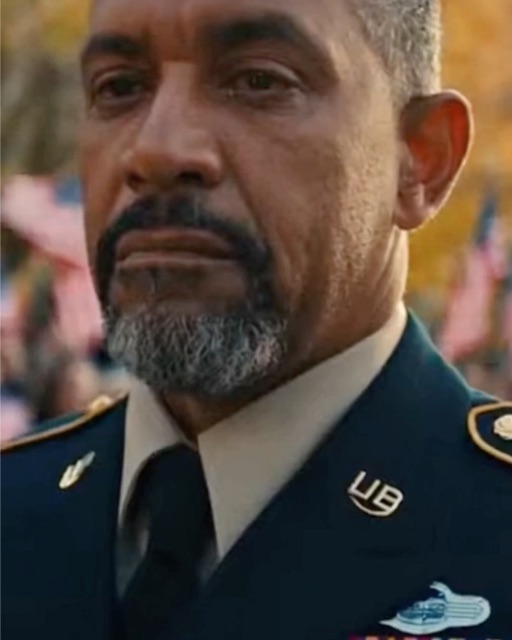
The mayor handed me a key to the city. The crowd cheered. Someone yelled “HERO!”
I didn’t hear them. I was back in Fallujah, watching Gentry bleed out against a bombed-out wall, telling me to stop crying and go get the others.
I got the others. Most of them, anyway.
They wanted me to cut a ribbon at the new VA hospital. Shake hands. Smile for cameras. I walked to the microphone instead.
“His name was Rodney Gentry,” I said. The crowd went quiet. “Twenty-three years old. He had a daughter named Keisha he never met. He’s not here because I am.”
A woman in the front row started crying.
“Dennis Wojcik. Thirty-one. Wanted to open a barbershop in Toledo. He threw himself on a grenade so four of us could run.”
I kept going. Name after name. The cheers stopped. Good.
“You want to call me a hero?” I asked. My voice cracked. “Then remember them. Because every time you thank me for my service, I see their faces. Every single time.”
After the ceremony, a reporter shoved a microphone in my face. “Do you regret enlisting?”
I looked at her. “No. I regret coming home alone.”
She asked for contact info. Follow-up interview. National coverage.
I gave her a folded piece of paper instead.
She opened it later that night and called me, sobbing. I know because I answered.
“What is this?” she whispered.
“The list,” I said. “Eighteen names. Eighteen families. You want a story? Tell theirs.”
She went silent.
Then she said something that made me drop the phone.
“The last name,” she choked out. “Number eighteen. Samuel Corbin.”
I didn’t say anything. I just listened to the sound of my own breathing.
“That’s my father’s name,” she said, her voice a raw whisper. “But he didn’t die in Iraq. He died in a car accident just outside of Richmond. Ten years ago.”
The cheap plastic of the phone clattered against my hardwood floor.
My world, which was already tilted on its axis, spun completely off.
I picked the phone back up, my hand shaking. “That’s not possible.”
“It is,” she insisted. “I was there. I was at the funeral.”
My list was sacred. It was carved into my memory, etched by fire and loss. It was the one thing in my life that was absolutely real.
“No,” I said, my voice hard. “He was with us. He took a piece of shrapnel meant for me. I held him.”
A heavy silence stretched between us, thick with confusion and grief.
“We need to meet,” she said finally. Her name was Eliana.
We met the next day at a diner that smelled of stale coffee and regret.
She slid a worn leather wallet across the table. Inside, behind a yellowed plastic window, was a picture of a man with kind eyes and a familiar smile.
It was him. It was Sam.
He looked older in the photo, a little softer around the edges, but it was undoubtedly him.
Then she showed me a death certificate. Samuel Corbin. Date of death: October 14th, ten years ago. Cause of death: blunt force trauma. Location: Route 64, Virginia.
The date was three months before our unit even deployed.
I felt a cold dread creep up my spine. Was my mind that broken? Had I invented a man?
“He was an accountant,” Eliana said, her eyes pleading with me to understand. “He crunched numbers. He wasn’t a soldier.”
“He was there,” I insisted, my voice low and desperate. “He was older than the rest of us. We called him ‘Pops’. He was quiet, but he was solid. He saved my life.”
She pulled a folded newspaper clipping from her bag. An obituary. It mentioned his loving wife, his daughter Eliana, and his fifteen years at a local accounting firm.
There was no mention of the military. No hint of service.
“Maybe it was someone who looked like him,” she offered gently. “Maybe you got the name wrong.”
I shook my head, grabbing the folded paper from my own pocket. My list. I smoothed it out on the table. The names were written in my own frantic scrawl, a document I’d created in a field hospital, terrified I might forget.
Number eighteen. S. Corbin.
“I don’t understand,” I whispered, staring at the name. It felt like a betrayal. The one truth I held onto was crumbling.
Eliana reached across the table, her hand hovering over mine. “Help me understand,” she said. “If you’re right, then my whole life is a lie. If I’m right… what does that mean for you?”
We decided to start with the other families. My biggest fear. The people I owed a debt I could never repay.
Our first stop was in a small town in Ohio, at the home of Dennis Wojcik’s parents.
A kind woman with Dennis’s eyes opened the door. His father, a man with calloused hands and a stooped back, stood behind her.
They welcomed me like a long-lost son, but I felt like a ghost in their house.
Dennis’s picture was everywhere. High school football. His army portrait. A goofy photo of him covered in shaving cream.
We sat in their living room, sipping iced tea. I told them about their son’s last moments, about his bravery. I left out the worst of the sounds and the smells.
After a while, I pulled out the picture of Samuel Corbin. “Did you ever see this man? Did Dennis ever mention a ‘Sam’ or a ‘Pops’?”
Mr. Wojcik squinted at the photo. “Can’t say I have. Dennis sent letters, but he never mentioned anyone by that name.”
His wife, however, was staring intently. “Wait,” she said, her voice trembling slightly. “His face… it’s familiar.”
She disappeared into a hallway and came back with a dusty photo album. She flipped through the pages, her finger tracing over images of young men in camouflage.
“Here,” she said, pointing.
It was a group photo, taken in the desert. A dozen of us, squinting in the sun. And there, on the edge of the group, slightly apart from the rest, was Sam. Samuel Corbin.
He was wearing the same uniform as the rest of us.
Eliana let out a strangled gasp. “He’s there.”
Mr. Wojcik looked from the photo to me, his brow furrowed. “Who was he, son?”
I had no answer for him.
We left their home with more questions than answers. The photo proved Sam was real. He was there. But the death certificate in Eliana’s bag proved he was already dead.
It didn’t make sense.
Our next visit was to Rodney Gentry’s widow, Maria. She lived in a cramped apartment on the outskirts of Atlanta.
Her daughter, Keisha, was now a teenager. She had her father’s smile. It was like a punch to the gut.
Maria listened to my story about her husband. She cried quietly, holding my hand.
When I showed her the picture, she nodded immediately. “Oh, Pops. Yes, Rodney talked about him.”
My heart hammered in my chest. “What did he say?”
“He said the old man was strange,” Maria recalled. “Said he didn’t act like the other soldiers. He was always watching, always listening. Rodney said he felt safer when Pops was on watch. He said it was like having a guardian angel with a rifle.”
A guardian angel who was supposedly dead before he even got there.
Eliana and I spent the next few weeks on the road, a strange pilgrimage of grief and confusion. We visited six more families.
Two of them remembered their sons mentioning an older, quiet man they called Pops. The others didn’t. No one knew his real name. He was a phantom.
Our last hope was tracking down my former commanding officer, Captain Matthews.
It took weeks of calls and favors, but we finally got an address. He was retired, living a quiet life in rural Vermont.
We found him chopping wood outside a small cabin. He was older, grayer, but his eyes were still sharp. He recognized me immediately.
“Sergeant Reed,” he said, putting down his axe. He wasn’t surprised to see me.
We sat on his porch as the sun began to set. I laid it all out for him. The list. Eliana. The death certificate. The photograph.
Matthews listened without saying a word, his expression unreadable.
When I finished, he stared out at the trees for a long time.
“You’re not crazy, Sergeant,” he said finally. “And your memory is not broken.”
Eliana leaned forward, her hands clenched. “Then who was he? What was my father doing there?”
The Captain sighed, a deep, weary sound. “Samuel Corbin was not a soldier. Not officially.”
He explained that Sam was a specialist, a civilian contractor attached to our unit. His field was cultural intelligence. He was an expert in local dialects and customs, brought in to help us navigate the complex tribal loyalties.
“He was an asset,” Matthews said. “A very valuable one. His work saved dozens of lives, yours included.”
“But the death certificate?” Eliana asked, her voice shaking. “The car accident?”
This was where the story took its darkest turn.
“It was a pre-emptive cover,” Matthews said grimly. “His job was extremely dangerous. He was a prime target. Before he deployed, a ‘death’ was arranged for him on paper. A clean break. If he was captured or killed, the official story was that he’d been dead for months. It provided plausible deniability and protected his family from any potential reprisal.”
Eliana looked like she had been struck. “So the funeral… the whole thing was a lie?”
“A necessary one, at the time,” Matthews said softly. “He knew the risks. He believed in the mission. He believed he was protecting people, both over there and back here. That included you.”
My mind reeled. The man I saw die, the man on my list, was Eliana’s father. My memory was true. The list was true. But the world had been lying to her for a decade.
“He died just as you remember, Reed,” the Captain continued. “He took shrapnel from an IED. The official report lists an unidentified contractor as a casualty. His name was scrubbed. For national security, they just let the original cover story stand. As far as the world was concerned, Samuel Corbin was already gone.”
I finally understood. I hadn’t just been carrying the weight of my brothers’ deaths. I had been carrying the sole, secret truth of Samuel Corbin’s.
My survivor’s guilt had, in its own strange way, kept his real story alive when the entire system was designed to erase it.
Eliana was crying, but for the first time, they weren’t tears of confusion. They were tears of understanding, of grief, and of pride.
Her father wasn’t an accountant who died in a meaningless accident. He was a hero who gave his life for the men beside him, for me.
We left Vermont with the truth. It was a heavy thing, but it was solid. It was real.
Eliana went on to write the story. Not for a big national paper, but for a veterans’ journal.
She didn’t write about conspiracies or cover-ups. She wrote about a man named Samuel Corbin. An accountant from Richmond who loved his daughter, who had kind eyes, and who was also a quiet hero in the sands of Iraq.
She told the stories of the other seventeen men on my list, too. She gave them back their lives, their dreams of barbershops and the daughters they never met.
The article was called “The Eighteenth Name.”
Something changed in me after that. The faces I saw when people thanked me for my service didn’t disappear. But now, they were joined by another face. Sam Corbin’s.
And his face wasn’t one of accusation. It was one of peace.
I started a foundation with the money from a book deal Eliana helped me secure. We called it The Gentry-Wojcik Legacy Project. We support the children of fallen soldiers, helping them with college tuition and mentorship.
I visit Keisha sometimes. I tell her stories about her father, Rodney. I tell her how he was the funniest man I ever knew, and the bravest.
My list is no longer a burden of guilt. It’s a map. It’s a mission. The weight I carried for so long didn’t crush me. It forged me into the man I am now, the guardian of their memory.
We often think the scars of the past are things we must overcome, burdens to be shed in order to move on. But sometimes, those scars are the very things that lead us to the truth. They are a testament not to what we have lost, but to what was real, what mattered, and what must never be forgotten. The heaviest burdens can, in time, become our greatest source of strength.



