
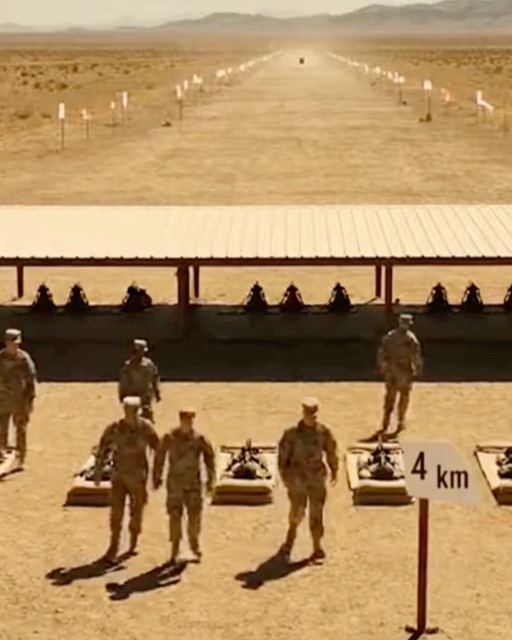
The range was boiling. Mirage eating the horizon. Steel plates a speck two and a half miles out.
Thirteen shots. Thirteen misses. No one wanted to be number fourteen.
General Darren Holt lowered his sunglasses. “Any snipers left?”
Silence. Boots didn’t shift. No one breathed.
Then a calm voice, like she was asking for a stapler. “Sir. May I try?”
Captain Kara Reeves. Supply. The one who signs our gas receipts and unlocks the coffee room at 0500. Not the legend-maker type.
She didn’t strut. She didn’t pose. She slid behind the rifle like it was a desk chair and opened a beat-up notebook, corners sweaty-soft, crammed with numbers and tiny arrows.
My heart pounded. The sun felt louder. She wasn’t chasing the target – she was reading the air. Heat lift. Side push. Mirage drift. Things you feel in your teeth more than see.
One breath. One squeeze.
Crack.
Then – clear as a bell through the furnace—clang.
Nobody moved. My jaw actually dropped. The steel sang and kept singing.
The general’s mouth twitched. “Captain, who taught you to read wind like that?”
Kara closed the notebook, eyes still on the shimmer, and said, almost to herself, “The target isn’t the problem, sir. The air is.”
General Holt took a step closer. “I asked who taught you.”
She hesitated, then flipped the notebook open to page one and held it up. I saw the name at the top, scrawled in block letters, and my blood ran cold.
Because the signature on that page belonged to Sergeant Major Thomas Corrigan.
The name hit the air like a physical blow. A ghost from a story we all knew.
Corrigan. The master marksman who became a cautionary tale.
He was the guy who wrote the book on long-range shooting. Then he got a chapter in the book on how to end a career.
Friendly fire. A bad call in a sandstorm. The official record was brutal, clinical. A tragic miscalculation.
They didn’t just discharge him. They erased him. His manuals were pulled, his methods officially labeled as “unreliable and reckless.”
His name was now a whisper, a synonym for failure.
General Holt stared at the name, his face a mask of stone. The friendly swagger he usually wore was gone.
He looked from the notebook to Kara’s quiet face.
“Where did you get this?” His voice was low, dangerous.
“It was my father’s,” she said, her tone even. Not defiant, just stating a fact.
A murmur went through the line of snipers. Corrigan’s daughter. Here. In supply.
It made a terrible kind of sense. Hiding in plain sight.
The General took the notebook from her. His thumb traced the faded ink of the signature.
He didn’t speak to her. He spoke to the senior NCO beside me.
“Get everyone back to the barracks. Range is closed.”
He turned and walked toward his vehicle, the notebook held tight in his hand.
He stopped at the door. “Captain Reeves. With me.”
It wasn’t a request.
We watched her follow him, her back straight, her stride as unassuming as ever.
She didn’t look like the daughter of a pariah. She just looked like Captain Reeves, the woman who knew where the extra printer paper was.
The door of the Humvee slammed shut, and they drove off, leaving us standing in the shimmering heat and the ringing silence.
I spent the rest of the day thinking about that single shot. That impossible clang.
It wasn’t just a good shot. It was a perfect shot. It was the kind of shot Thomas Corrigan was famous for before his fall.
He taught that the air wasn’t an obstacle. It was a river. You didn’t fight the current; you used it to carry you to the other side.
That’s what she had done. She’d read the river.
Later that evening, I was on guard duty near the command tent. I saw them inside, just two silhouettes against the canvas.
General Holt was pacing. Kara was sitting perfectly still in a folding chair.
I couldn’t hear their words, only the rhythm of the General’s angry steps. Back and forth. Back and forth.
He was a good man, General Holt. Fair. But he was also by the book.
And the book said Thomas Corrigan and his methods were poison.
For her to use them, to prove them right in front of thirteen of his best men, was more than just a lucky shot.
It was an act of rebellion.
I wondered what she was telling him. How she was explaining a lifetime of learning from a man the army had tried to forget.
I imagined her as a little girl, not playing with dolls, but with wind charts.
Learning to calculate spin drift before she learned long division.
Her father, a broken man, pouring all his lost knowledge into his only child.
The next morning, the base was buzzing. Rumors were flying like stray rounds.
Some said Captain Reeves was being transferred. Others said she was facing a court-martial.
For what? Making the rest of us look bad? For being her father’s daughter?
I saw her at breakfast. She was sitting alone, eating her oatmeal like it was any other Tuesday.
People gave her a wide berth. No one met her eyes.
She had become a ghost, just like her father.
Then General Holt walked into the mess hall. The room went silent.
He didn’t look at anyone. He walked straight to her table.
He placed the worn notebook down in front of her.
“I read this last night, Captain,” he said, his voice loud enough for everyone to hear. “Cover to cover.”
Kara looked up at him, her expression unreadable.
“Your father was a poet,” the General said.
My fork stopped halfway to my mouth. A poet?
“He didn’t write about ballistics,” Holt continued. “He wrote about listening. About respect. About understanding the world instead of just trying to conquer it.”
He pulled out the chair across from her and sat down. An unheard-of thing for a General.
“He was my first commanding officer,” Holt said softly, his voice now just for her, though we all strained to hear.
“I was a brand-new lieutenant. Scared out of my mind. He took me under his wing.”
The General stared at his hands on the table.
“I was there that day. The day of the incident.”
The whole mess hall seemed to stop breathing. This was the part of the story no one ever told.
“The intel was bad,” he said, his voice thick with memory. “They sent us in blind. The storm was a nightmare. You couldn’t see your own hand in front of your face.”
“Sergeant Major Corrigan was making calls based on sound, on the pressure in the air. On things none of the rest of us could even perceive.”
“He was trying to protect us. Trying to guide our fire onto an enemy we couldn’t see.”
General Holt finally looked up, and his eyes were full of a pain that was twenty years old.
“The brass needed a scapegoat,” he said. “The mission was a failure. They couldn’t admit the intel was garbage. So they blamed the shot.”
He looked at Kara. “They blamed the shooter.”
A heavy silence settled over the room. We weren’t just soldiers anymore. We were witnesses.
“I was a lieutenant,” Holt said, shame coloring his words. “I was told to write a report confirming the official story. To keep my mouth shut if I wanted a career.”
“And I did,” he whispered. “I did.”
He had carried that weight for two decades. The weight of his silence.
The weight of betraying a man who had taught him everything.
“Yesterday,” the General said, his voice growing stronger, “I didn’t just see a good shot, Captain. I saw the truth.”
“Thirteen of my best snipers, using the best modern doctrine, failed. Because the doctrine is designed for a perfect world.”
“You, using your father’s ‘reckless’ methods, succeeded. Because his methods were designed for the real world. For the chaos.”
He pushed the notebook back toward her.
“He wasn’t reckless,” General Holt said, his voice ringing with conviction. “He was just ahead of his time.”
Kara finally spoke, her voice barely a whisper. “He never blamed you. He said you were a good soldier following orders.”
“He was a better man than me,” Holt replied.
He stood up and addressed the entire mess hall.
“Captain Reeves is not in trouble,” he announced. “On the contrary. She has reminded us of a valuable lesson we chose to forget.”
“Effective immediately, she is temporarily reassigned. She will be leading a new workshop on advanced atmospheric calculation for our sniper teams.”
He looked right at Kara. “Using this notebook as her primary text.”
A wave of relief and disbelief washed over me. This wasn’t just a reversal. It was a revolution.
The General wasn’t just clearing her name. He was resurrecting her father’s.
Over the next few weeks, the range was a different place.
Kara wasn’t Captain Reeves from supply anymore. She was Professor Reeves.
She didn’t shout or command. She spoke quietly, pointing out the subtle dance of the heat haze, the way the wind bent around a small rise in the earth.
She taught us to stop looking at the target and start seeing the journey the bullet had to take to get there.
She was teaching us her father’s art.
The snipers, the same men who had missed thirteen times, were now hitting targets they’d previously thought impossible. They listened with a reverence I’d never seen before.
One afternoon, a civilian car drove onto the base. An old man got out.
He was thin, with wispy grey hair, and he walked with a slight limp. He looked frail, but his eyes were sharp. Razor sharp.
Kara saw the car and stopped mid-sentence. She ran to him.
It was Thomas Corrigan.
General Holt had found him. He was living in a small cabin a few states over, fixing clocks to make ends meet.
The General had flown there himself. To apologize.
Corrigan stood on the edge of the range, watching his daughter teach a group of elite soldiers from a notebook he’d written in his youth.
I saw tears welling up in his eyes.
General Holt walked over and stood beside him. They didn’t speak for a long time. They just watched.
Two old soldiers, standing in the sun, finally on the right side of history.
Corrigan’s official record was reviewed. With a General’s testimony, the truth of that day finally came to light.
His dishonorable discharge was overturned and replaced with an honorable one, with full retirement and back pay. His rank was posthumously restored, though he was very much alive to see it.
But the real restoration wasn’t on paper.
It was here, on this dusty range.
It was in the quiet confidence of his daughter, finally able to share his gift without shame.
It was in the newfound skill of a dozen snipers who now understood that the greatest obstacles are the ones you can’t see.
The story of Kara Reeves and her impossible shot became a legend on the base. Not because of the shot itself, but because of what came after.
It taught us that truth, like a well-aimed bullet, might travel a long and difficult path through a turbulent world.
But if it’s true, if it’s aimed with heart and guided by conviction, it will eventually find its mark.
It showed us that honor isn’t about never making a mistake, but about having the courage to make things right, no matter how long it takes.
And sometimes, the quietest person in the room isn’t quiet because they have nothing to say.
They’re quiet because they’re listening to the wind.



