
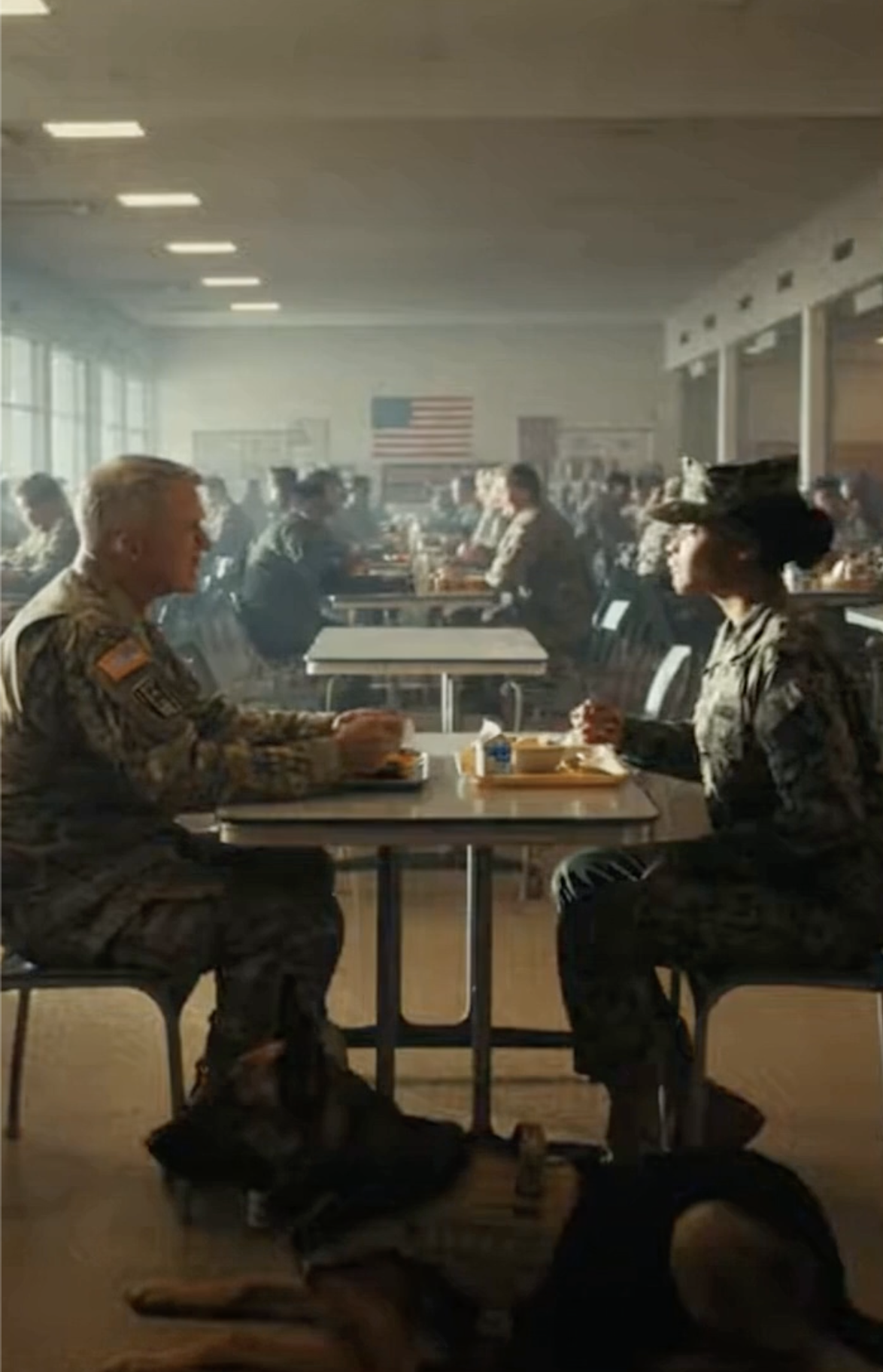
“Can I sit here?” the three-star asked, balancing a tray like any other hungry human at 0620.
“Sir,” I said, standing before my brain could catch up, “you need to leave. Now.”
He didn’t flinch. His aides stiffened. Under a nearby table, Ranger – the Belgian Malinois who never overreacted – had gone statue-still, ears pinned toward the service corridor. Not a growl. Not a bark. Just a low, warning hum that made my skin crawl.
My name is Avery Nolan. On paper: Petty Officer Second Class, Corpsman, rotation. In practice: the quiet one who watches patterns. Who notices when a door hesitates. When a truck arrives five minutes early. When the room you eat in holds its breath.
Breakfast had the wrong rhythm.
A cook was moving too fast. Another had gone too still. The coffee urn sloshed but nobody bumped it. My heart hammered so hard I could feel it in my teeth.
“Sir,” I said again, lower now. “Clear this hall. Five minutes. No panic.”
He looked at me for one beat too long, like he could hear the math I was doing in my head. Then he turned to his aides. “Empty it,” he said, voice even. “Quietly.”
The air snapped. Trays stopped midair. Boots reversed. Someone laughed too loudly to make it normal. Ranger’s handler raised a hand; the dog flowed out from under the table and locked onto the corridor like a laser.
I felt every eye on me. The General stepped closer, voice calm but not soft. “Who are you, really?”
“Just a medic, sir,” I whispered, already scanning the steel pans, the rolling carts, the one door that hadn’t opened all morning.
Ranger reached the cart beside the soup warmers and froze – nose inches from a covered tray, body rigid, tail down. He didn’t paw. He didn’t bite. He just sat and stared.
The handler’s radio cracked. “Stand by for lockdown.”
The doors thumped. The room exhaled—and then nobody breathed at all.
The General’s jaw tightened. “Is it device or dose?”
“Neither,” I said, pulse roaring in my ears. “He’s not alerting to a thing. He’s alerting to a person.”
“To who?” he asked.
I looked at the man in whites who hadn’t blinked since we walked in, the one with the too-clean apron and the wrong shoes, and my blood ran cold.
He turned, lifted the ladle, and I saw the scar on his wrist—the one I gave him the night everything went wrong.
He saw me see it. His eyes didn’t change, but his shoulders did. A tiny sag like a sail losing wind.
“Back of house,” the handler murmured, and Ranger’s focus never wavered.
“I know him,” I said, and my mouth went dry as chalk. “From Khurma Crossing.”
The General nodded once, like I had just answered a question he hadn’t asked. “Then you know his game.”
“I don’t,” I said, surprising us both. “I only know his wrists.”
The man with the scar slid the ladle back into the tray, slow and neat. His apron hung too straight. His hands didn’t shake.
“Nolan,” he said, like the years hadn’t happened. “Small world.”
“You shouldn’t be alive,” I said.
“Neither should you,” he replied, and I felt the night hit me all over again.
Khurma Crossing wasn’t in the brochure. It was a checkpoint on a road nobody wanted and everybody needed. It was a night of hot wind and blown lights and a radio stuck on squeal.
We had pulled a convoy through a bottle neck and a kid with a fractured femur was screaming inside my helmet. The interpreter had gone missing for ten minutes and came back with a story I didn’t buy.
That interpreter wore cheap boots and a watch that stopped five minutes before the blast. His hands were nimble and too clean for a place like that.
His name then was Mercer, or that was the name on his badge. I never knew if it was his first name or last name, and he never offered.
He had grabbed a scalpel when the generator kicked and shadows jumped. He had tried to cut a cuff off a friend or a handler, I never knew which.
I had caught his wrist and done the only thing that made him let go. A field clamp can do things a courtroom won’t.
He dropped the scalpel and bolted into the dark. Five minutes later, the pallet by the gate went to pieces and we picked meat out of tires until sunrise.
I put his wrist in my rear-view every night for a year. I never thought I’d see it again.
Now he was wearing a paper hat and a smile that didn’t touch his eyes. Now Ranger had him dialed in with a stare that could drill a hole in steel.
“I’m impressed,” the General said softly. “But I’m less patient than I look.”
“You and me both,” I said, and took one step toward the man with the scar.
His gaze flicked from the dog to the door and then back to me. He raised both hands a little, like he was about to surrender to a story he wasn’t ready to tell.
“Names must be fun for you,” I said. “Which one am I using today?”
“Call me Mercer,” he said, because of course he did.
“That wasn’t your name then either.”
“That’s because nobody likes the real one,” he said, and his voice was flat enough to skate on.
The General lifted a finger and two MPs ghosted into view by the end of the line. Their hands were open. Their eyes were not.
“Talk fast,” the General said. “My dog’s patience is a finite resource.”
Mercer looked past me at the glass serving line. He looked at the service corridor and the clock that read 0625. He looked like a man who had predicted each second and now saw them slipping.
“I didn’t come to poison anyone,” he said. “And I didn’t bring a device.”
Ranger’s ears flicked like someone had said his name. The handler murmured, and the dog’s head lowered a hair.
“You came to get caught,” I said, because his apron didn’t fit and his shoes were wrong for grease.
“You noticed,” he said. “So that’s new.”
“Why?” the General asked.
“Because if I’m in cuffs before six-thirty, gate three never opens,” he said. “And if gate three never opens, the man who thinks he’s going to die a hero by lunchtime will live long enough to stand trial.”
“Gate three?” the handler said into his sleeve. “Confirm?”
“Confirm what?” the General asked.
“That we’ve got a bread truck out there,” I said, thinking about rhythms again. “It came early.”
The handler’s radio answered on delay. “Bread truck at gate three arrived at 0607. Early by eight. Clearance tag scanned. Driver nervous.”
The General didn’t blink. He lifted his chin instead, and someone somewhere listened.
“Lock gate three,” he said.
“Locked,” came back, tinny and tight.
Mercer exhaled. He looked smaller and somehow uglier with the relief. “Thank you,” he said, which I was not ready to hear from him.
“This isn’t a favor,” the General said. “It’s a question with good lighting.”
Mercer’s hands were still at shoulder height. Grease glowed on his palms where he hadn’t washed well enough to fool anyone.
“Who’s your link?” I asked. “There’s always a link.”
“Kitchen,” he said, and I saw the too-fast cook in my head again. “Back right, five foot seven, buzz cut, loan shark smile.”
“And the one who was too still?” I asked.
“Not his idea,” Mercer said. “His idea is never to have ideas.”
The General didn’t look, he didn’t wave anyone. He just tipped his head the way a hunting dog does when the wind changes. His bodyguards didn’t move either.
Ranger did.
The handler’s hand didn’t lift far, but the dog slid like water along tile. He moved past the soup well and the stack of trays and then cut right without hesitation.
He flowed behind the serving line and disappeared through a half-open door that had bothered me all morning.
A woman in a hat gasped and clapped a hand to her mouth. A fork clattered somewhere, and then I heard the sound that is half growl and half engine.
Ranger had found something else.
The handler eased his radio up. “Watch,” he called, and then the word went tinny and rolled down the corridor.
He was twenty feet away and somehow also right at my ear. “Back pantry,” he said to himself. “He’s on a hold.”
“Holding means he sees, not bites,” I whispered, because some people at our table didn’t know dog language and I didn’t want fear to run wild.
The General’s eyes were on Mercer like nails. “Explain.”
“I’m a package, not a bomb,” Mercer said. “They knew you were coming for the change-of-command walk-through. They had a schedule for your coffee they shouldn’t have had.”
“We rotated the schedule last night,” the handler said to the General without looking at him. “Only five people saw it.”
“Make it four,” I said, because the panic in the pantry wasn’t loud, but it had a shape to it. “He’s in there with Ranger.”
The MPs peeled off like paper. They didn’t run. Nobody ran. Running tells the wrong story to the wrong people.
We moved as a pack toward the back, the General’s weight like a center of gravity that pulled us all.
Mercer didn’t try to move. He kept his hands up and his eyes open and he watched me like a man watches rain.
The pantry was cold and smelled like oranges. A kid in a cook’s hat had his back to the wall, eyes wide, breath coming too fast. Ranger was a black line across the space between them, body tight, head low, eyes locked.
The kid had a badge clipped to his pocket that didn’t match his hat. The badge belonged to someone named Dalrymple. The kid’s tag read Ellis, and neither name fit the way he stood.
The handler spoke like melted butter. “Don’t move.”
Ellis didn’t.
The General didn’t even blink at him. He looked instead at the steel door to the service alley. It was propped with a sack of potatoes shaped like a doorstop.
“Badge,” the handler said.
Ellis didn’t raise his hand. He didn’t have to. The badge shivered like it wanted to jump off his shirt.
“We good, sir?” the first MP said, eyes still on Ellis’s hands.
“Not yet,” the General said. “Phones.”
I stepped sideways to the prep counter and swept a tray with a hand towel over three phones that didn’t match the mix of cases I’d clocked earlier. Two were cheap and new. One was old and dangerous-looking, with tape on the back and a cracked corner that barely held together.
Ellis swallowed hard enough that his Adam’s apple clicked. Ranger didn’t blink.
“What’s your name?” I asked.
“Ellis,” he muttered.
“Try again,” I said. “Use the one your mother actually liked.”
He looked at the ground the way people do when their past is heavier than their feet. “Lew,” he said. “Short for Llewellyn.”
“Lew, look at me,” I said.
He did.
“You were going to open that door for the bread truck,” I said.
He looked at Mercer like a drowning man looks at tide. He didn’t know who to hate more, me or the man with the scar.
He licked his lips. “We did a test yesterday,” he said, voice hitching. “When you had that fire drill.”
I nodded, because I remembered it. The drill that felt like someone had picked the exact moment no one was ready.
“You watched who could open things when,” he said. “You watched who didn’t like to wait.”
“You learned the rhythm,” I said, because not only I watched patterns.
His eyes skewed to the steel door and then back to me. “They said it wouldn’t hurt anyone,” he said, which is what cowards always tell themselves.
Mercer flinched like the words had hit him. Maybe they had. Maybe they always had.
The handler’s radio spit a burst of static and then a voice that didn’t bother with calm. “Gate three driver is trying to reverse. We have pins down.”
“Do not let him out,” the General said.
“Blocked,” came back, sharp as a salute.
“EOD?” the General asked.
“Two minutes out,” the handler answered before anyone on the radio could, because he had counted steps since we walked in.
“Sir,” I said, and he looked at me like I was the one who could move pieces on the board faster than panic could. “There’s one more thing.”
He didn’t say go on. He just watched.
“The door that never opened,” I said, pointing past the rack of paper cups to the locked storeroom no one had used all morning. “Either somebody’s sleeping off a concussion, or we’re at three players.”
The General tipped his chin. The closer MP covered Ellis, and the other slid toward the door with the same smooth patience Ranger used.
He knocked once. He listened. He nodded once and then hit the handle like he meant it.
The door gave after two hits. The smell was bleach and blood cut with lemon oil. On the floor behind a crate of onions, a man in whites lay on his side, breathing shallow, eyes glassy.
“Dalrymple,” the handler said, reading the tag as he went to his knees. “Pulse present. Head wound.”
“I’ve got this,” I said, because I suddenly knew what to do with my hands again.
I slid into the storeroom on my knees and did the dance I’ve been doing since I was old enough to hold a stethoscope. Airway. Breathing. Circulation. Pupils.
He had a scalp bleed and a lump that would need watching. He had a ring with the Saint of Cooks on his finger and a strip of duct tape still sticking to his wrist.
“Hey,” I said, voice low. “You’re okay, Dalrymple. You got jumped, not judged.”
His eyes rolled and focused. He squinted at the light and then at me. “You’re not supposed to be here,” he whispered, which made me laugh right when I wanted to cry.
“Neither are half the people in hats,” I said. “Hold still.”
Behind me I could feel the room shifting. Ellis was crying and not wiping his face. Ranger hadn’t moved an inch. The General was making choices that moved like the tide.
“Call it,” he said to the handler.
“Ranger, out,” the handler said, and the dog flowed backward like rewind on a tape.
Ellis’s knees gave and he hit the floor like a man who finally understood what consequence weighs.
The General didn’t raise his voice, but the room listened. “Take him,” he said, and the MPs did, hands gentle, grips sure.
Mercer was still where we had left him. I wiped my hands on my pants and looked at him.
“What happens at six-thirty?” I asked.
His face twitched. “He calls the number and says a word,” Mercer said. “And an old friend at the pier does something stupid because he thinks he’s doing it for someone who cares.”
“The pier,” the handler repeated, head cocked. “We have tugs moving at seven.”
“Call Harbor,” the General said. “Now.”
The handler’s radio did its magic, and I heard words like secure and divert and hold position echo down hallways I couldn’t see.
I stood and looked at Mercer. He stared back like we were the only ones in a theater and the film had stopped.
“I want to hate you,” I said.
“You do,” he said, and his voice told me he already knew how heavy that hate had made me.
“You sold us out,” I said. “At Khurma.”
He swallowed and stood a hair straighter. “I thought I was saving a village,” he said. “I thought my handler was with the good guys, only in a different room.”
“A lot of people think that right before a wall falls on them,” I said.
He nodded once. “I didn’t know I worked for a man who only knew how to burn things.” His eyes slid to the pantry, the door, the badge now hanging from the MP’s belt. “I can’t undo what we did.”
“Why come here,” I asked. “Why me.”
His mouth twisted like the scar on his wrist. “Because you put that clamp on me and then stopped the bleeding anyway,” he said. “Because you told me to stop running even when I didn’t listen.”
I remembered it, and I hated that I did.
The General’s voice cut the space between us like a straight line. “Who is your handler,” he asked. “And where is he standing right now.”
Mercer’s eyes went dull for a second, like a man who knows the price of speaking and pays anyway. “Supply,” he said. “Master Sergeant Rennick. Desk by the back loading bay.”
The handler’s radio clicked. “Rennick?” he asked, very casual.
“Known,” came a voice that sounded like it already had a folder open.
“Go,” the General said, and one of the MPs peeled away so fast he left a crease in the air.
We stood there in the wet silence that happens after shouts. It was early still, but it felt like we had done a full day’s living.
I took a breath and listened to the hum of the refrigerator and the high whine of the lights. I watched Ranger sit at the handler’s heel and blink like he was bored.
A minute passed in which EOD took a truck driver out of the cab hands-first and cut a canvas seat cover open to find what everyone expects these days. A minute passed in which Harbor found a crew boss with a phone halfway to his mouth and a code word still under his tongue.
A minute passed in which I put gauze on a scalp and told a man named Dalrymple that he’d get the day off he deserved.
The General watched like he had all the time in the world. He probably did, because time bends for some people without asking permission.
“You were right, Petty Officer,” he said then, when the radios were only breathing. “It was a person.”
“It was three,” I said, because I couldn’t help myself.
He smiled with half his face. “And somehow that doesn’t surprise me.”
They took Ellis, still crying and muttering about promises that had sounded like music until they turned into noise. They took the bread truck driver, who didn’t cry at all. They took Rennick out of Supply with his shirt untucked and his excuses late.
They took Mercer too, and he let them. He didn’t try to run, and he didn’t beg. He only looked at me like a man on a dock looks at a ship that finally came.
As he passed me, he said one more thing. “You don’t fix a burn by making a bigger one,” he said. “You were right about that. I was late learning.”
“I was late too,” I said. “But we’re on time today.”
He blinked once. “That counts,” he whispered.
By 0700 the chow hall looked like any other morning after someone decides normal can breathe again. Someone refilled the coffee urn. Someone wiped down the tables where a three-star had almost eaten eggs.
Ranger stretched and yawned his horror movie yawn. His handler scratched his neck like it was Saturday in a living room.
The General stayed until the little things were orderly. He stayed until the big things were in motion. He stayed until his face could go back to being the one you see on a billboard by the gate.
He sat with me for a minute, which I didn’t expect. He put his hands on the table and let his shoulders drop.
“You watch patterns,” he said. “How did you learn that.”
I looked at the way his wedding band had dented his finger and at the small nick on his thumb where a kitchen knife had said hello to him last night. I looked at my own hands and the ghost of blood I’d scrubbed off a dozen times already.
“Someone once told me to stop treating life like a gun range,” I said. “They said most of it is kitchen math.”
He laughed then, low and honest. “That someone was smart.”
“She wasn’t wrong,” I said. “You know you can smell when a room is lying to you.”
He nodded like he did know. “That’s a gift.”
“It’s a chore half the time,” I said. “But it beats the alternative.”
He looked toward the door where Mercer had walked out. “What was he to you,” he asked. “Back there.”
“A mistake that turned into a story I told myself to stay angry,” I said. “And a person I didn’t let grow in my head because it was easier to freeze him.”
He nodded again. “We all have one,” he said.
“Do you forgive him,” he asked, and it didn’t sound like an order.
“I don’t know,” I said. “I don’t forgive that night. I don’t forgive the graves. But I’m not going to spend the next ten years pretending my hate is a home.”
He sat with that like it had weight, because it did.
“You did well,” he said. “Your eyes kept a lot of people breathing.”
“Ranger did more,” I said, because credit matters and dogs deserve medals more than most of us.
“He’ll get steak,” the handler said from two tables over, and the General smiled again.
He stood then. He did not salute me, but he did something we both understood as a nod to two different kinds of service. He tapped two fingers on the table and then on his heart.
“I want your CO to send me your packet,” he said, casual and also not. “You read a room the way my best chiefs read storms.”
“I like being a medic,” I said, and I wasn’t lying.
“You’ll still be one,” he said. “You’ll just be one in rooms where the lights are dimmer.”
I didn’t know then if that was a promise or a threat. Later I figured out it was an option.
They cleared the hall by seven-thirty, like nothing had happened but the smell of bacon overstaying its welcome. Shift B came in, eyes wide, voices bright, the way people do when they hear stories through six walls.
Dalrymple got a day where he didn’t have to count plates. Ellis got a lawyer. Rennick got a cell with a bad view.
The bread truck got a robot and a pair of men who looked like they were born wearing blast suits. Harbor got a tug that turned around before someone lost a hand.
Mercer got a chair in a room with a camera on a red dot. He talked for eight hours and nobody interrupted him in a way that got anyone hurt.
He gave them names and dates and numbers, the way a man pays down interest when he finally sees the bill. He gave them a map of a dozen small choices that make a big fire.
When it was over, someone gave him water and a sandwich he didn’t eat. He asked for one call. He didn’t ask me to be the one to pick up.
That afternoon, I sat on the step outside medical and watched Ranger chase a Kong in the grass. His handler threw it like he meant it and Ranger brought it back like a truck.
I breathed in and out like a person. I tried not to think about Khurma Crossing. I failed. But the failure didn’t own me the way it used to.
The General left the base that day with less fanfare than he brought. He shook a few hands and looked a few people in the eye and told a colonel with a crisp haircut to check his back door twice.
At 1630, I got called to Admin. It was quiet there the way snow is quiet. My CO looked at me like I had grown three inches.
“There’s a letter,” he said, sliding it across the desk.
I read the first line and had to sit down. It wasn’t a medal. It was a thing I didn’t know I wanted until it was in my hands.
They were offering me a slot on a small team that made sure rooms stayed honest. They wanted a medic who could hear math. They wanted someone who could keep a person breathing and also keep a plan from dying.
I told them yes, but not yet. I told them I’d finish my rotation because my patients still needed their stitches. I told them I’d take the class on K9 trauma care because Ranger wasn’t going to be the only dog who got hurt someday.
They said that was fine. They said the room would still be there when I was ready.
I walked back into evening with the letter in my pocket and the sky looking like old denim. The mess hall was quiet again. The clatter had gone back to being dishes and not alarms.
The next morning at 0620, I stood in line with a tray and a coffee cup and watched the new rhythm tick. The door that hadn’t opened the day before stood wide, with a wedge that wouldn’t let it think about closing.
Dalrymple spotted me and raised his hand in a small salute. He had a butterfly bandage on his temple and a smile that said he had slept.
The handler nodded at me and tapped Ranger’s shoulder. Ranger looked at me with his old man eyes and I almost laughed.
I poured coffee and sat at a table by the window. Someone sat across from me, not a general this time, just a lieutenant with dirt under his nails.
“You were here yesterday,” he said. “You did something.”
“I ate eggs,” I said. “Badly.”
He grinned. “Whatever you did, thanks.”
I shrugged. “I didn’t do it alone.”
He raised his coffee. “No one ever does.”
I raised mine back. He was right.
A week later, the bread truck driver made a deal that made his mother wince. Ellis wrote a statement that made his pastor frown. Rennick called a lawyer who knew the names of three judges who liked golf.
Mercer sat in a room and told a grand jury a version of himself that had fewer lies. He didn’t ask me for forgiveness again. He didn’t need to.
Months later, I got a letter from a small village near a place where roads fork into dust. A teacher wrote it in neat English that sounded like a hymn.
She said the well we dug after the bomb had finally filled. She said the boy we pulled from the blast had learned to run. She said she heard a rumor that the man with the scar had gone back to speak to a mother who lost a son and had brought bread.
I lit a candle on my kitchen counter and let the wax run. I wasn’t sure if it was for mercy or math.
Life does not tie bows the way movies do. It knots and it frays and sometimes you get to be the pair of hands that smooths one thread.
But sometimes, if you are very lucky, it rewards attention with grace. It takes the way you listen to rooms and turns it into a day that ends with everyone you love still around the table.
When I think about that morning now, I don’t think about the way my heart ate my ribs. I don’t think about the scar or the doorstop or the badge shaking like it wanted to be free.
I think about Ranger waiting for a word and then doing the one job he was made to do. I think about a General who trusted a petty officer’s gut enough to give his own a rest for five minutes.
Mostly I think about how small the first step was. It was a word said quietly to the right person at the right time without trying to make it a speech.
We spend so much time looking for loud moments we forget the quiet ones save us. The rhythm of a room. The smell of oranges. The way a tray slides or doesn’t.
If there’s a lesson in it for me, it’s this: listen when your bones talk, and act before your fear learns your name. Notice the wrong shoes. Trust the good dog. Be the kind of person who can be used for something more than the story you tell about yourself.
I used to think justice was a courtroom with flags, but sometimes it’s a kitchen with a dog. Sometimes it’s a general with eggs listening to a medic with a bad feeling.
Sometimes it’s catching the right person before they can open the wrong door.
And sometimes, if you’re very stubborn and a little kind, it’s forgiveness showing up not as a pardon but as a job well done.
We all move through rooms that lie to us now and then, and we all get to choose which lies we feed. Feed the ones that make you braver, not harder.
The reward isn’t a medal or a seat at the big table. It’s walking out into the evening and realizing you still like the person who walked in that morning.
That’s enough most days, and on the ones when it isn’t, there’s always another room to read and another hum you can hear if you’re quiet.



