“Ma’am, I’m going to need you to step over here.”
His voice was polite, but it had edges.
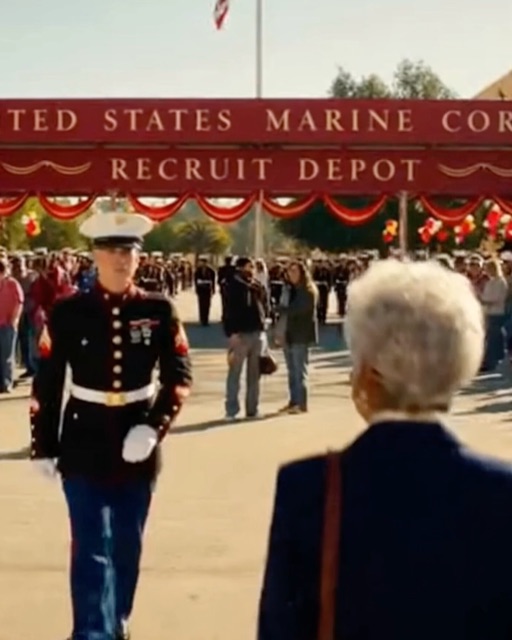
I turned. Young Marine. Fresh haircut, spotless uniform, the kind of posture you only get from weeks of someone shouting it into your bones.
“I’m here for my grandson’s graduation,” I said, holding out my pass and license.
He took them, but his eyes didn’t stay on the plastic. They dropped to my forearm.
The ink is older than he is. A wolverine bared over a downward Ka-Bar, jump wings fanned behind it. Sun-faded. Earned, not bought.
He squinted, and I saw it – the curiosity first, then the smirk.
“Nice tattoo, ma’am,” he said. “Your husband serve?”
My jaw tightened. “Scan the pass. Please.”
“You’ll need a sponsor to be on base,” he went on, tapping the laminate against his palm like a metronome. “Sometimes grandparents get turned around. Family center’s back that way.”
He handed my ID back, but not the pass.
I straightened before I even thought about it. Old muscle memory. Old spine.
“This is the entrance to the parade deck,” I said. “I’m exactly where I should be.”
His patience thinned. “Stolen valor is a felony,” he said, lighter now, like a warning wrapped as a joke. “People get those older designs to look legit.”
He didn’t mean to be cruel. He just didn’t know better.
I felt the heat rise in my face. Not anger. Something colder. It sounded like rotors in my ears, felt like night air on my teeth.
“Call your supervisor,” I said. “But I’m not missing that ceremony.”
He clicked his radio. Families slowed. You could feel their eyes. To them, I was a stubborn grandmother holding up the line.
Boots approached. Not the thump of recruits. A different cadence. Heavier. Certain.
An officer stepped in – silver hair at the temples, chest full of years. The young Marine started talking fast, pointing at my arm like it was evidence.
The officer didn’t look at my license.
He looked at the tattoo.
His face changed first – confusion, then something like recognition, then… respect. He snapped to attention so sharply it cut the air.
The young Marine blinked.
“Sir?” he said, voice a notch higher.
The officer saluted me.
“Ma’am,” he said, loud enough for the families to hear. “Permission to escort you myself.”
I didn’t move. My fingers were shaking now, and I hated that they were.
He turned to the corporal, voice flat. “Do you know who you’re speaking to?”
Color drained from the kid’s face.
The officer looked back at my arm—at the wolverine, the blade, the wings—and then he said the one thing that made the whole crowd lean in at once.
“Because that ‘old’ mark on her skin isn’t a souvenir. It’s the unit insignia for a detachment that pulled my platoon out of a canal outside Sangin when the world was on fire.”
The kid’s mouth opened and shut like a fish.
His name tape said Beckett.
I watched him swallow.
The officer shifted, softening just a shade. “Corporal, return her pass.”
Beckett fumbled with the laminate like it might burn him.
He pressed it into my hand and cleared his throat. “Ma’am, I—”
“Later,” the officer said, not unkind. “We’ll talk later.”
He turned back to me and his eyes were steadier than his voice. “I’m Colonel Harrow,” he said. “Walk with me.”
My knees ached under me, but the old bones understood that tone.
We moved past the gate while whispers followed like a wind.
I tucked the pass into my coat pocket with fingers that wouldn’t quite warm.
“I didn’t think anyone would remember that patch,” I said.
He exhaled through his nose like a man who’d been holding a breath for years.
“I was a captain the first time I saw it,” he said. “Green glow sticks bobbing on shoulders, voices you couldn’t place in the dust, and that mean little animal on a pack flap.”
I looked at the parade deck opening ahead like a sea of white socks and proud faces.
“You were in Sangin?” I asked.
He nodded once. “We were stuck in the spillway after a pressure plate,” he said. “We’d lost two, one was bleeding out, and all the radio wanted to do was die.”
The air was clear and blue as a toy, but it tasted the way Helmand had tasted on some mornings.
Like iron and grit and someone else’s sweat.
“You came in,” he said, quiet now. “You and three others we never properly met.”
“We were attached,” I said. “Not meant to leave names.”
He gave me a look with weight in it. “Detachment V, Joint Recon Support,” he said. “The Wolverines.”
He made it a sentence like a prayer.
I let the corner of my mouth lift. “Unofficially,” I said. “We weren’t supposed to be anybody.”
“People who are ‘nobody’ don’t jump into a dry riverbed with a bag of tourniquets and a radio that actually talks,” he said. “You kept a nineteen-year-old alive who named his first daughter after the medic on your team.”
We passed a line of families with hats that said Proud Marine Granddad and shirts made with iron-on letters.
I listened to a child practice the Marine Corps Hymn off-key into a juice box straw.
“I was logistics on paper,” I said, because that had always been easier to tell strangers.
He glanced down at my forearm again. “Paper isn’t skin,” he said.
We reached the bleachers and the hush you feel near a stage waiting for a curtain.
He gestured toward a section near the front.
“This is for Gold Star and legacy families,” he said. “And… the folks my staff and I would be fools not to honor.”
“I don’t want to take someone else’s spot,” I said, the old stubborn bite still there.
He shook his head. “There’s room,” he said. “Besides, I want the graduating Marines to see you when they march past.”
I let him lead me to the end of a row and sat like I was new at sitting.
My hands relaxed around my purse only when the announcer’s voice crackled over the speakers.
Beckett’s face moved through the crowd at the side of the bleachers, still red, still tight at the mouth.
He stopped at the bottom step and waited like a dog at a threshold.
When I glanced his way, he came up two stairs and froze.
“Ma’am,” he said, posture iron again. “I was out of line.”
The noise around us rose and fell like surf, but he tried to be heard.
“We get a lot of folks,” he said. “Fake stuff on hats, old uniforms that don’t sit right, stories that don’t add up.”
His eyes flicked to my tattoo and then away like it hurt him.
“My mom,” he said, and the word caught. “She married a guy who wore a cover he didn’t earn, and I watched him get locked up.”
He swallowed again and I watched the boy under the Marine.
“So I guess I get tight,” he said. “I thought I was protecting this place.”
“You were,” I said, and I meant it. “You just aimed a little too low this time.”
He blinked like he didn’t expect that answer.
“You see what you see,” I said. “But the trick is to see a little more.”
Colonel Harrow watched from two rows back with that half-smile people wear when life gives them a line they’ve been hoping to hear.
Beckett nodded hard. “Permission to get you some water, ma’am?”
“Already hydrated,” I said, touching my coat pocket. “But thank you.”
He squared up like that helped settle him, and then he backed away with care for his footing.
The band started up and the bleachers vibrated in the chest.
The graduates flowed out from under the stands, slow and perfect, and I forgot about everything but counting steps and shoulders.
I looked for the shape of him without expecting to find his face.
He was in Bravo Company, Third Platoon, tall because our whole clan is tall, and his ears stuck out like his grandfather’s.
He’d called the night before and said he didn’t know if he’d cry, and I’d told him not to embarrass the Corps.
He’d laughed that kind of laugh that puts a ladder over a wall and lets you cross.
His name was Miles.
He used to set up my canning jars like ranks when he was six.
He used to fix my porch light with tape and faith at eight.
He’d asked about my tattoo when he was twelve and I’d told him a woman I knew had been in a unit that used to do hard things in the dark.
He’d said he wanted to do hard things too, like reach the green cereal bowls without a stool.
He never asked again after that like he’d understood there are doors you open slow.
When the platoons turned the corner and the sun flashed off barrel bands, I felt that old heat creep around my collar.
I found him because I knew his gait.
He marches like his mother used to run track, all hip and push.
I kept my hands on the bench so they wouldn’t lift on their own like I was trying to pluck him from the formation and hug the starch out.
He looked straight ahead like nobody had ever taught him how to smirk.
His jaw was set for the eyes on him.
He was beautiful in the way a filled-in line is beautiful.
Colonel Harrow leaned forward and said, “He’s got your spine.”
“My daughter says he’s stubborn in three languages,” I said.
He laughed, then went quiet again because the voices called cadence and the world shrank to timing.
I watched the DIs move like heat lightning along the edges and remembered other edges.
Someone coughed behind me with a rattle that said cigarettes and poor choices, and somewhere a baby wailed without caring about the Corps motto.
When the band cut and the command broke the formation and the new Marines shouted that word in one voice, my throat closed on me.
They carried the sound like it had a handle.
They called that they were Marines.
It hit hard, every time, no matter the years you’d learned to tuck your soft parts deep.
When the last echo fell flat and the clapping broke into laughter and crying and people saying names they’d said at birth and never like this, I stood up slow.
My knees betrayed me at the same age my hair started lying to me.
Colonel Harrow put a hand near my elbow without touching it.
“Take your time,” he said. “There’s no race to a hug.”
I smiled because he understood the important parts.
Families spilled toward the asphalt like a dam had given.
Ribbons with names, balloons with stars, phones up like offerings.
I waited on the edge of the bleachers and watched the river pass.
He broke off from his platoon when their DI released them with a grunt that wasn’t for the world, and then he was a boy again and not a moving statue.
He found me before I found him.
He came in fast, then checked himself like two different men had grabbed the wheel inside him.
“Gran,” he said, and that was all his voice could do.
I put my hand on his cheek the way I did when he was fevered at nine.
“Marine,” I said, because he’d earned that first.
He blinked hard and laughed out the side of his mouth.
“Yes, ma’am,” he said, trying to stand at attention and hold me at the same time.
“Don’t stand for me,” I said. “Stand for the flag when it needs you to, but fall into this hug because it needs you to too.”
He folded me up and I let him, his body solid and clean and shaking like a sapling in a sudden wind.
He smelled like soap and new cloth and adrenaline.
“Your mom’s parking,” I said when he let go a fraction. “She’ll elbow a colonel to get to you if traffic doesn’t move.”
“Wouldn’t be the first time,” he said, and there was his mother’s bite.
Colonel Harrow stepped up then, posture formal and eyes amused.
“Private Ellison,” he said in that measured way. “I’m Colonel Harrow. Your grandmother will deny it, but she’s why I’ve got a scar instead of a grave.”
Miles’ eyes flitted from my arm to the colonel’s face.
He froze in a way I recognized from his pop quizzes in seventh grade.
“Sir,” he said. “I… sir?”
The colonel smiled with that small, dangerous joy you get when you get to set a record straight.
“She won’t tell you,” he said. “But if you ever wondered why she keeps the pantry like a supply depot, or why lightning doesn’t make her flinch, it’s because she’s carried things you’ll learn the names for.”
Miles looked at me and his jaw worked like he had three replies fighting.
“I thought you did paperwork,” he said to me, soft.
“I did,” I said. “The kind you write on your legs with a Sharpie when the table won’t sit still.”
He huffed something that might grow into a laugh later.
“I should have guessed,” he said. “You always fold a map like it owes you money.”
I put my hand at his elbow and felt the power of that muscle under the neat new sleeve.
“I wasn’t going to say anything today,” I said. “Because this day is yours.”
Colonel Harrow cleared his throat and dug in his pocket like a man looking for a name in lint.
He pulled out a coin.
It was the size of a silver dollar, stamped with an EGA on one side and a simple Latin phrase on the other I’d forgotten I knew.
He held it out to me first like a courtesy.
“Actually,” he said. “If it’s all right, I’d like to make something part of his.”
He looked to Miles and then back to me.
“This coin’s been with me since ’04,” he said. “When certain people did things they still won’t admit.”
He put it in Miles’ palm and closed his fingers over it.
“You carry this,” he said. “Not because of me, but because it reminds you to be the kind of Marine who sees the whole person in front of him.”
Miles’ throat bobbed.
“Thank you, sir,” he said, the words hitting their target.
Harrow nodded once, then straightened like a clock reset.
“I’ll leave you to your family,” he said. “Come by my office before you leave the depot if you can, Ms. Ellison.”
I watched him go into the crowd with that easy authority people think is born but is usually built.
Miles turned back and looked at my tattoo again, and this time he didn’t look away.
“What was it called?” he asked.
I shook my head with a smile that tasted like metal and memory.
“It had a name,” I said. “It just didn’t want to be famous.”
He grinned despite himself.
“I thought I was surprising you by joining the Marines,” he said. “Now I feel like I just brought home a stray cat to a house full of tigers.”
“You surprised me plenty,” I said. “You surprised me by being braver than your fears, and that’s all a person can ask for.”
We took pictures with his mother when she finally fought through two layers of people and three layers of rules.
She cried into his shirt and then scolded him for getting taller without permission.
He took it with good humor like he’d trained for it.
Beckett hovered at the bottom of the bleacher stairs again, and this time he didn’t pretend he wasn’t watching.
Miles noticed and stiffened like trouble might be back.
“It’s all right,” I said. “That one’s learning.”
Beckett climbed three steps and gave Miles a sharp look that was also an apology.
“Congratulations, Marine,” he said, and that mattered because it came from a different place than it would have an hour earlier.
“Thank you, corporal,” Miles said.
Beckett cut his gaze to me. “Ma’am,” he said. “Could I ask a dumb question later?”
“I prefer dumb questions that get smarter,” I said. “Find us after chow.”
He nodded and retreated with the wariness of a man who knows he needs to unlearn something and isn’t sure how loud it will be.
We wandered through the booths and the shade tents, and I got roped into three hugs from strangers who said their sons had needed a grandmother’s hand on their back.
I didn’t tell them I’d needed the same.
When we finally made it to the small building with a flag snapping so hard it had a rhythm, Colonel Harrow was waiting like he knew my pace.
His office was cooler than the sun had any right to allow.
He shut the door as a courtesy, not a secret, and went to a frame on the wall that wasn’t quite straight.
He took it down and laid it on the desk like a body.
The photo was grainy and green and taken at night through something that didn’t want to give you a clean image.
You could make out the spillway, the dark mouths of culverts, the shape of men hunched where they shouldn’t have to be.
In the corner was a blur that could be shrug or stride.
But on the blur’s pack, clear as a slap, was a small, mean wolverine.
I touched the glass and my finger left a print that would annoy someone later.
“You kept this?” I asked.
He shrugged. “When the paperwork turned into a coffin and then a career, I needed proof that some of the good wasn’t a fairy tale.”
He slid a folder across the desk with no label.
“It’s a letter,” he said. “Not for a museum. For a grandson.”
I didn’t touch it yet because my fingers were busy holding something else that wasn’t physical.
“I won’t put pressure on him,” I said.
“It’s not a push,” he said. “It’s a compass bearing if he ever needs one.”
He cleared his throat and got a little formal again because we both needed to move some air.
“I’d like to invite you to speak to our family volunteers next month,” he said. “Nothing classified, just… what you just did to Corporal Beckett in thirty seconds.”
I laughed without giving it volume. “Teach him not to be a fool?”
“Teach him not to be a fool twice,” Harrow said. “He’s got a good heart he dresses like a uniform.”
I looked out the window where two kids were trying to saluting each other and both were getting it wrong.
“I can do that,” I said. “If my tomatoes cooperate.”
We walked back into the heat and found Miles and Lydia by the bleachers where a grandmother from Tennessee had started a bake sale out of her purse.
We stayed until the shadows got sharper and people started to separate into those going home and those going to the next thing.
Beckett found us near the parking lot with his hat under his arm and his shoulders two inches lower than this morning.
He addressed Miles, which was right.
“Private,” he said. “Word to the wise.”
Miles listened like he’d been paid to.
“You’ll see people who want to stand next to your shine,” Beckett said. “You’ll see people who think your shine belongs to them.”
He glanced at me and back at Miles.
“Make your own light,” he said. “And check your eyes when you look at folks.”
Miles nodded slow. “Roger that,” he said.
Beckett turned to me and tried a smile like he hadn’t used one in a while.
“I’m here because men like me didn’t listen to women like you,” he said. “I’ll try to do better now.”
“That’ll do,” I said. “Try is a good start if you keep walking.”
He held out his hand.
I took it and felt the sting of old calluses meeting new ones.
We said our goodbyes with promises that meant something because they were small.
On the way out, Lydia drove and Miles talked while I watched the road like I always do.
He asked about training and food and whether drill instructors have to practice that voice in a closet.
We laughed until my ribs wondered what I was doing.
At a red light by the main gate, I reached into my bag and touched something I’d put there this morning and argued with twice.
It was wrapped in an old dish towel my mother had embroidered with a violet.
I set it on his knee.
He looked at me like he was holding a bird.
“Open it when we’re off base,” I said. “The MPs don’t need a story.”
He grinned. “Yes, ma’am,” he said, obedient for the first time that day because it was new and he liked the feel of it.
We crossed beneath the sign that has made more men and women straighten their backs than a thousand sermons.
When we pulled into the strip mall down the road where there’s always a new nail salon and the same sandwich shop, he unwrapped the towel.
The Ka-Bar lay in his hands like weight and history.
The leather handle had darkened where sweat had lived.
He didn’t lift it like a movie.
He held it like a person holds a photograph of someone you love when they’re not in the room.
“I can’t take this,” he said, already having taken it because the world had wanted him to.
“You can borrow it for the rest of your life,” I said. “Because you’ll give it to somebody else someday who needs two extra inches of backbone.”
He nodded and breathed shallow.
“There’s a scratch under the guard,” I said. “I want you to know what it says.”
He turned the blade until the light cut across it.
Three letters I hadn’t let go of for a long time glinted there where only the hand that held it would read them.
M E L.
He looked up, a question start and stop in his eyes.
“My husband,” I said. “Miles Ellison, Sr.”
He blinked and then I watched him put it together without needing help.
“You carried both of us with you,” he said.
“I did,” I said. “And I will, even when you’re three thousand miles away eating chow that lies about meat.”
He laughed, and the world softened another notch around the edges.
We ate bad sandwiches and too many pickles because my family has a contract with vinegar and regret.
He told me about a kid in his platoon who’d almost quit twice and a drill instructor who said a thing he would never be able to forget or forgive.
He asked me if I thought he was strong enough.
I told him strength isn’t a thing you pick up and put down, it’s a thing you make in layers.
He asked me if I was ever scared.
I told him every day, and that’s how you know you’re paying attention.
We sat with paper cups between us, and a man walked by in a hat that didn’t belong to him.
I watched Beckett’s lesson land in my grandson’s eyes.
He looked at the man and then looked away like he didn’t need to be the cop of the world.
He reached over and put his hand on mine.
“Thank you for not telling me,” he said after a while. “And for telling me.”
“I wanted you to be yours first,” I said. “And I wanted you to know what you come from, but not what you owe.”
He squeezed my knuckles gently.
“I owe you everything,” he said.
“Save that for your mother,” I said. “She did the hard parts at 3 a.m. with a fever and a broken washing machine.”
He snorted and shook his head like we all do when we wish we could pay a bill that isn’t money.
We drove back to our motel on the highway that smells like ocean and pavement, and I slept without a light on for the first time in a week.
In the morning I wrote a letter on motel stationery with the logo pressed in too deep.
I addressed it to Corporal Beckett.
I told him I’d once believed everyone who wore a thing had earned it, and that it took getting my own face rubbed in the other kind to toughen my sense.
I told him the job was to narrow the gap between what people say they are and what they are by being the kind of man who could be both patient and precise.
I thanked him for asking a dumb question.
I signed it with initials I’d earned and my first name, because both matter.
Before we left town, we stopped by the depot one more time.
The guard on duty wasn’t Beckett, but he had the same posture and the same young face that the Corps prints and sends out into the world.
We dropped the letter at the family center because that seemed like a place where questions went to get better.
By the time we got home, our porch light had gone out again like it always does when I’m gone.
Miles fixed it without tape this time.
He stood on the top step and looked out over my little yard like he’d already left it and come back.
People think the twist is what Colonel Harrow said at the gate, that the tattoo wasn’t for a husband or a story you tell when you want a free beer.
But the bigger twist was this.
My grandson had already decided the kind of man he wanted to be without my ghost pushing him into it, and telling him the truth didn’t change his choice, it steadied it.
A week later a card came from the base.
It was from Beckett, and it had two lines.
Thank you for not making me smaller when I was wrong, it said. I’m running a volunteer shift at Wounded Warrior on Thursdays now, because I think my eyes need to learn more.
I put the card on my fridge in the space where most people hang the pizza coupons, and I fed the tomatoes, and I took a long walk without counting exits.
At church that Sunday the pastor asked if anyone had a joy to share and I stood up and said my grandson had graduated, and a boy behind me who didn’t know me clapped like he meant it.
After the cake in the fellowship hall, a woman came up and pointed at my arm.
“My nephew did two tours,” she said. “What’s your tattoo mean?”
I looked at it and for the first time in a long time I didn’t hear rotors in my ears.
“It means I did my job,” I said. “And that the people I love know me better today than they did yesterday.”
She smiled like that fit in her mouth easy.
There are a thousand ways to miss a person’s truth.
You can miss it because you’re eager to be hurt or eager to be a hero.
You can miss it because looking hard is work and we get tired and we think shortcuts aren’t a sin.
I missed my own, for a while, hiding behind the paperwork I pretended I’d only ever pushed.
But that day at the gate, a young man’s sharp eyes and a silver-haired officer’s long memory put a thing back where it belonged.
Respect isn’t a rank you wear or a patch you buy or a word you insist on.
It’s a job you do in little steps with your mind open and your mouth closed until it’s time to open both.
It’s looking twice when your first look is hot and generous or hot and mean.
It’s knowing when to salute and when to say sorry, and it’s having the sense to know both have power.
If there’s a lesson in a faded tattoo and an old woman’s shaky fingers at a parade deck, it’s this.
The people you pass every day have chapters you haven’t read yet, and if you slow down long enough to listen, you might hear the part where they saved your life without ever telling you.