
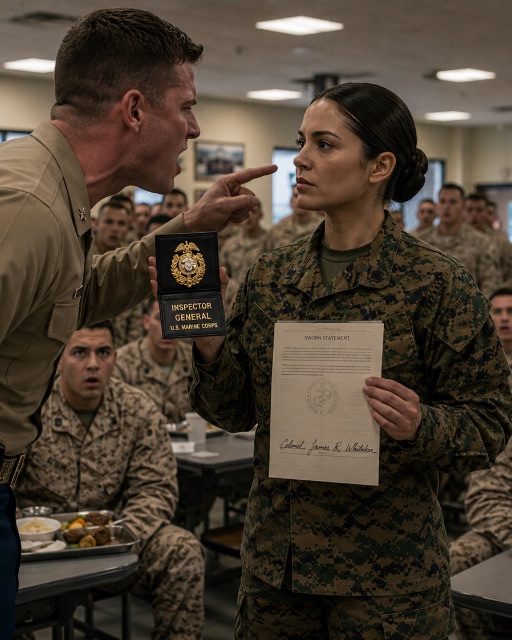
“YOU THINK YOU CAN TALK BACK TO ME?”
Forks froze. The whole mess went silent. My gut knotted because I knew that tone. Captain Marcus Brennan had found his next target.
She stood by the drink dispensers. Small. Still. Jacket zipped high, no name tape showing. Not a recruit’s posture. Too calm. She just watched the room like she’d seen this play out a hundred times.
Brennan puffed up. “Where’s your name tape?”
“Covered,” she said, even voice. No blink.
“Convenient. What unit?”
“Temporary attachment.”
He stepped into her space so everyone could hear. “That doesn’t mean you ignore authority.”
“It also doesn’t mean you get to manufacture violations.”
My blood ran cold. Nobody said that to Brennan. Not out loud. Not after what he did to that nineteen-year-old last quarter and skated on it.
“Watch your mouth,” he snapped.
“I am,” she replied.
He grabbed her sleeve and yanked. Trays crashed. I was on my feet before I knew it. “Unhand her, sir.”
Brennan skewered me with a look. “Sit down, Staff Sergeant, before I bury you too.”
He shoved a finger inches from her nose. “I can end your career before you finish dinner. Do you know who I am?”
She sighed. Not scared. Pitying. “Yes, Captain. I know exactly who I am. But you have no idea who I am.”
She slid a wallet from her jacket and flipped it open.
The gold Inspector General badge caught the lights. The room actually gasped. Brennan’s smirk died on his face. His hands shook.
She clipped the badge to her collar. Her voice dropped, low enough to make his knees go soft. “I’ve been undercover in this unit for three weeks. The recorder in my pocket just got everything I needed. But that’s not the worst part for you.”
She pulled a folded document from her breast pocket. Held it two fingers high.
“This is a sworn statement. Signed yesterday. By someone in your chain of command.”
She unfolded it just enough for him to see the name.
His face went white. Because the signature belonged to a Lieutenant Colonel. Wallace. Our Battalion Commander.
Brennan stumbled back a step. The color drained from him like water from a bucket.
He looked from the signature to the woman, his mind clearly failing to process the betrayal.
The woman’s name tape was now visible, unzipped slightly from her jacket. Major Katherine Shaw.
“Lieutenant Colonel Wallace has been documenting your behavior for six months, Captain,” she said, her voice a clinical, final verdict.
“He initiated this investigation after the incident with Private Harris.”
My heart hammered against my ribs. Private Harris. The nineteen-year-old kid.
Brennan tried to speak, but only a wet, pathetic sound came out.
Major Shaw gestured toward the entrance of the mess hall. Two stone-faced Military Police officers stepped inside.
They moved with a purpose that sucked all the remaining air out of the room.
“Captain Brennan, you are to escort these gentlemen to your office,” Major Shaw commanded, her tone now leaving no room for argument. “You will surrender your sidearm and your command credentials. Is that understood?”
He couldn’t even nod. He just stared, a ghost in his own uniform.
The MPs flanked him, not touching him yet, but their presence was a cage. He looked small, deflated, the schoolyard bully who’d finally been confronted by the principal.
As they led him away, his eyes found mine across the mess hall.
There was no anger in them. Just a hollow, dawning terror. He knew.
He knew that this was it. The end of the line.
The silence in the mess hall held for a long, heavy moment. Then, slowly, like a spell breaking, the whispers started.
Major Shaw turned her attention back to me. Her expression softened just a little.
“Staff Sergeant…” she began, glancing at my name tape. “Miller. You have a moment?”
“Yes, ma’am,” I said, my voice hoarse.
She picked up a fallen tray and started gathering the spilled food. An act so normal it was jarring.
“Let’s not leave a mess for the staff,” she said simply. I knelt down to help her.
For a few seconds, a Major and a Staff Sergeant were just two people cleaning up a spill on the floor.
When we were done, she looked at me directly. “My temporary office is the old supply room, second floor of the admin building. Be there in thirty minutes.”
“I’ll be there, ma’am.”
She gave a single, sharp nod, then turned and walked out. The room watched her go, a mix of awe and fear in their eyes.
I walked back to my table. My own dinner was cold, but I couldn’t have eaten anyway.
My squad was looking at me, their expressions wide.
“Staff Sergeant,” Corporal Diaz said, his voice low. “What just happened?”
“Justice, I think,” I answered. I wasn’t sure I believed it myself yet.
Thirty minutes later, I stood outside the door she’d mentioned. I took a breath and knocked.
“Enter.”
The room was sparse. A folding table, two chairs, a laptop. Major Shaw was typing, but looked up as I came in.
“Close the door, Staff Sergeant Miller.”
I did as I was told, standing at a modified parade rest.
She gestured to the chair opposite her. “Have a seat, Adam. May I call you Adam?”
It was a deliberate choice. A way to take this out of the formal chain of command and make it person to person.
“Yes, ma’am.” I sat. The chair was hard plastic.
“I listened to the recording from the mess hall,” she said, not looking at her screen. “You stood up. You said, ‘Unhand her, sir.’ To a Captain. For someone you thought was a Private.”
I just nodded.
“Why?” she asked. Not an accusation. A genuine question. Her eyes were sharp, analytical.
I thought about it for a second. “It was the right thing to do, ma’am. He crossed a line.”
“He’s crossed a lot of lines,” she said quietly. “Most people are too afraid to call him on it. You weren’t.”
She leaned forward, her hands clasped on the table. “I’m going to be straight with you, Adam. This investigation is much bigger than one outburst in the mess hall. Captain Brennan’s conduct has been a problem for a long time.”
“Private Harris,” I said, the name feeling like a stone in my mouth.
Her face hardened. “Yes. Private Harris. Tell me what you know about that situation.”
I took a deep breath. “Harris was a good kid. A little clumsy, maybe a little too eager to please, but he had heart. He was in my fire team.”
“Brennan took a dislike to him. Said he was weak. He rode him. Hard. Not training. It was personal.”
“One day, during a field exercise, Brennan had Harris low-crawl through a thistle patch for an hour. Said it was for ‘noise discipline.’”
“Harris came back torn to shreds. His arms were bleeding, infected within a day. He had a severe allergic reaction.”
“He ended up in the infirmary for a week.”
Major Shaw was listening, her gaze unwavering.
“And the official report?” she prompted.
“The report said Harris disobeyed a direct order and attempted a shortcut through hazardous terrain, injuring himself through his own negligence,” I recited, the words tasting like ash. “Brennan wrote it himself.”
“And it was signed by two other NCOs,” she added.
“They were pressured,” I said, maybe too quickly. “Brennan threatened their careers if they didn’t back his story.”
“But you weren’t asked to sign?”
“No, ma’am. I was the one who took Harris to the infirmary. Brennan made sure I was on a different assignment when the statements were taken.” It was a sore spot. I felt like I had abandoned my Marine.
Major Shaw nodded slowly. “And what happened to Private Harris?”
“He was given a General Discharge. Under Other Than Honorable conditions. For a pattern of misconduct and endangering himself and his unit.”
“He lost everything, ma’am. His benefits. His GI Bill. His pride.”
“He went home branded a failure. All because a Captain with a god complex decided to make an example out of him.”
The anger I’d been suppressing for months came out hot. My hands were balled into fists in my lap.
“Thank you for your honesty, Staff Sergeant,” she said, her voice gentle again. “Your account matches the evidence we’ve been gathering.”
“What evidence, ma’am?”
“Lieutenant Colonel Wallace became suspicious after the Harris incident. The story didn’t add up. Brennan was too smug about it.”
“Wallace started a quiet inquiry. He found other instances. Extorting money from junior Marines for better duty assignments. Falsifying PT scores to punish those he didn’t like. Denying leave for family emergencies out of spite.”
“The man was a cancer in this battalion.”
It was all true. We all knew it, or at least suspected parts of it. But we lived under the shadow he cast, too afraid of the consequences to speak up.
“He thought Wallace was his protector,” Major Shaw continued. “He’d boast that the Battalion Commander had his back. In reality, Wallace was his chief accuser. He was feeding us everything.”
That was the twist that stunned me most. The man we thought was complicit was actually the one setting the trap.
“He needed incontrovertible proof,” she said. “He needed someone on the inside. That’s where I came in.”
“I’ve been logging his daily abuses. The casual threats. The public humiliations. The way he creates a climate of fear.”
“Tonight,” she paused, “tonight was the keystone. Public assault. Publicly threatening a subordinate who intervened. All of it recorded.”
She gestured to a small digital recorder on the table. The little red light was still blinking.
“Your statement, your willingness to stand up, it adds a layer of credibility that is impossible to refute. You corroborated the character of the man we’re investigating.”
I didn’t know what to say. I just felt a profound sense of relief.
“What will happen to him?” I asked.
“He will face a court-martial,” she said without hesitation. “For assault, dereliction of duty, conduct unbecoming an officer, maltreatment of subordinates… the list is long.”
“His career is over. He will likely face time in the brig. He will not be allowed to harm another Marine ever again.”
A weight I didn’t even realize I was carrying lifted from my shoulders.
“And Staff Sergeant,” she added, her eyes meeting mine, “thank you. What you did took courage. The Corps needs more leaders like you.”
I left her office feeling ten feet tall.
The next few weeks were a blur. The entire battalion felt different. The air was lighter.
People were talking openly. Sharing stories about Brennan they’d kept locked away. It was like a dam had broken.
The fear was gone, replaced by a cautious optimism.
Lieutenant Colonel Wallace addressed the whole battalion at an impromptu formation. He didn’t give details, but he didn’t have to.
He spoke about leadership, responsibility, and the sacred trust between leaders and their subordinates. He said that trust had been broken, and that it was his duty to fix it.
He looked tired, but resolute. I understood then that he had carried this burden just as we had, but from a different vantage point.
Life started to return to normal. A new Company Commander was assigned, a quiet, competent Captain who seemed more interested in training schedules than in flexing his authority.
Then, about a month after that night in the mess hall, I was summoned again. This time to the Battalion Commander’s office.
I was nervous. Getting called to the Colonel’s office is rarely a good thing.
When I entered, Lieutenant Colonel Wallace was there. And so was Major Shaw.
“At ease, Staff Sergeant,” Wallace said, his voice calmer than I’d ever heard it. He gestured for me to sit.
“We brought you here to close a final loop,” he said.
Major Shaw slid a file across the desk. It wasn’t thick.
“The court-martial proceedings against former Captain Brennan are complete,” she said. “He was found guilty on all counts. He was stripped of his rank, dishonorably discharged, and will serve two years at Leavenworth.”
I nodded. It felt final. Just.
“But that’s not why we called you here,” Colonel Wallace said. He leaned forward.
“Your testimony, Staff Sergeant Miller, was instrumental. Not just for convicting Brennan, but for what came after.”
He opened the file. On top was a picture of a young man with a familiar, hopeful smile. Private Harris.
“The board of inquiry reviewed the entire Harris case based on the evidence from Brennan’s trial,” Major Shaw explained.
“With your testimony, and statements from the other NCOs who admitted they were coerced, they found that a grave injustice had been committed.”
My breath caught in my throat.
“As of yesterday morning,” Colonel Wallace said, a rare smile touching his lips, “the finding against former Private Harris has been officially overturned.”
“His discharge has been upgraded to Honorable. His record has been wiped clean. All his back pay, allowances, and benefits are being restored.”
I couldn’t speak. I felt a surge of emotion so strong it nearly knocked the wind out of me.
“But there’s more,” Major Shaw said, her voice soft.
She slid a single sheet of paper out of the file and turned it toward me.
It was a letter.
My eyes scanned the first few lines.
“Dear Staff Sergeant Miller, Colonel Wallace told me what you did… I don’t know how to thank you. You gave me my life back…”
“We offered him reinstatement,” Colonel Wallace explained. “A chance to come back and finish his enlistment, if he wants. He’s thinking about it.”
“But he specifically asked for one thing. He wanted us to make sure you knew.”
I looked down at the letter again, reading the words from a kid I thought I had failed. A kid who now had a future again.
And I realized the most important twist of all.
I thought I was just standing up for a stranger in a mess hall.
But in that moment, I was finally keeping a promise I made to myself. To look out for my Marines.
I had failed Harris once, through silence and inaction. But by speaking up, months later, I had finally helped bring him home.
That night was never about saving Major Shaw. It was about redeeming myself.
My own command took notice. I received a Navy and Marine Corps Commendation Medal for my actions. It sits on my desk, but it’s not the medal that matters.
It’s the copy of the letter from Harris that I keep with it.
The lesson from that day is simple, but it’s one I’ll carry with me for the rest of my life.
Leadership isn’t about the rank on your collar. It’s about the integrity in your heart.
It’s not about how loud you can shout, but about who you’re willing to speak up for when they have no voice.
And sometimes, the single bravest thing you can do is to be the one person who stands up in a silent room and says, “That’s not right.” You never know whose life you might be saving.



