
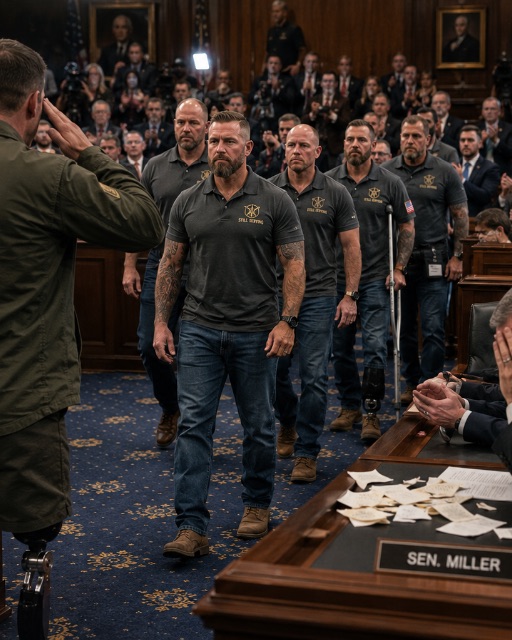
I was still in my dress blues when my phone buzzed. I almost didn’t look. My legs were screaming from standing at that podium for forty minutes, and the morphine was wearing off in waves.
But Trent had told me to watch the news at six. So I watched.
The press conference was already running. Miller looked like a man attending his own execution. His hands shook so badly he had to flatten the paper against the lectern just to read it.
He started with the names.
Polhaus. Correa. Withington. Briggs. Names I knew. Names I carried. Names that visited me at 3 AM when the phantom pain in my shins made sleep impossible.
By name eleven, Miller’s voice was cracking. By fifteen, he was barely whispering into the microphone.
Then he hit nineteen.
He stopped. Dead stopped. The silence stretched so long that CNN cut to a split screen, thinking they’d lost the feed.
Miller looked directly into the camera. His eyes were wet. His mouth opened three times before sound came out.
“Private First Class… Kyle… Miller.”
The room erupted. Reporters were shouting. Flashbulbs strobed.
I stared at my phone screen. Kyle Miller. I knew that name. Not from any official report – because he’d been scrubbed from every official report.
Kyle Miller was the reason we went back into that valley.
Kyle Miller was the kid on the radio, screaming coordinates through a shattered jaw while his position was being overrun. The kid whose extraction Senator Miller had called “a waste of fuel and manpower.”
His own nephew.
No – I scrolled further. The article had already been updated twice.
Not his nephew.
I called Trent. He picked up on the first ring. He was breathing hard, like he’d been running. Or pacing.
“You saw it,” he said. Not a question.
“Trent. Is Kyle Miller really – ”
“Yeah.”
“How long have you known?”
The silence on his end lasted four heartbeats. I counted them.
“Since the night we loaded the bags, brother. Since I read the dog tags myself and watched that senator go on TV the next morning talking about ‘acceptable losses’ without a single crack in his voice.”
My hands were shaking. The phone almost slipped.
“He knew,” I whispered. “He knew who was in that valley and he still—”
“He didn’t just know, Eric.”
Trent’s voice dropped to something I’d never heard from him. Not anger. Something past anger. Something that had aged in the dark for years.
“He’s the one who sent him there.”
I sat on the edge of my hotel bed. The medal was still in its case on the nightstand. The President had shaken my hand four hours ago. The whole country had watched me stand on legs held together with titanium and stubbornness.
And now this.
“There’s more,” Trent said quietly. “The document Reggie showed him today? That wasn’t the real leverage. That was just the door opener.”
“Then what’s the real—”
“Check your email. I sent it thirty seconds ago. But Eric—” He paused. “Before you open it, I need you to sit down. And I need you to remember that Kyle Miller’s mother is still alive. And she’s been getting letters from her son for the past ten years.”
My blood went cold.
“That’s impossible. We loaded him into—”
“Open the email, Eric.”
I opened it.
The attachment was a photograph. Grainy. Taken from a distance. Timestamped eight months ago.
It showed a man standing outside a café in a city I recognized. A city that was supposed to be behind enemy lines. A city we were told was leveled two weeks after the extraction failed.
The man was older. Thinner. A scar ran from his ear to his jaw.
But I knew that face. I’d seen it screaming into a radio handset while tracer rounds split the dark above us.
Kyle Miller was alive.
And the person who had been writing those letters to his mother—forging them, keeping her quiet, keeping the secret sealed in committee—was the same man who just read nineteen names on national television.
Senator Miller hadn’t buried a casualty.
He’d buried a prisoner.
My phone buzzed again. A second attachment from Trent. This time it was a scanned page. Handwritten. Kyle’s handwriting—I recognized it from the FOB, from the crude jokes he’d scratch onto ammo crates.
Three sentences.
I read them.
Then I read them again.
Then I dropped my phone, because the third sentence named the person who had negotiated Kyle’s captivity in exchange for—
My hotel room phone rang. The front desk.
“Sir, there’s a woman in the lobby asking for you. She says she’s Kyle Miller’s mother. She says she knows you carried her son out. And she’s holding an envelope she says you need to see before…”
The line went dead.
I looked at the door.
Someone was already knocking.
The knock was soft. Hesitant. Not the sound of security or someone with an agenda. It was the sound of a person afraid of what was on the other side of the door.
I picked up my discarded phone, my thumb hovering over Trent’s number. My legs ached as I stood, the formal blues of my uniform feeling like a costume for a play that had gotten horribly real.
I limped to the door and looked through the peephole.
She looked older than I imagined. Ten years of a special kind of grief had carved lines around her eyes, but those eyes… they were Kyle’s. Wide and clear, even now when they were filled with a terrifying, fragile hope.
She was holding a thick manila envelope, clutching it to her chest like a shield.
I opened the door.
For a moment, we just stood there. She looked at my face, then down to my legs, a flicker of pained recognition in her gaze.
“You’re Sergeant Evans,” she said. Her voice was quiet, but steady.
“Eric, ma’am. Please.”
She nodded, not offering her own name. She didn’t need to. We both knew who she was.
“They said you were the last one with him,” she said, her eyes searching mine for a truth I didn’t even have until an hour ago. “They said you carried him.”
I swallowed. The words felt like shards of glass in my throat. “Yes, ma’am. I did.”
A single tear traced a path down her cheek. “I needed to see the man who showed my son that kindness.”
She held out the envelope. “And I think you need to see this.”
I took it. It was heavy, packed with papers. “What is this?”
“My son’s letters,” she said, her voice dropping to a whisper. “The ones his father started sending me. But there’s another one. It came yesterday. It’s different.”
My mind raced. His father? The news report said nephew.
“His… father?”
She looked confused for a second. “His uncle. I’m sorry. I get them mixed up. After my husband died, his brother, the Senator… he was like a father to Kyle.”
The lie was so deep it had roots. Senator Miller wasn’t just the uncle who sold him out. He was the surrogate father who pretended to mourn him.
I stepped back and held the door open wider. “Ma’am, I think you should come in.”
She walked into the room, her presence making the space feel both smaller and more significant. My medal in its box on the nightstand seemed to mock me. A prize for a story that was a complete lie.
I put the envelope on the desk and called Trent back, putting him on speaker.
“Trent, I’m here. With Kyle’s mother.”
“Sarah,” her voice supplied from across the room. “My name is Sarah.”
“With Sarah,” I corrected myself. “She brought letters.”
“The ones an aide was forging on the Senator’s orders,” Trent’s voice crackled through the phone. “We know about those. That was part of the pressure on Miller.”
“No,” I said, opening the manila envelope. Inside were dozens of letters, all in the same careful script. All on the same plain stationery. “There’s one that’s different.”
At the very bottom of the pile was a single, smaller envelope. The paper was rougher. The stamp was foreign. I pulled it out.
Sarah leaned forward. “It came yesterday. The postmark isn’t one I recognize. And the handwriting… it’s shaky. But it’s his. It’s what his writing looked like before he… before.”
My hands trembled as I opened it. Inside was a single sheet of paper, a thin, almost translucent kind.
It wasn’t a long letter. Just a few lines.
“Mom,” it started. My breath hitched.
“They told me you think I’m dead. I’m not. I couldn’t come home. Not yet. The mission isn’t over. The wolves are inside the fence. Tell Sergeant Evans the key is what the Shepherd lost.”
I read the last sentence out loud. “Tell Sergeant Evans the key is what the Shepherd lost.”
There was silence on the other end of the line.
“Eric,” Trent finally said. “What does that mean? The Shepherd?”
My mind flashed back to a dusty briefing room. A map. A call sign for a high-value asset we were supposed to support on that operation. A corporate executive from a defense contractor named Sterling-Gable. He was there to inspect his company’s new “non-lethal” crowd control tech.
The asset’s call sign was Shepherd.
The operation went sideways. Shepherd was supposedly evacuated before the firefight started. We were sent in to cover the withdrawal of the main force. And then Kyle’s outpost got hit.
“The Shepherd was a contractor,” I said slowly, the pieces clicking into place with horrifying speed. “An executive from Sterling-Gable. His name was Albright.”
“What did he lose, Eric?” Trent pressed.
“His briefcase,” I whispered. “During the chaos of the evac, he lost his briefcase. It was a whole thing. He was screaming about it. We thought it was just some rich guy losing his laptop.”
The third sentence in the note Trent had emailed me. The one from Kyle naming who negotiated his captivity.
“Sterling-Gable gets the no-bid contract for sector security. I get to live.”
It wasn’t the Senator’s deal. It was Albright’s. The Senator just signed off on it. He traded his own son to cover up something Albright had done. Something in that briefcase.
We didn’t just stumble into a firefight. We were sent in to die to create a distraction.
Kyle didn’t get overrun by chance. He was sacrificed.
“Oh my God,” Sarah whispered from her chair. She was looking at the forged letters spread on my desk. “All this time… all these lies…”
Trent’s voice was grim. “So Kyle was taken to keep him quiet about what really happened. He saw the deal go down. The Senator buried his own son to get a campaign donation and good press from Sterling-Gable.”
“No,” I said, a new, chilling realization washing over me. “It’s more than that.”
I looked again at the photo of Kyle. The scar on his jaw. The city that was supposed to be a ruin. I looked at the note he sent his mother.
“The mission isn’t over.”
“Trent,” I said, my voice low. “He wasn’t just a prisoner. He didn’t just survive. He was working.”
The silence from Trent was different this time. It was a dawning understanding.
“He was captured,” I went on, thinking out loud. “He saw Albright make a deal with the local warlord. A deal to trade Kyle for God knows what. Maybe to fake a battle so Sterling-Gable’s gear looked good. But something was in that briefcase. Something Albright couldn’t afford to lose.”
“So the Senator’s son becomes a political prisoner,” Trent finished for me. “A secret held by a warlord to guarantee the contract payments keep coming from Sterling-Gable, funneled through black-ops budgets the Senator approves.”
“But Kyle didn’t just sit there,” I said, pacing the room, the pain in my legs a dull, distant throb. “He’s a comms guy. He’s smart. He spent ten years in that city. He probably learned the language. He made contacts. He didn’t just watch. He gathered intelligence.”
The forged letters. The real one. The picture. It all made sense.
The Senator was sending fake letters to keep Sarah quiet. But Kyle… Kyle found a way to get a real one out. A signal. He knew I was getting the medal. He knew the whole country would be watching. He knew Senator Miller would have to be part of it.
He timed it perfectly. He weaponized his own story.
“The photo from eight months ago,” I said. “That wasn’t an accident. That was a proof-of-life. He was letting us, letting you, know he was out and moving.”
“And the confession from the Senator today was just the first domino,” Trent said. “Kyle wanted his father to fall, but he knew the real target was bigger.”
Sarah stood up, her face a mask of fierce resolve. The fragile woman who had knocked on my door was gone. In her place was a mother who had found her purpose.
“What was in the briefcase?” she asked.
I looked at the notes. At the fragments of a ten-year puzzle laid out on a hotel desk. “I don’t know,” I admitted. “But Kyle does. And he wants us to get it.”
“Tell Sergeant Evans the key is what the Shepherd lost.”
It wasn’t just a message. It was an order.
“Okay,” Trent said. “This is above my pay grade, Eric. We’re not talking about a dirty politician anymore. Sterling-Gable is one of the biggest defense contractors on the planet. They have lawyers and lobbyists and God knows what else. They have their own private army.”
“And we have the truth,” I said. “And we have a national hero they just put on every TV screen in the country.”
I picked up the medal from its case. It felt cold and heavy in my hand. “And I’ve got a private meeting with the Secretary of Defense tomorrow morning. A courtesy call. For the hero.”
Sarah looked at me. “What are you going to do?”
I looked from her face to the image of her son on my phone. The kid who screamed coordinates through a broken jaw, who never gave up. The man who endured a decade of hell and turned it into his own intelligence operation.
“I’m going to finish the mission,” I said.
The meeting the next morning was in a sterile, wood-paneled office at the Pentagon. The Secretary of Defense, a man named General Peterson, was all smiles and firm handshakes. He talked about my courage, my sacrifice.
I let him talk. I waited until he was done pinning a commendation ribbon above the pocket of my fresh uniform.
Then I placed the single, rough-paper letter from Kyle on his very large, very empty desk.
“Sir,” I said. “I believe there’s been a mistake.”
He looked at the letter, then at me. The friendly smile vanished. “What is this, Sergeant?”
“That’s a letter from Private First Class Kyle Miller. Received two days ago. I believe you know his father, Senator Miller, who declared him killed in action ten years ago.”
Peterson’s face didn’t move. He had years of practice at that. “That’s impossible.”
“Is it?” I pushed the handwritten note from Kyle and the printout of the photo across the desk. “Or is it more impossible that the CEO of Sterling-Gable, Robert Albright, just so happened to secure a forty-billion-dollar contract renewal a week after Kyle Miller disappeared?”
The General’s eyes flickered to the name. Albright. That was the reaction I needed.
“The briefcase he lost, sir,” I continued, my voice steady, all the casualness gone. “It didn’t have a laptop. It had payment ledgers. Details of a side deal Albright was running, selling restricted targeting systems to a third party. The warlord we were fighting was just his middleman. The firefight that day wasn’t a battle. It was a corporate clean-up. My men died, and Kyle was traded, to cover up Albright’s corporate treason.”
Peterson was silent for a long time. He picked up the letter from Kyle. He read it.
“The wolves are inside the fence,” he read softly. He looked up at me. “Kyle Miller was one of my best comms analysts in training. Brightest kid I’d ever seen. I signed his deployment orders myself.”
That was the twist I never saw coming. Peterson knew him. He wasn’t just a name on a page to him.
“He’s been collecting evidence for ten years, sir,” I said. “Everything Albright has done. Every payment, every illegal sale. He says the key is what the Shepherd lost. He wants us to find that briefcase, or what was in it.”
The General stood and walked to his window, looking out over the river. “The Senator’s confession was designed to be the end of the story. A lone, grieving father making a terrible choice. Contained.”
“It’s just the beginning,” I said. “And Kyle’s mother is waiting at a very public hotel for her son to be brought home.”
Peterson turned from the window. The mask was gone. In its place was the look of a commander who had been handed an impossible problem and a single, clear solution.
“Son, what the Army can and cannot do officially are two very different things,” he said. “The information in that briefcase could destabilize three allied governments if it came out the wrong way.”
He walked to a safe in the corner of his office. “But a private citizen, a decorated war hero, asking questions on behalf of a Gold Star mother who has just found out her son might be alive… he can do a lot.”
He handed me a single keycard. “Robert Albright is giving a speech at the Sterling-Gable stockholders’ gala tonight. At the National Portrait Gallery. This will get you in the back door. The Shepherd’s original briefcase was logged as destroyed, but I have a feeling the contents weren’t. A man like Albright is too arrogant for that. He keeps trophies.”
My heart was pounding. “What am I supposed to do?”
“Nothing,” the General said. “Just be seen. Be a ghost at the feast. Let him see you. Let him see the man who carried Kyle Miller’s empty bag off a battlefield. Let him wonder what you know.”
He paused. “Kyle’s an asset. And we don’t leave our assets behind. We just have to give him a path home. Your job is to create that path.”
That night, I didn’t wear my dress blues. Trent had dropped off a simple, dark suit. I didn’t look like a soldier anymore. I just looked like one of the hundreds of powerful men and women flooding the gallery.
Except my face had been on every channel for the last forty-eight hours.
I found Albright near a statue of Lincoln. He was laughing, a drink in his hand. He was older, more bloated than in the mission files, but it was him. The Shepherd.
I just stood about thirty feet away, by the bar, and watched him.
It took him five minutes to notice me. His smile froze. The glass in his hand trembled. He whispered something to the man he was talking to and started to move away, towards an exit.
I didn’t follow. I just took out my phone and dialed the number General Peterson had given me.
“He’s moving,” I said quietly.
“We see him,” a voice on the other end responded. “We have the briefcase.”
It was that simple. My presence had spooked him into retrieving his stash, confirming its location for the team Peterson had in place. The wolves inside the fence were hunting each other.
Two weeks later, I was standing on a private tarmac. Sarah was beside me, her hands twisting the strap of her purse. A small, unmarked jet landed and taxied to a stop.
The door opened.
A man walked down the steps. He was thin, and he walked with a slight limp. A scar ran from his ear to his jaw.
He saw his mother, and his face broke into a smile that was ten years in the making.
He didn’t run to her. He walked, slowly, deliberately. His eyes met mine over her shoulder as he hugged her. He nodded once. A nod of thanks. A nod that said, “Mission complete.”
There were no cameras. No reporters. Robert Albright had resigned from Sterling-Gable for “health reasons” and was now facing a sealed inquiry. Senator Miller was a footnote, a disgraced politician whose bigger crimes were swallowed by a story no one would ever publish.
Kyle’s story wouldn’t be told in the news. It would be told in the quiet gratitude of the lives he saved with the information he gathered. His heroism wasn’t in a single battle, but in a decade of silent endurance.
Standing there, watching him hold his mother, the phantom pains in my own legs finally went quiet.
My war was over. His was too.
Sometimes, the greatest battles aren’t the ones fought with guns in dusty valleys. They’re the ones fought in silence, over years, with nothing but hope and a stubborn refusal to be forgotten. Justice isn’t always loud. Sometimes, it’s a quiet flight home.



