Sarah stepped off the bus at Fort Campbell, clutching a worn duffel bag. At twenty-eight, she looked barely old enough to enlist – small frame, soft features, and a nervous half-smile that made her look like a college freshman.
“Another fresh recruit,” Sergeant Thompson muttered, laughing with the seasoned veterans. “Looks like she’s never seen the inside of a barracks, let alone a battlefield.”
Sarah kept her head down.
At intake, the officer barely looked up from her clipboard. “Specialty?”
“Combat medic, ma’am.”
The officer smirked, scanning Sarah’s slight build. “Previous deployments?”
Sarah hesitated for just a fraction of a second. “Five tours, ma’am. Three Afghanistan. Two Iraq.”
The clipboard slipped from the officer’s hands, clattering against the desk. Five tours? Most soldiers didn’t survive that many. And this girl looked like she belonged in a dorm room.
The whispers started immediately. By lunch, the rumor of “stolen valor” had spread through the entire base. Sergeant Thompson had heard enough. He decided to make a public example of her.
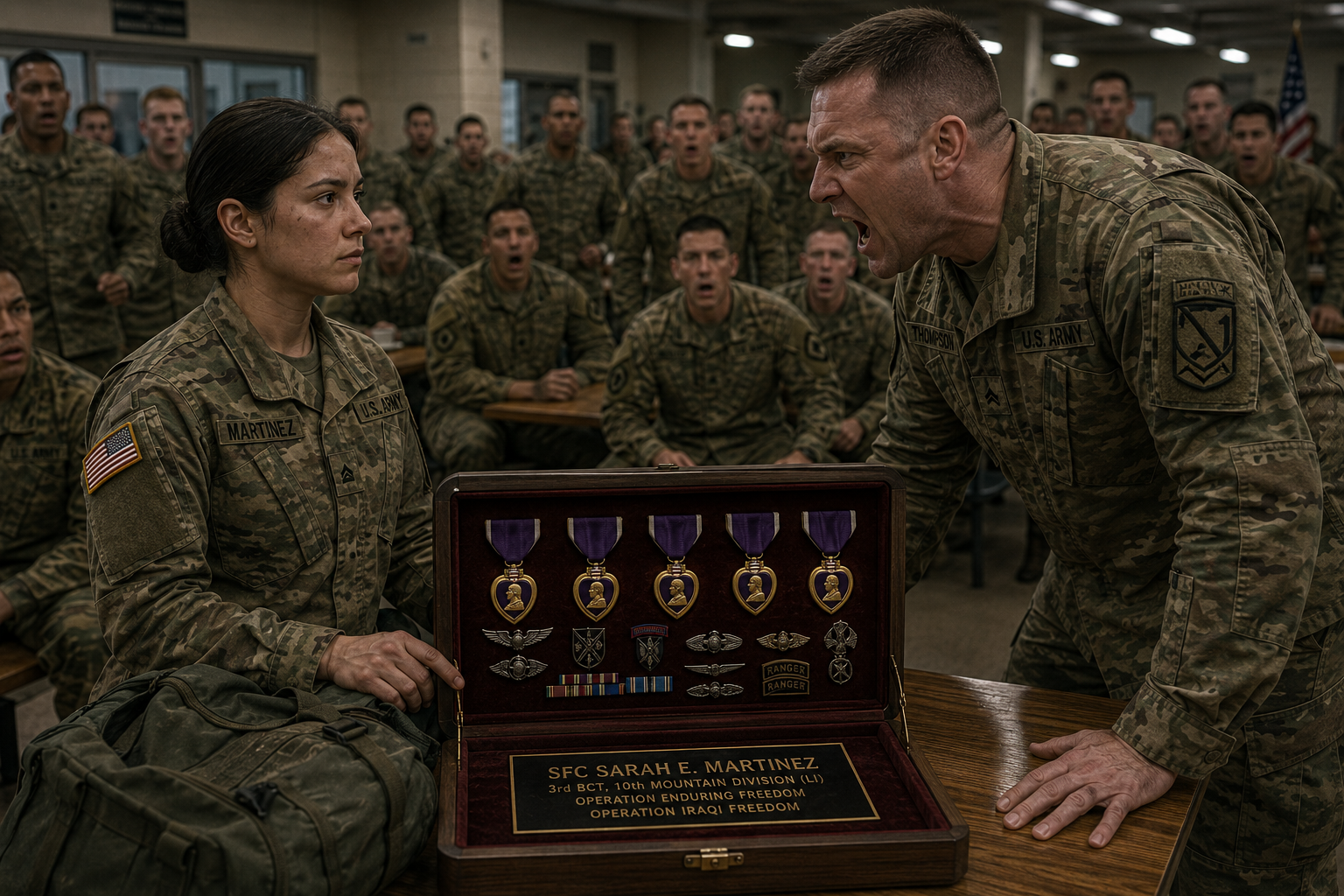
He marched straight up to Sarah’s table in the crowded mess hall, slamming his heavy palms down. The room went dead silent.
“I don’t know what kind of sick joke you’re playing, Martinez,” Thompson barked, his face turning red. “But we don’t tolerate liars playing dress-up. Dump the bag. Let’s see your ‘proof.’”
Sarah didn’t argue. She didn’t even blink.
She calmly reached down, unzipped her faded green duffel, and pulled out a heavy, battered velvet display box. She popped the gold latch and pushed it across the table toward him.
Thompson froze. His jaw dropped, and the blood completely drained from his face.
He wasn’t just looking at five Purple Hearts.
He was looking at a Distinguished Service Cross, a Bronze Star with valor device, and a citation signed personally by the Secretary of Defense. But that wasn’t what made his hands shake.
Pinned to the inside of the lid was a faded photograph. A photo of a young female medic dragging a wounded soldier through a dust storm, blood soaking through her uniform, her teeth gritted, one arm shattered and hanging limp at her side.
The wounded soldier in the photo was missing half his face.
Thompson recognized him immediately.
Because that soldier was Thompson himself. Fallujah. 2007. The ambush that killed four members of his squad. The explosion that took his left eye and shattered his cheekbone. He’d spent eleven months in a military hospital. The doctors told him he flatlined twice on the medevac. They told him a medic – a woman nobody could identify afterward – had dragged him four hundred meters under enemy fire with a broken arm and a collapsed lung, applied a tourniquet with one hand, and performed an emergency tracheotomy in the dirt with a ballpoint pen casing.
They never found her. She was listed as a temporary attachment. Her file was sealed. Command said she’d been reassigned. Thompson spent years trying to track her down. He wrote letters. Filed requests. Hit dead ends.
And now she was sitting across from him in the mess hall, eating powdered eggs like it was any other Tuesday.
The room was so quiet you could hear the fluorescent lights buzzing.
Thompson’s hands were trembling. His one good eye was filling with tears. Every soldier in that mess hall watched as the toughest sergeant on base slowly lowered himself to one knee.
His voice cracked. It barely came out as a whisper.
“You’re her. You’re the one who—”
Sarah looked up. Her eyes were steady. Calm. The same eyes that had stared down a firefight and refused to leave a dying man behind.
She set down her fork.
“You still owe me a pen, Sergeant.”
Thompson let out a choked laugh that turned into a sob. He grabbed her hand with both of his and pressed his forehead against her knuckles.
Nobody in that mess hall said a word. But one by one, every single soldier stood up.
Then the base commander walked in. He hadn’t come for lunch. He was holding a folder stamped CLASSIFIED in red. He looked at Sarah, then at Thompson, then back at Sarah.
“Martinez,” he said. “I need you in my office. Now.”
Sarah wiped her mouth with a napkin and stood.
“What’s this about, sir?”
The commander’s face was unreadable. He opened the folder just enough for her to see the first page.
Sarah’s calm finally broke. Her hands started shaking. The color left her face.
Because the folder didn’t contain a commendation. It contained a photograph—taken three weeks ago—of a man she had personally watched die in her arms in Kandahar in 2011.
He was alive. And he was standing outside the base gate.
The commander leaned in and said six words that turned her entire world inside out.
“He doesn’t remember who he is.”
A cold dread seeped into Sarah’s bones, colder than any desert night.
She followed the commander, Colonel Matthews, out of the silent mess hall. Every eye was on her, but the stares were no longer filled with suspicion. They were filled with awe.
They walked in silence to his office. The air inside was still and heavy.
Matthews closed the door behind them and gestured to a chair. “Please, sit.”
Sarah sat, her hands clasped tightly in her lap. The photo was seared into her mind.
It was Corporal Daniel Collins. She remembered the warmth leaving his body. She remembered closing his eyes herself.
“How?” was all she could manage to say.
The Colonel sighed, taking a seat behind his large oak desk. He slid the folder across to her.
“Three weeks ago, an allied patrol found him wandering in a remote province near the border,” he explained. “He was malnourished, dehydrated, and had no identification.”
“They brought him to a field hospital. His fingerprints eventually flagged him in the system as Corporal Daniel Collins. KIA. Kandahar. 2011.”
Sarah’s breath hitched. “I was there. I was the medic on scene. The patrol was ambushed. He had multiple gunshot wounds to the chest. There was… there was nothing I could do.”
Her voice was steady, reciting a report. But her memory was a brutal, vivid filmstrip. The dust, the shouting, the metallic taste of fear, and Daniel’s hand clutching hers.
“We believe you,” Matthews said softly. “Your after-action report was meticulous. You declared him deceased on site.”
“So he’s a ghost,” Sarah whispered.
“A ghost with amnesia,” the Colonel corrected. “He doesn’t know his name. He doesn’t know where he’s from. He remembers nothing before waking up in that hospital.”
“He has violent reactions to most stimuli,” Matthews continued. “Loud noises. Authority figures. Questions. He’s been non-responsive. Until a psychologist was reading his file aloud.”
Sarah looked up, already knowing what was coming next.
“When she read your name from the report, ‘Medic Sarah Martinez,’ he became calm. He repeated it. It’s one of the only things he’s said.”
The weight of it settled on her. The last person he saw before his world went dark was her. Her name was an anchor in a storm of nothingness.
“What do you need me to do, sir?” she asked.
“We need you to talk to him, Sarah,” the Colonel said, his voice pleading. “The doctors think you might be the only person who can reach him. The key to unlocking who he is.”
An hour later, she was being escorted to a secure wing of the base hospital. Sergeant Thompson was waiting for her outside.
He looked awkward, his face still etched with the shame and profound gratitude from the mess hall.
“I heard,” he said gruffly. “Figured you could use… I don’t know. Backup.”
Sarah gave him a small, tired smile. “Thank you, Sergeant.”
“It’s Mark,” he said. “My name is Mark. And you never have to call me Sergeant again.”
The gesture, so simple, meant the world. She wasn’t an outcast anymore. She had an ally.
A doctor led them into an observation room. Through a one-way mirror, she saw him.
It was Daniel. But it wasn’t.
The man she remembered was cocky and smiling, with bright eyes. This man was gaunt, his hair prematurely grayed at the temples. A long, thin scar ran from his hairline to his jaw. He sat on the edge of a bed, staring at his own hands as if they belonged to a stranger.
He was a ghost wearing a familiar face.
“He’s physically recovered, for the most part,” the doctor said. “But mentally… he’s lost.”
Sarah took a deep breath. “I’m going in.”
Thompson put a hand on her shoulder. “You sure about this? You don’t have to.”
“Yes, I do,” she said, her voice firm. He was her soldier. You never leave one behind.
She entered the room alone. The door clicked shut behind her.
Daniel didn’t look up. He just kept staring at his hands.
Sarah pulled a chair over and sat a few feet away from him, giving him space. She didn’t say anything for a long time. She just sat with him in the quiet.
Finally, she spoke. Her voice was soft, like she was talking to a frightened animal.
“Hi, Daniel.”
His head snapped up. His eyes, clouded with confusion and fear, locked onto hers. He didn’t recognize her.
“My name is Sarah,” she said gently. “It’s okay. You’re safe here.”
He flinched at the word “safe,” as if it were a foreign concept. He looked around the sterile room, then back at her. A flicker of something crossed his face. Not recognition. More like a question.
“Sarah,” he repeated, his voice raspy from disuse. The name sounded right to him, even if the face meant nothing.
That’s how it began.
Every day, Sarah spent hours with Daniel. She didn’t push him for memories of the war. Instead, she talked about baseball. About fishing trips with her dad. About the ridiculous taste of gas station coffee.
She brought him a real cheeseburger one day. He ate it slowly, cautiously, but a hint of a smile touched his lips. It was the first time she’d seen it.
Thompson became a regular fixture. He’d bring coffee for Sarah and just stand guard outside the door, a silent, hulking protector. He felt he owed her a debt that could never truly be repaid.
Slowly, Daniel started to emerge from his shell. He began asking questions. Simple things. “What’s your favorite color?” “Did you have a dog growing up?”
He was building a new world, one small piece at a time. And Sarah was at the center of it.
But something felt wrong.
A high-ranking official from Intelligence, Director Evans, had taken a keen interest in Daniel’s case. He was polished, smooth, and always present.
“Any breakthroughs, Martinez?” he’d ask, his smile never quite reaching his eyes. “We need to know what he remembers about his capture.”
Sarah felt a protective instinct flare. “He’s not ready, sir. Pushing him could cause a total regression.”
Evans would just nod, that plastic smile in place. “Of course. Your judgment is paramount, medic.”
One evening, Thompson caught her as she was leaving the hospital. He looked worried.
“Something’s not right,” he began, his voice low. “I’ve been pulling old files. The official report on Collins’s ambush is thin. Too thin.”
“What do you mean?” Sarah asked.
“The unit that found the bodies… it wasn’t a standard patrol. It was a specialist team, dispatched from another sector. The timeline is off. They were practically waiting for the attack to be over.”
A chill went down Sarah’s spine.
That night, during their session, Daniel was agitated. He kept rubbing the scar on his face.
“It burns,” he whispered. “The metal was hot.”
Sarah froze. “What metal, Daniel?”
“The… the truck,” he stammered. “It wasn’t their truck. It was one of ours. It was green.”
The enemy forces in that area didn’t use American-made vehicles. The ambush was supposedly conducted by local insurgents.
The next day, she told Thompson. His one good eye widened.
“Friendly fire?” he guessed.
“Or not so friendly,” Sarah replied, her mind racing. “The report said the enemy was neutralized. But what if the real enemy just drove away?”
Their investigation became covert. Thompson used his old contacts, men who owed him favors, to dig deeper. Sarah carefully guided Daniel’s memory, looking for clues that wouldn’t trigger a panic attack.
She brought in a map of the province where he was found.
He stared at it for a long time, then pointed to a remote, mountainous area. “The cave,” he said. “Cold. Dark. A man brought me water.”
“An enemy soldier?” Sarah pressed gently.
“No,” Daniel said, shaking his head. “He spoke English. He told me to stay quiet. That I was safer there, presumed dead.”
The pieces were clicking into place, forming a terrifying picture. Daniel wasn’t captured by the enemy. He was hidden by an ally after his team was eliminated by an American asset.
He was a witness. Someone wanted him dead. And they thought they had succeeded.
That evening, as Sarah was talking to Daniel, he suddenly grabbed her hand. His eyes were wide with a new kind of terror. It wasn’t confusion. It was recollection.
“The radio,” he gasped. “I heard him on the radio, just before the attack. He gave our position. He used my callsign.”
“Who, Daniel? Who did you hear?”
Daniel’s face contorted in a struggle to remember the name. His eyes darted past Sarah, looking at the one-way mirror. He was looking right at Director Evans, who was standing there with Colonel Matthews.
“Evans,” Daniel whispered, the name coming out like a curse. “The voice on the radio was Evans.”
In the observation room, Evans’s smile finally vanished. He saw the look on Daniel’s face and knew the game was up. He turned to Matthews, his expression hardening.
“The subject is unstable,” Evans said coolly. “He’s a security risk. I’m having him transferred to a secure intelligence facility for debriefing. Effective immediately.”
Colonel Matthews looked from Evans to the panic on Daniel’s face through the glass. “I don’t think that’s wise, Director.”
“It’s not a request, Colonel,” Evans snapped, two armed MPs appearing behind him.
But Thompson was already moving. He burst into the observation room. “Sir, you can’t let him take that man.”
Sarah, inside the room with Daniel, understood everything in an instant. This wasn’t a transfer. It was a death sentence. Evans was taking Daniel somewhere to silence him for good.
She stood between Daniel and the door as the MPs entered. “You’re not taking him.”
One of the MPs moved to grab her. Before he could, Thompson stepped in front of her, a solid wall of muscle.
“You’ll go through me first,” he growled.
Evans laughed. “Don’t be a fool, Sergeant. You’re obstructing a matter of national security.”
Colonel Matthews was torn. He was a man who followed the chain of command, but his gut screamed that this was wrong.
“What is this about, Martinez?” he demanded.
“Director Evans arranged the ambush that killed Daniel’s team,” Sarah said, her voice ringing with certainty. “Daniel survived, so Evans had him listed as KIA and planned to eliminate him. But someone got to him first and hid him. Evans is a traitor.”
The accusation hung in the air. Evans’s face was a mask of fury.
“That’s a ludicrous allegation! She’s hysterical. Arrest them all!”
As the MPs raised their weapons, Sarah did the last thing anyone expected. She reached into her medical kit and pulled out an epinephrine auto-injector.
She stood next to Daniel and held it to his neck.
“Everybody back up,” she commanded, her voice ice. “This man has a severe heart condition from his trauma. Any undue stress could kill him. And if you take one more step, I’ll inject him myself. His heart will give out, and you’ll lose your precious witness, Director.”
It was a total bluff, but it was delivered with the absolute conviction of a medic who had made life-or-death calls in the middle of a firefight. She knew exactly how to make it sound real.
Evans hesitated. He needed Daniel, either to find out who hid him or to silence him. A dead body here and now would raise too many questions.
The standoff was broken by Colonel Matthews. He had seen the truth in Sarah’s eyes, and the pure guilt in Evans’s. He pulled out his sidearm.
But he didn’t point it at Sarah or Thompson. He aimed it squarely at Evans.
“Director Evans,” Matthews said, his voice like granite. “You are under arrest on suspicion of treason. Drop your weapon.”
The MPs, loyal to the base commander over a visiting intel director, lowered their own rifles, their expressions relieved.
Evans’s face crumpled. He was trapped. It was over.
The aftermath was quiet. The base was locked down as military investigators unraveled the spy ring Evans had been running for years, selling intelligence to the highest bidder.
Daniel was moved to a safe house, with Sarah and Thompson as his personal security detail. With the threat gone, his memories started to return more clearly.
He remembered Sarah not just as the medic from that horrible day, but as a friend. They had served on the same forward operating base for months. He remembered laughing with her over terrible coffee and sharing stories of home.
One afternoon, they were sitting on the porch of the safe house, watching the sunset.
“I remember you now,” Daniel said softly. “All of it. You tried to save me. You held my hand.”
“I did,” Sarah said, her throat tight.
“You saved me twice, Sarah,” he said, turning to look at her. The confusion in his eyes was gone, replaced with a deep, quiet gratitude. “Once from death, and once from nothingness. How do I ever thank you for that?”
Sarah just shook her head. “You don’t have to. We don’t leave people behind.”
When the investigation was over, Colonel Matthews called Sarah into his office once more. Thompson and a fully recovered Daniel stood with her.
“The Pentagon wants to give you another medal,” he said, a smile on his face. “And a promotion. They want you teaching advanced field medicine at West Point.”
Sarah thought about it for a moment. She looked at Thompson, the grizzled sergeant who became her fiercest defender. She looked at Daniel, the man she pulled back from the brink.
“With all due respect, sir,” she said, “I have to decline.”
Matthews raised an eyebrow. “Decline? Why?”
“Because my place isn’t in a classroom,” Sarah replied. “It’s out there. With them.” She nodded toward the hundreds of young soldiers on the training fields outside. “Someone has to be there to bring them home.”
A true hero doesn’t seek the spotlight or the rank. They find their purpose in the quiet, selfless act of serving others. Strength isn’t measured in the medals you wear, but in the lives you touch and the hope you give when all seems lost. Sarah Martinez knew her reward wasn’t a piece of metal on her uniform; it was the lives of the soldiers she fought for, the family she found in the most unlikely of places, and the quiet knowledge that she was exactly where she needed to be.