
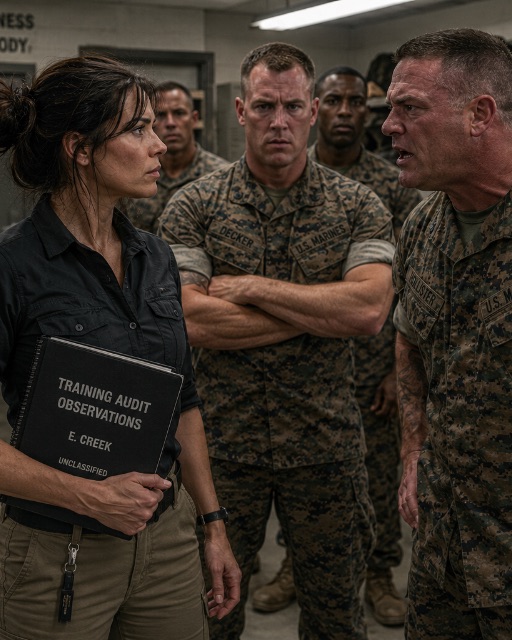
“Final warning. I was Force Recon trained.”
I said it softly. But every Marine around that combatives pit heard every word.
Six of them had closed in around me near the edge of the mat like I was some anxious civilian contractor who’d wandered onto the wrong installation carrying paperwork and too much confidence.
They expected me to retreat.
I didn’t move.
The nearest instructor stepped close enough to intimidate without technically touching me. That calculated almost-contact men use when they want witnesses later saying, “Nobody touched her.”
I looked at him once. Then past him toward Gunnery Sergeant Dale Hollister.
He stood twenty feet away, arms crossed, grinning with the smug certainty of a man who thought he already understood me.
A woman. A civilian observer. A failed candidate. A problem he could embarrass before chow.
Hollister laughed first. The others followed, because men like him always train the room when it’s acceptable to be cruel.
“Well damn,” he shouted. “She’s documenting us already. Better smile nice, boys. We got ourselves a little compliance officer.”
I lowered my eyes to my notebook. And I kept writing.
That irritated him more than fear ever would have.
Fear feeds men like Hollister. Silence forces them to think.
My credentials read Evelyn Creek. Civilian assessment specialist. The file Hollister had pulled was thin. Clean. Carefully designed to insult me.
Force Recon candidate. Medical withdrawal after six weeks. Civilian contract assignments afterward.
A woman who almost made it. A woman who failed.
The file was bait.
And Hollister swallowed every word.
By 0800 on my first morning, he’d circulated my fake history through the cadre like gossip in a roadside diner. By lunch, every smirk in the yard told me the story had spread.
“You need directions to the observation section, ma’am?”
“Careful near the mats. People actually train out here.”
I’d survived uglier rooms filled with uglier men. So I kept writing.
Every pairing. Every score sheet. Every unexplained rotation delay. Every time a lighter female candidate got matched against a male Marine forty pounds heavier and later marked down for “lack of control.”
By the third training block, I had eleven irregularities logged.
By the seventh, I’d found corruption dressed in uniform.
The name that kept surfacing was Lance Corporal Priya Santosh. Twenty-one. Quiet. Sharp. Her actual performance was strong. Her official scores were garbage.
Someone had altered them. Not carelessly. Just enough to remove her from selection without raising questions above cadre level.
That was Hollister’s specialty. Administrative cruelty. The kind that destroys careers with paperwork while calmly saying, “Standards are standards.”
On day three, he stuck me behind the equipment shed in a folding chair where I could technically observe while practically disappearing.
“Contractor wants to watch training,” he announced. “She can watch from the cheap seats.”
The Marines laughed again.
I sat down. Crossed one ankle over the other. Opened my notebook.
And because nobody considered me important enough to monitor, I watched everything.
At 0712, a male candidate rolled his ankle during a scramble drill. The assigned instructor was halfway across the mat screaming at another recruit.
I was closest.
I stood. Crossed the mat. Dropped to one knee. Finished assessing the injury in under twelve seconds.
“Grade two sprain,” I said without looking up. “No structural instability. He can continue if you want rotation maintained, or I can pull him. Your call, Gunny.”
The yard went silent.
Not because I helped.
Because of how I moved.
No hesitation. No wasted energy. Hands positioned correctly. Weight balanced perfectly.
Hollister looked irritated instead of impressed.
“Torres,” he barked. “Walk it off.”
The Marine limped away.
I returned to my chair.
That’s when I noticed Corporal Vance staring at me from the scoring table. Young NCO. Sharp instincts. Not courageous yet, but observant.
He leaned toward another instructor and whispered something.
I didn’t need to hear it. I already knew what he’d noticed.
Your body never truly forgets elite training, no matter how hard your file tries to erase it.
That night, beneath a flickering fluorescent light, I opened two folders. One was my contractor notebook.
The other was encrypted.
Mission log.
I typed a single sentence.
Pattern is coordinated. Not random.
Cruel men improvise. Corrupt systems organize.
On day ten, Staff Sergeant Kwame Decker cornered me near the locker area.
Hollister stayed absent. That was different. Cowards love distance once misconduct starts looking prosecutable.
Decker entered with two NCOs beside him. They positioned themselves between me and the exit like they’d rehearsed it.
He smiled pleasantly. “Ma’am, just checking on you. We want to ensure you feel welcome here.”
I looked at his boots. Then his hands. Then the doorway. Then I wrote down the time.
He unfolded a printed document. My fake record.
“Says here you didn’t finish the pipeline. Medical withdrawal after six weeks. Happens sometimes. Nothing to be ashamed of.”
His tone sounded warm. His eyes didn’t.
Then the side door opened.
Lance Corporal Santosh walked in. Wrong place. Worst possible moment.
Decker turned immediately, like a predator catching movement.
“Well, Lance Corporal,” he announced loudly, “since you’re here, maybe we should discuss your latest performance metrics.”
Santosh froze.
He began reading her falsified failures out loud. Control deficiencies. Circuit failures. Aggression concerns. Endurance weakness.
Every word false.
I stood.
Not dramatically. One step forward.
I placed myself directly between Decker and Santosh. My back toward her. My eyes locked on him.
The entire locker room tightened.
Decker’s smile twitched. “You got something to say, ma’am?”
“Yes,” I replied calmly.
He waited.
I glanced at my notebook. Then back at him.
“Please continue.”
He hated that.
Bullies despise witnesses who understand exactly what they’re witnessing.
He finished his performance, but the rhythm was broken. He came intending to crush Santosh. Instead, he handed me a recorded sequence complete with motive, witnesses, exact wording, and intimidation tactics.
When the men finally left, Santosh stayed frozen near the doorway, breathing hard like she was trying not to collapse.
“Ma’am, I…”
“You didn’t do anything wrong,” I told her quietly. “When you get back to your bunk tonight, write down everything you remember. Not for me. For yourself.”
She nodded once. Small. Unsteady. But not defeated.
After she left, I sat back down. Forty-five seconds later, Decker’s entire speech was fully documented.
On the outside, my binder looked like an ordinary contractor folder.
Inside, it was tabbed, indexed, and built for formal investigation review.
Built to destroy men who believed women only documented things because they were emotional.
What they didn’t know was that I’d spent years writing after-action reports in places where one missing detail could get people killed.
And they still didn’t understand the most dangerous truth of all.
I wasn’t there to complain.
I was there to complete the operation.
The next morning, Hollister called a full formation at the pit. He wanted an audience for whatever he’d planned next. He didn’t know my encrypted log had already pinged a secure inbox at 0400.
He didn’t know who was already driving through the gate.
And he definitely didn’t know the name printed on the orders folded inside my jacket pocket – the name that would make every Marine in that yard snap to attention the second it was read aloud…
Hollister stood in the center of the pit, basking in the morning sun.
“Alright, ladies and gentlemen!” he boomed, a showman playing to his crowd. “We have a special treat today.”
He pointed a thick finger directly at me.
“Our civilian observer here claims she was Force Recon trained. Well, words are wind. Training is a verb.”
He waved a hand toward the mat. “So, Miss Creek, since you’re so good at assessing our candidates, why don’t you come out here and give us a little demonstration?”
The laughter was immediate and ugly.
This was the trap. If I refused, I was a coward. If I accepted and lost, I was a joke.
I closed my notebook and placed it carefully on my folding chair.
I didn’t walk around the pit. I walked straight across it, my boots sinking slightly into the soft dirt.
I stopped a few feet from the mat, meeting his gaze without a flicker of emotion.
“Who am I demonstrating with, Gunnery Sergeant?” I asked, my voice even.
His grin widened. He turned and pointed toward a hulking instructor, a Staff Sergeant who outweighed me by at least sixty pounds of solid muscle.
“Staff Sergeant Graves has graciously volunteered his time,” Hollister announced.
Graves cracked his knuckles. He looked bored, like this was a chore he had to get through.
This wasn’t about training. This was about punishment.
I stepped onto the mat. The soft give of it felt familiar, like coming home to a place you barely remembered.
Behind Hollister, I saw Corporal Vance’s face. He looked pale, worried. He knew this was wrong.
Hollister was moving to the edge of the mat to get a better view. That’s when Vance made his move.
He didn’t shout. He didn’t make a scene. He just stepped close to the Gunnery Sergeant, his head bowed as if asking a question.
He whispered.
I was too far away to hear the words, but I saw the effect.
Hollister’s smug grin vanished.
It was replaced by a slack-jawed confusion, then a dawning horror. The color drained from his face until he was the color of bleached bone.
His eyes shot toward me, no longer filled with condescension, but with pure, undiluted terror.
The whispers from Vance must have traveled, because a sudden, uneasy silence fell over the cadre. The laughter died in their throats.
Hollister swallowed hard, his Adam’s apple bobbing. He looked like a man who had just realized he’d been playfully poking a great white shark with a stick.
“Hold,” he croaked, his voice a fraction of its former volume. “Everybody hold.”
But it was too late.
The sound of a vehicle approaching cut through the tension. Not a Humvee. Something sleeker.
A black government sedan rolled to a stop on the access road just beyond the pit.
The dust settled.
Every Marine, candidate and instructor alike, turned to look.
The rear door opened, and a man stepped out. He was tall, ramrod straight, with the silver eagles of a full-bird Colonel on his collar.
He moved with an authority that needed no introduction.
The entire yard snapped to attention. The sound of dozens of boots clicking together was the only noise in the world.
Hollister looked like he might actually collapse.
The Colonel didn’t look at the formation. He didn’t look at Hollister.
His eyes found me on the mat.
He walked directly toward me, his polished shoes leaving perfect prints in the dirt. He stopped at the edge of the pit.
“Major Creek,” he said, his voice ringing with crisp command. “I trust your assessment is complete.”
A collective gasp went through the crowd.
Major.
The word hung in the air, heavier than any physical weight.
I stepped off the mat. “Yes, sir. It is,” I replied, my posture shifting instinctively into the familiar bearing of an officer.
The Colonel nodded once. “Then let’s conclude this.”
He finally turned his gaze on Gunnery Sergeant Hollister, and the temperature seemed to drop ten degrees.
“Gunnery Sergeant,” the Colonel’s voice was quiet, but it cut like glass. “Care to explain why one of my senior field intelligence officers is about to be used as a sparring dummy by your staff?”
Hollister’s mouth opened and closed. No sound came out.
I opened my binder. The one that looked like a simple contractor’s folder.
“Colonel, my report details a coordinated effort by Gunnery Sergeant Hollister and Staff Sergeant Decker to sabotage the selection chances of female candidates, specifically Lance Corporal Santosh,” I stated clearly.
I handed the binder to the Colonel. He took it without looking at it.
“This goes deeper than simple misogyny, sir,” I continued.
I turned my eyes back to Hollister. “This was personal, wasn’t it, Gunny?”
He flinched.
“You knew exactly who Lance Corporal Priya Santosh was. You served under her father, then-Captain Santosh, fifteen years ago at Camp Pendleton.”
The blood completely drained from Hollister’s face now. He knew.
“Captain Santosh caught you skimming from the unit’s recreational fund. He could have ended your career. Instead, he handled it internally, made you pay it back, and gave you a second chance. He thought you learned a lesson about integrity.”
I let the words hang in the air.
“But you didn’t learn integrity, did you? You learned resentment. And when his daughter, a candidate with top-tier potential, landed in your training cycle, you saw a chance for payback. A way to hurt the man who showed you mercy by destroying his daughter’s dream.”
The silence was absolute. Every Marine was staring at Hollister, not with fear or respect, but with utter contempt.
His entire world, built on intimidation and a carefully crafted image of a tough-but-fair Marine, had just been demolished in under a minute.
“Staff Sergeant Decker,” the Colonel barked.
Decker, who had been trying to blend in with the background, snapped to attention.
“My report documents his direct role in the falsification of scores and intimidation,” I added.
Two Military Police officers, who had arrived silently behind the Colonel’s vehicle, stepped forward.
“Gunnery Sergeant Hollister, Staff Sergeant Decker,” the Colonel ordered. “You are relieved of your duties. The MPs will escort you to the Provost Marshal’s office.”
They didn’t resist. They looked broken. As the MPs led them away, the myth of their power dissolved into the morning air.
The Colonel addressed the remaining cadre. “This command has zero tolerance for corruption. Zero tolerance for officers who mistake their rank for a crown. You will all be subject to review.”
He then turned to the candidates. “Standards are standards. But integrity is the foundation of everything we are. Never forget that.”
He looked back at me. “Major. A word.”
We walked away from the pit, leaving the stunned Marines to process the morning’s events.
Later that afternoon, I found Lance Corporal Santosh packing her gear, an uncertain look on her face.
“Ma’am… Major,” she corrected herself, stumbling over the rank. “I don’t know what to say.”
“You don’t have to say anything,” I told her gently. “Your scores have been corrected. You’re back in the selection pipeline, effective immediately.”
She looked down at her hands. “Thank you. But after all this… seeing how they operate…”
I understood. The trust had been broken.
“Selection for Force Recon is one path,” I said. “It’s a good one. But it’s not the only one.”
I paused, choosing my next words carefully.
“I didn’t just notice that your scores were being manipulated, Lance Corporal. I noticed why you were a threat to men like Hollister. You’re not just physically capable. You’re observant. You see patterns. You processed what was happening to you not just with emotion, but with analysis.”
I saw a flicker of her true self return to her eyes. The quiet, sharp intelligence I’d logged in my notes.
“My official title is Field Intelligence Officer,” I told her. “My real job is to go into broken places and figure out why they’re broken. It requires a different kind of strength. It requires seeing what everyone else misses.”
I held out a simple business card. It had nothing on it but an email address and a string of numbers.
“The medical withdrawal on my file wasn’t a lie,” I said. “It was a transfer. I was selected out of the pipeline for a different program. A program that needs people who can think their way through a problem, not just fight their way through it.”
Her eyes widened as she understood.
“When you finish this cycle,” I said, “and you will finish it, I want you to contact me. There’s a different door I can open for you. If you want it.”
For the first time since I’d met her, Priya Santosh smiled. It was a real smile, full of hope and a newfound sense of purpose.
“Yes, Major,” she said, her voice firm. “I want it.”
Before I left the base, I found Corporal Vance, the young NCO who had whispered the warning to Hollister.
“What did you tell him, Corporal?” I asked.
He looked a little nervous. “Ma’am, a few years back, my uncle, who was in 3rd Recon, told me a story. About an operator they called ‘Spectre.’ An analyst so good she could predict enemy movements from scraps of intel. He said she vanished from the records, went deep cover for a special command. The only thing he remembered was they said she voluntarily washed out of the pipeline to create her cover.”
He looked at me. “When I saw how you moved, how you documented everything… it just clicked. I took a risk, Ma’am.”
I put a hand on his shoulder. “Courage isn’t about not being afraid, Corporal. It’s about doing the right thing when you are. Your file is going to get a flag.”
He looked alarmed. “A bad one?”
“No,” I replied. “A good one. The kind that gets you noticed by people who value integrity over obedience.”
As I drove away from the base, my completed report on the passenger seat, I felt a sense of quiet satisfaction.
Hollister and Decker’s careers were over, but that wasn’t the victory. The victory was in the silent spaces they left behind.
It was in a young corporal learning the true meaning of courage.
It was in a determined lance corporal finding a new path, one perfectly suited to her unique strengths.
The world is full of bullies who use their power to shrink the world for others. They build their castles on fear and thrive in the dark. But they forget one simple truth.
True strength isn’t found in a loud voice or a heavy hand. It’s found in the quiet resolve to stand for what’s right. It’s in the patience to observe, the discipline to document, and the courage to speak truth to power, not with anger, but with inescapable fact.
Because in the end, the light always finds a way in. And character isn’t who you are when everyone is watching. It’s who you are when you think you’re alone in the shadows, because you are never truly alone.



