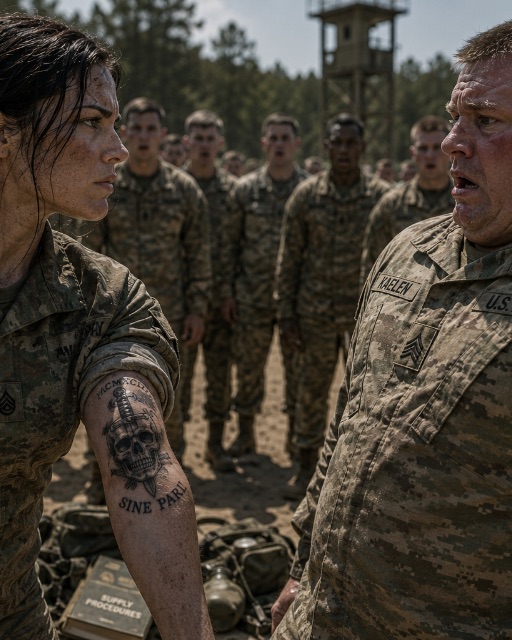
He booted my ruck so hard the buckles snapped and it skidded through the Georgia dust. Water bottles spun out. The whole line went dead quiet.
“Pick it up,” I said.
Staff Sergeant Todd Mercer got nose-to-nose with me, sweat and coffee on his breath. “You don’t give orders here, Specialist,” he hissed, loud enough for everyone to hear. “You’re a paper pusher in my yard. You salute. You smile. You say ‘Yes, Sergeant.’”
My pulse didn’t spike. It dropped. Ice-cold. I’d felt hotter wind and colder fear in places I still don’t let myself name.
I glanced at my ruck in the dirt, then back at him. He puffed up, like he needed me to flinch to stay in control.
I didn’t.
“Pick. It. Up,” I repeated.
He jabbed a finger toward my chest. My jaw clenched. The platoon’s boots seemed glued to the gravel. No one breathed.
I didn’t raise my voice. I reached for my sleeve instead.
The rip of Velcro sliced through the morning like a shout. I pushed the fabric past my elbow and turned my forearm so only he could see.
He leaned in. His face changed.
The red drained out. His mouth opened and nothing came out. Not a word. Not a shout. Just a tiny sound, like he’d swallowed wrong.
I held his stare. The field spun around us and then stopped.
He swallowed again, eyes locked on my skin.
But when he saw the tattoo, he actually took a step back – then lowered his voice and said a name no one on that field was supposed to know.
“Daniel,” he whispered, the name a ghost on his lips. “Daniel Mercer.”
The name was inked on my arm, just below a pair of crossed rifles over an angel’s sword. Beneath it, a date. The day his world, and mine, had been permanently fractured.
He straightened up, his eyes wide and lost. The bulldog NCO was gone, replaced by a man looking at a ghost.
“My office,” he finally choked out, his voice a bare rasp. “Now.”
He turned on his heel and strode away without another word. The platoon finally took a collective breath, a quiet murmur rippling through the ranks.
I knelt, gathering my scattered gear with deliberate slowness. The plastic clasps on my ruck were broken, just like something inside the Staff Sergeant.
I slung the damaged pack over one shoulder and walked toward the company headquarters, the Georgia sun beating down on my neck.
His office was small, crammed with binders and the smell of stale energy drinks. He was standing behind his desk, his back to me, staring at a framed picture on the wall.
It was a photo of two young men in uniform, smiling. One was Todd Mercer, younger and leaner. The other was his brother, Daniel. My friend.
“You have no right,” Todd said, his voice shaking with a rage that was really just grief in disguise.
I stood there, silent.
He spun around, his face a mask of pain. “You have no right to wear his name on your arm. You weren’t even infantry. You’re a supply clerk.”
That was the official story. That’s what my file said. It was a clean slate, a quiet corner of the Army they put me in after everything fell apart.
“You were with him,” he accused, his voice rising. “In that firefight. The report said he was killed saving his team. Saving you.”
I didn’t answer. A promise is a heavy thing to carry.
“They gave him a medal,” Todd continued, his voice cracking. “My parents have it on their mantle. A hero. But you were there. You came home. He didn’t.”
His words were like stones, each one hitting a wall of silence I had built around that day.
“What happened, Specialist Markham?” he demanded. “You owe me that. You owe him that. Tell me how my little brother died.”
I met his gaze. “I can’t do that, Sergeant.”
That was the wrong answer. The raw grief in his eyes hardened back into fury.
“Get out of my office,” he snarled. “And you better believe your life in my platoon is going to be hell.”
He wasn’t lying.
The next few weeks were a quiet, grinding war. He had me on every miserable detail. Cleaning latrines with a toothbrush. Raking the gravel of the motor pool until every stone was perfectly aligned.
I was given double shifts, the worst equipment, the most tedious tasks. He’d inspect my work with a magnifying glass, finding fault in the flawless.
The other soldiers kept their distance. They saw what was happening. A few offered quiet words of sympathy when Mercer wasn’t around, but no one wanted to get caught in his crosshairs.
I just did the work. I kept my head down. I kept my mouth shut.
One evening, a young Private named Harris found me polishing the hubcaps on the Captain’s Humvee long after everyone else had gone home.
“He really has it out for you, man,” Harris said, leaning against the vehicle.
I just kept polishing. “It’s his right.”
Harris shook his head. “No, it’s not. It’s not right at all. Whatever is going on, you don’t deserve this.”
I stopped and looked at the kid. He couldn’t have been more than nineteen, the same age Daniel was when we first met.
“Just do your job, Harris,” I said, my voice softer than I intended. “Keep your head down. Don’t make waves.”
He lingered for a moment. “I heard some of the other NCOs talking. They said you used to be somebody else. That you weren’t always a clerk.”
I went back to polishing. “Used to be is a long time ago.”
The harassment got worse. Mercer would call for inspections in the middle of the night, tearing my locker apart for a speck of dust. He’d ridicule me in front of the formation, calling me a paper-pusher who was afraid of real work.
He was trying to break me. He needed to break me because he couldn’t break the memory of his brother.
The breaking point finally came on a humid Tuesday afternoon. We were at the rifle range. My reclassification to supply meant I rarely touched a weapon anymore, but everyone had to qualify.
I shot a perfect score. Every single round in the center of the target. It wasn’t arrogance; it was muscle memory, etched into me from a thousand other ranges and a hundred other days that weren’t practice.
Mercer saw my target. He walked over, his face dark.
He didn’t say a word. He just picked up the paper, ripped it in half, and dropped it on the ground.
“You fail to qualify, Specialist,” he said loud enough for the range safety officer to hear. “Looks like your hands are only good for paperclips after all.”
Something inside me, a tightly locked door, started to creak open.
Later that day, he had the platoon doing ruck marches in the blistering heat. He loaded my pack with extra sandbags, making it weigh twice as much as anyone else’s.
I didn’t complain. I just cinched the straps and started walking.
At the halfway point, as men were gasping for water, Mercer stopped in front of me. He looked at my face, dripping with sweat, and saw no surrender.
That made him angrier.
“You think you’re tough, Markham?” he sneered. “You think carrying a heavy pack makes you a soldier? My brother carried a heavy pack. He carried his whole team. And freeloaders like you are the reason he’s gone.”
He pointed at me. “Daniel was a hero. He died for something. What have you ever done but hide behind a desk? He was worth ten of you.”
That was it. The promise I made to a dying friend was to protect his family from pain, not to let his memory be twisted into a weapon.
I dropped my ruck. I walked over to him, my steps measured and calm.
“You want to know what happened, Sergeant? You really want to know?” I asked, my voice low and dangerous.
“I’m waiting,” he spat.
“Not here,” I said, gesturing to the exhausted men around us. “Let’s go for a walk.”
We walked away from the platoon, over a small, dusty hill, until we were out of earshot. The only sound was the buzzing of cicadas.
I took a deep breath. “Daniel wasn’t just my friend. He was my fireteam leader. He was the best I ever knew.”
Todd’s face tightened.
“We were on a rooftop patrol in a town you’ve never heard of. It was supposed to be a quiet sector. It wasn’t.”
I could see it all behind my eyes. The sun, the dust, the sudden crack of a sniper’s rifle.
“We got pinned down. The first round hit our comms guy. No radio. The rest of the platoon was six blocks away, with no idea we were in trouble. It was just the four of us.”
“A grenade came over the wall,” I said, my voice barely a whisper. “It landed right in the middle of us. There was no time. Nowhere to go.”
I paused, the memory so clear it felt like I could taste the dust again.
“I was the closest to it. I saw it. I froze. Just for a second. An entire lifetime lived in that one second of doing nothing.”
Todd was utterly still, his eyes locked on mine.
“But Daniel didn’t freeze,” I continued. “He… he did what heroes do. He shouted my name. And then he jumped on it.”
The words hung in the hot, heavy air between us.
Todd shook his head slowly. “No. The report… the report said it was a firefight. It said he was shot leading a charge.”
“The report was my story,” I said, my throat tight. “Because Daniel made me promise.”
I reached into my wallet, my fingers trembling slightly. I pulled out a small, folded, sweat-stained piece of paper. It was worn thin at the creases.
“He gave me this, a week before. We all wrote them. Letters, just in case. His was for you.”
I unfolded it and held it out. Todd’s hand shook as he took it. It was Daniel’s familiar, messy handwriting.
‘Todd,’ the letter began. ‘If you’re reading this, it means I didn’t make it home. Don’t be sad. And don’t be angry. You were the best big brother a guy could ask for. You taught me how to be tough. You taught me how to stand up for myself.’
Todd’s breath hitched. Tears were openly streaming down his face now.
‘But there’s something else I need you to know. The guys I’m with, especially Markham, they’re my family out here. We look after each other. If something happens to me, promise me you won’t blame them. Promise me you’ll see them as my brothers, too. And if you ever see Markham, buy him a beer. Or kick his butt in a video game for me. But don’t you ever, ever let him buy you a round. He’s terrible with money. Tell Mom and Dad I love them. Be good. Your little brother, Danny.’
Todd finished the letter and his hands dropped to his sides. The paper fluttered to the ground. He sank to his knees in the dirt, his shoulders shaking with ragged sobs.
All the anger, all the misplaced guilt, all the pain he’d been carrying for two years, it all came pouring out.
I knelt in front of him. I didn’t say a word. I just waited.
“He saved you,” Todd finally whispered, his voice raw. “My brother saved you.”
“Yes,” I said.
“And I… I’ve been…” He couldn’t finish the sentence.
“You were grieving,” I said. “You had it wrong. I can’t blame you for that.”
I told him about the rest. About how I’d been the one to carry Daniel’s body off that roof. About the official debriefing.
“They wanted to give me a medal for my actions after,” I explained. “I told them to give it to him. I told them a version of the story where he died charging the enemy. A story that made him a legend. It’s what he would have wanted. He wouldn’t want his family to know he died covering for my mistake, for my moment of fear.”
My “paper pusher” job was my choice. I requested a quiet post, away from the action. The price of being saved was that I no longer felt I deserved to be the kind of soldier Daniel was.
We sat there in the dirt for a long time.
The next morning, at the platoon formation, Staff Sergeant Mercer stood before us. His eyes were red-rimmed, but his back was straight.
He called my name. “Specialist Markham, front and center.”
I walked to the front of the formation. The silence was absolute.
He walked past me. He walked all the way to the supply room door where my broken ruck was sitting, right where I’d left it.
He picked it up.
He carried it back and stood in front of me. He held it out with both hands.
“Specialist Markham,” he said, his voice clear and steady for the whole platoon to hear. “I apologize. My conduct was unacceptable. I was wrong.”
He then looked at my ruck. “I broke your equipment. I will replace it personally.”
He held my gaze, and in his eyes, I saw the brother, not the bully. “He’d be proud of you, Markham. I’m proud of you.”
He saluted me. A Staff Sergeant saluting a Specialist. It was the highest form of respect and apology he could offer.
I saluted back.
The story isn’t about a tattoo or a fight on a dusty field. It’s about the burdens we carry that no one can see. It’s about how grief can twist a good man into something he’s not. And it’s about how the truth, no matter how painful, has the power to heal. We often judge people by the uniform they wear or the job they do, never knowing the battles they’ve already fought or the promises they’re struggling to keep. True strength isn’t about how hard you can kick, but how gracefully you can pick up the pieces.