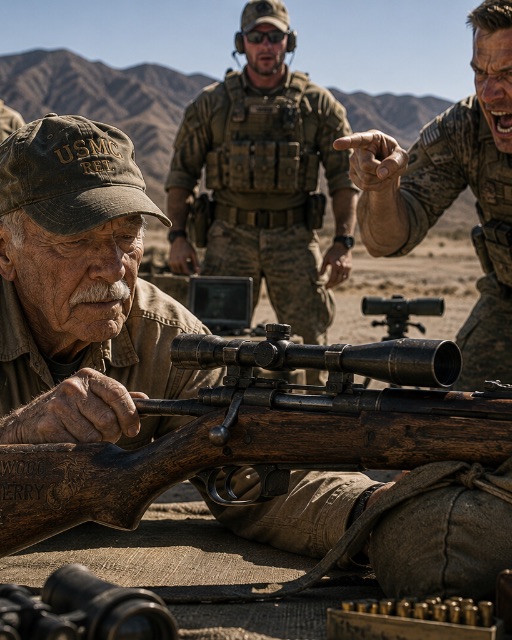
…a row of tally marks. Dozens of them. Carved deep, weathered black by time and gun oil.
I counted thirty-seven before I lost track.
Miller saw them too. His smirk faltered for just a second, but he was too far gone to back down now. “What is this, grandpa? Your hunting score? Squirrels?”
The old man slid a single brass cartridge from his shirt pocket. It was hand-loaded. The casing was yellowed with age, but the tip was freshly polished.
“Three currents,” the old man repeated softly. “The first one rises at the boulder field. The second one breaks left at the dry creek. The third one is the one that kills you. It drops at nine hundred yards because of the iron in the soil.”
Sergeant Doyle, our spotter, was staring at his laptop. His face had gone white. “Sir,” he whispered to Miller. “Sir, his numbers… they match. The system just caught up to him.”
Miller wasn’t listening. “Just take the shot, old man. Embarrass yourself so we can all go home.”
The groundskeeper settled behind the rifle. He didn’t use the bipod. He didn’t check the scope – a battered steel tube older than my father. He just breathed.
One breath. Two.
The crack of the shot wasn’t loud. It was flat. Final.
A mile away, the steel target rang like a church bell.
Nobody moved. Nobody breathed.
The old man worked the bolt, caught the spent casing in his palm, and slowly stood up. He turned to Miller, and for the first time, his pale blue eyes weren’t kind.
“Son,” he said quietly. “You don’t know who I am, do you?”
Miller’s mouth opened, but nothing came out.
That’s when Colonel Hayes came sprinting from the command tower. I have never seen the Colonel run. I have never seen him afraid. He stopped six feet from the old man, snapped to attention so hard his boots cracked, and saluted.
“I’m sorry, sir,” Hayes said, his voice breaking. “I didn’t know you were coming back. I never thought I’d see you on this range again. Not after what happened in – ”
And then he said the name of the operation. The classified one. The one they teach us about in training but tell us never existed.
The one where every man was supposed to have died in 1971.
Every man, except… “The Ghost.”
The silence on the range was broken only by the whistling wind and the frantic thumping of my own heart.
The Ghost. It was a legend, a campfire story for recruits.
They said The Ghost was a sniper so skilled, he moved through the jungle unseen and unheard. They said he completed an impossible mission alone after his entire unit was wiped out.
They also said he died on that mission, a phantom honored with a star on a wall that no one could ever see.
Apparently, he didn’t die. He just started cutting the grass.
The old man, who I now knew was The Ghost, returned Colonel Hayes’s salute with a slow, tired nod. “At ease, Daniel. You were just a lieutenant back then.”
The Colonel, our commander, a man who made generals nervous, actually blushed. “Yes, sir. Just a green lieutenant trying to keep up with you.”
Miller looked like he was about to faint. His arrogance had evaporated, replaced by a pale, shivering confusion.
“What is… what’s going on?” he stammered, looking from Hayes to the old man.
The old man ignored him. He looked at me, at my rifle. “Adams, isn’t it?”
I swallowed hard. “Yes, sir.”
“You clean your weapon properly,” he said. It wasn’t a question. “But you rely on the tools too much. The tools can lie.”
He gestured at Doyle’s laptop, still displaying the wind data and a perfect, calculated trajectory that now seemed like a child’s toy.
Colonel Hayes cleared his throat. “Master Sergeant Thorne, perhaps we could continue this in my office.” He was trying to contain the situation, to put a lid back on a history he’d thought was long buried.
The old man, Master Sergeant Thorne, shook his head. “No, Daniel. This started out here. It should end out here.”
His pale eyes found Miller again. They weren’t angry anymore. They were filled with a profound and heavy sadness.
“You remind me of someone, son,” Thorne said, his voice low and gravelly. “Confident. Sure of your station. Sure that the world works the way the books say it does.”
He held up the rifle with the tally marks. “You asked about my score. You were closer than you think, but you got the game wrong.”
He turned to Colonel Hayes. “Let the boy see the file, Daniel. Let them all see it.”
Hayes hesitated. “Sir, that file is still classified above top secret. It’s buried so deep – ”
“Then dig it up,” Thorne commanded, and there was a sudden steel in his tone that made the Colonel flinch. “It’s been almost fifty years. The ghosts are tired of waiting.”
The Colonel nodded, defeated. He spoke into his radio, his voice a strained murmur. There was a pause, a series of codes exchanged, and then a quiet “Yes, sir, I understand” from the other end.
A new kind of quiet fell over us. Not tense, but… expectant. Like the air before a storm you know has been brewing for half a century.
We stood there for what felt like hours. Miller didn’t speak. He just stared at the ground, his face a mask of shame. I found myself looking at Thorne, at the lines etched on his face, wondering what stories they told.
Finally, an armored vehicle pulled up. A young officer I’d never seen before, wearing the insignia of the intelligence corps, stepped out carrying a single,
thin file bound in red tape. He handed it to Colonel Hayes with a look of pure terror, saluted, and practically ran back to his vehicle.
Hayes held the file like it was a live grenade. He walked over and handed it not to Miller, but to me.
“Thorne’s orders,” he said quietly. “You read it, Adams. Out loud.”
My hands trembled as I opened the folder. The first page was a personnel file.
“Thorne, Elias. Master Sergeant. Unit: Special Operations Group ‘Whisper.’ Status: Killed in Action, November 1971. Operation: Silent Echo.”
I looked up at Thorne. “Sir, it says you’re dead.”
A small, sad smile touched his lips. “In some ways, that’s true.”
I turned the page. It was a mission summary, heavily redacted. The objective was simple: insert a 38-man team deep behind enemy lines to eliminate a high-value target.
The next page was a hand-written after-action report. It was from a young Lieutenant Daniel Hayes.
My voice shook as I read his words aloud.
“The unit was betrayed,” I read. “Intel was bad. The landing zone was a trap. We were told there was no enemy presence. There were three battalions.”
“They were waiting for us,” Hayes added, his own voice thick with memory. “We walked right into an ambush. It was a slaughter.”
I continued reading. Hayes’s report described chaos. Men falling before they even got off the choppers. The small contingent of support staff, including Hayes himself, was ordered to pull back immediately, to leave the main force for dead.
“I protested the order,” Hayes said, looking at Thorne. “They told me to shut my mouth or I’d be shot for insubordination. They said the mission was already a loss.”
I turned to the final page in the file. It was a single sheet of paper, a memo signed by a General Walton C. Miller.
My blood ran cold. The same last name.
I looked at the young officer beside me. At Miller. The cocky, arrogant Miller, who was now staring at that memo as if it were a snake.
The memo was brief. It authorized the “acceptable sacrifice” of S.O.G. Whisper for the “greater strategic good.” It argued that their deaths would provide a necessary distraction for a larger, simultaneous operation elsewhere.
They weren’t sent to fight. They were sent to die.
And the man who signed the order, who called their lives an “acceptable sacrifice,” was General Walton C. Miller.
“My grandfather,” Miller whispered. The words were choked, barely audible. “That was my grandfather.”
Thorne finally looked at him, his gaze piercing. “Yes,” he said. “I know.”
The first twist had landed. A betrayal from the highest levels of command. But the story wasn’t over. Not even close.
“I was the point man,” Thorne said, his voice now a distant echo. “Farthest out. I saw them setting the trap. I tried to warn them.”
“His radio was dead,” Hayes explained. “Standard procedure was to maintain radio silence until engagement. By the time he could warn them, it was too late.”
Thorne picked up the story. “I watched my men die. All of them. Men I’d trained with, bled with. Brothers.”
He paused, his eyes glazing over with a memory a mile deep and fifty years old.
“I couldn’t save them. I could only do one thing.”
He patted the old rifle.
“Your grandfather, son,” he said to Miller, “thought he was sacrificing a thirty-eight man team. He was wrong. He sacrificed thirty-seven men and unleashed one ghost.”
For three weeks, Thorne hunted the men who had killed his unit. He used the jungle, the terrain, his instincts. He became the phantom they whispered about. He completed the original mission—taking out the high-value target—and dozens more besides. Alone.
“I lived off the land. Used their own ammunition against them. They never saw me. They just felt me.”
And then came the second twist. The one that explained everything.
I looked at the rifle in his hands, at the thirty-seven tally marks. “Is that… is that for them? The men you lost?”
Thorne shook his head slowly. The sadness in his eyes was almost unbearable.
“No, son,” he said softly. “The men I lost are never forgotten. I carry them right here.” He tapped his chest.
“These marks…” He ran a gnarled thumb over the scarred wood. “These marks are for the ones who sent them to die.”
My mind reeled. Thirty-seven tally marks. Thirty-seven men in his unit.
“After I got back,” Thorne continued, “after they pulled me out of that jungle and told me I was officially a ghost, I started digging. Took me years. Decades.”
He looked from the file to Miller. “Your grandfather was just the one who signed the paper. But there was a whole committee. Men in suits who traded lives for promotions. Politicians who needed a win, no matter the cost.”
“Thirty-seven of them. The ones who planned it. The ones who covered it up. The ones who benefited from it.”
He looked down at the rifle again. “This isn’t a list of men I’ve killed. This is a list of promises I’ve kept.”
The air crackled. This frail-looking old man wasn’t just a soldier. He was an instrument of a very slow, very patient kind of justice.
“What did you do?” Miller asked, his voice trembling. He wasn’t asking as a soldier. He was asking as a grandson, terrified of the answer.
“Nothing you’re thinking, son,” Thorne said, his voice softening. “Vengeance is a fool’s game. It burns the man who holds it.”
“I didn’t hurt them. I just made sure the world knew who they were.”
He explained how, over the decades, he had tracked down every single person involved. One by one, he exposed them. Not with violence, but with truth.
He leaked a document that ended one man’s political career. He provided an anonymous tip to a journalist that unraveled a corporate fraud scheme run by another. He sent a forgotten photograph to a man’s wife that revealed a long-buried affair tied to the betrayal.
He dismantled their lives, their reputations, their legacies. He used the truth, the one thing they had tried so hard to bury, as his weapon.
“Each time a lie was exposed, each time the truth came out and one of them faced the consequences of their actions, I made a mark,” Thorne said. “Thirty-seven marks. For thirty-seven men.”
He pointed a finger at Miller. “Your grandfather was the last one on my list. He died peacefully in his bed two years ago, hailed as a hero. I thought I had failed.”
“But I was wrong.”
This was it. The final, rewarding twist. The one that brought everything full circle.
“I didn’t understand it then,” Thorne said, his gaze fixed on Miller. “The universe has a strange way of balancing the books. Justice isn’t always loud. Sometimes, it’s a quiet whisper across generations.”
“I have worked on this base for twenty years. I’ve watched lieutenants come and go. I’ve seen them all. But then, a few months ago, you arrived.”
He stepped closer to Miller, who looked like a statue.
“I saw your name on the duty roster. I saw your picture. And I saw the same arrogance, the same casual cruelty in your eyes that I saw in his photograph all those years ago. The poison had been passed down.”
“I knew then that my work wasn’t finished. The last promise wasn’t about him. It was about his legacy.”
Thorne picked up the single, spent cartridge from where it had fallen on the dusty ground. He walked over to Miller and pressed it into his hand.
“Today wasn’t about a target a mile away, son. It was about you. It was about giving you a choice.”
“You can continue to be your grandfather’s legacy—arrogant, blind, and built on a foundation of lies. Or you can be your own man. You can learn that true honor isn’t about the rank on your collar, but the character in your heart.”
“You can learn humility.”
He gently took the old rifle from my hands, the one with the thirty-seven tally marks, and held it out to Miller.
“Or,” Thorne said, his voice dropping to a whisper, “you can start learning to make your own marks.”
Miller stared at the rifle, then at the brass casing in his palm, then at the old man’s face. For the first time, I saw something break in his eyes. The arrogance wasn’t just gone; it was shattered.
Tears streamed down Miller’s face. He didn’t wipe them away. He sank to his knees in the red dirt of the firing range.
He didn’t take the rifle. He just looked up at Thorne and whispered, “I’m sorry.”
It wasn’t just an apology for his words. It was an apology for his name, for his history, for a crime fifty years old.
Thorne nodded, a single, final acknowledgment. He placed the rifle on the ground, turned, and began to walk away, his work finally, truly, done.
Colonel Hayes put a hand on my shoulder. “Let him go,” he said.
We watched until the old groundskeeper, the Ghost, the Master Sergeant, disappeared over the rise.
The story of that day spread like wildfire, though no one ever spoke of it officially. The file was re-buried, but the truth was out in the place it mattered most.
Miller was never the same. He requested a transfer from the officer track and spent the rest of his tour as an enlisted man, working with the kinds of soldiers he used to look down on. They said he became one of the best leaders on the base, not because he gave orders, but because he knew how to listen.
I saw him once, months later, cleaning his weapon. He was doing it with a slow, deliberate patience I recognized. He was learning.
Sometimes, when the wind is right, I think I can still hear that steel target ringing like a church bell. It’s a reminder.
It’s a reminder that history isn’t dead. It walks among us, in the faces of quiet old men who cut the grass. It teaches us that true strength isn’t about how loud you can shout or how far you can shoot. It’s about the weight of your promises and the courage to face the truth, especially when the truth is your own. It’s about remembering that every action has an echo, and sometimes, it takes a lifetime to hear it.