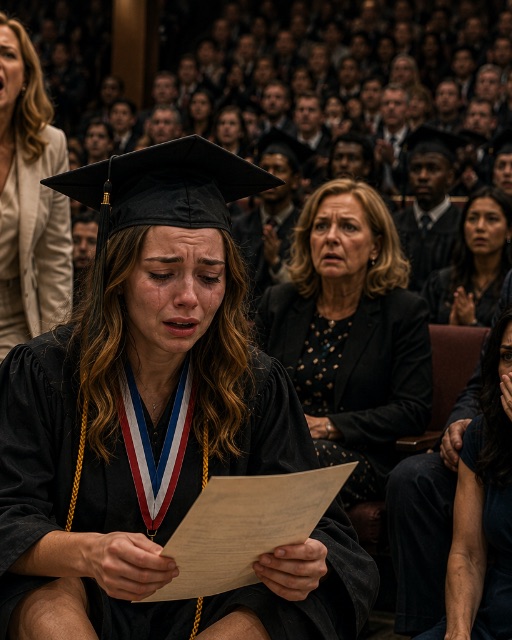
I was three steps from the stage when I heard it.
“Take that medal off.” My mom’s voice sliced through the clapping. “You were a mistake before you were a student.”
Seven hundred people went dead quiet.
The gold cord felt like a noose. My mom, Renee, had spent twenty years telling me I was a “charity case” in our own house. I’d worked double shifts at the diner and slept in my hatchback just to be here. I hadn’t even invited her. My roommate, Brenda, had “surprised” me by sending her a ticket.
Security started down the aisle. My hands were shaking so hard I almost dropped my cap.
Then the Dean – Dean Keating – stepped up to the mic. She didn’t look at the guards. She looked at me.
“Pause,” she said. “Cut the feedback. We’re changing the program.”
My heart slammed. I thought I was about to be escorted out for the “crime” of being born. But then the screen behind her lit up.
“The Board has selected one graduate for the Legacy Award – full funding for any grad program and a $40,000 stipend,” she announced. “The committee reviews blind. This year’s recipient maintained a 3.9 GPA while homeless and working three jobs.”
She turned to the second row, looking Renee dead in the eye.
“Ma’am,” she said, her voice like ice. “I don’t know who your daughter was. I know who she is.”
The room exploded. People stood up. Professors were cheering. I was sobbing as I took my diploma, but my phone buzzed in my gown pocket.
Unknown number: “I’m your father. I was in the back. The woman sitting next to Renee is my lawyer. She just gave her an envelope you need to see.”
I found Renee in the parking lot five minutes later. She was clutching a brown folder, her face gray, looking like she’d seen a ghost.
“Give me that,” I said, pulling it from her hands.
Inside: a birth certificate. Not the one I’d used for school or my driver’s license. The father’s name wasn’t blank. It was the CEO of the company that funded my scholarship.
But that wasn’t the part that made me scream.
I looked at the line that said “Biological Mother.” It wasn’t Renee’s name. It was the name of the woman standing right behind me…
The name belonged to Eleanor Vance.
I spun around so fast my graduation cap flew off my head and skittered across the asphalt.
She looked nothing like Renee. Where Renee was sharp angles and a permanent scowl, this woman was soft curves and large, haunted eyes. Eyes that were currently filled with tears.
“Elara,” she whispered, and the name sounded like a prayer.
My own name. The real one, I guessed, from the birth certificate still clutched in my hand. Not the one Renee had given me—Katherine, a name she spat more than said.
“What is this?” I demanded, my voice cracking. I looked from Eleanor to Renee. “What is going on?”
Renee let out a harsh, broken laugh. “Don’t listen to her. She’s a liar. This is some kind of sick joke.”
But there was no conviction in her words. There was only panic.
A tall, silver-haired man in an expensive suit stepped forward, flanking Eleanor. He looked familiar, his face chiseled and serious like the portraits in a corporate boardroom. He was Robert Davies, the name on the certificate. My father.
“It’s no joke, Renee,” he said, his voice low and firm. “It’s over.”
Next to him stood the woman who had handed Renee the envelope. She was all business, her expression unreadable. “Renee Miller,” she said calmly, “you’re aware of the penalties for fraud and extortion.”
Extortion? My head was spinning. The parking lot suddenly felt like a stage, and I was the only one who didn’t know their lines.
Renee’s face, already pale, turned the color of ash. “You can’t prove anything.”
“Oh, but we can,” the lawyer said, holding up a sleek, modern smartphone. “We have the original hospital records, the falsified adoption papers you filed, and two decades of bank transfers.”
The pieces started slamming into place, forming a picture so monstrous I couldn’t breathe.
“You’re her sister,” I said to Renee, my voice barely a whisper. I was looking at Eleanor. They shared a certain structure in their cheekbones, a shape to their eyes, now that I was really looking.
Eleanor nodded, a single tear tracing a path down her cheek. “My older sister.”
The story came out in ragged, painful bursts right there in the university parking lot.
Robert and Eleanor had been young, barely twenty themselves. He was the son of a business tycoon, she was a art student working her way through college. A classic story of two worlds colliding.
They fell deeply, impossibly in love.
When Eleanor got pregnant, they were terrified but ecstatic. They planned to run away together, to build a life far from his disapproving family.
Renee had been the only one Eleanor confided in. Her big sister. Her protector.
“She helped me,” Eleanor choked out, her gaze fixed on her sister with a look of ancient betrayal. “She found me a quiet clinic, away from the city. She said she would handle everything.”
Renee, who was a nursing assistant at the time, had handled it.
After I was born, she told Eleanor that I had a severe heart defect and hadn’t survived the first night. She presented her with a forged death certificate.
To Robert, she told a different lie. She said Eleanor had panicked, signed the baby over for a closed adoption to a nameless couple, took a wad of cash, and ran.
Two lies, perfectly crafted to break two hearts and isolate them from each other and their child.
“Why?” I finally managed to ask Renee, the word scraping my throat raw. “Why would you do that?”
Renee’s eyes darted around, looking for an escape that wasn’t there. “She had everything!” she shrieked, finally dropping the facade. “The rich boyfriend, the perfect life, the baby. I had nothing! I was just the dependable, boring older sister.”
Her jealousy had been a poison she’d been drinking her whole life.
“I thought… I thought I could get money from his family,” she confessed, her voice dropping to a conspiratorial mutter. “A payoff to take care of the ‘problem,’ the abandoned niece. But they just wanted me gone. They gave me one lump sum and told me to never contact them again.”
So she was stuck. Stuck with me. A living, breathing reminder of her failed scheme.
Every “You’re a charity case,” every “You were a mistake,” it wasn’t about me. It was about her. I was the mirror reflecting her own failure, her own cruelty, back at her.
My whole childhood, a landscape of neglect and bitterness, suddenly made a horrific kind of sense. The secondhand clothes, the missed meals, the cold indifference—it was all punishment for a crime I didn’t commit. The crime of existing.
My father, Robert, cleared his throat, drawing my attention. “Elara, after Renee’s lie, I spent years looking for your mother. I hired investigators, I searched databases, but Renee had covered her tracks well.”
He looked at Eleanor. “I finally found her six months ago. She was living in Oregon, teaching art at a community college. She never remarried.”
When they finally met, after twenty years of heartbreak, they started comparing their stories. The pieces didn’t fit. Eleanor knew she’d never have given me up. Robert knew the story of her running off with cash never felt right.
They realized the only person at the center of both lies was Renee.
So they started investigating her. They found me.
“We saw your name on the honors list for the university,” Robert said. “My company is a primary donor. It was… a sign.”
The Legacy Award wasn’t random. It was a test. They submitted my file—stripped of my name but full of my achievements against all odds—to the blind committee. They wanted to see, to prove to themselves, that I had survived. That I had thrived in spite of everything.
“We knew we couldn’t just walk up to you,” Eleanor added gently. “We didn’t know how to tell you. Then we saw Renee in the crowd.”
Her outburst had forced their hand. The text message, the lawyer, the confrontation—it was a desperate, messy Plan B.
The lawyer stepped forward again. “The bank transfers I mentioned,” she said, her focus entirely on Renee. “They weren’t from twenty years ago. They were from last month.”
Another twist. My head snapped back to Renee.
“It turns out,” the lawyer continued, “Ms. Miller here discovered another secret about Mr. Davies’s business about five years ago—an old environmental issue that was settled long ago, but could still cause a PR headache. She’s been blackmailing him ever since.”
This was the second envelope. Not my history, but hers. A documented history of extortion. She hadn’t just stolen a baby; she’d made a career out of inflicting pain for profit.
That was it. That was the final break. Any microscopic, residual tether I might have felt to the woman who raised me snapped.
Security had finally made their way to our little drama in the corner of the lot. They stood a respectful distance away, waiting for a signal.
I looked at Renee, a crumpled, pathetic figure, her life of lies collapsing around her. There was no anger left in me. Just a vast, empty canyon where a daughter’s love should have been.
“You told me I was a mistake,” I said, my voice steady for the first time. “But you were the one who made a mistake. You made the wrong choice twenty years ago, and you made the wrong choice every single day after that.”
I turned to Robert’s lawyer. “Do what you need to do.”
As the security guards stepped forward, my roommate, Brenda, came running up, her face a mask of horror and confusion.
“Oh my god, Kat—Elara—I am so sorry,” she gasped. “I just thought… I thought if she saw you up there, if she saw you winning, she’d finally be proud of you. I never thought she would do that.”
Tears streamed down her face. And in that moment, I understood. She wasn’t malicious. She was a friend who, in a clumsy, misguided way, had tried to give me the one thing I always pretended I didn’t want: a mother’s approval.
I pulled her into a hug. “It’s okay, Brenda. You’re my family. You’re the one who was there.”
After a lifetime of being told I was a burden, I was suddenly standing between two people who were desperate to claim me. A mother who thought I was dead. A father who thought I was abandoned.
It wasn’t a fairytale reunion. There were no swelling orchestrations or running into each other’s arms.
It was awkward. It was painful. It was real.
Eleanor reached out a hesitant hand, then dropped it. “I’m so sorry, Elara. For not finding you sooner. For not being strong enough to fight my sister.”
Robert looked like a man who could command boardrooms but had no idea how to talk to his own daughter. “I have a lot to make up for,” he said stiffly, but his eyes were filled with a profound regret that felt genuine.
I took the diploma, still rolled up in my hand. I looked at the gold medal that was still around my neck. I looked at my real parents.
I didn’t owe them anything. But maybe, I owed myself the chance to find out what a real family felt like.
The months that followed were not easy. I started a graduate program in social work, using the stipend to get a small apartment and, more importantly, a good therapist.
There were awkward weekend brunches with Robert, where we talked about the weather and my studies, circling the twenty-year chasm between us.
There were long, tearful phone calls with Eleanor, where we slowly, carefully, pieced together the years we had lost. She sent me a box of her old art supplies. I sent her a photo of a small painting I’d done.
One day, Robert showed me a faded photograph he kept in his wallet. It was him and Eleanor, young and carefree, sitting on a park bench. He was looking at her like she was the only person in the world. It was the first time I saw him not as a CEO, but as a man who had his heart broken.
Renee took a plea bargain. The scandal was contained, but her life as she knew it was over. I felt nothing. She was a stranger a court had once assigned to me.
My own happily ever after wasn’t about finding a long-lost family of wealth and privilege. My reward was something quieter.
One evening, about a year after my graduation, I was volunteering at a youth shelter. I was there as part of my social work practicum.
I saw a teenage girl huddled in a corner, clutching a worn-out textbook, trying to study amidst the chaos. She had that same look in her eyes I recognized from the mirror: a mix of exhaustion, defiance, and a desperate hope she was trying to hide.
I sat down next to her. I didn’t offer pity. I just offered her a granola bar from my bag.
“Hard day?” I asked.
She just nodded, not looking up.
“I get it,” I said softly. “I used to sleep in my car. I told myself it was camping.”
She finally looked at me. A flicker of recognition.
I didn’t tell her the whole crazy story about a secret baby and a CEO father. I told her the part that mattered. I told her about working three jobs, about feeling like a mistake, about the relentless climb. I told her about the moment I walked across a stage and realized my worth was never up for debate.
My real Legacy Award wasn’t the money or the grad school acceptance. It was this. The ability to sit in a shelter and look another human being in the eye and say, “I see you. You are not alone. And where you are now is not where you have to end up.”
Family isn’t always the one you’re born into. Sometimes, it’s the one you fight to build. And sometimes, the greatest inheritance isn’t money or a name, but the strength to turn your own pain into someone else’s hope. My beginning was a story of lies, but my ending, I decided, would be one of truth.