The qualification range at Fort Irwin was a graveyard of egos that afternoon.
Thirteen shooters. Thirteen misses. The steel target sat at 4,000 meters like a dare nobody could answer. General Carter stood behind the firing line with his arms crossed, his jaw tighter with every failed attempt. This was supposed to be the Army’s best. They couldn’t touch it.
“Anyone else?” he barked. Not a question. A challenge.
Nobody moved. The shooters were done. Pride was already bleeding out in the sand.
Then a hand went up from the back of the crowd. Not from the sniper section. From the supply tent.
A few heads turned. Most didn’t bother.
Her name tape read PRUITT. Specialist Emily Pruitt. Logistics. She processed ammunition requisitions and counted crates for a living. She had no sniper qualification. No marksmanship badge beyond standard. Nothing in her file that said she belonged anywhere near that rifle.
“Ma’am, this is a long-range – ” the range NCO started.
“Let her shoot,” General Carter interrupted. His voice was flat. Bored, even. He didn’t expect anything. He just wanted to see someone try.
Emily walked to the firing line. She didn’t rush. She didn’t look nervous. She moved like someone who had done this a thousand times in a place nobody knew about.
The range went quiet.
She didn’t settle into the standard prone position. She kicked a divot into the dirt for her heel, adjusted the bipod legs to an uneven height, and did something that made the instructor gasp – she dialed the scope down, not up.
“She’s aiming at the dirt,” a corporal snickered.
Emily ignored him. She closed her eyes for a second, feeling the heat rising off the sand. She wasn’t calculating math. She was feeling the air.
Crack.
The rifle kicked dust into the shimmering heat.
One second. Two. Three. Four.
The wait was agonizing. The men smirked, ready to dismiss her as a waste of ammo.
PING.
The sound was faint, but unmistakable. The steel target didn’t just vibrate – it spun wildly on its chain.
The spotter lowered his binoculars, his mouth hanging open. “Impact,” he choked out. “She… she hit the mounting bolt. It’s a perfect shot.”
Nobody spoke. The wind filled the silence.
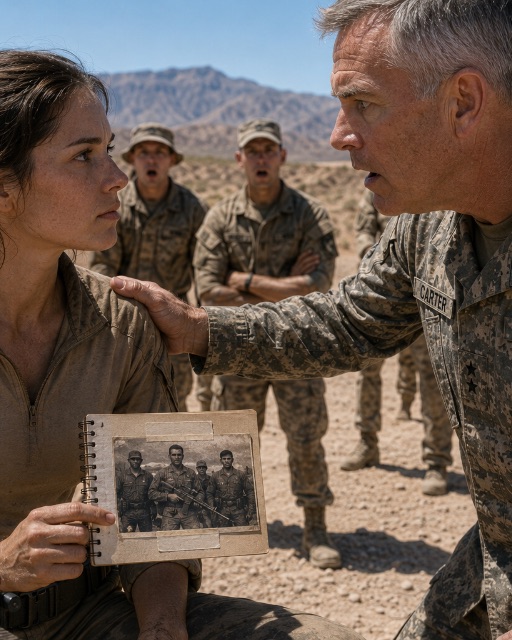
General Carter didn’t cheer. He didn’t clap. He marched straight to Emily, his boots crunching heavily on the gravel. He grabbed her shoulder, spinning her around.
“Who are you?” he demanded, his voice shaking. “Supply officers don’t make shots that my best instructors miss.”
Emily didn’t salute. She didn’t flinch. She just handed him the small leather notebook she’d been referencing on the firing line.
“I’m just doing my job, sir,” she said softly.
The General looked down at the open page. He expected to see windage equations or ballistics charts.
Instead, he saw a single, faded photograph taped to the paper.
It was a picture of a sniper team from twenty years ago. Ghillie suits. Dust. A classified firebase in a valley that officially didn’t exist. Five shooters. One woman in the center, holding a rifle that matched the one still warm on the ground behind them.
The woman in the photograph had the same eyes as Emily. The same jaw. The same quiet stillness.
But that wasn’t what made the General’s face drain of color.
It was the man standing next to her. Young. Grinning. Sergeant’s chevrons. Dog tags catching the light.
It was him.
General Carter’s hands started to tremble. He recognized the firebase. He recognized the mission. He recognized the night they were ambushed and the bodies they were told were never recovered.
He looked up at the quiet woman and whispered, “I thought you were dead.”
Emily held his gaze. Her eyes were dry. Steady. Twenty years of silence sat behind them.
She reached over and turned the notebook to the next page.
There was a second photograph. This one wasn’t faded. It was recent. Crisp. Taken from a distance with a long lens.
It showed General Carter shaking hands with a man in a dark suit outside a building with no signage.
Emily’s voice didn’t waver.
“You were supposed to come back for us,” she said. “Instead, you made a deal with the people who sold our position.”
The range was dead silent. Every soldier within earshot had stopped breathing.
The General opened his mouth. Nothing came out.
Emily leaned in close enough that only he could hear.
“I didn’t come here to shoot targets, sir. I came here because the notebook has one more page. And on that page is the name of every person involved in what happened that night.”
She paused.
“Your name is on it.”
She stepped back. Straightened her uniform. Looked him dead in the eye.
“And the person I report to now? He’s already seen it.”
The General’s phone buzzed in his pocket. He pulled it out with shaking hands.
One new message. No sender ID. Four words.
He read it, and his knees nearly buckled.
Emily picked up her rifle, slung it over her shoulder, and walked off the range without another word.
Nobody stopped her.
The message on the General’s phone read: Your nine o’clock is canceled.
It was an appointment he had with the man from the photograph. A meeting about a new contract, miles away from here. Nobody should have known about it.
Carter’s blood ran cold.
“Dismissed!” he roared at the stunned soldiers on the range. “All of you, dismissed! Back to your billets!”
His voice cracked like a whip, and men scrambled to obey, desperate to be anywhere else. They grabbed their gear and vanished, leaving Carter alone in the swirling dust and the long shadows of the afternoon.
He stumbled to his command vehicle, barking at his driver to get him back to headquarters. He grabbed his aide, a young, nervous captain.
“Find me everything there is on a Specialist Pruitt. Emily Pruitt. Logistics.” His voice was raw. “I want to know what she had for breakfast. I want her entire life on my desk in ten minutes.”
The captain just nodded, eyes wide, and ran.
Emily, meanwhile, did not go back to the supply tent. She walked calmly past the barracks, past the motor pool, to a dusty parking lot reserved for personal vehicles.
She climbed into a ten-year-old pickup truck that looked like it had seen better days. It started with a familiar grumble.
Sitting in the passenger seat was a man in his late sixties, with kind eyes and hands permanently stained with grease. He held out a cold bottle of water.
“How’d it go, Sarah?” he asked softly, using her real name.
Sarah Keene, formerly Sergeant Keene, took a long drink. The cold water was a shock to her system.
“It went as planned, Marcus,” she said, her voice finally losing its icy calm. “He remembers.”
Marcus, once her spotter, the only other survivor from that night, nodded grimly. He had been the one to drag her, wounded and unconscious, from the ruins of their firebase.
“Twenty years is a long time to forget,” he said. “Some things you can’t bury deep enough.”
Back at headquarters, the captain returned to General Carter’s office, looking even more terrified than before.
“Sir,” he stammered, holding a single sheet of paper. “This is it. This is all we have.”
Carter snatched the paper. The official file for Specialist Emily Pruitt was a masterclass in blandness. Born in a small town that barely existed, high school records, basic training scores that were perfectly average. It was a life designed to be overlooked.
“This is impossible,” Carter muttered. “This file is a ghost.”
The phone on his desk rang. It was a secure line. He waved the captain out of the room and picked it up.
“Carter.”
The voice on the other end was smooth, cold, and utterly devoid of warmth. It was Thorne, the man in the suit.
“We have a problem, General,” Thorne said without preamble. “A significant one.”
“I know,” Carter hissed. “One of them is here. A woman. She survived.”
There was a pause on the line. Then a soft, chilling chuckle.
“That’s not the problem, General,” Thorne said. “That’s a symptom. The problem is that our mutual interest, the Calloway Contract, just had its security protocols flagged by the Pentagon.”
Carter’s heart hammered against his ribs. The Calloway Contract was his retirement. It was his legacy. It was worth hundreds of millions.
“How?” he croaked.
“Someone demonstrated a critical vulnerability in the hardware,” Thorne explained, his voice turning hard. “Someone shot a prototype’s mounting bolt from an impossible distance. Does that sound familiar?”
Carter finally understood. The range. The target. The shot. It wasn’t just revenge. It was a message to the entire military-industrial complex. It was a warning shot across the bow of his whole life.
“She played me,” Carter whispered, collapsing into his chair.
“She played us all,” Thorne corrected. “Clean this up, General. Or our partnership, and your career, will be permanently canceled. Just like your nine o’clock.”
The line went dead.
Sarah drove the old truck miles off-base to a small, isolated ranch house. For twenty years, this had been their base of operations.
Inside, the walls weren’t decorated with art, but with maps, charts, and photographs of men in suits and military uniforms. It was a web of conspiracy, methodically unraveled.
“He called Thorne,” Marcus said, looking up from a bank of humming computer monitors. “He’s scared. Thorne is putting the pressure on him.”
“Good,” Sarah said, pulling off her uniform and changing into simple jeans and a t-shirt. She was no longer Specialist Pruitt. She was herself again.
“They think this is about what happened to us,” she said, tracing a line on a map that connected a shipping port to a conflict zone in Africa. “They think it’s about the past.”
“It’s never been just about the past,” Marcus agreed. “It’s about making sure it doesn’t have a future.”
For two decades, they had lived in the shadows. They had scraped by, taking odd jobs, using their old skills to stay hidden while they pieced together the truth. They learned that their team wasn’t ambushed by chance. They were sacrificed.
Their position was sold to a corporate rival who wanted the mineral rights in that valley. Carter, their young Sergeant at the time, was told to look the other way. In exchange, he was “rescued” as a lone survivor, given a medal for his fabricated heroism, and put on the fast track. Thorne was the one who made the deal.
That deal became the blueprint. Betrayal for profit. And the Calloway Contract was its newest, biggest iteration.
The next morning, General Carter walked into his office to find two people waiting for him. They were not in uniform. They were a man and a woman in plain, dark suits that screamed federal authority.
And standing beside them, as calm as she was on the firing line, was Sarah Keene.
“General Carter,” the woman said, stepping forward. She was older, with sharp, intelligent eyes. “I am Director Evans, Department of Defense Inspector General’s office. I believe you’ve met Sergeant Keene.”
Carter’s face went pale. He looked from Evans to Sarah, then back again. This wasn’t just a rogue soldier. This was an official investigation.
“I don’t know what this is about,” Carter began, his voice failing him. “This ‘Sergeant Keene’ is a deserter. A ghost.”
“No, sir,” Evans said, her voice cutting through his bluster. “She is a whistleblower. And a witness. She came to us eighteen months ago.”
This was the twist Carter never saw coming. He thought she was acting alone, a vengeful phantom. He never imagined she had brought the full weight of the system down on him.
“Her story seemed… improbable,” Evans continued, walking around his desk, looking at the photos of his decorated career. “A decorated sniper team, declared lost in action, but actually sold out by their own command for corporate interests. It sounded like a movie.”
She paused right in front of him.
“But then she started providing evidence. Bank transfers. Coded communications. And this.”
Evans placed a familiar leather-bound notebook on his desk. It was Sarah’s notebook.
“This isn’t a journal, General. It’s an indictment. Twenty years of meticulous research. Every player, every deal, every life that was traded for a dollar.”
Carter stared at the book as if it were a snake.
“And then,” Evans said, “she told us about the Calloway Contract. How you and Mr. Thorne were about to do it again. Sell advanced military hardware to a private militia, create instability in a region, and then get paid to clean it up. The same pattern.”
Sarah finally spoke. Her voice was quiet, but it filled the cavernous office.
“We couldn’t just give them the notebook, sir,” she said, looking Carter in the eye. “We had to show them. We had to prove that the vulnerabilities I found on paper were real.”
Carter looked at her, bewildered. “The shot…”
“The target on the range wasn’t just a piece of steel,” Evans explained. “It was a precise replica of the control housing on the drone system you were selling. Built from schematics Sergeant Keene acquired.”
She paused for effect. “Your best men couldn’t hit it. She did. The test wasn’t for her marksmanship. It was for our evidence.”
The whole thing had been a setup. The range, the target, the impossible shot. It was a live-fire demonstration for the Inspector General, and he was the unwitting master of ceremonies.
“I am a General of the United States Army,” Carter finally said, drawing himself up, a final, pathetic attempt at authority. “You cannot do this.”
Director Evans gave a small, sad shake of her head. She gestured to the two agents who had been silent until now.
“Thomas Carter,” she said, her voice now formal and cold. “You are under arrest for conspiracy, treason, and violations of the Uniform Code of Military Justice.”
The agents stepped forward. Carter didn’t resist. He just looked at Sarah, at the woman he had left to die two decades ago. There was no hatred in her eyes. Only a deep, profound sadness.
They didn’t take him out the back door. They walked him down the main hallway, past the portraits of honored leaders, past the astonished faces of his staff and the young soldiers who had once looked up to him. The message was clear. Justice was not happening in the shadows.
A month later, Sarah stood in a quiet section of Arlington National Cemetery. The sky was a crisp, brilliant blue.
Five new headstones gleamed in the sun. The names of her fallen friends, their honor finally restored. They were no longer “lost.” They were remembered.
Marcus stood beside her. He placed a hand on her shoulder.
“You did it, kid,” he said, his voice thick with emotion. “You brought them home.”
Sarah didn’t say anything. She reached into her pocket and pulled out a single, perfectly polished 4,000-meter casing. The one from the shot that started it all.
She knelt and placed it gently at the base of the central headstone. A final report to her team. Mission complete.
Her quest for justice was over, but her new life was just beginning. She was no longer a ghost haunted by the past. She was a woman who had faced down an impossible darkness and brought it into the light.
The truest measure of a person is not found in the rank they achieve or the power they wield. It is found in the promises they keep, especially to those who are no longer here to see them fulfilled. Some debts can never be repaid, but every wrong can, and must, be made right.