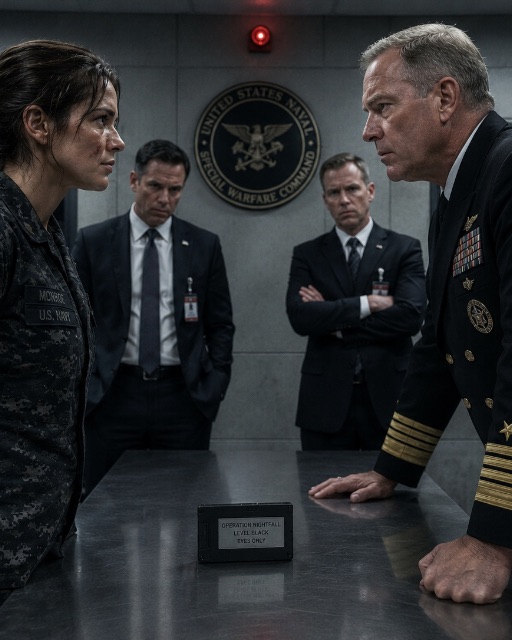
The lights died so fast the air felt heavier.
Emergency strips glowed, then those went too. Only the glass of the interrogation room turned into a black mirror.
Admiral Hayes didn’t flinch. “We move. Now.”
The agents hesitated. I didn’t. I slid the sealed drive back into my sleeve and stood.
“Codes?” one agent croaked, patting at a dead phone.
“No signals,” I said. “They cut it at the breaker, not the grid.”
Hayes looked at me. I could tell he was measuring how much to trust a ghost.
“We’re not waiting for backup,” I said. “They’re already inside.”
We hit the hallway. Boots on concrete. The hum of a base turned silent – wrong silent. Somewhere deep, a generator should’ve coughed to life.
It didn’t.
Which meant someone with a key had their hand on the override.
We turned a corner and almost collided with two MPs. They raised rifles. Then they saw Hayes.
“Stand down,” he ordered.
They didn’t lower the muzzles.
That was the tell. Their eyes weren’t on his face. They were on my wrist.
On the ink.
The trident that wasn’t supposed to exist the way mine did.
“Who’s your watch officer?” Hayes asked, voice even.
They didn’t answer. The shorter one pressed a finger to his earpiece out of habit. Nothing there. No comms.
Then a door at the end of the hall buzzed. A red light turned green. A lock slid.
Not our clearance.
The MPs stepped back on some signal we couldn’t hear and let us pass – too easily.
“We’re being funneled,” I said under my breath.
Hayes heard it too. He shifted his posture, the way old war dogs change angles when they smell a trap.
We took the stairs down. Two flights. Three. The concrete got colder. Paint older. The kind of corridor that exists on no tour map and all the right blueprints.
“Why now?” Hayes asked as we moved. “If you stayed dark this long – why show up at a memorial today?”
I swallowed. “Because the list started moving again.”
“What list?”
“The one Cain kept for people he didn’t finish.”
A muscle in Hayes’s jaw ticked. “Cain is ash.”
“So am I,” I said. “On paper.”
He didn’t argue.
We reached a steel door with a keypad I remembered hating. Hayes didn’t ask how I knew it. He just watched.
My fingers moved like they never forgot. The panel chirped. The lock hissed.
Inside, a forgotten briefing room blinked awake on battery power. An ancient projector. An older fridge. A smell like dust and bleach.
I set the drive on the table and slid the trident coin from my other sleeve. I pressed it to the metal plate in the center. The room clicked. A panel in the wall lifted with a tired groan.
“You kept this?” Hayes whispered, almost to himself.
“No,” I said. “We buried it. Twice.”
He nodded once. Gave me the spacebar with a look. “Show me.”
The screen lit. Static. Then a menu of files I prayed I’d never see again.
OPERATION—REDACTED.
HANDLER FOOTAGE—REDACTED.
PERSONNEL EXTRACTION—FAILED.
My throat went dry. I picked the one that answered his question without asking it.
The projector sputtered. A paused frame appeared—grainy, but clear enough.
A man sat at a metal table, laughing with someone just off-camera. A hand slid a folder in front of him. He signed.
Hayes leaned in, his breath catching.
I hit play—
—and froze, because the face that turned toward the lens wasn’t Cain at all, but the person standing under the same flag we’d just saluted at the pier.
Captain Marcus Thorne. Decorated. Celebrated. The man Hayes himself had pinned a medal on just last year.
“Marcus?” The Admiral’s voice was a low crackle of disbelief, the sound of a foundation turning to sand.
The video played on without sound. Thorne looked pleased with himself. He slid the folder back, gave a casual salute to the person off-screen, and walked away.
A hero of the fleet, signing a death warrant.
“He was Cain’s partner,” I said, my own voice feeling distant. “Cain was the muscle. Thorne was the architect.”
Hayes didn’t take his eyes off the frozen image of Thorne’s smiling face. “Explain.”
“Cain built the list of targets. Internal threats, he called them. Whistleblowers. People who knew too much. My unit was supposed to be the cleanup crew.”
“Your unit didn’t exist.” It wasn’t a question.
“Exactly,” I said. “We were ghosts. When the program was shut down, we were supposed to be shut down with it. Permanently.”
I pointed to my wrist. “This tattoo? The broken tine on the trident? It’s a marker. It means you were part of the unit that was erased.”
That’s why they called me an imposter at the memorial service. Anyone with real access would know my service record was a black hole, and that version of the trident meant I was dead.
Hayes finally looked away from the screen, his face aged ten years in ten seconds. “So you survived the purge.”
“Cain got sloppy. I got lucky,” I corrected him. “I thought when he died, it was over. But two weeks ago, a name from the list turned up dead in a car accident in San Diego. Last week, another had a heart attack in Norfolk.”
“Accidents happen,” Hayes said, but the conviction had drained from his voice.
“Not to these people,” I said. “Thorne is finishing the job. That’s why I came back. I knew he’d be at the memorial.”
I couldn’t tell him the whole truth yet. Not how my own name was on that list. Not how I checked under my car every morning and never slept in the same place for more than a few nights.
The Admiral ran a hand over his face. The weight in the room wasn’t just silence anymore; it was betrayal. This was a man he had mentored, a man he had trusted like a son.
“There’s more,” I said softly, my finger hovering over another file.
He just nodded, braced for the next blow.
The file name was simple. “TRAINING_ACCIDENT_R_HAYES”.
The Admiral went rigid. His son, Robert, had died two years ago. A parachute malfunction during a HALO jump. A tragic, unavoidable accident. That was the official story.
I clicked the file.
The footage was from a helmet cam, shaky and chaotic. A night jump. The wind screamed past the microphone. You could see the lights of a city far below.
Another jumper appeared in the frame, giving a thumbs-up. The patch on his arm was visible for just a second. It was Robert Hayes. Young, confident, alive.
Then another figure moved in beside him. Fast. You could see a gloved hand move toward Robert’s parachute pack. A quick, deliberate motion. A click.
Robert’s thumbs-up faltered. He looked confused. He pulled his ripcord. Nothing. He pulled the reserve. A tangle of cords flew out, shredded.
The helmet cam spun wildly as Robert tumbled. The other figure just watched, a dark silhouette against the moonlit clouds, falling away calmly.
Just before the footage cut out, the figure turned his head slightly. The moonlight caught the side of his face for less than a second.
It was Marcus Thorne.
The projector hummed, displaying the last, terrible frame. The air left the room.
Admiral Hayes made a sound, a choked, guttural noise of pure agony. He stumbled back and gripped the edge of the metal table, his knuckles turning bone white.
The man he had treated like a son had murdered his actual son.
“He was on the list,” I whispered. “Robert found something. A money trail. He reported it to the wrong person.”
He reported it to Captain Thorne.
Hayes didn’t respond. He just stared at the image of his son’s last moments, his entire world collapsing in on him. All the medals, the flags, the years of service—they all felt like lies.
Before he could speak, a soft click echoed from the hallway.
The door to the briefing room swung open.
Captain Marcus Thorne stood there, flanked by the two silent MPs from the corridor. He wasn’t holding a weapon. He didn’t need to. His smile was disarming enough.
“Admiral,” he said, his voice smooth and respectful, as if he’d just stumbled upon a late-night work session. “Working late, I see.”
His eyes flicked to me, then to the screen. The smile didn’t waver. “Ah. A trip down memory lane.”
Hayes straightened up. The grief on his face was replaced by a cold, hard fury I had only seen in men about to do something final.
“Marcus,” he said, his voice dangerously low. “You have five seconds to explain why I shouldn’t end you right here.”
Thorne chuckled, a sound utterly out of place. “Because you, of all people, understand. You understand that the body must be kept healthy. Sometimes, that means cutting out the cancers.”
“My son was not a cancer!” Hayes roared, his voice bouncing off the concrete walls.
“With all due respect, sir, he was,” Thorne said, his tone shifting to that of a patient teacher. “He found a funding discrepancy for a program that shouldn’t exist. Instead of trusting the chain of command, he was going to go to the press. He was a weakness. A liability.”
“He was a soldier who believed in the principles you were supposed to uphold!”
Thorne took a step into the room. “Principles are for peacetime, Admiral. We are not, and have never been, in peacetime. We are in a perpetual state of war against decay, from the outside and from within. I do the hard things so that families back home can sleep soundly, believing in heroes.”
He gestured to me. “She understands. Her unit was built on that very truth. We are the immune system. We purge the infection before it spreads.”
“You’re a murderer,” I said flatly.
“I’m a pragmatist,” Thorne corrected me. “And now, I need that drive. It contains the full architecture of my network. My assets. My future targets. It’s the key to keeping this country safe for the next fifty years.”
He looked back at Hayes, his expression softening with false sympathy. “Give it to me, sir. Let me finish my work. No one ever has to know the truth about Robert. He can remain a hero who died in a tragic accident. His legacy will be preserved.”
It was a cruel, brilliant move. He was offering Hayes a choice: justice for his son at the cost of public scandal and staining Robert’s memory, or silence.
“You reveal this,” Thorne continued, “and every enemy of this nation will use it to tear us apart. Robert’s name will be dragged through the mud. They’ll invent stories. They’ll say he was a traitor to justify what he found. Is that what you want for him?”
Hayes was frozen, trapped between his duty as a father and his duty as an admiral.
I knew he couldn’t make that choice. So I had to make one for him.
I grabbed the drive from the table. “You want it? Come and get it.”
The MPs raised their rifles. Thorne held up a hand to stop them.
“There’s nowhere to run,” he said calmly. “The base is locked down. My men control every exit.”
“I don’t need an exit,” I said. My hand slipped to the side of the projector. There was an old, heavy-duty power cable plugged into a floor socket. I yanked it free.
With a swift motion, I swung the heavy plug end into the projector’s lens. It shattered with a pop, showering the table in glass. The room plunged into near-total darkness, lit only by the faint green glow of the keypad on the door.
I didn’t run. I dropped to the floor and slid under the heavy metal table.
Chaos erupted. One of the MPs fumbled for a flashlight. Thorne was shouting orders.
But then, a different voice cut through the noise. Admiral Hayes.
“Hold your fire!” he commanded, his voice ringing with an authority that even Thorne’s men couldn’t ignore.
A flashlight beam cut through the dark, but it wasn’t pointed at me. It was on Hayes. He stood tall, his face a mask of resolve.
“Marcus,” he said, his voice quiet but carrying more weight than a gunshot. “You spoke of pruning the garden. Of cutting out the disease.”
He took a step toward Thorne. “My son, Robert, he wasn’t a disease. He was a gardener. He saw a weed and he tried to pull it.”
Thorne was silent, momentarily thrown off by Hayes’s change in tactic.
“You talk about duty,” Hayes continued, “about the hard choices. The hardest choice, Marcus, is not pulling the trigger. It’s upholding our values when it is most difficult. It’s trusting the very system you claim to be protecting.”
One of the MPs shifted his feet. The younger one. His light wavered.
“You are the disease, Marcus,” Hayes said, his voice resonating with years of command. “You’ve been rotting this institution from the inside out, all in the name of patriotism. But that’s not patriotism. It’s tyranny.”
Suddenly, the red emergency lights flickered back on with a hum. The power wasn’t fully restored, but it was enough.
In the crimson glow, I could see the younger MP’s face. He was pale, his eyes wide. He wasn’t looking at Thorne for orders anymore. He was looking at Admiral Hayes.
The sirens started then. Faint at first, then growing louder. Someone outside the lockdown had noticed. Someone had followed protocol.
Thorne knew it was over. His window of opportunity had closed. His face twisted from calm confidence to pure rage. He lunged, not at me, but at Hayes.
He never made it.
The younger MP, the one who had hesitated, stepped forward and leveled his rifle at Thorne’s chest. “Sir, stand down!”
His voice was shaking, but it was firm. The other MP, seeing his partner’s move and hearing the approaching sirens, lowered his own weapon.
Thorne froze, his hands raised halfway. He looked from the MP to Hayes, his expression one of utter defeat. The silent, invisible authority he’d wielded for years had just evaporated.
It ended not with a bang, but with a choice. A young man chose his oath over a corrupt commander.
In the weeks that followed, there was no public trial. No explosive scandal. Captain Marcus Thorne wasn’t arrested. He was quietly and permanently reassigned to a remote weather station in Alaska to “oversee meteorological data for naval transport.” He was a ghost, exiled to the ice, his network of influence cut off at the source.
Admiral Hayes used the drive not as a weapon, but as a scalpel. One by one, Thorne’s assets were dismantled. There were sudden retirements, unexpected transfers, quiet internal investigations that ended careers. The rot was cut out, piece by painful piece, without killing the patient.
A few months later, I was sitting at a small cafe overlooking the Pacific. The sun was warm on my face. For the first time in years, I wasn’t scanning the crowd or checking for cars that had passed me twice.
My phone, a new one with a new number, buzzed on the table. It was an encrypted message from an unknown sender.
It just said, “Job done. Be free.”
I looked out at the vast, blue ocean. Admiral Hayes had visited his son’s grave. I’d seen it in a photo a contact had sent me. On the polished granite, next to the small American flag, sat a single, dark coin with a trident etched into it.
Justice doesn’t always come like a thunderstorm, loud and violent. Sometimes, it’s a quiet, rising tide that slowly, relentlessly, wears away the stone, revealing the truth that was hiding underneath all along. True strength isn’t about how much you can destroy, but about what you have the courage to rebuild.