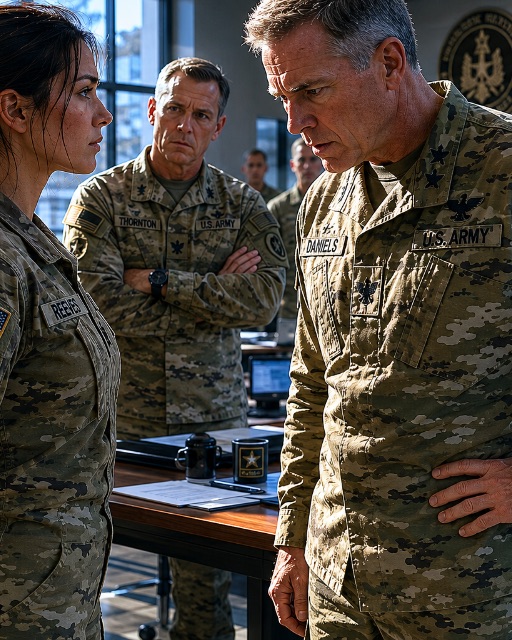
HE STOPPED WALKING. AND THEN HE DID SOMETHING NO ONE IN THAT ROOM HAD EVER SEEN A COLONEL DO.
He stood at attention.
Not the lazy half-posture officers throw at each other in hallways. Full attention. Chin up. Shoulders squared. Eyes locked forward like he was standing in front of a general.
Directed at a captain.
The room didn’t just go quiet. It collapsed into silence. The kind of silence that has weight.
Thornton’s mouth opened slightly. No words came out.
Preston unfolded her arms.
Harris took a half-step backward without realizing it.
Colonel Daniels held the position for exactly three seconds. Then he extended his hand.
Not a handshake of greeting.
A handshake of recognition.
“Captain Reeves,” he said. His voice was low, steady, and stripped of everything casual. “It’s an honor.”
Maya shook his hand.
“Thank you, sir.”
Daniels still hadn’t looked at anyone else in the room. Not once.
His eyes moved back to the insignia. Burgundy and gold. Crossed swords. The single star.
“Only five officers have earned that insignia in the last twenty years,” he said.
He didn’t say it to Maya.
He said it to the room.
Then he turned around.
And for the first time, he looked directly at Thornton.
The expression on Daniels’ face wasn’t anger. It was worse than anger. It was the specific, quiet disappointment of a man who had just walked into his own house and found someone rearranging the furniture badly.
“Major Thornton,” Daniels said. “My office. Now.”
Thornton’s jaw tightened. “Sir, I was just – ”
“Now.”
The word landed like a door slamming shut.
Thornton walked. He didn’t look back. He didn’t make eye contact with anyone. His shoes clicked against the linoleum with the hollow rhythm of a man who had just realized he’d been laughing at something he didn’t understand.
Preston was staring at the floor.
Harris was staring at Maya.
Everyone else was pretending to work while not typing a single keystroke.
Daniels turned back to Maya one more time.
“Captain, I’d like you in Conference Room B at 0900. There’s something I need to brief the division on.” He paused. “Something most of them aren’t ready to hear.”
“Yes, sir.”
He nodded once.
Then he leaned in – just slightly – close enough that only she could hear.
“I served with Warrant Officer Pollard in Kandahar,” he said quietly. “He told me about the people who wear that patch. He told me what they had to survive to earn it.”
His voice dropped even lower.
“He also told me that two of the five didn’t make it home.”
Maya said nothing.
Her face gave away nothing.
But her hand – the one hanging at her side – closed into a fist so tight her knuckles went white.
Daniels straightened, turned on his heel, and walked toward his office.
The room stayed frozen for another ten seconds after the door closed.
Then the whispers started.
Low.
Careful.
The kind of whispers people use when they’ve just realized they’ve been standing next to something they should have been afraid of.
Harris was the first to speak out loud.
“Captain Reeves,” he said. His voice was different now. Softer. Almost careful. “Is there anything you need for your workspace?”
Maya unclenched her fist.
“A coffee would be fine, Lieutenant.”
“Yes, ma’am.”
He practically jogged toward the south wall.
Preston walked past Maya’s desk without a word. But she slowed – just for a half-step — and her eyes dropped to the insignia one more time.
This time she didn’t smirk.
She swallowed.
Maya sat down at her desk.
She opened her document bag.
She pulled out a plain black notebook and a government-issued pen, and she began writing as though the last ten minutes hadn’t happened at all.
But underneath the notebook, tucked inside the bag’s inner lining where no one would ever think to look, was a single photograph.
Faded. Creased at the corners. Taken somewhere with red dust and no horizon line.
Five people in that photo. Standing shoulder to shoulder. No smiles. No names visible. Just five burgundy-and-gold patches lined up in a row.
Three of the faces had small black Xs drawn across them in ink.
Maya’s face was one of the two still unmarked.
At 0900, she walked into Conference Room B.
Every seat was full.
Thornton was in the back row. He looked smaller somehow. Like someone had quietly removed a load-bearing wall from inside his chest.
Daniels stood at the front of the room beside a projection screen that was still dark.
He waited until the door closed.
Then he turned on the projector.
The first slide contained no text. Just an image.
The insignia. Burgundy and gold. Crossed swords. Single star.
“Most of you have never seen this before,” Daniels said. “That changes today.”
He clicked to the next slide.
A single line of text appeared:
OPERATION DAWNFIRE — CLASSIFICATION: ELEVATED COMPARTMENTED
“Two years ago,” Daniels continued, “a joint task force was deployed to a region I am not authorized to name in this room. Their mission parameters are still sealed. What I can tell you is that the task force consisted of five officers hand-selected from across every branch.”
He looked at Maya.
“Captain Reeves is the senior surviving member of that task force.”
The room didn’t breathe.
“The operation resulted in the successful extraction of thirty-one allied intelligence assets from behind enemy lines over a ninety-six-hour window. It also resulted in the deaths of three of the five officers on the team.”
Daniels paused.
“The reason this matters to all of you — right now, in this room — is because the intelligence those assets provided is the foundation of every operational plan this division has produced for the last eighteen months.”
He let that settle.
“Every. Single. One.”
Someone in the second row inhaled sharply.
“Captain Reeves has been transferred to this division not as an administrative addition,” Daniels said. “She’s here because the Secretary of Defense personally requested her reassignment to oversee the next phase of operational integration.”
He clicked off the projector.
“She outranks every planning authority in this room in terms of operational knowledge. Her clearance level is above mine. And if any of you — any of you — have questions about the validity of the insignia on her sleeve…”
He looked directly at Thornton.
“…I suggest you file a formal inquiry with the Pentagon and wait the six to eight months it will take for them to tell you exactly what I just told you.”
Silence.
Absolute, crushing silence.
Daniels straightened his notes.
“Captain Reeves,” he said. “The floor is yours.”
Maya stood.
She walked to the front of the room the same way she’d walked into the building that morning.
No hurry. No performance. No need to prove anything to anyone.
She placed her black notebook on the podium.
She looked out at the room full of majors, lieutenant colonels, and one very quiet major in the back row who couldn’t meet her eyes.
And she said five words that Thornton would replay in his mind every single night for the rest of his career.
“Let’s talk about what’s next.”
But what nobody in that room knew — not Daniels, not Thornton, not even Harris — was that inside Maya’s notebook, on the very last page, written in a handwriting that wasn’t hers, were seven words:
“The fifth officer is still alive. Find them.”
And the name written beneath it was someone already sitting in that room.
Maya began to speak, her voice even and calm. She didn’t talk about tactics or ordnance. She talked about a teacher in a village school, an asset codenamed ‘Sparrow,’ who had used his own meager savings to buy chalk for his students.
She mentioned a doctor, ‘Keystone,’ who had risked everything to smuggle medicine to a resistance cell.
She spoke of mothers and fathers, farmers and mechanics. She gave them faces. She gave them humanity.
The room of hardened officers, used to dealing in maps and numbers, sat transfixed.
Her eyes swept the room as she spoke, a slow, methodical scan. She paused on Major Thornton, whose face was a mask of contrition. She passed over Major Preston, whose curiosity had been replaced by a deep, professional respect.
Then her eyes landed on Lieutenant Harris.
He was sitting in the third row, leaning forward slightly, notepad untouched. He wasn’t just listening; he was absorbing her words as if they were oxygen.
His gaze was fixed on her, but there was something behind his eyes. A flicker of recognition. A ghost of shared memory.
The name in her notebook was Lieutenant Evan Harris.
She continued her briefing, but a part of her mind was now entirely focused on him. This young, eager officer who fetched coffee and said “Yes, ma’am” with such earnestness.
It didn’t make sense.
Captain Miller, the fifth member of their team, had been a brilliant strategist, a cynic with a dry wit and a mind like a steel trap. He’d been declared killed in action after the extraction went sideways, caught in an explosion that had taken out their communications hub.
How could that man be this green Lieutenant?
The meeting concluded. Officers filed out, murmuring in low, respectful tones.
Thornton hung back. He waited until everyone else was gone, except for Maya and Daniels, who was gathering his papers.
“Captain,” Thornton started, his voice rough. “I… there’s no excuse for my behavior this morning. It was unprofessional and disrespectful. I am sorry.”
Maya looked at him. She saw the genuine shame in his eyes.
“We all make assumptions, Major,” she said, her tone devoid of malice. “The important thing is what we do after we learn we’re wrong.”
Thornton nodded, relieved. “If there’s anything you need, any resources I can provide, please don’t hesitate.”
“Thank you, Major. I’ll keep that in mind.”
He gave a slight, almost imperceptible nod and left the room.
Daniels approached her. “He’ll be an ally now. A useful one.”
“I think so, sir,” Maya agreed.
“What you did in there,” Daniels added, “making it about the people… that was important. A lesson some of them had forgotten.”
Maya simply nodded, her thoughts still on Harris.
Over the next few days, she watched him. She gave him small, meaningless tasks. Fetching reports. Collating data. Standard work for a junior officer.
He did it all with a cheerful efficiency. He was polite, prompt, and utterly unremarkable.
There was no sign of the sharp-edged Captain Miller she had known.
She decided to set a small trap.
One afternoon, she called him to her desk. “Lieutenant, I need you to run a threat analysis on these grid coordinates.”
She handed him a file. The coordinates were for a training area in Virginia. Harmless.
But within the file, buried in a paragraph of technical jargon, was a single code word from Operation Dawnfire.
A word only the five of them would ever know: “Sundown.”
“Right away, ma’am,” Harris said, taking the file.
He returned an hour later and placed the completed analysis on her desk. It was thorough, well-written, and completely by the book.
“Anything stand out, Lieutenant?” she asked, not looking up from her screen.
“No, ma’am,” he said. “Standard low-threat environment. Minimal chatter. All clear.”
His voice was steady. Too steady.
Maya finally looked up at him. She held his gaze. “Nothing at all?”
For the first time, she saw a crack in his facade. A muscle in his jaw twitched. His eyes, for just a fraction of a second, looked haunted.
“No, ma’am,” he repeated, but the words were brittle.
He turned and walked back to his desk.
Maya knew. He had seen the word. And his choice to say nothing was a confession in itself.
He was hiding. The question was why.
The next piece of the puzzle came from Warrant Officer Pollard, the old intelligence hand who had given her the initial note. He sent a single, encrypted email.
It contained a link to a file transfer. Inside was a heavily redacted incident report.
The report was about the explosion at the communications hub during Dawnfire. It detailed the event that had supposedly killed Captain Miller and two others.
But Pollard had highlighted a tiny detail Maya had never been given. The explosive signature wasn’t consistent with enemy ordnance.
It was consistent with one of their own claymore mines.
A mine that had been positioned to protect their flank.
A mine that Captain Miller himself had set.
The official conclusion was a tragic accident. A premature detonation.
But Miller was the best demolitions expert she had ever known. He didn’t make mistakes like that.
The black Xs in her photograph suddenly took on a new, darker meaning. She hadn’t drawn them because her friends were gone. She had drawn them because she was starting a new mission: find out who took them from her.
She had to talk to Harris. To Miller.
That evening, she waited until the office was nearly empty. Only she and Harris remained, working under the low hum of the fluorescent lights.
“Lieutenant,” she called out. “A word, please.”
He walked over, his posture still that of a subordinate. “Ma’am?”
She didn’t get up. She just looked at him, her expression unreadable.
“The sun is getting low,” she said quietly.
It wasn’t a question. It was the first half of a call-and-response phrase they had used to verify their identities in the dark.
Harris froze. The color drained from his face. The easygoing Lieutenant vanished, replaced by a man holding his breath, cornered.
His eyes darted toward the door, then back to her. He saw no threat in her face, only a profound, shared sorrow.
He swallowed hard, his throat working. He leaned in close, his voice a raw whisper she barely recognized.
“…and the birds fly south.”
It was him. Captain Evan Miller was standing in front of her.
“What happened, Evan?” she asked, her own voice dropping.
“We were betrayed, Maya,” he whispered, the name sounding foreign in the sterile office. “It wasn’t an accident.”
He explained in short, clipped sentences. Just before the blast, he’d overheard a fragmented transmission on a secondary channel. A voice he recognized.
It was General Peterson, their overarching commander for the operation. He was giving their position away.
Miller realized in that horrifying second that the mission wasn’t just about extraction. It was a setup. Someone wanted the intel, but they also wanted the team that gathered it erased.
He tried to warn the others, but it was too late. He’d been closest to the comms hub. The explosion threw him clear, but he was badly wounded. When he came to, the area was overrun. He knew if they found him, he was dead.
So he did the only thing he could.
He became a ghost.
He stripped the dog tags and insignia from one of the other fallen soldiers, a young lieutenant caught in the crossfire, and swapped them with his own. He let the world believe Captain Miller was dead.
He spent months recovering in a field hospital under a false name, then used his knowledge of the system to get a low-level administrative reassignment. As Lieutenant Harris, no one would look twice at him. He was hiding in plain sight, digging for proof.
“Peterson is here,” Miller said, his voice tight with fury. “He’s visiting this base in three days for a ‘command review.’ I think he’s coming to scrub the final loose ends.”
“Me,” Maya stated.
Miller nodded. “Me, too, if he knew I was alive. He thinks I’m dead, and he thinks you’re just a quiet captain they can bury in paperwork. He doesn’t know you have that patch on your arm.”
“Pollard knows,” Maya said. “He’s the one who told me you were here.”
A flicker of hope crossed Miller’s face. “If Pollard is in, we might have a chance.”
They had less than seventy-two hours.
They decided to bring in one more person. Not Daniels. They couldn’t risk his career if they were wrong.
They chose Major Thornton.
Maya called him into the empty conference room late that night. Miller stood in the shadows.
“Major,” Maya began, “you said to ask if I needed anything.”
“Of course, Captain. What is it?”
“I need you to commit a potentially career-ending security breach for me. With no questions asked.”
Thornton stared at her, his confidence faltering. “What are you talking about?”
Miller stepped out of the shadows. Thornton’s eyes widened in disbelief. He recognized the face from the mission briefings he’d since studied obsessively.
“Captain Miller?” he breathed. “You’re supposed to be dead.”
“Reports were exaggerated,” Miller said dryly, a flash of his old self.
Maya laid out the situation. The betrayal. General Peterson. The impending visit.
“Peterson’s travel servers are firewalled six ways from Sunday,” Miller explained. “But his advance team’s logistics server is less secure. I need access to it. You have the administrative clearance to get me a temporary login. A ghost in his machine.”
Thornton paced the room, his mind reeling. This was treason if they were wrong. A court-martial, at best.
He stopped and looked at Maya’s sleeve. At the insignia he had once mocked. He thought about the shame he’d felt that morning. He thought about her words: The important thing is what we do after we learn we’re wrong.
“I’ll do it,” he said, his voice firm. “Tell me what you need.”
For the next two days, the office ran as normal. But underneath, a silent war was being fought. Thornton created a digital backdoor. Miller, using the login, dove into the network, searching for anything that connected Peterson to the botched mission.
He found it on the morning of Peterson’s arrival. Buried in an encrypted audio log from a logistics officer was a conversation. It was Peterson, complaining about the cost of “decommissioning assets” and referencing the grid coordinates of Operation Dawnfire.
It was the smoking gun.
But it was on a secure military server. They couldn’t just download it.
General Peterson arrived like a visiting monarch, his entourage sweeping through the building. Maya and Miller watched from the main office floor.
“He’s heading to the secure briefing room,” Miller muttered. “Daniels is with him.”
“Thornton,” Maya said into a tiny comms unit. “Is the network isolated?”
“As much as I can make it,” Thornton’s voice came back, tense. “Peterson’s personal terminal is connected. He has five minutes before the system automatically purges my access.”
This was it. They had one chance.
Maya walked straight toward the security checkpoint for the classified wing.
The guard stopped her. “Captain, access is restricted.”
“General Peterson is expecting me,” she said, her voice like ice. She pointed to the patch on her sleeve. “He has a follow-up question about Dawnfire.”
The guard, seeing the insignia and hearing the operational name, hesitated just long enough. Maya walked past him.
She entered the secure corridor just as Peterson and Daniels were about to enter the briefing room.
“General Peterson,” she said.
The General, a tall man with a chest full of medals, turned. He saw her, and then his eyes fixed on the patch. A flicker of something cold and ugly passed through his eyes.
“Captain,” he said, his voice smooth as oil. “I wasn’t aware you’d be joining us.”
“There was some old business to clear up, sir.”
“Colonel,” Peterson said to Daniels, “give us a moment.”
Daniels looked from Peterson to Maya, sensing the sudden tension. He hesitated, then gave a slight nod and stepped back.
As soon as Daniels was out of earshot, Peterson’s demeanor changed. “You should have stayed where they put you, Captain. Buried in a file cabinet.”
“The three men you killed deserved better than that,” Maya said, her voice shaking with controlled rage.
“They were soldiers,” Peterson sneered. “They died for their country.”
“No. They died for your bank account,” Maya retorted. “We have the audio log, General.”
Peterson paled. He lunged for her, his face a mask of fury.
But Maya was ready. She sidestepped him easily. And Colonel Daniels, who had never fully left, stepped forward and blocked Peterson’s path.
“General,” Daniels said, his voice hard as granite. “I think you need to come with me.”
Behind him, two military police officers appeared. Thornton had called them the moment he saw Peterson lunge on the security feed.
The truth unfurled in a cascade of formal inquiries and sealed testimony. General Peterson had been selling operational intelligence for years. Operation Dawnfire was meant to be his final, brutal cleanup, eliminating the very assets—and the team sent to rescue them—who could expose him.
His arrest sent shockwaves through the Pentagon.
Weeks later, the office was quiet again. Major Thornton was at his desk, working with a newfound humility. He’d received a formal reprimand for the security breach, but a quiet commendation from the Secretary’s office had landed in his file right next to it. His career was intact.
Evan Miller, his name and rank restored, stood beside Maya’s desk. He wore the crisp uniform of a Captain again.
“They’re adding our teammates’ names to the memorial wall next week,” he said softly. “There’s going to be a ceremony.”
“We’ll be there,” Maya replied.
He looked at the burgundy-and-gold patch on her arm, identical to the one now back on his own. “We’re the last two.”
“No,” Maya said, looking out at the ordinary, bustling office. “We’re the first two of the next chapter. We honor them by making sure it never happens again.”
True honor isn’t found in the medals you wear or the rank on your collar. It’s measured by the integrity you hold when no one is watching, and the courage to stand for what’s right, even when you’re standing alone. And sometimes, the greatest heroes are the ones no one ever knew were there at all.