
How a joyful reception turned into a moment I will never forget
The hardest part of my wedding day was not that my mother-in-law stepped into the spotlight. It was what my brand-new husband quietly asked me to do right after she did it. That single whisper changed how I saw him, his family, and the future I thought we had just promised each other.
I grew up used to making room for other people. In my family, someone was always louder, busier, or needier. My sister drew attention without trying. My dad filled a room like a brass band. My mom smoothed every rough edge, and I learned to be the easy one who didn’t ask for much. It was a habit—be calm, make peace, avoid a scene—that followed me into adulthood.
Then I met Ethan. With him, I felt seen. Not as the person who keeps the peace, but as someone whose feelings and plans actually mattered. I believed I was building a life where I could finally show up at full size. And for a while, that felt true.
Then I met his mother, Lydia.
Lydia is the kind of person who does not enter a room—she makes an entrance. Every moment seemed like a stage to her. She had a polished look, a practiced smile, and an opinion about everything. After Ethan proposed, she treated our wedding as if it were a co-production and her name was first on the poster.
She weighed in on my dress, the flowers, the lighting, and even the tone of my vows. When she warned me not to “sound too earnest” because “restraint gives elegance,” I remember saying that promising to love her son for life might deserve a little sincerity. She offered a small smile that somehow felt like a pat on the head.
I reminded myself that families are complicated. I loved Ethan, and I wanted to believe the best. As the big day arrived, I decided to let go and enjoy what we had planned.
The day began beautifully—then took a sharp turn
The ceremony was lovely. The weather held, the music was perfect, and Ethan cried during his vows, which nearly undid me in the best way. At the reception, Lydia was surprisingly agreeable. She complimented the flowers, hugged relatives, and even told me I looked beautiful without adding any backhanded comment. For a moment, I thought maybe this was a turning point for us.
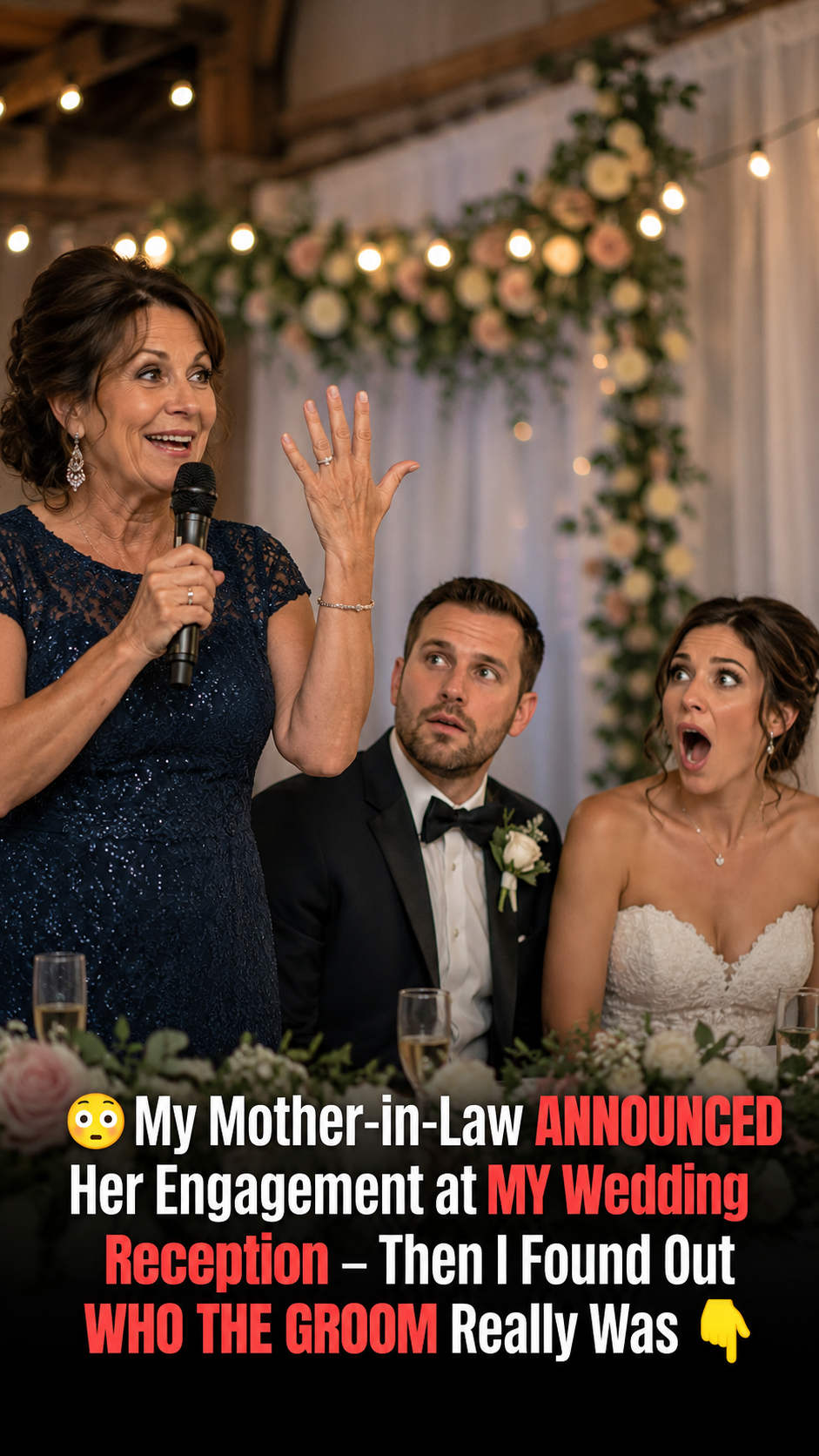
After dinner, the band paused and the toasts began. They were sweet and funny and emotional—the kind of toasts that warm a room. I was finally relaxing when Lydia stood and asked for the microphone. My spine went stiff before I could stop it. Ethan gave me a little shrug, a silent suggestion to let her say a few kind words.
She started with grace, speaking about how magical the night felt and how happy she was to see her son marry “such a lovely woman.” Polite applause followed. Then she smiled wider and said, “And in the spirit of love, I realized this is the perfect time to share some news of my own. I’m engaged.”
The room erupted. People clapped and cheered. A few stood. Someone even called her name like she’d just won an award. Lydia lifted her hand and showed off a large, sparkling ring. It was bold and bright—more like a statement than a symbol. Guests streamed toward her table to gush and congratulate.
I stood there, the bride at her own wedding, feeling like part of the decor. My maid of honor, Tessa, slipped to my side. “Is this really happening?” she asked through her teeth. I told her I might faint. She leaned closer and whispered that she could make a “red wine accident” occur if necessary. I almost laughed. Mostly, I wanted to walk outside and breathe.
As more guests surrounded Lydia, I noticed something odd. When people asked who her fiancé was, she dodged the question. “You’ll meet him soon,” she said. “He’s private.” “It happened quickly.” Her laugh sounded forced. The energy around her wasn’t joy—it was closer to relief, or relief’s cousin, panic. And that bothered me more than her timing.
“Please don’t make a scene”
That’s when Ethan came to my side. Still smiling for the room, he murmured, “Please don’t make a scene.” The words felt like cold water. I searched his face. He didn’t look surprised. He looked tired.
“You knew?” I asked. “You let her announce this at our wedding?” He didn’t answer directly. He just asked me again to keep calm, not now, not here. The old habit—be the reasonable one, don’t ruin the moment—pressed on my chest. I stood very still and tried to keep my voice steady.
Across the room, one of Lydia’s oldest friends called out, “Where’s the lucky man?” The room quieted, turned, and waited. A side door opened, and in walked a man in a dark suit. He looked to be in his fifties. Broad shoulders, guarded eyes, a face that gave away nothing. He wasn’t warm. He wasn’t beaming. He looked like someone who measured every step and every exit.
Lydia moved quickly to him and gripped his arm too tightly. “Darling,” she said brightly, “everyone was just asking about you.” He glanced at her hand on his sleeve, then at the room, and said nothing. Ethan had gone pale beside me.
“Who is that?” I asked him. Nothing. I asked again. Finally, he whispered, “His name is Victor. He handles debt recovery.”
The words hung in the air between us. Debt recovery.
And suddenly, pieces slid into place. The comments Lydia had been making about “liquidity.” Her evasiveness when I mentioned honeymoon plans. Ethan’s insistence that cash gifts stay accessible “for flexibility.” Private phone calls. Tight looks between mother and son. This wasn’t an engagement. It was something else entirely.
The truth stands up in a crowded room
I walked toward Lydia. The room followed with its eyes; people feel the weather change before the storm breaks. Tessa kept pace at my shoulder. I stopped in front of Lydia and asked, calmly, “Who is he really?”
Her smile wobbled. “My fiancé,” she said. I shook my head. “Try again.” A low murmur moved through the tables. Lydia’s friend leaned forward, too entertained for decency. The mask slipped at the edges.
Before Lydia could answer, the man in the suit—Victor—lifted his chin and spoke in an even, dry voice. “Lydia and I are not engaged.”
Silence. Real silence. The kind that presses on your ears.
Victor continued, as if reciting a prepared statement. “My firm represents two creditors. Ms. Mercer”—he nodded slightly toward Lydia—“asked me to attend tonight for a family matter requiring discretion. This morning she informed me that, for strategic reasons, she intended to introduce me publicly as her future husband. I advised against it.”
Lydia’s eyes filled. She whispered, “Please.” The word landed in the still air with nowhere to go. Around us, guests shifted in their chairs. Some looked away. Others looked closer. Lydia’s practiced elegance fell away in a breath, and there it was—fear, pride, and the kind of exhaustion that comes from trying to hold a story together after it stops being true.
What Ethan finally admitted
Ethan reached me then, his voice low. I asked him plainly, “What have you not told me?” He stared at the floor, then at me, like he was deciding if a smaller lie could cover a larger one. Finally he said, “She lost the house three months ago.”
He explained in halting sentences. There were loans on top of loans. Credit cards. Private lenders. Refinancing and more refinancing to keep up appearances after his dad died. Lydia had borrowed from friends and from people she shouldn’t have. It all fell apart at once.
“Why didn’t you tell me?” I asked. He didn’t answer at first. When he did, the truth landed harder than I was ready for. “Because I didn’t want you to call off the wedding.”
I felt the floor shift. “Why would I call it off?” I asked, though I already knew where the path was leading. His expression changed—guilt and then a kind of defense that told me the rest before he spoke.
“I moved some of the cash gifts yesterday,” he said.
Ten thousand reasons to rethink everything
“How much?” I asked. He swallowed. “Ten thousand.” My knees nearly buckled. The money our families and friends had given us to start our life—taken before the cake had even been cut, moved in secret to patch a hole that kept getting bigger. I could picture the envelopes with careful handwriting, the thoughtful cards, the generosity meant for us both. My grandparents’ gift. My parents’ check. Our friends’ contributions. All meant to help us build a home, not rescue a lie.
“You stole from me,” I said. He rushed to correct me. “It was ours.” I shook my head. “Not when you took it in secret to cover for your mother.”
Across the room, Lydia sank into a chair, her hands covering her face. For the first time that night, she stopped performing. I felt a flicker of pity—honest, unwanted, and short-lived. She had been keeping up appearances for so long that she chose spectacle over honesty, even tonight. But pity does not rebuild trust, and it does not make a marriage safe.
The moment I chose myself
I looked at Ethan and saw something with sudden clarity. He wasn’t just a devoted son. He was bound to his mother by old habits, by fear of her collapse, by years of cleaning up and calling it love. If I stayed, I would be asked—again and again—to make myself small so their crises could stay big. Every celebration would be up for negotiation. Every boundary would be temporary. Our life would always be one step away from being “strategically” redirected to whatever fire needed putting out next.
I took off my wedding ring. Ethan went white. “Please, don’t,” he whispered. I set the ring on the table beside a glass of champagne no one had touched and said, as gently as I could, “I just promised to share a life with you, and your first loyalty was somewhere else. You didn’t trust me with the truth, and you didn’t protect us from a choice you already knew was wrong.”
He said it wasn’t fair. I told him it was painfully fair. Around us, the room tried to pretend it wasn’t listening. The band stood very still near the stage. Somewhere, someone laughed too loudly at nothing. I felt the lace on my dress against my skin, the weight of the day on my shoulders, and a surprising steadiness in my chest.
Lydia lifted her head. Mascara streaked. “Please don’t leave like this,” she said. I looked at her and, for once, did not make myself smaller to ease someone else’s discomfort.
“This is exactly how I need to leave,” I answered.
I turned to Tessa and asked if she could help me gather my things. “Absolutely,” she said without hesitation. We walked toward the doors. Behind us, whispers rose and fell. The night air outside was cool and honest. I shook so hard my teeth nearly chattered, and Tessa slipped my coat over my shoulders. She asked me what I wanted to do next.
I looked back at the glowing windows and the silhouettes moving within, at the family I had almost merged with, and I spoke without checking who it might upset. “I want my life back.” She squeezed my hand. “Then that’s where we start.”
What I learned that night
Families survive hard times with honesty, not with secrecy and show. Help is possible only when people tell the whole truth—especially about money. Love can motivate beautiful sacrifices, but it can also turn into quiet enabling if no one draws a line. I wish Lydia had asked for help plainly. I wish Ethan had trusted me with the truth before we stood under an arch and promised each other everything.
But wishes do not repair broken trust. Choices do. That night, I chose not to make myself small anymore. I chose to believe that the right partner will face hard news beside me, not hide it from me. And I chose to believe that a life built on honesty—even after a public heartbreak—is better than a life built on “strategic” stories told to keep up appearances.
For anyone facing a similar crossroads
If you find out something big has been hidden from you, especially before a major promise like a wedding, pause. Breathe. Ask for the whole truth in clear words. Money secrets don’t stay small. Public scenes are never easy, but private betrayals leave deeper scars. You deserve a partner who trusts you with the hard parts and stands with you when family storms roll in.
Would you call it a betrayal, or an act of loyalty gone wrong? That answer says a lot about the kind of marriage you hope to build—and what you will, and will not, carry into your future.



