We had been waiting so long to become parents that hope itself started to feel like a trick. Then, on an ordinary Tuesday morning, a message arrived that made my hands shake. The adoption agency wrote just six words: We have a baby girl. In that instant, the future we had been preparing for quietly stepped through the door.
My husband, Rodgers, gripped my shoulders, his eyes wide with a question he could barely say out loud. When I nodded, we both cried right there in the kitchen, two people who had been standing outside a locked door for years and finally heard the click of a key turning. The drive to the hospital was a blur of joyful panic, the kind where you look twice at streetlights because you suddenly don’t trust your eyes. By the time we reached the maternity wing, it all felt too beautiful to be real.
The social worker who met us was kind and efficient, the way people are when they know they’re walking someone through a life-defining moment. We were guided down a quiet hall, past soft beeping and the gentle hush of new life. Through a window, I saw the nursery—rows of tiny bassinettes, small blankets tucked to careful perfection. Somewhere in there, a child was waiting for us.
The Call That Opened the Door
It had taken nearly four years to get to that hallway. Four years of forms that probed personal corners of our lives. Four years of home visits where strangers opened closets and tested smoke detectors with polite smiles. Four years of interviews about how we would handle race, loss, medical uncertainty, and the tender question of attachment. We stood in waiting rooms with other couples who wanted what we wanted and tried to swallow our envy when someone else got matched first. Friends tried to be helpful with their well-meant lines about “perfect timing,” but sometimes those words stung more than they soothed. Over time, I became the woman who leapt for the phone and then hated herself for hoping each time it rang.
Yet here we were, ushered into a soft-lit room while the paperwork was prepared and a nurse went to bring our baby to us. I pressed my hands together, useless with excitement and nerves. Rodgers kept glancing at the doorway as if joy itself might walk through it wearing a name tag. When the door opened and the nurse stepped in, our lives tipped into a new shape.
Joy Meets a Whisper
The nurse’s badge read Rhoda. She was smiling, the way everyone had been smiling since we arrived, the way kindness looks when it knows it’s part of something good. In her arms, swaddled in a pink blanket, was the smallest face I had ever seen. She was all softness and quiet, with a fist tucked next to her cheek as if she were guarding some tiny newborn secret.
Rhoda placed the baby in my arms with the care of someone handing over a treasure. The room seemed to narrow to a pinpoint—just my breath, a warm weight, and the echo of a dream finally become real. I memorized her mouth, the little quiver of it, and the peaceful way she settled against me. Rodgers put a hand to his face, and I knew if I looked at him I would cry again.
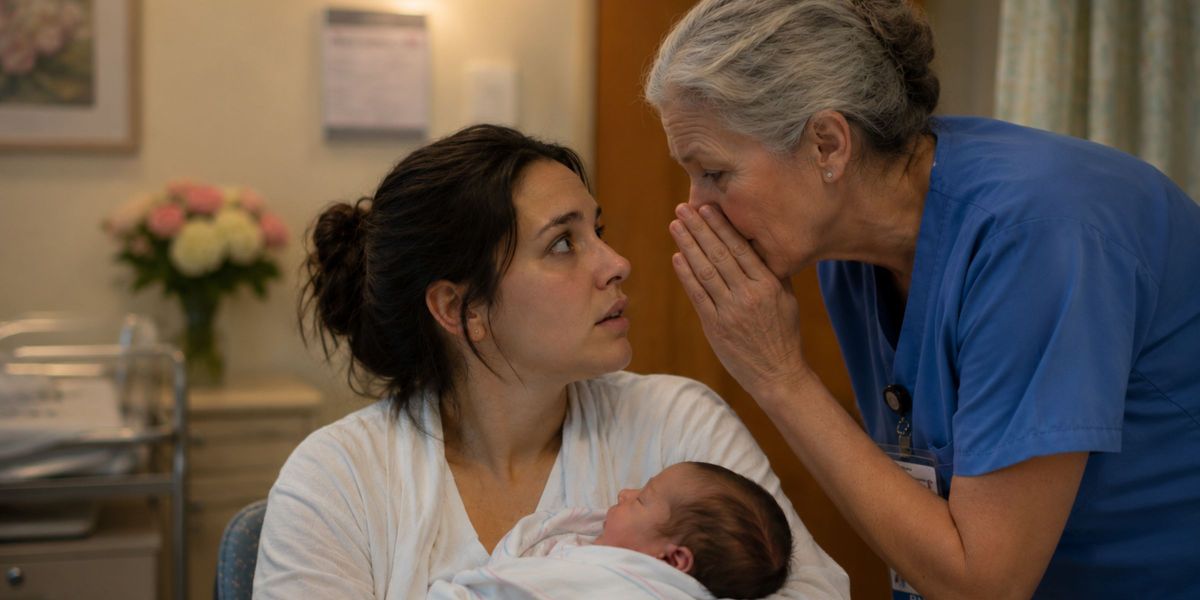
That’s when Rhoda’s expression changed. She glanced toward the hallway, then behind her shoulder, as if making sure we were momentarily alone. She leaned in, close enough that I could feel the whisper before I fully understood it. In five quiet words, she placed a crossroads between us.
“The biological mother didn’t consent.”
The ground shifted. I looked down at the baby—our baby, the agency had said—and then back at Rhoda. She held my gaze with a firm, warning kindness, the sort that says, Don’t ask me to repeat this. Then she stepped away and left the room, and the echo of those words stayed, loud as a bell someone was trying to muffle.
A Choice I Couldn’t Unhear
Rodgers was still near the window, watching us with the awed, undone look I had seen on new fathers in movies. He moved closer and touched the edge of the pink blanket with a single trembling finger. “She’s real,” he breathed. “Melissa, she’s really here.” I wanted to protect that joy, to hold it away from the draft that had just blown through the middle of the moment. But the words were already threading themselves through my conscience, and I knew that if I pretended I hadn’t heard them, I’d never be able to unknot what came next.
I let Rodgers take the baby, and I watched him fall in love in real time. There is a look a person gets when everything changes and they know it. He glanced up at me and, almost shyly, said we could call her Makena—just as we had whispered to each other on tired evenings when hope felt too fragile to say out loud. I nodded, unable to trust my voice. The social worker returned with a neat stack of forms and a smooth, rehearsed explanation of each page we needed to sign.
When she slid a paper across to me and referred to “the adoption agreement requested by the birth family,” something inside me steadied. I set the pen down and excused myself to the restroom. Then I went looking for the nurse who had just changed the weather in my heart.
The Hallway and the Honest Door
I found Rhoda near a supply station. She saw me coming and turned away, which told me everything about the risk she had taken. I followed her into the restroom, my voice low and careful. I promised I would not use her name, that I would not put her job at risk. I told her I simply needed to understand what those five words meant, because I could not, in good conscience, carry a child out of this hospital if her mother had not truly agreed to let her go.
Rhoda looked at me in the mirror for a long moment, as if measuring what I might do with the truth. Finally, she told me the birth mother was in room 418 and advised me to be careful. “It’s not as simple as no consent,” she said quietly. “She’s under pressure.”
Room 418
Outside the door, I paused and took a breath I could feel all the way to my fingertips. Inside, a young woman lay against the pillows, worn with the particular kind of exhaustion that follows a night of labor and too many tears. She could not have been more than 25. Her hair was caught up hastily, her face pale, her eyes wary and tired. When I introduced myself and said why I had come, her lower lip shook.
I did not try to make a speech. I simply asked if she had been pressured into making the adoption closed when she wanted it open, or into anything she didn’t truly want. She said no at first, dabbing at her eyes, looking toward the door as though afraid it might open. Then, breath by breath, the shape of the truth emerged. Her name was Cindy. She had chosen adoption—she was certain about that—but she wanted it to be open, at least enough that she could receive a simple update each year and a few photos. Her parents, Rita and William, were insisting it be closed, final, with no line left between past and future.
She told me the baby’s father had disappeared as soon as he learned she was pregnant. She said her parents were worried that contact, even limited, would keep her stuck in grief, keep her from school, keep her from rebuilding. And then, as if on cue, the door opened and her parents walked in.
Between What Hurts and What Heals
Rita’s face was taut with worry; William’s jaw was so tight it looked like a kind of armor. They were upset to see me there, upset that lines had been crossed. “This is a closed adoption,” William said, and for a moment the air filled with the sharp sound of certainty. Cindy started to cry again. “Please, Dad. I told you I want an open adoption. Let her hear me.”
I don’t know what courage stepped in for me then. Perhaps it was the knowledge that a newborn down the hall would live with the results of this conversation for the rest of her life. I told them I was there because I refused to build my family on someone else’s pain. The room went still. What Cindy asked for was not co-parenting or confusion. It was a single email each year on her daughter’s birthday, with a few photographs if we were willing—just enough to quiet the lifelong ache of wondering.
“An open arrangement keeps you tied to this forever,” William said gently but firmly. Cindy looked at him with wet eyes and answered in a voice that changed everything. “No, it keeps me from wondering forever.”
You could feel something shift then. Rita sat down slowly, as if her knees needed the chair more than her pride did. I turned to Cindy and asked her to tell me exactly what she hoped for, not what anyone else had told her to accept. She pulled a folded sheet from her bag, a list she had written to keep herself from losing her courage. One email each year on the child’s birthday, with a few photos if we agreed, and the understanding that when the child was older, if she asked to know more and if we all felt it was right, we would find our way together and gently.
I said yes. Simple as that. If Rodgers agreed as well—and I believed with my whole heart that he would—then yes. Rita stared at me like I had stepped off the expected path and invited everyone to take a kinder road. William’s face softened in that quiet way men sometimes shift when they realize firmness and wisdom are not the same thing. Cindy, surprised, asked me why I would agree.
“Because I already love her,” I said. “And I don’t want the first thing I do for her to be closing the door on where she came from.”
Telling the Truth at Home Base
I went back to the room where Rodgers stood with Makena curled against his chest, whispering the nonsense syllables of brand-new fatherhood. He looked at me with a question on his face, and I closed the door and told him everything—Rhoda’s whisper, room 418, Cindy’s wish, and the narrow, decent bridge we could build between grief and peace.
He listened without a single interruption. Then he looked down at our girl and said softly, “You did the right thing. Why would we not want her to know anything about her daughter?” The relief that moved through me was so deep my knees trembled. Rodgers squeezed my hand. “I would rather lose this adoption,” he added, “than spend our lives wondering if we kept someone’s child under terms her heart never agreed to.”
Rewriting the Paperwork, Keeping the Promise
The next hours were practical and tense in the exact way life gets when real people have to change plans. The agency was not thrilled that I had found my way to Cindy’s room. A hospital administrator used the phrase “procedural irregularity” more than once. But when Cindy stated clearly, in front of the right people, what she wanted—an open contact agreement with simple, specific boundaries—everything shifted to meet her words. The law cared most about her actual consent, and that consent included the terms that allowed her to heal.
Rita apologized to her daughter for pushing so hard without listening. William took longer to soften, but in the end, he looked at Cindy and said what every grown child needs to hear: that he had tried to protect her future and had almost forgotten it was hers to shape.
When the revised agreement was ready, Rodgers signed, then I did, and finally Cindy. The room was so quiet that the sound of each pen on paper felt ceremonial, like a blessing. We took Makena home the next morning.
Bringing Makena Home
The house that had stood ready for years finally received its small, rightful resident. Rodgers stood in the nursery doorway and whispered, half in disbelief, “She really is here.” This time my smile didn’t wobble. We had brought our daughter home honestly, with the door to her beginnings left respectfully ajar.
Every year on Makena’s birthday, I sit down and write Cindy a letter in the shape of an email. At one, I told her about the yellow bath duck and the dramatic protest against naps. At three, I told her about the boots worn on hot days and the strawberries she renamed “red moons.” At six, I told her about the shy way she approached new places and the fearless way she loved people once she decided they were safe. Each message carries a few photos—frosting on her face, a paper crown made in school, front teeth missing and a grin that looks exactly like joy feels.
Cindy always writes back a few lines, full of gratitude and calm. She has never once crossed a boundary. She holds the line we drew together with care, measuring her love in trust instead of intrusion. And in our home, we have always told Makena her story in the way people who read the best guidance and still worry do—honestly, gently, and at the pace her growing heart could hold.
What That Day Taught Me
Makena knows she grew in Cindy’s body. She knows Cindy loved her and chose us, and that families can be built in more than one brave way. She is 10 now, all elbows and questions and laughter that floods a room. Sometimes, when I watch her running across the yard, I think about the moment in the hospital when everything could have started with someone else’s pain. One signature. One decision. One quiet choice to tell myself it wasn’t my place to ask, to listen, to do the hard right thing.
Instead, our beginning included a nurse named Rhoda who bent toward me and trusted that decency—real, practical decency—might still be chosen when it cost something. She was right to take that risk. Because our daughter came to us honestly. And because telling the truth at the beginning gave us peace for all the days that followed.
Makena calls me Mom and Rodgers Dad. We are her parents. Cindy is not a shadow in our hallways or a threat hovering over our happiness. She is part of the truth of our daughter’s life, and the truth has turned out to be far kinder than secrecy ever pretended to be.
If, one day, Makena wants to know more, we will meet that day with steady hearts and open hands. Until then, each year I write to the woman who trusted us with her most precious gift. I tell her about the light of our daughter’s laughter and the small ways she surprises us. Before I click send, I listen for the sound of her feet somewhere in the house and think the same thing every time: love did not shrink when we made room for the truth. It grew—wider, deeper, and strong enough to hold us all.
A Gentle Question for You
If you were standing where I stood that day—with joy in your arms and a quiet warning in your ear—would you have opened room 418? I believe most of us would. Not because we enjoy hard things, but because, at this season in life, we understand the way peace is made. It’s built with honesty, patience, and the choice to do right where it matters most: at the start.