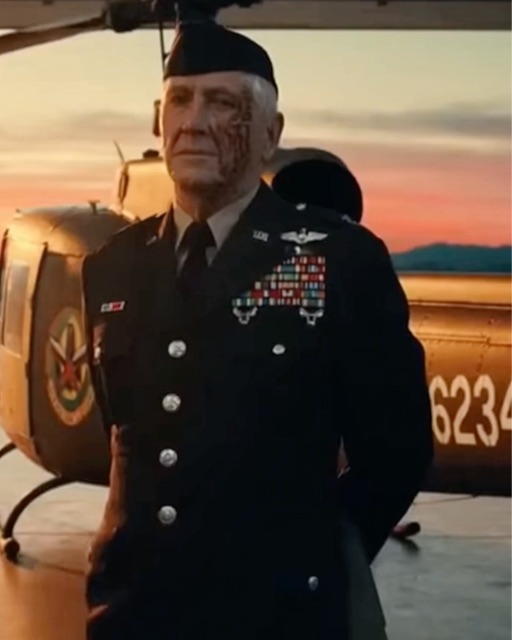
The old Army aviator stood alone in front of the hangar just before sunset. Dress uniform, ribbons pressed, flight wings catching the orange light. One side of his face carried a burn scar that had healed into something permanent. His bearing was still pure military.
Behind him sat a restored helicopter, nose painted in the colors of a unit that no longer existed.
A few younger troops figured he was there for a photo op.
One muttered under his breath. “Probably wants to tell us how they did it in the good old days.”
The aviator didn’t turn around.
“No,” he said. “I’m here because that aircraft is wearing the wrong number.”
Everyone stopped talking.
The maintenance chief walked over, suddenly careful. “Sir, this bird was restored from archived specifications.”
The veteran pointed to the tail boom. “Then the archive lied.”
Now half the hangar floor was watching.
He stepped toward the helicopter and placed his palm flat against the metal. Like he was touching a headstone.
“The aircraft carrying my crew home never landed with that number,” he said. “It landed with another one. One they erased.”
The chief climbed the ladder. Checked the tail plate.
Fresh rivets.
Replacement metal.
The serial beneath the paint didn’t match.
Nobody moved.
The old aviator saluted the aircraft anyway. Because Army airframes carried American soldiers. That alone demanded respect.
One by one, the troops around him came to attention. Saluted too.
Then the chief pried loose the replacement plate.
Behind it was an older panel. Stamped. Original.
And wedged between the layers – an oil-stained envelope.
The veteran saw the handwriting.
His whole body went rigid.
That handwriting belonged to his crew chief. The one officially declared dead in the crash report.
The maintenance chief handed it to him carefully. “Sir…”
He opened it.
Inside was a torn manifest page. And one message.
We landed. They renamed the aircraft before sunrise.
A young lieutenant whispered. “Who would do that?”
The veteran didn’t answer.
He was looking up at the operations office windows above the hangar floor.
Because someone was standing there.
Watching them.
And slowly – very slowly – raising a salute back.
The old aviator’s name was Colonel Thomas Callahan, retired. The man in the window was General Marcus Thorne.
They had been captains together, a lifetime ago.
Callahan tucked the envelope into his breast pocket. The paper was fragile, almost holy.
He nodded once to the maintenance chief, a gesture of thanks that spanned decades.
Then he turned and walked toward the stairs leading up to the offices.
The young troops parted for him like he was a ship cutting through water. Their earlier mockery had evaporated, replaced by a thick, curious silence.
Every step on the metal staircase echoed in the vast hangar.
He didn’t knock on the door. He just opened it and stepped inside.
General Thorne stood by the window, his hand now resting at his side. His uniform was immaculate, his face a mask of composed authority.
“Tom,” Thorne said. His voice was steady, but his eyes told a different story. “I had a feeling you’d find it.”
Callahan walked to the desk and placed the envelope on the polished wood.
“You knew it was there, Marcus.” It wasn’t a question.
“I hoped it would stay hidden,” Thorne admitted. “For everyone’s sake.”
“My crew chief was Sergeant Frank Miller,” Callahan said, his voice dangerously quiet. “The Army told his mother he burned with the aircraft.”
He gestured toward the hangar floor below. “That aircraft didn’t burn. Frank’s note says they landed.”
Thorne let out a long, slow breath. He looked old. Older than the stars on his shoulders.
“They did land, Tom. Or what was left of them did.”
The story began to spill out, not in a rush, but in weary pieces.
It had been a covert mission, deep in a place they were never supposed to be. A rescue operation for a downed intelligence team.
Callahan was the pilot. Frank Miller was his crew chief. Two young specialists were in the back. And his co-pilot was a fresh-faced Warrant Officer named David Sterling.
“We took heavy fire going in,” Callahan recounted, his eyes seeing the past. “Lost an engine. But we got the intel team.”
“We know,” Thorne said softly. “The mission was a success. The team got out.”
“But we didn’t,” Callahan stated. “We went down on the return leg. Hard landing in the jungle. Communications were shot.”
He touched the scar on his face. “I was thrown clear. Woke up hours later. The bird was wrecked. The official report said there were no survivors.”
Thorne finally moved away from the window. He sat down heavily in his leather chair.
“The report was written by a scared lieutenant on the ground, miles away,” Thorne explained. “By the time a recovery team could be dispatched, a new directive had come down from the top.”
“A directive?”
“The entire operation had to be buried. It was a political nightmare waiting to happen. Admitting we were there would have started a war.”
So they erased it.
The mission never happened. The intelligence team was “recovered” during a training exercise.
And Callahan’s crew, along with their helicopter, were declared lost in a routine transport flight far from the real location.
“Your crew wasn’t on that helicopter, Tom,” Thorne said. “They made it back.”
Callahan stared at him, the entire foundation of his grief starting to crack.
“Frank got the bird running. On one engine and a prayer, he got it into the air with the rest of the crew.”
They had landed at a remote, black-ops airfield just before dawn. Battered, bleeding, but alive.
“I was the captain in charge of that airfield,” Thorne confessed. “I got the call directly from a three-star general. ‘Make it disappear.’”
So he did.
He ordered the maintenance crew to swap the tail numbers with a helicopter that truly had been lost in a storm. He filed the paperwork. He classified the real logs.
“I gave your crew a choice,” Thorne said, his voice barely a whisper. “They could come forward, and the whole political mess would explode. Their careers would be over, and they’d probably face a court-martial for just being there.”
He paused, letting the weight of it sink in.
“Or they could disappear. New identities, honorable discharges under a classified program. They could just… go home and live.”
Callahan’s mind was reeling. Frank. David. The two specialists. Alive.
“And Frank?” Callahan asked, his throat tight. “Why the note?”
“He knew you’d survived, Tom. He heard it on the radio chatter just before they took off. He knew you’d wake up alone and think they were all gone.”
Thorne pointed to the envelope.
“He wedged that in the old panel before my guys put the new one on. He was leaving you a message. A promise. He bet that someday, you’d come looking for the truth.”
“Where are they, Marcus?” Callahan demanded.
Thorne opened a drawer in his desk. He pulled out a single, thick file with no markings.
“I couldn’t put it in the official record,” he said. “But I never lost them. I kept my own file. For this day.”
He slid it across the desk.
“Frank Miller runs a small engine repair shop in rural Montana. The specialists, they scattered. One’s a fishing guide in Alaska, the other teaches history at a community college in Oregon.”
Callahan felt his legs weaken. He leaned against the desk for support.
“And David Sterling?” he asked. “My co-pilot?”
Thorne’s expression grew somber. “That’s… more complicated. David was hurt badly in the landing. Internal injuries. The kind the Army medical system wouldn’t have been kind to. He would have been discharged, permanently disabled, and forgotten.”
“Frank refused to leave him,” Thorne continued. “He said the mission wasn’t over until everyone was home safe. Not just back on base, but truly safe.”
Frank had used his new identity and the back pay they were given to get David the best private medical care, off the books. He nursed him back to health himself.
The file contained addresses. Phone numbers. A lifetime of lies built to protect a sacred truth.
“You covered for them,” Callahan said, looking at the General with new eyes. “All these years.”
“It was the only honorable thing I could do,” Thorne replied. “My orders were to erase a mission. I did. My orders were not to abandon good soldiers. So I didn’t.”
Callahan took the file. It felt heavier than any weapon he had ever carried.
His first stop was Montana.
He drove a rental truck down a long gravel road, dust kicking up behind him.
He found the shop just as Thorne had described. A simple, metal-sided building with the words “Miller’s Repair” painted on the side.
An old man in greasy overalls was leaning over a lawnmower engine, his back to the door.
Callahan stood there for a long moment, his heart pounding against his ribs.
“A crew chief should know better than to use a foreign wrench on an American engine,” Callahan said, his voice husky.
The man froze. He slowly straightened up, wiping his hands on a rag. He turned around.
It was Frank Miller. His face was a roadmap of wrinkles, his hair was pure white, but his eyes were the same. Sharp, intelligent, and loyal.
Tears welled in Frank’s eyes. He dropped the rag.
“Skipper,” he breathed.
They didn’t shake hands. They met in the middle of the concrete floor and embraced, two old soldiers holding each other up. Two ghosts proving they were real.
“I knew you’d come,” Frank said, pulling back. “I knew you wouldn’t let it lie.”
They talked for hours. Frank filled in the gaps. He told Callahan about the terrifying flight back, about the deal with Thorne, and about the quiet lives they had all built.
“There’s one more person you need to see,” Frank said finally.
He led Callahan out the back of the shop to a small, neat house with a well-tended garden.
A man was sitting on the porch in a wheelchair, reading a book. He looked up as they approached.
His hair was graying at the temples, and he had smile lines around his eyes.
It was David Sterling. His co-pilot.
David’s face broke into a grin of pure, unadulterated shock. “Colonel?”
Callahan walked up the ramp to the porch. “It’s Tom, David. Just Tom.”
David reached out a hand. “Frank always said you were too stubborn to die. And too stubborn to forget.”
The reason for the wheelchair became the final, heart-wrenching piece of the story. During the hard landing, David’s spine had been severely injured. The Army would have put him through a dozen surgeries and then discharged him into a VA system that might have failed him.
“Frank made me a promise,” David said, his voice thick with emotion. “He said we were a crew. And a crew leaves no one behind. He built this house for me. He’s been my family ever since.”
This was the real twist. The cover-up wasn’t just about politics. It was about saving one of their own from a broken system. Frank had orchestrated his own disappearance, and that of his crewmates, to fulfill the ultimate soldier’s promise.
He hadn’t just brought his co-pilot home. He had made him a home.
Weeks later, Colonel Callahan stood in front of the hangar once more.
This time, he wasn’t alone.
To his left stood Frank Miller. To his right, David Sterling sat in his wheelchair. General Thorne was there, too, standing a respectful distance away.
The young troops from before were assembled, along with the maintenance chief. They knew the story now. Everyone on the base did.
The helicopter behind them had been changed.
The maintenance crew had worked all night. They had removed the false tail number and, using the old, stamped panel as a guide, restored the aircraft to its true identity.
It now wore the number it had landed with on that dark, forgotten morning.
General Thorne stepped forward. “The official record has been amended,” he announced, his voice carrying across the hangar. “Mission logs have been declassified and corrected. The records of Sergeant Frank Miller, Warrant Officer David Sterling, and Specialists Peterson and Craig are now officially listed as ‘Honorably Discharged, Mission Complete.’”
He looked at the three men.
“Welcome home.”
Callahan stepped forward and faced the helicopter. He brought his hand up in a slow, perfect salute.
Frank Miller, standing tall, saluted beside him.
From his chair, David Sterling raised his own hand to his brow.
Then, behind them, General Thorne saluted.
And one by one, every single soldier on that hangar floor, from the youngest private to the maintenance chief, came to attention and rendered the sharpest salute of their lives.
They weren’t just saluting a machine of metal and wire.
They were saluting a promise. They were saluting a crew that understood that the mission never truly ends.
Honor, Callahan realized, wasn’t something awarded on a certificate or engraved on a monument. It was a quiet, stubborn thing you carried inside you. It was the choice to protect the person next to you, no matter the cost. It was the love that turned a crew into a family, a bond that not even time, lies, or a forgotten war could ever break.