Thirteen shots. Thirteen misses. The kind of silence that makes your teeth ache.
General Kirk Whitaker lowered his sunglasses. “Any snipers left?”
Nobody moved. Nobody wanted to be miss number fourteen.
“May I have a turn, sir?” A calm voice. No bravado.
Captain Mallory Ortiz stepped out of the line. Supply. Clipboard queen. Coffee key guardian. Not the person you hand a rifle built to swat a fly two and a half miles away.
She didn’t strut. She didn’t pose. She opened a beat-up notebook – pages worn thin, corners soft, numbers packed into the margins like they were trying to escape.
I was on range duty, sweating through my vest. When I glanced at that notebook, my stomach tightened. The handwriting looked… familiar.
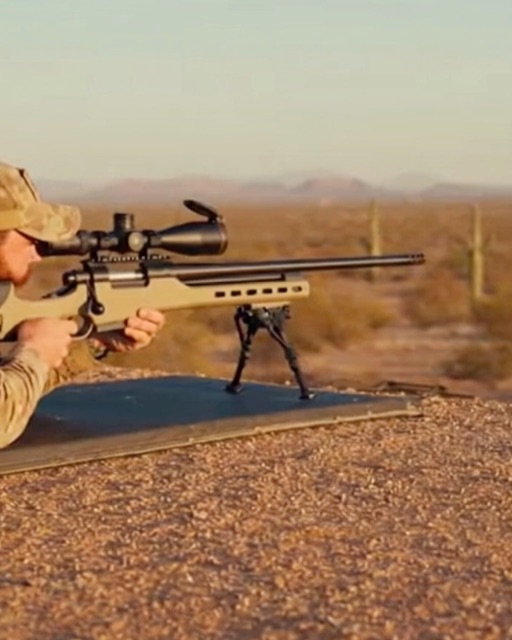
Mallory laid down. Slow breath. No hurry. No chatter. Just the desert boiling and the barrel steady.
The trigger broke.
Crack.
We all flinched.
A half-second later – clang. Clean. Bright. Like a church bell in a furnace.
My heart pounded in my ears. The line erupted, then choked itself quiet because even cheering felt too loud.
The general stared at her like he’d just watched the sun rise in the west. “Who taught you to read wind like that, Captain?”
Mallory closed the notebook with two fingers, eyes still on the mirage. “Someone who told me the target isn’t the problem, sir. The air is.”
She tucked the notebook under her arm. It slipped, just enough for the inside cover to flash.
I saw the signature and felt my blood run cold.
Because the name on that first page belongs to Sergeant Elias Vance.
And Sergeant Elias Vance was a ghost.
He was the man they erased from the photos, the name you didn’t speak. He was the cautionary tale they told recruits about the price of a single mistake.
My own story was tangled up with his. I was there that day. Just a kid, really. A private whose job was to watch and learn.
And what I learned was how quickly a hero could become a pariah.
The rest of the day was a blur. The general pulled Captain Ortiz aside, their conversation low and intense. The other shooters just kept looking from the distant target to the supply captain, their faces a mix of awe and confusion.
I just tried to keep my hands from shaking. Elias Vance. After all these years.
That evening, I found her in the supply depot. It was her kingdom. Rows of metal shelves, the smell of cardboard and clean lubricant, the quiet hum of fluorescent lights.
She was updating inventory on a tablet, her face illuminated by the screen. She looked just as calm and methodical as she had on the range.
“Captain Ortiz?”
She looked up. No surprise in her eyes. It was like she’d been expecting me.
“Sergeant Miller.” She put the tablet down.
I didn’t know where to start. My throat was dry. “That notebook.”
A flicker of something crossed her face. She pulled it from a pouch on her belt. She held it like it was a holy text.
“You recognized the name,” she said. It wasn’t a question.
I nodded. “I was there. At Al-Kut. I was on his spotter team.”
Her expression softened, but a wall went up behind her eyes. She had heard this before, I realized. The judgment. The pity. The morbid curiosity.
“He was my father,” she said, her voice dropping to a whisper, as if the concrete walls had ears.
The words hit me harder than the rifle’s recoil. I had known Vance had a family, a wife and a little girl. I just never connected them to the present. To this quiet, impossibly skilled captain.
“I’m sorry,” I said, and I meant it. “I never… I never believed the official report.”
That was the first crack in her armor. Her shoulders slumped just a fraction. “Almost no one who was actually there did.”
“They said he missed,” I said, the memory still sharp and ugly. “They said his shot gave away our position. Cost two men their lives.”
“He never missed,” Mallory said, her voice fierce. “Not a shot like that. Not him.”
She opened the notebook. The pages were filled with that familiar, precise script. It wasn’t just numbers and wind charts. There were notes. Observations. Sketches of terrain.
“He taught me everything,” she said, tracing a line of data with her finger. “He started when I was ten. Taught me patience first. How to watch a leaf fall from a tree and predict where it would land.”
“He taught me that you don’t fight the elements. You just listen to them. The wind, the heat, the spin of the earth itself. They’re all telling you a story.”
She flipped to a page near the back. It was dated. The day of the Al-Kut incident.
The handwriting was the same, but hurried. Anxious.
“Look,” she said, pointing to a paragraph.
I leaned in. It was a note about the intelligence. ‘Intel is bad. Target location is a ghost. Feels like a trap. Whitaker is pushing too hard.’
Whitaker. General Whitaker. He was a Colonel back then. The man in charge of the operation. The same man who had praised her on the range today.
My blood ran even colder.
“My father argued with him,” Mallory continued, her voice trembling slightly. “He said the coordinates were wrong, that the wind patterns indicated a different position. He told Whitaker they were walking into an ambush.”
“Whitaker wouldn’t listen. He told my father to follow orders or face a court-martial.”
She took a deep breath. “So my father did what he was trained to do. He made the shot based on the intel he was given. And when the ambush was sprung, exactly where my father predicted it would be, they needed a scapegoat.”
“It was easier to blame a single sniper’s miss,” I finished for her, the sick feeling of truth settling in my gut. “Than for a Colonel to admit a catastrophic intelligence failure.”
We stood there in the silence of the depot. The hum of the lights sounded like a scream.
“Why are you still here?” I asked. “In his army? The one that buried him?”
“To clear his name,” she said, her eyes locking onto mine. They were brilliant, intense. “I joined to find the truth. To prove what he wrote in this book.”
“This notebook,” she tapped it, “is more than just a training manual, Sergeant. It’s his testimony.”
I finally understood. The quiet demeanor. The supply job, keeping her under the radar. The years of practice, honing a skill that was her birthright. It was all part of a plan. A long, patient, meticulous plan.
“The shot today,” I said. “That wasn’t a coincidence.”
A small, sad smile touched her lips. “I’ve been waiting for an opportunity. For a shot no one else could make. A shot that would make people ask questions.”
It was a brilliant move. She hadn’t made an accusation. She had made a statement. An undeniable declaration of a legacy they had tried to erase.
“The General knows,” I realized. “When he saw you, and that notebook… he must have known.”
“He knows who I am,” she confirmed. “The question is, what will he do about it?”
The next morning, I was summoned to the General’s office. I walked in, my heart pounding. Captain Ortiz was already there, standing at ease. General Whitaker was behind his desk, staring at the notebook which lay open between them.
He looked older than he had yesterday. The desert sun had carved deep lines into his face, but today they looked like lines of guilt.
“Sergeant Miller,” he said, his voice gravelly. “Captain Ortiz tells me you were part of Sergeant Vance’s team at Al-Kut.”
“Yes, sir. I was.”
He gestured to the chair. “Sit down.”
I sat. The silence in the room was heavier than any I’d ever experienced.
“For fifteen years,” Whitaker began, looking at the notebook and not at us. “I have told myself a story. I told myself that Elias Vance was a good soldier who made a fatal error under pressure.”
“I told myself that I made the best decision I could with the information I had. That my report was accurate. That it was necessary for morale, for the integrity of the command.”
He finally looked up, first at Mallory, then at me. His eyes were filled with a profound weariness.
“They were lies,” he said, the admission costing him everything. “All of it.”
This was the twist I never saw coming. I expected denial. I expected a threat. I did not expect a confession.
“The intel was bad from the start,” he said. “It came from a source high up the chain. A source that could not be questioned. I had my orders, and I had my ambitions. I pushed my men into a meat grinder because I was too proud and too scared to question authority.”
He looked directly at Mallory. “Your father was right. He warned me. He saw the air, and all I saw was the target on a map. When it all went wrong, I let him take the fall. It was… it was the greatest act of cowardice in my entire life.”
Mallory didn’t flinch. She just stood there, a statue of stoic grace.
“Why now, sir?” she asked, her voice steady. “Why tell us this now?”
“Because yesterday,” he said, tapping the notebook. “I didn’t just see a captain make an impossible shot. I saw Elias Vance standing on that range. I saw his legacy, living and breathing and demanding a reckoning.”
“And I realized,” he continued, his voice cracking, “that I am tired of the ghost in my room. I am tired of the story I’ve been telling myself.”
He stood up and walked to the window, looking out over the same range where Mallory had rung the steel.
“Clearing his name officially will be difficult. The people who fed me that bad intel are now in very powerful positions. An inquiry will end my career. It might mean a court-martial for me.”
He turned back to face us. “And it is long overdue.”
He was going to do it. He was going to sacrifice himself to fix the mistake that had haunted him for a decade and a half.
In the weeks that followed, General Whitaker was true to his word. He formally requested a review of the Al-Kut operation, submitting his own testimony as the primary evidence. He named names. He exposed the faulty intelligence and the subsequent cover-up.
The fallout was immense. His career was over, just as he predicted. He was forced into retirement, his reputation in tatters among the top brass. But among the soldiers, the ones on the ground, a different story was told. A story of a General who, in the end, chose honor over rank.
The investigation cleared Sergeant Elias Vance of all wrongdoing. His official record was amended. He was posthumously awarded a medal for his attempts to prevent the disaster.
But here was the final, most rewarding twist of all. Sergeant Vance wasn’t dead.
The shame and the disgrace had been too much. After his discharge, he had simply disappeared. He changed his name, moved to a quiet town in the mountains, and lived a solitary life, communicating only with his daughter. He couldn’t bear to face the world that believed he was a failure.
The day his name was cleared, Mallory took a leave of absence. I drove her to the airport. She was clutching the notebook.
“He knows,” she said, a real, brilliant smile finally reaching her eyes. “He watched the news. He’s waiting for me.”
She was no longer Captain Ortiz, the quiet supply officer. She was Mallory Vance, the daughter who moved heaven and earth to give her father his name back.
I saw a picture a few months later. She sent it to me. It was her and an older man with kind, tired eyes, standing on a porch overlooking a vast, wooded valley. He had his arm around her, and in his other hand, he held the old, worn notebook. They were both smiling.
Mallory was eventually reassigned, not to a supply depot, but as the lead instructor at the sniper school. She used her father’s notebook as the core of her curriculum. She didn’t just teach recruits how to shoot. She taught them how to see.
Sometimes, the loudest statements aren’t made with a shout, but with a quiet, perfect, undeniable act. Mallory’s shot didn’t just hit a target 4,000 meters away. It traveled back fifteen years, broke through a wall of lies, and delivered the truth.
It’s a powerful lesson. The target isn’t always the problem. Sometimes, the real challenge is the invisible space in between—the air, the lies, the years of silence. But if you have the patience, the skill, and a legacy of truth on your side, you can hit it, clean. You can make it ring like a bell for all the world to hear.