“THEY CALLED ME “NEW GIRL” – UNTIL 0800 MONDAY
They didn’t bother learning my name. Fine. Let them.
“New Girl,” they’d say, like a joke. Or a dare.
Corporal Mason Reed said it the loudest. Big voice. Bigger crowd. He liked an audience.
Friday, late. Empty corridor. His boots stopped in front of me; two buddies fanned out behind. He flicked my folder out of my hands. Papers everywhere.
I bent to pick them up.
He slammed me into the wall. Boot to my side. Copper on my tongue. I heard one of them snort like this was supposed to be funny.
I stood back up, slow. Blood on my lip. Heart steady. I looked Reed dead in the eyes.
“You just made a career-ending mistake,” I said, wiped my mouth, and walked.
All weekend, I heard his laugh in my head. Good. Let him.
Monday. 0759. The gym smelled like disinfectant and rubber mats. Boots thudded. Voices bounced. Reed was holding court, grinning like payday.
0800.
Silence fell the way it does when rank walks in.
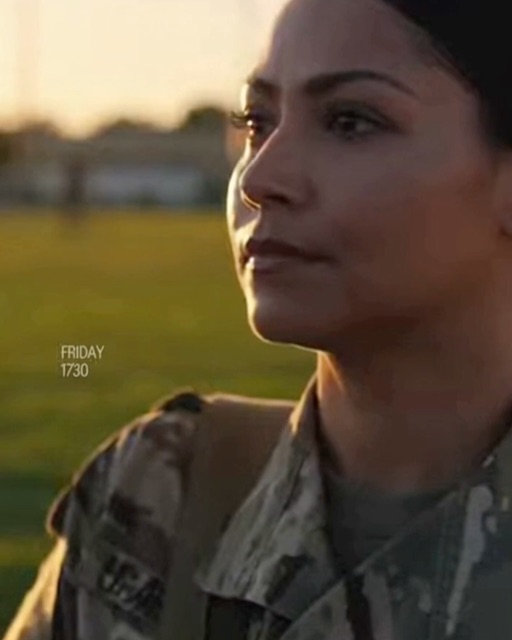
I stepped onto the center mat. Black top. Clipboard in hand. No smile.
Reed’s laugh cut off mid-breath. He tried to square his shoulders. Failed.
I set the roster down where everyone could see. My pulse didn’t move. I could feel thirty pairs of eyes, waiting to see who I was.
“Form up,” I said, and the room obeyed before the brain caught up.
Reed finally looked at the header. Then the first line. His color drained out like someone pulled a plug.
I turned the clipboard so the front row could read, tapped the box under “Evaluation Officer,” and watched his mouth open and close.
Because the signature on that line wasn’t his commander’s. It was…”
It was Captain M. Vance, Evaluation Officer, Brigade Assessment Team.
My name.
I watched the realization crawl across Reed’s face, slow and sour, like he’d bitten into something rotten.
SFC Dunne, the senior NCO, snapped everyone into two ranks before I had to ask. He didn’t look at me long, but when he did, it was measured and withholding, like a man checking fences in a storm.
I walked the line and read the names off the roster the way a metronome keeps time. Names are anchors. They tell you who you’re responsible for. They also tell you who’s responsible for their choices.
“Corporal Reed,” I said, even, like I wasn’t tasting the memory of his boot.
“Ma’am,” he said, and his voice caught on the title like it stuck in his throat.
We started with combatives basics. Warmups, sprawls, hip escapes. Nothing fancy. Bodies on mats, breath and rubber, the kind of sound that fills your skull when your face is an inch from the floor.
I paired them off, but I counted quietly as I walked. Numbers more than names at first, until the names settled where they belonged.
Reed tried to angle away from the one partner I had in mind for him, a quiet infantryman with a scar that ran from his hairline to his ear like a pale lightning bolt.
“Reed and Crawford,” I said, pointing. “Mat three.”
Their eyes met. Crawford nodded, polite and easy. Reed swallowed and gave a tight smile that didn’t reach anything but the surface.
We moved to dominant position drills. Mount. Side control. Escapes. I corrected with two fingers and a word at a time, never more.
Reed powered through the first few reps like the floor owed him something. He didn’t listen to cues. He relied on muscle and heat.
Crawford waited him out.
On the fifth go, Reed blew through his balance and rolled. Crawford let him, then replaced guard with a fluidity that made a couple of the younger privates blink.
“Breathe,” I told Reed when he tried to come up high and crush. “You’re not a battering ram.”
He stared straight ahead like he hadn’t heard me.
“Again,” I said.
The thing about gyms like that is the walls remember. Scuffs, sweat, fingerprints from ten thousand hands. You learn the room the way you learn a face.
I had learned it that way before, as a private at Fort Moore when they still called it Benning, when my hands were new and my lungs burned every day like they were going to turn inside out.
Back then, nobody bothered to learn my name either.
My last name was different then too, but that’s a story you don’t lead with if you want people to do their jobs without digging into your life like it’s a buffet.
We moved into assessment circuits. Timed drills. Grapple rounds. Techniques graded on form, control, recovery.
Reed lasted two rounds before his breathing went choppy. He still hit hard, but the precision bled out because his focus wasn’t on form; it was on not losing in front of his people.
I wasn’t there to make a spectacle. I was there to measure who they were when they thought no one who mattered was watching.
I walked past Reed as he came off the mat and brushed my shoulder against his on purpose. Not a collision. Just enough to say I wasn’t moving out of his way anymore.
“Water,” I said, and he nodded without looking up.
When I turned back to the center, Dunne had already thrown me a clean mat towel. He didn’t ask if I needed it. He knew better than to make me say it out loud.
“Alright,” I said, clapping once so it cracked. “We’re going to talk about why I’m here.”
Silence rolled across the gym like fog. Even the fans sounded quieter.
“Your brigade’s under a routine readiness assessment,” I said, which was true. “I’m the combatives evaluator for today, but that’s not the whole bill.”
I lifted the clipboard so they could see the second page, the one with the line of blocks: Technical Proficiency, Leadership, Discipline, Unit Climate.
“Four boxes,” I said, tapping each. “You only get the first one on the mat.”
I let that sit.
It’s funny how fast a room of tough people can feel like a classroom when they realize there’s a test they didn’t study for.
“If you’re thinking, ‘awareness training,’ you’d be half right,” I said. “We both know policy slides don’t fix anything if the floor doesn’t back it up.”
I saw a couple nods then. The kind you give when you don’t want to be seen nodding.
There are jokes about evaluators. There are bigger jokes about captains, especially captains in black tops carrying clipboards. There’s a half-truth in every joke.
Here’s another truth: by Friday afternoon, I already had thirteen statements in my bag, six recordings, and one video still waiting on a timestamp pulled from a camera angle they didn’t know existed.
That wasn’t because I set anybody up, even if it felt like that to the ones who had a sense that rules were something other people had to follow.
It was because someone in this room had reached out a month ago with an email that had more courage in it than most people muster in a year.
We hit break, and I watched who moved where. People tell you how they operate when they think nobody’s clocking them.
One of Reed’s buddies, a wiry mechanic named Hargrove, hovered near me like he wanted to speak but couldn’t find his pocket of air.
He’d been there Friday night, laughing low, the sound that still stuck under my ribs.
“Ma’am,” he said, voice just above a whisper. “Quick word?”
“Walk,” I said, and we circled the edge of the mats like two people counting steps to pretend we weren’t talking.
“I shouldn’t have laughed,” he said, eyes fixed on the brick wall. “I don’t know why I did.”
“You know why,” I said. “It was easier than standing in front of your friend.”
He flinched at “friend” like I’d thrown something.
“It won’t help to nod at me over here and wolf-pack over there,” I said. “Pick who you are and stick with it.”
He nodded, and his throat worked like he’d swallowed glass.
“I gave that email,” he muttered then, so low the fans almost ate it. “I didn’t think anyone would actually come.”
I didn’t look at him or break stride.
“Then you’re the reason I’m here,” I said. “Make it count.”
We stepped back onto the mat like nothing had passed between us. That’s sometimes the only way to keep a secret from a hungry room.
Session two ran cleaner because that’s what happens when people know the game is fair and the whistle is in use. You could feel them settle into it, even the ones who didn’t want to like me.
I held back from showing anything until the end on purpose. Evaluate first. Demonstrate second. People hear better after they’ve had to work.
“Reed,” I said, when the last pair finished and the stopwatch beeped. “Up.”
He came forward like a man walking to a mic at a wedding. Everything that wasn’t his face said he’d rather be anywhere else.
“You and me,” I said. “Basic escape from mount, no strikes.”
He blinked like he thought I was playing. I wasn’t.
We went down, and he took top first. He did what he’d always done. He tried to smother space with weight instead of kill angles.
I let him push into me. I let my back say what it wanted to say about Friday.
Then I let my hips do the talking.
Trap, bridge, roll. Simple. Efficient.
He hit the mat with a thud that sounded like the inside of a drum.
I held upright and counted out loud to three, giving him a breath to find his face again. Then I offered a hand.
He didn’t take it. He rolled away and came up on his own, pride bleeding at the edges of his mouth like a split lip he wouldn’t let me see.
“Again,” I said, and we swapped.
He tried to bench-press me off when I took top with a high mount, the way new lifters do when they haven’t learned that your arms aren’t jacks.
I floated his push and followed his momentum so his elbows arrowed under his own ribs. My knees bit the mat by his armpits and I took his wrist, palm up, like I was about to read him.
I felt the exact point he realized I wasn’t bluffing. It’s a shift in a body that you can’t fake. The muscles hiccup. The head turns left too late.
I didn’t finish it. I let go.
He lay there for a second, chest heaving, eyes above my shoulder like the ceiling was safer.
“Breathe,” I said again, soft now. “Technique wins if you let it.”
When we stood, I saw the faces of his section behind him. They weren’t grinning anymore. They didn’t look mortified either. Mostly they looked quiet, the way people do when a simple thing knocks a hole in a loud story.
I moved on. You don’t humiliate if you want change. You give the truth, and you move.
After chow, I met with the company leadership in the office off the gym. The room smelled like coffee and old chevrons. There was a whiteboard covered in marker where someone had tried to draw a plan and ended up drawing a storm.
The company commander, Captain West, had a calm that came from not needing to prove who he was. His rank sat on his chest the way a tree sits in good earth.
First Sergeant Bell was a quiet boulder in the corner. He gave me the impression of a man who had seen every kind of mess and had a bucket for all of them.
Dunne stood at parade rest like he had a hinge in his spine.
I put my folder on the desk and slid out the sheets. Clean. Underlined. Precise.
“Here’s the short version,” I said, because nobody in a uniform needs the long version unless they ask for it. “Your combatives are passable. Your leadership and climate are not.”
West’s jaw moved once. Bell didn’t move at all.
“I’ve got video of a corporal assaulting a subordinate on Friday night,” I said, and nobody asked me to define assault because we all know lines. “I’ve got audio of two section members egging it on.”
I looked at West and didn’t blink.
“I also have six statements that detail hazing incidents in the last three months that you’d never hear about if one of your own hadn’t decided he’d had enough.”
West let out a long breath that softened his shoulders but not his face.
“Names?” he asked.
“I’m not burning my source in this room,” I said. “But I’ll give you the rest because the process doesn’t work if you hide facts under rugs.”
I slid the sheet to him. He read. He didn’t pass it to Bell. He held it like a live thing while he stared through it.
He finally looked up.
“I’ll initiate preliminary actions on Reed and the two named,” he said. “We’ll secure the footage and contact CID for guidance if it meets the threshold.”
“It meets it,” I said. “You also have a climate problem that’s going to choke your best people if you don’t cut it off at the neck.”
Bell shifted like a granite block rolling an inch.
“What’s that look like, in your words?” he asked, and his voice had gravel and authority in it.
“It looks like small rules broken in public and big ones broken in hallways,” I said. “It looks like a clown car of nicknames and silence when it matters. It looks like young soldiers teaching each other that power is the only language anyone believes.”
He took that in and nodded once, like I’d given him a map.
I passed a second set of forms.
“You’ll also find an anonymous link on the company page this afternoon,” I said. “It’s for your soldiers to report issues that aren’t crimes but still kill teams. You can read the patterns in there like a book if you’re brave.”
West rubbed a hand over his jaw.
“You here for all of this?” he asked. “Or you rotate out after today?”
I held his gaze.
“I’ll be here all week, at minimum,” I said. “Longer if the colonel says my boots should stay.”
He nodded, then looked at Bell without looking, the way people who’ve worked together a long time can do.
Bell dipped his chin. It meant nothing to anyone watching, and everything to both of them.
I left the office to the smell of coffee and the sound of two leaders deciding they were about to do something hard and not friendly. That sound is rare. You learn to respect it when you find it.
The afternoon drills were less tense because a decision had been made somewhere invisible, and decisions clear air the way a storm clears heat.
I ended the day by sitting them all down on the mats and telling a story I hadn’t told in this room before.
“When I was a private, I slept under a broken vent for a week because someone higher than me thought it was funny to find out how long it would take me to complain,” I said. “I didn’t complain. I got pneumonia and cracked a rib coughing.”
I watched their faces swing from disbelief to that shade of anger that feels like shame when you see it from the right angle.
“I came back,” I said, tapping my chest. “I didn’t come back because anyone made it easier. I came back because one sergeant major told me my name out loud in formation and made three people say it after him until they got it right.”
There’s always a way to fix a thing if a room full of people decide to quit making it worse.
“You can be that sergeant major,” I said to Dunne, and to Bell when I met his eyes. “Or you can be the silence that makes more of this.”
I didn’t look at Reed when I said it. I didn’t have to.
When I packed my bag, Hargrove hovered again, hands flexing like he wanted to squeeze out what he needed to say.
“I’ll make a statement,” he said finally, like he’d been trying the words on in an empty mirror all day. “A signed one.”
I nodded once.
“Courage isn’t a trophy,” I said. “It’s a toolbox. Use it again tomorrow.”
He smiled, small and tired.
As I was about to leave, Reed’s voice came from behind me.
“Ma’am,” he said. “Request a word.”
I turned. He stood at attention that looked like it had been put on wrong.
“Go,” I said.
He struggled for a second like he was looking for a place to rest a heavy box.
“I’m not going to stand here and lie,” he said, and it didn’t sound like a speech. It sounded like teeth. “I did what you said I did. I can say I was joking. I can say I was keeping order. None of that’s a reason.”
He looked past my shoulder like the door might be kinder.
“I did it because I could,” he said, and his voice was thin now. “I did it because it got me laughs and I liked the sound.”
He swallowed and looked back at me.
“That’s not who I wanted to be when I put this on,” he said, and he flicked his eyes at his stripes like they were someone else’s. “I don’t know how to get back to the first part of me without losing the second.”
There it was. The thing most people never say because it costs too much.
“You’re going to lose the second part anyway,” I said. “One way is a staircase. The other is a cliff.”
He closed his eyes for a half second.
“I’ll take the stairs,” he said, and I believed him in that way you believe people who have just realized the ground ends sooner than they thought.
We met with West and Bell again. Reed signed a written statement that didn’t dodge a single word. He called his two buddies and told them he was doing it. One followed him right in and added truth to truth. The other didn’t. The other wanted a day to think.
We gave him that day. A fair chance. A rope over your head is still a rope you can use to climb.
That night, I drove out to the small motel off base where I’d been sleeping because the barracks felt too loud for that kind of work. I ate a salad that tasted like the plastic it came in and watched a late baseball game on mute so the noise wouldn’t come with it.
I didn’t sleep much. The first night after people say real things usually steals hours. You learn to give them up without a fight.
Tuesday was paperwork and interviews. Crawford spoke plain and left it all on the mat, which he would have done whether I was there or not. He was that kind of calm.
Hargrove shook but he spoke too. You could see his spine growing in as the sentences linked together.
The third man, the one who’d asked for a day, came in at lunch. He set his cap on the edge of the desk like he was lining it up for inspection.
“I laughed,” he said, before he sat down. “I should’ve walked.”
We walked through it all. Dates, words, small shoves, nicknames that stuck like burrs. We talked about the day he’d quietly taken a private to medical because the kid twisted his knee and didn’t want anyone to know he couldn’t run.
People are rarely only one story. That’s not a defense. It’s a map.
By Wednesday, the company felt different. Bell started formation by reading three names out loud and following them with the words “accountable” and “professional” and “this is on me too.”
Nobody threw up their hands. Nobody rolled their eyes. They just stood a fraction taller.
I held two more evaluation blocks and wrote up the technical piece. Most passed. A few didn’t. That’s how numbers work. The failing ones would retest.
After afternoon drills, I found Reed alone in the gym folding towels with the kind of care you usually reserve for flag details. Extra duty had a way of putting a man in an honest room.
“Captain,” he said, measured. Not “ma’am” this time. A name like a weight you choose to lift.
“How’s the staircase?” I asked.
“Steep,” he said, and half smiled. “But at least I can see my feet.”
He surprised me then.
“My kid sister’s seventeen,” he said, folding the last towel and squaring the edges. “She texts me before school. I told her not to let anyone call her anything she doesn’t like.”
He held the towel a second longer.
“I didn’t realize I was the anyone,” he said, and he let out a breath that had been sitting there since Friday.
Sometimes grief for the person you were is the first clean thing a man says all week.
We shook hands on accountability. Then we sat on the edge of the mat and he asked me the question none of them had asked me yet.
“Why’d you tell me Friday was a career-ending mistake?” he said. “I thought you were just another private. I thought you were bluffing.”
“I wasn’t bluffing,” I said. “But not for the reason you think.”
He waited.
“My last name used to be Larkin,” I said, quiet. “Back at Benning, before I took my grandmother’s name after she died. Back then, a corporal named Niles made a joke like yours and pushed me into a locker for laughs on a dead floor.”
His eyes stayed on me, not on the floor. That counted for something.
“I did what soldiers do,” I said. “I came back harder, and I made rank, and I learned when to hit and when to write. But I kept that laugh like a pocket knife.”
I tapped the mat.
“When I told you you’d made a career-ending mistake, I wasn’t warning you because I liked the sound of it,” I said. “I was telling you because I knew what it would cost you if you didn’t hear me.”
He took that in and nodded like a man who finally understood a language he’d been faking since he was a kid.
Thursday, West held a formation nobody wants to hold and everybody remembers. He talked about respect like it was steel. He said the names of three programs nobody likes to sit through and then said, “they don’t work unless we do.”
He promoted a private who had been doing E-3 work for six months without the stripe because of a lost packet. He apologized to the private by name. He made three people repeat the private’s name after him until they got it right.
Dunne and Bell stood in the back where the shadows are and listened to their people breathe.
By Friday, the mood in the gym had lost that brittle edge that comes when folks are waiting for a shoe to drop. There was a different kind of energy in the floor, an underlay of “we’re doing this” that you can’t fake if you tried.
I held the last technical retest that morning. The two who missed the first time passed clean because they’d been working at 2100 on their own, drilling guard breaks like they were counting beads.
I signed off the packet and handed it to West.
“We’re not done,” I said, standing in his doorway while he thumbed through. “But this is a better start than I hoped for when I drove through your gate Monday.”
He looked up and smiled with his eyes.
“Most starts are ugly,” he said. “We’ll take one that isn’t a lie.”
At 1300, I met with Reed, Bell, and West to finalize what Reed already knew. West gave him a reduction in rank and extra duty. Bell pulled his team leader billet. There’d be a review after sixty days to see whether separation made sense.
Reed didn’t argue. He didn’t plead. He stood there like a man in the open with the rain on his face.
When we were done, he asked for something I didn’t expect.
“Permission to address the company at the end of the day,” he said. “Not to make a speech. To tell them what I did and tell them I’m going to work it off.”
Bell glanced at West. West looked at me. I nodded once.
“Say your name when you do it,” I said. “Make them say it back.”
He did.
He stood there at 1700 in front of men and women who knew him loud and he told them the one quiet thing that costs the most.
“I hurt someone because I could,” he said. “I’m not that man anymore as of this minute. Hold me to that.”
He said his full name and made them say it back. He said Hargrove’s name and apologized to him in public for pulling him with him.
Hargrove’s hands were shaking when he shook Reed’s after. All the jokes in the world can’t stand up in front of a handshake like that if the room’s on your side.
After the formation, Crawford came up to me and stuck out a hand.
“Ma’am,” he said. “Thank you for not just coming here to write people’s endings.”
“Write your own,” I said. “I’m just here to make sure the margins are even.”
The brigade colonel extended me a week, then didn’t need me for it. That’s the best kind of extension. It means the wheel is starting to turn without your hand on it.
On my last day, I walked the gym alone for a minute and touched one of the scuffs on the wall like a woman checking the edge of a scar.
I felt the air in that room the way you feel a cut that’s healing: tender, but not angry anymore. Ready to be skin again.
On my way out, the custodian stopped me. He was an older man with a white beard and the kind of eyes that have seen every kind of sweat and every kind of sorrow.
“You’re the lady with the clipboard,” he said, smiling. “Your girls and boys stood a little taller this week.”
“They’re their own,” I said. “But yeah.”
He nodded like he already knew.
“Names matter,” he said. “Even the ones people try to take from you.”
I smiled and stepped into the sun.
A month later, I got a postcard in the mail with a picture of a battered boxing gym in town. The note on the back was short.
“Stairs are stairs,” it read, in Reed’s blocky handwriting. “Teaching footwork to kids on Saturdays. Feels right. Thanks for not pushing me off the cliff.”
There are a lot of ways to end a story like that. The easy one is to say people got what they deserved and leave it at that. The true one is messier, and better.
Hargrove made sergeant that winter. I got a photo of his stripe pinned on crooked and a grin like he couldn’t feel his face.
Crawford took over as a team leader and didn’t raise his voice because he didn’t need to. People like him are gravity in a room.
West got a commendation he’ll probably hide in a drawer because the ones that matter to him wear boots, not ribbon bars.
Bell started a monthly open-floor where anybody could say anything with no rank, and people did. The first three were awkward. The fourth one fixed two things I can’t write about because they aren’t my stories.
As for me, I drove to my next base and my next black top and my next set of names. There’s always another roster. There’s always another mat that smells like disinfectant and old rubber. There’s always another man or woman who needs to hear their name spoken clean for the first time in a while.
People still call people things they don’t deserve. That won’t stop in my lifetime. Maybe it won’t stop in my granddaughter’s either.
But you can make a room where it stops for long enough that somebody new learns not to love the sound of a bad laugh.
You can make a day at 0800 where silence falls and someone who thought they were nobody steps onto the center mat and says “form up,” and a room full of humans obeys before their brains catch up for the first time.
Here’s the lesson I keep in my chest pocket like a folded picture. You never know who you’re talking to, and you don’t need to know to do the right thing. Power shows you who you are, and so does the way you treat the person who doesn’t have any.
Your name is your first rank. Learn other people’s and say them like you mean them. That’s how you build a floor that doesn’t give when the weight gets heavy.