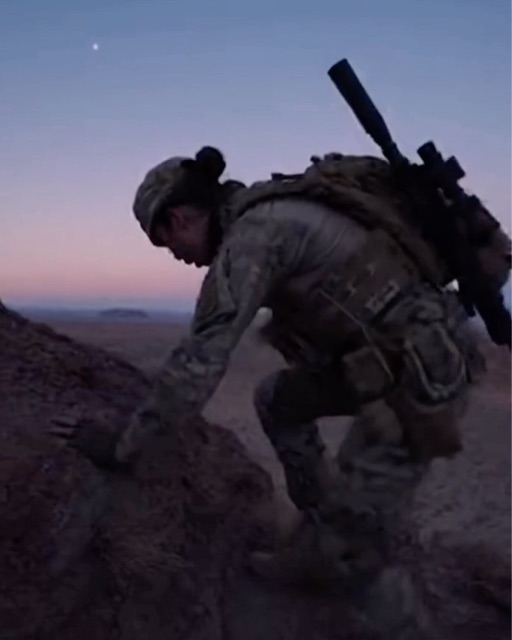
“Stand down. It’s too risky,” General Todd said, closing the folder like a coffin lid.
I set my badge on the table. “Then I’m not yours anymore.”
Twenty-four hours later I was belly-down on a sun-baked ridge, two thousand meters out, glass on a makeshift camp where they were parading a downed pilot like a trophy.
Captain Trevor Cole.
He’d yanked me out of a burning MRAP three years ago. Didn’t ask permission. Didn’t wait for backup. I still hear the hiss of my own breath that day, the metal popping, his gloves on my vest, the promise he didn’t make but kept.
So no – some spreadsheet wasn’t going to decide his ending.
No backup. No comms. Just a borrowed truck, a thermos of warm coffee, and my old Tac-50 cradled like a heartbeat.
Wind steady. Mirage dancing. My pulse slow.
Through the scope, I counted six. One pacing. Two smoking. One with a radio. Trevor on his knees, hands zip-tied in front, a rag at his temple soaked rusty-brown.
“Breathe,” I whispered.
I dialed 0.6 left for the wind.
Then something felt wrong.
The guy with the radio wasn’t scanning – he was reciting. His lips moved like he’d memorized a script. The one “guarding” Trevor? Safety on. The “zip-tie” around Trevor’s wrists had slack. Too much slack.
My stomach turned to ice.
I inched the magnification. A ring flashed on the pacer’s hand – West Point crest. Boots all the same brand, too new for desert rats. Patches that didn’t match the weathering on the uniforms.
This wasn’t a capture.
This was a stage.
I slid the crosshairs off the guard’s ear and settled them where no one expected—just below Trevor’s jaw.
That’s when he lifted his head, looked straight into my glass, and mouthed my name… as a tiny red shimmer began to dance across my scope.
I rolled right an inch and the red dot wobbled with me like a cat toy, playful and lethal.
They had me lased.
I exhaled and slid backward, pushing the rifle along the mat, keeping it low so the sun wouldn’t flash on steel.
A heartbeat later, a round kissed the rock where my cheek had been, spat grit across my tongue, and left the smell of struck stone.
Counter-sniper, high ground behind, maybe three hundred meters off my right shoulder, clever enough to keep the sun at his back.
I didn’t get mad; I got smaller.
I slid like a snake into the sage, took my time, circled a bush, and built a new rest with my pack, keeping the camp in my periphery and the ridge line where I guessed my friend waited in my glass.
Another round came lazy and late, a probe more than a kill, and I smiled because he was guessing too.
I eased the scope past a knuckle of basalt and saw him in silhouette, prone, Mira cover on his lens, muzzle brake like teeth, cap backward like a kid at a ballgame.
He didn’t belong out here either.
I held two mils high because the mirage off the rock was worse on his side, and I sent one breath into the stock until it stopped shaking.
My first shot wasn’t to kill.
I took his bipod.
Metal sparked and the rifle kicked off his rest and he threw an arm around it like it was a dog about to dart into traffic.
He swore loud enough for me to hear it as heat carried voices like balloons and he crabbed backward, fast and low, living to fight another hour.
Good.
I didn’t want a dead American on my conscience today.
At the camp, the choreography missed a step.
The guy with the radio turned and stared up at the ridge I’d just scooted from, a little off rhythm now, and he forgot his line.
Trevor took that beat and coughed, a messy sound that covered the word he made next with his lips.
Go.
It wasn’t the apology I feared.
It wasn’t a plea I didn’t need.
He was telling me this wasn’t the place to win.
I slid the bolt, stoked a fresh cartridge, and aimed where none of them expected—a license plate on the back of their pickup idling behind the canvas.
I shot left of center and caught the tire, and in the whine and hiss of rubber bleeding out, the neatness of their stage got sloppy.
Men turned.
Lines broke.
Someone shouted for a medic who didn’t exist.
Trevor used the slack on his wrists and the jerk in their heads and leaned, just enough to bump a tripod they’d set up behind him, a camera with a hood on it like a bird feeder.
I felt sicker.
They weren’t making a ransom video.
They were making a show.
I backed out and ghosted down the spine of the ridge, using the heat and scrub to fold around me, counting steps, counting breaths, counting seconds like they were coins I couldn’t waste.
My truck was tucked in the crease of a dry wash, grey as a rumor, and I slid behind the wheel and popped it in neutral and let gravity do half the work while my mind tried to decide the other half.
They wanted me to shoot Trevor.
They wanted me to be the last man to hold that trigger so the blame fell clean and the budget request for “expanded domestic counter-terror capability” floated through some committee with a sad slideshow.
I knew that because a year ago I’d told Todd we were sliding, that we were calling too many things threats because it fed something that had nothing to do with safety.
He’d smiled like he was a pastor and told me to have faith.
Faith didn’t earn hazard pay.
I bumped the shifter into drive and let the truck ease toward the two-track that ran east like a crack in old paint, and I kept low in the seat and counted the birds because it kept my hands from doing something stupid.
Three minutes later and a mile down, I stopped under a cottonwood no one had asked to grow here, and I climbed the hill on its shoulder to a new hide where I could see not just the camp but the slope above it where I’d pushed the other shooter.
He’d gone, but he’d left tracks like a polite thief.
They cut into a draw where the rocks got bigger and the air less friendly, and I followed with my eyes until they ended in a flat spot the size of a bed where a second case lay open and a spare rifle looked at the sky like it had a question.
They’d brought a team.
I panned back to the camp and saw the men tug Trevor up and hustle him toward the truck, the one now yawning on its rim like a drunk losing a shoe.
They swore and kicked it and someone made the call to move him on foot to the next ridge where another vehicle waited, and the radio man finally used the antenna for what God built it for.
I couldn’t hear his words but I knew the cadence—overlord callsigns and blocks of time and the way people talk when a plan isn’t dead but it’s not pretty either.
I made a choice I didn’t love.
I folded the bipod, cradled the rifle, and jogged the wash back to the truck, put rubber on rock and used speed to pay off the distance between them and me until I could pull off again and make the rest on foot.
There’s a way to run with a rifle that keeps your lungs from kicking your teeth.
I remembered that rhythm, and a minute later I was in the shadow of a scarp with sun above and the men I needed to touch two ridges over.
I built a hasty rest with my pack and the rifle butt in the notch of my shoulder and went back to school.
Two thousand meters is a number that’s real if you’ve done it.
Today the air was kind and the ground hard and the target big in the way a person gets big when he’s the one thing that matters in a field of stone.
I dialed for distance and wind and I found their world in mine, and I did what I’d left that building to do.
I didn’t shoot Trevor.
I walked the reticle to the ankle of the man on his right where his foot met ground and his boot laced too neat for desert dust, and I broke his femur with a shot the weight of a soft-spoken lie.
He went down like a tree cut at the wrong notch and everyone else flinched at the wrong ghost and I was moving the crosshairs again, cutting tendons and will without stopping hearts, writing a message in pain I could live with.
Three of six fell, and the fourth froze and tried to aim where he believed I’d be and the fifth did the math and tossed his rifle and lifted both hands like we were in a movie at the end.
The sixth grabbed Trevor and shoved him forward and used him like a door against bullets, and I hissed because I don’t shoot through friends.
Trevor solved it.
He stumbled with purpose and went limp, all bones and apology, and they both kissed gravel and I took the open pocket and stapled the sixth’s shoulder to the earth with copper and heat.
Silence did that stretchy thing it does after gunfire, like a trampoline that takes too long to stop.
I didn’t wait.
I slid down the cut, staying low, staying simple, and I made the last thirty yards on my belly while everyone who could had their face in the dirt.
Trevor lifted his head an inch and one eye found mine and something like a smiling curse lived there.
“You stubborn idiot,” he breathed when I rolled him onto his side and saw the fake blood on the rag and the neat edges of makeup where they’d tried too hard to make hurt look ugly.
“You okay?” I asked, fingers on the slack tie that came free like a kid’s first magic trick.
“I was,” he said, flexing wrists, “until you turned this into an outpatient ward.”
“We need to move,” I said, because the quiet had teeth and I could feel it thinking about us.
“The ridge to the southwest,” he said, like he’d paced it in his sleep. “They’ve got a second vehicle and a man who likes to stand in shade and pretend it’s cover.”
We slid like we were made for dirt and made the rock as a drone hummed over us, friendly as a bee that didn’t care who you were until you swatted it.
I put the scope on it and breathed and took the shot no one would ever log in a report, the kind of shot that takes a moving speck against a dancing soup of heat and makes it fall like a toy.
The drone hiccuped, tried to remember which way was down, and then forgot and ate the ground in a little clatter of plastic and wires.
“Unauthorized,” Trevor said, grinning in a way that made me want to punch and hug him both.
“Saving you never came with a form,” I said, and he blew out a laugh that sounded more like relief than humor.
We didn’t go to the southwest ridge.
We went north, because that’s where no one had planned to look for two idiots with too much stubborn and a rifle older than some marriages.
We cut into a gully the map pretended wasn’t there and came up on the back side of the road where my truck sulked like it wanted a better owner.
Trevor slid into the seat, eyes on the mirror and hands not shaking, and I put the rifle across my knees and tried not to argue with the part of me that wanted to go back and apologize to the men groaning on the rock.
“Don’t,” Trevor said, reading me like the book he’d borrowed and never returned. “They’ll have medevac wheels on them in four. Sometimes you have to let professionals bandage the mess you made.”
“Whose show was that?” I asked, starting the truck and pointing its nose at sky and heat.
“Todd’s,” he said, and he didn’t even flinch when he said the name. “And a contractor outfit that likes to sit at long tables and call themselves ‘solutions.’”
“Why you?” I asked, because Trevor was the guy you sent to pull burning idiots out of metal, not the guy you used to sell a slide deck.
“Because I said no to a test they wanted to run over domestic airspace,” he said. “Because I told them running scare videos about a saboteur pilot would get somebody killed. Because I told them you were right.”
“About what?” I said, and my mouth tasted like the sand had made a nest in there.
“About calling too many things threats,” he said. “About building a machine that needs fear to eat. They figured if they couldn’t turn me into a hound, they could use me as a rabbit.”
“And me as the fox,” I said.
“And you as the headline,” he said. “Disgraced operator takes justice into his own hands. Pilot executed by friendly fire. General promises reforms with bigger budget.”
“Casual Friday,” I said, and the laugh didn’t feel good coming out.
We took country roads that were more suggestion than agreement, following cattle gates and the wisdom of our tires, keeping mountains to our left because that meant west and west meant excuse if someone asked where we’d gone.
He had me turn down a wash that felt like a bad idea until it opened onto a flat where a mobile home squatted with its windows open like it had opinions and a windsock on a pole told us which way God breathed today.
“Friend of a friend,” he said, answering the question I hadn’t asked. “He flies crop dusters and thinks the government is best when it’s busy alphabetizing its own inbox.”
The guy’s name was Denny, and he had a belly like a friendly bowling ball and a shirt that said “Plant Whisperer” and eyes that saw too much and didn’t make trouble out of it.
He didn’t ask questions.
He put three ham sandwiches on a plate like it was a sacrament and slid a pitcher of iced tea across the table and handed me a curtain rod to jam in the sliding door so no one came in wrong.
“You boys been on the news yet?” he asked, which is how men like him ask if they need to dig a new garden.
“Not if I shot good,” I said, chewing past the knot that had landed in my throat when the heat and quiet stopped making me tall.
“Sounded like you did,” he said, and he toasted nothing with tea and went outside to whistle at the wind like an old song.
We spread a map on the table and moved salt and pepper like units, and Trevor opened a pouch sewn inside his boot and slid a micro SD card onto the Formica like it was state food.
“I wasn’t supposed to keep this,” he said.
“What is it?” I asked.
“The rehearsal,” he said. “All of it. The brief, the call sheet, the drone test, the first cut of the video with dummy audio. It’s sloppy because they didn’t think anyone outside the circle would watch it.”
“They think a lot of things,” I said.
“Most of what they think starts with how to keep their chairs warm,” he said.
We didn’t call a reporter.
We called a clerk.
A woman in a windowless office in Albuquerque who files things folks never read and had one rage she fed carefully at home, a rage about the way names get big and mistakes get small.
I’d met her when she stamped my life into a manila envelope once, and she’d told me I was either the dumbest person she’d met that week or the only sane one.
Her name was Fay, and she answered on the second ring and swore before hello because the phone I used belonged to Denny and it had a sticker that said “Call Your Mom.”
“You in trouble?” she asked, because voices carry weather.
“Yes,” I said, and I told her enough without drawing a map, and when I stopped she hummed the way someone hums when they are sorting paper in their head.
“Bring it to the field office in Las Cruces,” she said. “Don’t call first. Park in the lot near the busted palm. Walk in with a hat.”
“They’ll see me,” I said.
“Good,” she said. “If they see you, they’ll have to do something official. Official leaves trails. Trails make my job less like running in pudding.”
We went at dusk, because everyone is a little worse at their job when the sun is deciding who gets the last light.
I traded the rifle for a toolbox Denny gave me and a hat that said “Yard Sale Champion,” and Trevor put on an old flannel and a limp and walked like a man who had set new rules for his legs without asking their opinion.
No one stopped us in the lobby.
No one had confidence to do it.
We went to the counter and asked for “someone with a notary seal and a clean conscience,” and the woman who came out did not smile but she did not frown, which was the good sign.
Fay’s hair was pulled tight like she was mad at it, and her eyes took us apart and put us back together, and she looked at the SD card and then at us like we were both stupider and braver than we needed to be.
“You understand you’re giving me a grenade,” she said.
“It only goes off if you pull the pin,” I said.
“I like pins,” she said, and she walked into the back with the card and a notebook and shut the door like a secret, and I sat on a cheap chair and tried not to think about how authority looks like beige when it’s honest.
While she watched files load, a man in a tie too wide came in the other door and smelled like cologne and decisions.
He saw Trevor and did math, fast enough to know he’d miscounted before he opened his mouth.
“You’re supposed to be dead,” he said, then caught himself and turned it into a chuckle, like we’d all come to the same birthday party by mistake.
“Wedding’s next door,” I said, and he decided to be offended and then decided not to, and he walked back into his office and closed the door without turning his back on us.
Fay came out fifteen minutes later and her mouth was a straight line that wasn’t a smile and wasn’t not.
“You boys brought me a song,” she said.
“We tuned it first,” I said.
She nodded and laid a pen on the counter because she is who she is, and I signed a form that said I had given what I had to someone else and then she did a thing with a stamp that makes paper loud and ten percent braver.
“I’m going to have to make calls,” she said.
“They’ll try to steal this,” I said.
“They can try,” she said, and then she gave me a number handwritten on a sticky note, a home number with an area code nobody brags about, and told me to answer on the first ring for the next week and no other time.
We walked out like men who’d left confession and decided they still believed in something.
A man in a suit leaned against a pillar and I recognized him from a photo in a holiday party email years ago, the one where Todd had his arm around a kid who’d just gotten his first coin.
The kid had been this man once, before he got bigger pictures on his wall.
He pushed off the pillar and looked like he wanted to cast us in a show.
“You made a mistake,” he said, voice even, eyes tired.
“We made a choice,” I said.
“Same thing,” he said. “Different pay scales.”
“How’s Todd taking it?” Trevor asked, and the suit flickered at the name like a radio with a loose wire.
“He hasn’t called me yet,” he said. “Which means he’s called someone above me twice.”
We didn’t offer to make his day better.
We went back to the truck and sat for a minute like we were waiting for the first sound of the verdict we never get to hear, and then we drove toward the motel Denny said wouldn’t ask for ID if you used cash and common sense.
It smelled like old smoke and pine cleaner, and the bedspread had a pattern that had seen too much life and tried not to judge it, and we took showers that left the desert on the tile.
At two a.m., Fay called.
She didn’t say hello.
“They ate my first email,” she said. “So I fed it to someone’s wife by mistake.”
“What?” I said, sitting up in the dark like a kid in a tent.
“Accidentally,” she said, and I could hear the smile that wasn’t for me. “When men have clearance and secrets, sometimes their wives have patience and printers. I put a copy in a PTA report and I stapled it on a fundraiser. It’s messy but it’s public.”
“Will it work?” Trevor asked, breath warm, voice rough.
“It’ll make it work,” she said. “By noon tomorrow, there’ll be three men in suits pretending this never happened and two who decide to remember the rules. Todd will pick which group he’s in. He should pick fast.”
We didn’t sleep after that.
We watched the motel TV without sound and saw the same story scroll about a heat wave and a puppy rescued from a storm drain, and at eight the local news broke into itself to tell us something we already knew.
A training exercise near White Sands had gone wrong, three contractors had been injured, and an investigation was underway into “miscommunication between agencies.”
They used the word miscommunication like it was a bruise you couldn’t put your finger on.
At noon, they said something more interesting.
A clip leaked of a rehearsal video, the kind you don’t release unless you want a new job, and in it a man in a mask pulls off his mask and asks if he should “look more foreign.”
It wasn’t the kind of question you recover from.
Fay texted me even though she hadn’t said she would.
He’s running.
That was all it said.
She meant Todd.
I believed her.
By sunset, a senator with a haircut that cost more than my truck said on camera that “we must ensure our efforts to protect the homeland do not become theater,” and I laughed without humor because when senators say must it means they will if someone else does the lifting first.
We didn’t see Todd until the third day.
We didn’t go to him.
He came to us, because men who live on chairs forget how to hunt and end up at the diners where people who still remember sit.
He slid into our booth without asking and ordered coffee he didn’t drink, and he didn’t look as tall as he did behind a podium.
“You cost me a lot,” he said like he was telling me my dog had eaten his shoe.
“You almost cost me a friend,” I said.
“I never meant for him to be hurt,” he said, and Trevor smiled in a way that had nothing to do with joy.
“You meant to scare them,” Trevor said. “You meant to take a shortcut. You meant to win the meeting.”
“I meant to keep you safe,” Todd said, and I didn’t know if he believed it anymore.
“By being the guy they needed,” I said. “Not the guy we needed.”
He put a small square on the table.
It was a secure token, the kind you need to open the doors to rooms most people think are empty.
“I’m resigning,” he said. “I’m going to tell the committee I oversaw improper exercises and failed to maintain appropriate oversight.”
“That’s a lot of words for ‘I got caught,’” I said.
“It’s also a road,” he said. “You gave me a choice. I’m taking the one that lets me not spend the rest of my life trying to keep a story straight.”
“You could also tell them who else wrote the story,” Trevor said.
He looked at his hands and didn’t answer, which was an answer.
He slid out of the booth like he’d paid for the check he hadn’t, and he left the token on the Formica like a confession, and we let him go because sometimes the best thing you can do with a man is let him walk toward his own end.
In the weeks after, the machine turned like a thing that had found a pebble in one of its teeth.
Names we didn’t know suddenly retired to “spend more time with family,” and a review board with a long name produced a report that said less than it should and more than it would have if no one had been brave.
They called me.
They asked me to come in and tell the story with less curse words and fewer judgments and a lot of yes sirs.
I went.
I told it plain.
I told them about the radio man who learned lines.
I told them about a laser on my scope and a drone that hummed like a lie and six men who weren’t supposed to bleed that day but did because someone else had wanted a good show.
I told them about Trevor’s mouth saying go and a friend named Denny with good tea and a lady in Albuquerque who stapled truth to paper like it would keep.
When I left the room, a young officer with skin that hadn’t decided if it wanted to be old yet walked with me to the elevator and didn’t look up when he asked his question.
“Was it worth it?” he said. “Going against the grain like that?”
“It depends on what you’re trying to make,” I said, pressing the button that makes slow things slower. “Toast burns if you don’t watch it. So do countries. Someone has to stand near the toaster.”
He almost smiled, and the elevator opened, and we were both surprised it hadn’t stalled after all that calling.
Trevor flew again.
Not right away.
There was rehab and there were meetings and there were articles with photos that tried to catch his eyes like fish and pull something useful from them.
The day he went back up, it was over the same desert where I’d laid belly-down and counted men like reasons.
He took a slow turn over the ridge where I’d sent the round that made a drone forget physics, and he radioed Denny because Denny had started listening to tower traffic the way you listen to an old pal who finally learned to call.
“Looks pretty from up here,” Denny said, tinny and proud.
“It was pretty before,” Trevor said. “We just weren’t.”
I went to see Fay and she gave me a plant because people like her don’t do trophies.
“You can keep something alive,” she said, which was the nicest thing she could say without learning my middle name.
I put the plant on my kitchen table where the light hits if you decide to get up early, and I watered it on schedule because sometimes discipline is love wearing a watch.
Months later, I got a letter with no return address and a stamp that had seen too many sorting machines.
Inside was a photo.
It was of a room full of chairs, one of them empty, and a date stamped on the bottom like a train ticket.
On the back, in a hand I knew but had never seen write, were four words.
I’m telling them everything.
I burned the photo on the grill behind my house because some things make better smoke than souvenirs, and I flipped a steak I’d earned and I let myself sit until the stars came in like late guests who don’t need apology.
Sometimes I get asked why I took the shot.
They mean the drone, the tire, the bones I broke so men would get humble enough to lay down ego and pick up sense.
They don’t mean the shot I didn’t take.
They don’t mean the way my breath lived in my ribs while Trevor’s jaw sat behind my crosshairs and every part of me that likes orders begged me to do something clean, simple, and wrong.
That was the shot no one authorized.
Not shooting.
Letting a thing happen the way it needed to, not the way fear orders, even when your hands know how to make decisions faster than your head and you want to be done with it.
It doesn’t make you a hero.
It just makes you ready to carry what comes next without breaking in the wrong place.
We tell ourselves big stories about bravery.
We put it on posters and on bumpers and in speeches, and then we forget what it looks like when it’s ugly and good at the same time.
Sometimes bravery is belly-down on hot rock, doing math while sweat argues with your eye, finding a way to make harm smaller without turning it into something worse.
Sometimes it’s filing the right form and stapling it to the right packet and smiling at the wrong man so he signs it.
Sometimes it’s just not shooting when every part of you that is scared wants to make enough noise to drown the fear.
The day we didn’t let a stage become a truth, I learned something about what we owe each other.
We don’t owe each other perfection.
We owe each other the boring work of showing up and the small courage of telling the truth even when it costs a chair you liked sitting in.
You can count the cost in friends you keep, and the ones who leave, and the quiet you get back when you can sleep again.
And if you’re lucky, you get to watch a good man fly over a patch of earth that tried to eat him, and you get to whisper thank you to a desert that held your weight and didn’t complain.
That’s enough for me.