
“MAJOR GENERAL ORDERED ME TO STATE MY NAME – THEN HE SAW THE TATTOO
“State your name.”
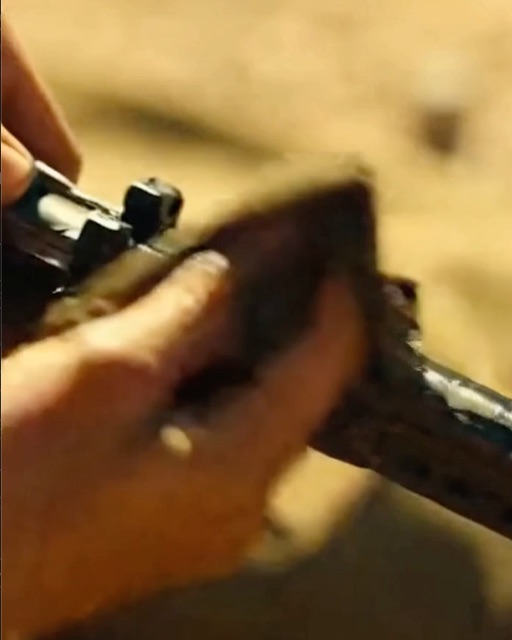
I didn’t look up. The cloth kept moving. Oil lines shimmered across the bolt like veins. Arizona heat pressed my shoulders flat.
Boots crunched behind me. More than one pair. Heavy. Sure of themselves.
“Look at me when a superior officer is speaking.”
I clicked the carrier home and finally breathed. “Sir, if you don’t know my name… you shouldn’t be standing on my range.”
Silence hit hard. Somebody huffed a laugh. Another muttered.
I stood. Not fast. Just enough.
Major General Blackwell blocked the sun. Ribbons, steel jaw, eyes like cold glass. Five officers behind him. One lieutenant wearing that academy smirk.
“Your range?” the General asked.
I kept my gaze steady. No defiance. No apology. “Your lane three is off. Wind variance is wrong. Scope tables are outdated. Your shooters are compensating by point-three mils. You’ll miss when it matters.”
A flicker of doubt behind him. A glance toward the tower. The smirk sharpened.
“And who are you to be correcting my installation?” the General said, voice like a blade.
I straightened. The tank pulled across my back.
He saw it.
The raven in the crosshairs. Coordinates etched through the wings. Ink the color of old gunmetal. And right beneath it –
Everything around us stopped.
Color drained out of his face. His mouth parted like the air had left him for good. He didn’t blink.
“Sir?” the lieutenant tried, softer now.
Nothing.
My heart thudded once, hard. Heat became noise. The world narrowed to the way his eyes wouldn’t leave the ink.
He knew. Not my face. Not my file. The mark.
He swallowed, jaw unhinging, something human breaking through all that brass.
When he finally spoke, he didn’t ask my name – he used one no one on this base should know.
“Rook,” he said, like a prayer he wasn’t sure he should say out loud.
The lieutenant’s smirk cracked. The officers behind him shifted their boots.
I didn’t move. I couldn’t, for a second. Old air filled my lungs and made my chest hurt.
“Range cold,” Blackwell said, not looking away from me.
A hand signal went up from one of the majors. The tower’s light turned red. Shooters in the pits lowered their rifles and looked around.
“Everybody else, go find shade,” Blackwell said. “We’re done here until I say otherwise.”
The lieutenant started to speak, then swallowed it. The others backed off, slow and curious. They said nothing. They looked a lot.
When it was just us and the heat and the wind, Blackwell took one step closer.
“It’s really you,” he said, quiet like a field church.
“Never said it wasn’t,” I said.
“I read the report,” he said. “Burial at sea. Effects returned. Citation drafted.”
“Paper burns easy,” I said. “Bodies don’t.”
He looked at the ink again. The raven’s wings cut across my shoulder blade and bit into my spine. The coordinates ran down rib to rib, numbers like little scars.
His eyes touched the tiny letters under it.
The date. The valley. The night the radios died.
“Why are you here,” he said, and it wasn’t sharp anymore. It was tired.
“Because lane three is off,” I said. “And because ghosts don’t like sloppy math.”
He almost laughed. It came out as a breath that never turned into sound.
“You can’t be here,” he said. “Not under that name. Not on my line.”
“I’m a contractor,” I said. “Badge says ‘Tech Four’. Plaque on the office says ‘Sage Desert Training’. Your S-3 signed it. I’m inside your wire because you asked for help two weeks ago.”
He blinked once, and I got to watch the calculation catch up with memory.
“I sent that request to an anonymous inbox,” he said. “The one that called itself Wren.”
“That inbox belongs to me,” I said. “I changed the locks on the tower door yesterday. Your people didn’t notice.”
He looked past me at the lane. He stared at the little flags that never moved when they should have.
“Lane three is off,” he echoed.
“By point-three mils,” I said.
He worked his jaw like he was chewing on gravel. Then he did something I hadn’t expected.
He offered me his water.
I took it. I sipped, and the dust on my tongue turned to sludge.
We stood like that for a minute, two long shadows on hot earth and ghosts between us.
“You didn’t die in that valley,” he said.
“Not for lack of trying,” I said.
“I signed things,” he said. “I told people you did. I stood next to a flag and said words.”
“I know,” I said. “I watched the clip. You looked good. Stiff. Honest.”
He winced at that. It wasn’t a joke. It was a truth that tasted like blood.
“I needed you gone,” he said.
“Everybody did,” I said. “Some because they cared. Some because I was a problem. Some because it was clean.”
He nodded once, like a man taking a hit he knew was coming.
“What do you want, Rook,” he said. “If you’re here to bury me, do it fast. I’ve got a battalion on the hook and a timetable that doesn’t forgive.”
“I want your lane fixed,” I said. “I want your shooters to stop cheating without knowing they’re cheating. I want you to see what happens if they don’t.”
He looked back at the tower. He knew range safety. He knew angles. He knew a ricochet can travel farther than a lie.
He turned his head toward the building where the lieutenant with the smirk had vanished.
“Kersey,” he said, like the word itself had a taste.
“That one’s been swapping tables from a civilian app and calling it doctrine,” I said. “He’s got a photocopy from 2009 tacked to a corkboard and three new scopes still in boxes because the vendor took him golfing.”
Blackwell’s mouth twisted. It wasn’t a smile.
“You have proof,” he said.
“I have groups,” I said. “I have wind logs. I have screenshots. I have the receipt for the wrong steel on lanes two and three.”
He didn’t ask me how I had any of that. He knew the answer.
“You came back from the dead to fix a range,” he said.
“I came back to fix myself,” I said. “The range is the part I know how to touch.”
He stood very still. Then he nodded.
“Show me,” he said.
We walked lane to lane. He watched. He didn’t try to be the loudest voice in the sand. He let me talk.
I set the flags where the wind wanted them, not where the paint thought they belonged. I changed the angle on the steel until the sun glared off it clean.
I typed new numbers into an old tablet with a cracked screen. I printed tables that matched the rounds they actually shot, not the ones they thought they could afford.
I brought a shooter up from the ready line. He looked nervous. He watched my hands more than he watched the target.
“You trust your zero,” I told him.
“Yes, sir,” he said to me, and then looked terrified that he’d said it to the wrong man.
“I’m not a sir,” I said. “I’m a guy who has missed more than you ever will. Shoot on my call.”
Blackwell stood back with his hands behind him. He watched the little details. He always had.
The shooter took a breath. He lined up. The wind peeled sweat off our faces.
“Send,” I said, and the crack snapped the air in half.
The steel chimed. It wasn’t a lucky hit. It was in the paint, where math and nerves shook hands.
Blackwell watched the splash. He looked at me like the story he’d read about me and the story he was watching now were two sides of the same coin.
“Kersey,” he said again, and there was granite in it now.
I nodded toward the tower.
“He’ll tell you budgets,” I said. “He’ll tell you timelines. He’ll use a lot of big words that don’t get mud on their boots. He’ll mention compliance more than he’ll mention skill.”
“He’s not my problem for long,” Blackwell said.
That was the general talking. The man inside the bars was still back at a valley with a dead radio and no moon.
“You were the one who drew the raven,” he said, eyes on the ink. “Back then. In chalk on the side of the truck. I remember.”
“You told me it looked like a crow fell into a blender,” I said.
He laughed for real then. It hurt us both, but in a good way.
The heat pressed down harder. The tower door opened. Lieutenant Kersey came down the steps with a clipboard and the face of a man who had been practicing denial for years.
“Sir,” he said. “We really can’t shut down training on such short notice. We have a schedule – ”
“Walk with me,” Blackwell said.
Kersey looked at me like I was a grease stain.
“I don’t believe we’ve been introduced,” he said, using the kind of tone you practiced in a mirror.
“This is the consultant you recommended,” Blackwell said. “You know. The one we’re paying to fix the mistakes you said we didn’t have.”
Kersey blinked like people do when their ladder gets pulled away.
“I didn’t—” he started.
“Save it,” Blackwell said. “Lane three is off and I can smell it. The steel is wrong on two and three and I can feel it. The logs are a fiction and I can read.”
Kersey looked at the table with the printed sheets. He looked at the flags that moved. He looked at the steel that had a new shine to it.
“We’ve been within standards,” he said, weak.
“Whose standards,” I said.
“Industry,” he said.
“We are not an industry,” Blackwell said, and his voice rolled like thunder across dry ground. “We are the ones people call when their world explodes.”
Kersey wilted like a plant left on a windowsill too long.
“Sir, the vendor assured us—” he tried.
“The vendor will explain it to the inspector general,” Blackwell said.
Kersey’s eyes widened at those two letters. It meant the uniforms from the big building would ask hard questions with pens that never ran out.
I watched his shoulders go down. I saw the lie that had been chewing a hole in him for months. He wasn’t evil. He was small. He was scared. He had cheated himself first and all of us after.
“I can fix it,” he said. “I can stay late and—”
“You will write me a full account,” Blackwell said. “Every decision you made. Every pressure you felt. Every shortcut you took. You will hand it to me by eighteen hundred. You will not touch a rifle until we are done here.”
Kersey swallowed. He looked at me like I had thrown a rope. He didn’t know how to tie it.
He left again, smaller.
Blackwell and I stayed in the heat until the sun got bored of watching us.
We worked. We dragged sandbags. We pulled new cable. We recalibrated scopes with care that bordered on love.
By the time shadows got long, the line had lost its lazy aim and stood straight.
Blackwell leaned on a post and looked out over the dirt like it was the ocean.
“You didn’t ask me why I said your name,” he said.
“I don’t need to,” I said.
“You deserve to hear it,” he said. “You deserve to hear what that word means to me.”
I didn’t tell him I already knew. The night teaches you what words cost.
“We were pinned in that wadi,” he said. “Four vehicles and a truck with a gun that sounded like a god with a cough. I was a lieutenant colonel then. I thought my rank could stop bullets. I was wrong.”
“You ducked like a man with a brain,” I said.
“I leaned into a wheel well and tasted rubber,” he said. “And then that gun stopped. Not for long. Just for a breath. Long enough for us to crawl out and be smaller targets.”
He looked at the raven on my back as if it might fly.
“I looked up,” he said. “I saw a shimmer on a ridge. And I knew the math it took to hit what had been trying to kill my boys from that far. I knew the cost of being the one who pulled the trigger. I knew the name of the ghost on that ridge even if I hadn’t met him yet.”
He took a breath like he was diving.
“Rook,” he said. “The one who goes first to find the lines. The one who babysits the king so the others can play. I never forgot.”
He looked older when he said it. Not weaker. More real.
“Then why bury me,” I asked.
“Because I lost good men that night who never got buried right,” he said. “Because you disappeared into a file and I got told you were a problem with a pulse. Because the house wanted the story to end where it didn’t ask any more questions.”
“What did you want,” I said.
“I wanted to put the pieces somewhere I couldn’t break them anymore,” he said. “I wanted to pretend I could stop hurting people by being small.”
“You don’t do small,” I said.
“You’d be surprised,” he said.
We let that sit for a minute.
A truck rattled up with cases of new steel. The driver hopped out and looked at our faces and decided he didn’t exist.
We signed for the delivery without words.
We were bolting a fresh plate to lane two when a crack snapped the sky to glass.
It wasn’t our lane. It wasn’t anyone’s lane.
It was a private from a unit on the far side of the berm who had decided to clear his weapon without clearing his head.
The round hit the old plate we hadn’t replaced yet and threw back a kiss of metal that wasn’t supposed to fly.
A kid yelped. He dropped his hand and blood came out strange, bright and thin and fast.
We were moving before the echo made a home.
Blackwell’s voice stole air from the world.
“Medic!” he bellowed, and the desert shook.
I wrapped my belt around the kid’s forearm where the blood pumped. I twisted a wrench into the leather and wound until he stopped leaking like a punctured radiator.
The kid tried to say he was fine. He wasn’t.
“Hold this,” I told him. “Look at me. Breathe and count from fifty to one.”
He said fifty-four twice.
Blackwell knelt in dust that had never seen a general’s knee. He put a hand on the kid’s neck and talked about baseball like he played it every weekend.
The medic came like a storm and left like a plan, and the kid got smaller on the back of the cart until his boots were all I could see.
We stood up, slow like old men.
Blackwell looked at the plate. He looked at the hole that shouldn’t have made that happen.
“You said the steel was wrong,” he said.
“It’s too hard,” I said. “It doesn’t drink the impact. It splinters and throws it back.”
He closed his eyes like a man trying to rewind time with his face.
“Close it,” he said. “All of it. Until you and I both say it’s right. I’ll take the heat.”
“You’ll get more than heat,” I said.
“Good,” he said. “Maybe I’ll burn clean.”
We shut it down for a week.
The calls started on day one. The ones with stars on their shoulders and signatures that could settle land. They wanted to know why a general had closed their toy.
Blackwell took them, every one.
He said words like safety and standard and liability. He said words like dead kid and family and my fault.
He never said my name. He never said my call sign. He kept that part in his pocket like a coin he wasn’t ready to spend.
Kersey showed up to my little office with red eyes and a stack of paper. He put it on the desk like a confession.
“I wrote it,” he said.
“All of it,” I said.
“I didn’t sleep,” he said.
“Good,” I said, and I didn’t mean it like a barb. I meant it like a cure.
He sat in the chair and looked at his hands.
“My dad taught math at a high school,” he said, out of nowhere. “He used to say there were only two ways to cheat. One was to look at someone else’s paper. The other was to pretend you understood your own.”
“What would he say now,” I asked.
“He’d tell me to show my work,” he said.
“Then show it,” I said.
He handed me a flash drive like it weighed pounds.
“I’ll be out of a job,” he said.
“You might be out of this job,” I said. “But if you do this right, you’ll still have your name when it matters.”
He nodded. He looked like a kid who had taken the bike apart and was now holding screws he didn’t recognize.
We worked late. We coded the plates. We tallied the rounds. We wrote the math on a whiteboard and never erased the parts that hurt.
Blackwell came by at midnight with coffee that tasted like melted tires. He read every page and signed every line.
“We’re going to court a lot of trouble,” he said.
“It was already courting you,” I said. “You just didn’t RSVP.”
He smirked at that. He left tired and straighter.
The inspector general team rolled in three days later. They asked questions like drills. They took notes like gravity.
They found the steel contracts. They found the invoices that said AR500 and delivered cheaper sheet. They found the vendor who went golfing with Kersey and the sergeant major who had put his brother-in-law on the supplier list.
They found rot that looked like paperwork until a kid bled on the dirt.
They wrote reports. They made phone calls. They left with boxes.
There were tears. There were resignations. There was one pair of handcuffs.
There was also a meeting where Blackwell stood in front of a hundred tired faces and told them the truth like it was a door he could open for them.
“We messed up,” he said. “No one is dying because I don’t like an email out of D.C. They’re dying because we let small lies become big ones. That ends now.”
He didn’t look at me when he said it. He didn’t have to.
When the dust settled, Kersey was moved. He kept his pay for now and lost his pride for a while. He started learning from a staff sergeant with a nose for wind and a heart like a metronome.
He came to me a week later with a question, not an excuse.
“How do you feel the wind on your face and trust a number,” he asked.
“You don’t,” I said. “You let your face tell your number where to start. Then you let the steel tell you where to finish.”
He nodded like that was the first clean thing he’d heard in a year.
Blackwell asked me to stay for a month. He called it a consultancy. I called it penance.
We rebuilt more than lanes.
We rebuilt habits.
We told kids to slow down. We told leaders to stop pretending.
We put a chalkboard in the tower where the new tables lived. We wrote next to them the names of the people who had learned the hard way why numbers matter.
We didn’t glorify. We remembered.
At night, I went back to the off-base room with the broken fridge and the shower that hissed like a snake. I cleaned my rifle even though I hadn’t fired it.
I wrote letters I’d never send.
One was to a woman named Miriam I had never met who lived a long way from a valley that still bent my dreams. She had written me once a year to a box that never wrote back.
Her letters were about her little girl and a garden and a pie she made on Sundays. They were about a man with my call sign who had kept them, one night, when a road was no longer friendly.
I had saved her letter the way you save a life.
I had come here because I couldn’t throw it away.
On the fourth Sunday, Blackwell asked me to go for a drive.
We left the wire without a convoy. We drove west until the land went flat and the air got thinner.
He pulled off down a dirt track and killed the engine by a pile of rocks that didn’t look like an accident.
He got out and didn’t put on his hat. He looked around like he was checking an old promise.
“I come here when it’s bad,” he said. “No one else does. It’s not on any map.”
“What happened here,” I asked.
“My daughter learned to shoot here,” he said. “When she was twelve. She put three rounds in a paper plate and looked at me like I’d given her the moon.”
He didn’t cry. He talked plain.
“She was eighteen when she took my truck out with a boy who didn’t know a red light from a dare,” he said. “She died quiet. He died loud. None of it made any sense.”
I looked at the pile of rocks. I understood. You mark the world so it can hold what you can’t.
“I wanted to quit after that,” he said. “I wanted to go home and get small and make bread and mow a lawn.”
“And you didn’t,” I said.
“I stayed and tried to do less harm,” he said. “Sometimes I did the opposite.”
He took a folded paper from his pocket. He handed it to me like it had burned him every day.
“I wrote this ten years late,” he said. “To you. To someone with a name I buried with good intentions.”
I read it.
It was short. Not because he didn’t have words. Because the ones he wrote were the right ones.
He said he was sorry.
He said I had saved him and he had hurt me.
He said he was tired of being a story people used and ready to be a man again.
I folded the letter half as many times as he had.
“I don’t need this,” I said. “Not for me.”
“You don’t,” he said. “But I do.”
I gave it back.
We stood in the kind of quiet you only find in places that have listened more than they’ve spoken.
“Rook,” he said after a while. “What does the tattoo mean to you now.”
I looked at the raven. I looked at the numbers.
“It used to be an anchor,” I said. “Then it was a map. Lately it’s just a thing my skin remembers.”
“And the letters under it,” he asked. “The date.”
“It’s the night I stopped pretending I was a ghost,” I said. “The night I picked a fight with my own story and lost in a way that saved me.”
He nodded. He knew a thing about losing the right way.
We drove back with the windows down and the dust in our teeth like a new sin.
The month became six weeks. The range got quiet and honest.
The kids with shaky hands stopped biting their lips and started listening.
The staff sergeants with sixteen years started smiling like they meant it again.
Kersey passed a recert with an eighty-nine and didn’t cheat to get there.
Blackwell put a plaque in the tower. It had no names on it. Just a promise.
We will do it right or we will not do it.
He asked me, on the day I signed my last invoice, if I wanted a job.
Full time. Official. Back in the world I had slipped out of like a bad dream.
“I can’t,” I said. “I can’t belong to walls again.”
“You don’t have to,” he said. “You can belong to people.”
“That’s heavier,” I said.
“Yeah,” he said, and he smiled like a man who’d started lifting late and wasn’t done.
I told him no, and it wasn’t a lie dressed like a yes. It was a no that included coffee and calls and a chair in the back of any class I wanted.
He gave me a coin. It wasn’t fancy. It had a raven scratched into it with the tip of a knife.
He pressed it into my hand like I was someone who could carry it.
On my last morning, I walked the line before anyone came.
The sun came up slow and kind.
I put my palm on lane three and felt the cool that hides under heat if you wake up early enough.
I said names under my breath. I said sorry only when it fit.
I left a little paper under the chalkboard.
It said two things.
Wind counts. People do too.
I went to the little post office on the edge of town where the woman behind the glass chews gum like it owes her money.
I mailed a letter to Miriam.
It said thank you for the letters you sent to a name that didn’t answer.
It said I am not him and I am also not not him.
It said I hope the pie still tastes like a Sunday.
It said take care of your little girl with the good laugh.
It said a man with a different scar reads your words when the night won’t stand still.
I signed it with my real name, the one on the card the DMV gave back to me when I stopped running.
Calder Haines.
It didn’t feel wrong in my hand.
Two months later, I got a postcard with a picture of a lighthouse and a kid’s handwriting that said you write funny but my mom says it’s nice, and it made something in my chest stop biting.
Blackwell called once a week after that. Not always for work.
Sometimes to talk about baseball.
Sometimes to talk about a kid who had finally learned to call his shot.
Sometimes to just breathe into a phone with a man who used to be a ghost.
We didn’t fix the world. We fixed a line in a desert and a habit inside two men.
It was enough for a while.
I took a job three towns over teaching people who don’t have to shoot how to breathe better when they’re scared.
We did a lot of counting to one.
I got a dog that doesn’t like fireworks and loves beef jerky.
I learned that healing doesn’t happen when someone tells you to get over it. It happens when you stand in the same place as your hurt and let someone decent stand there with you.
I drove back to the range once in the fall when the heat had run off somewhere else.
The plaque was still there. The chalkboard was still honest.
Kersey waved at me like a man who had decided to be hard on himself in the right way.
Blackwell hugged me with one arm and didn’t apologize for it.
We drank gas station coffee and pretended it tasted good.
He told me he had started a scholarship in his daughter’s name for kids who wanted to learn how not to lie to themselves with numbers.
It fit him.
The base made a few people mad with how strict it got. They left. The ones who stayed were the ones you wanted next to you when the sky fell.
On my way out, I took one last look at the raven in the crosshairs in the mirror of my truck.
It looked back at me like a thing that had done its job.
I smiled at it like you do at a friend you can finally let go of a little.
Driving east, the road went straight for a long time and then found a hill to pretend was a mountain.
My hands felt light on the wheel.
Here’s the thing I learned standing under a sun that wants to burn everything you’re not careful with.
You don’t get to fix the past. You get to name it and hold it and let it turn you into someone you wish your younger self could have met.
You don’t get to outrun who you were. You get to walk beside it until you both remember how to breathe.
Sometimes justice is a courtroom and a report. Sometimes it’s a general on his knees in the dirt making a vow he keeps.
Sometimes forgiveness is not letting a man off the hook. It’s handing him a better one and telling him to fish for something worth eating.
And sometimes the most dangerous ranges are the ones inside your head.
Do the work. Fix the lanes. Tell the truth even when it shakes.
If this story found you at the right time, let it ride shotgun with you a while and, if it helps, let somebody else read it too.



