
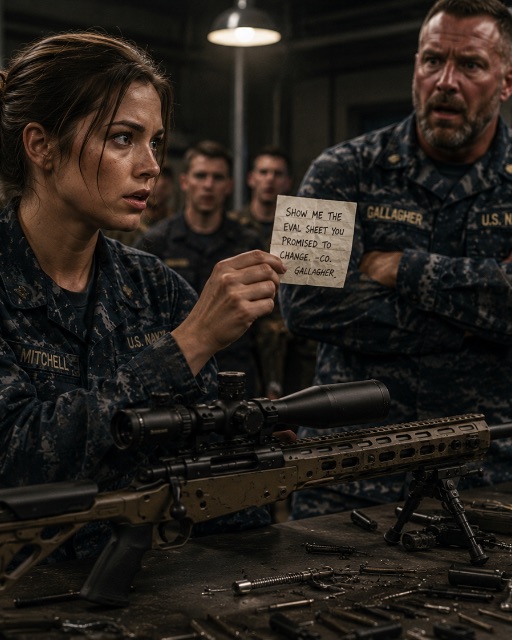
It was Gallagher’s handwriting. I’d seen it a hundred times on evaluation forms, on failed exercise reports, on the countless pink slips he’d tried to use to bury me.
But this wasn’t a failure notice.
The room was dead quiet. Twenty-six operators, some of the most dangerous men on the planet, stood frozen like statues. I could hear the fluorescent lights buzzing overhead.
I cleared my throat and read it out loud.
“To whoever finds this pin – ”
I paused. Looked at Gallagher. His jaw was clenched so tight I could see the veins in his temple throbbing.
” – if you found it blindfolded, you’re the one.”
I kept reading.
“Operation NIGHT SIREN requires a shooter who can field-strip, reassemble, and fire in zero-visibility conditions. JSOC has requested a single candidate from this program. I was told to find the best. I was told to break them first.”
My voice didn’t waver. But my pulse was hammering so hard I could feel it in my teeth.
“Signed, Senior Chief Brody Gallagher. Endorsement attached.”
I flipped the paper over.
There was a second signature underneath his. A signature I recognized from briefing documents that were so classified, most people in that room would never see one in their entire careers.
A signature from the commander of –
I stopped reading.
Not because I was told to. Because Gallagher’s hand was on my wrist.
He wasn’t squeezing. He wasn’t angry.
He was shaking.
The man who had screamed in my face for eleven weeks, who had called me “Maestro” like it was a slur, who had made me low-crawl through sewage water at 0300 while he poured coffee on my back – that man looked at me with something I had never once seen in his eyes.
Fear.
Not of me.
For me.
“You weren’t supposed to read that part out loud, Mitchell,” he said quietly. So quietly that only I could hear.
Then he leaned in closer and whispered seven words that turned my entire world inside out.
Seven words that explained why he’d been so brutal. Why he’d hidden the pin. Why every single “impossible” task he’d thrown at me over the past three months had been carefully, surgically designed to simulate conditions that no normal sniper would ever face.
Seven words that told me this program – the one I thought I was fighting to survive – wasn’t the real program at all.
He pulled back. Looked at me. And for the first time in eleven weeks, Senior Chief Brody Gallagher did something no one in that armory had ever seen him do.
He saluted me.
A Senior Chief. Saluting a Lieutenant. In front of the entire class.
Not because of rank.
Because of what I was about to walk into.
I folded the paper carefully, slipped it back into my pocket, and picked up my rifle.
“Senior Chief,” I said. “When do I leave?”
He didn’t answer. He just looked at the clock on the wall. Then back at me.
“You already have.”
I turned around. The armory door was open. Standing in the doorway were two men I’d never seen before. No insignia. No name tapes. No branch identification. Just gray jackets and the kind of stillness that only comes from people who have done things that don’t exist on paper.
One of them held a manila envelope with my name on it.
The other held a boarding pass.
The destination printed on it was a city I’d only ever heard mentioned once — in a Chopin biography, of all places. The city where Chopin played his last concert before he vanished from public life.
I looked back at Gallagher one final time.
He mouthed two words.
“Play beautifully.”
I walked out of the armory, and the door sealed shut behind me.
I never saw Senior Chief Gallagher again.
But six weeks later, lying prone on a rooftop in a country I am still not allowed to name, staring through my scope at a target I am still not allowed to describe, with my finger resting on a trigger that would change the trajectory of something far bigger than I ever understood —
I finally realized what those seven words were.
And why he was afraid.
Because the seven words Gallagher whispered to me that day in the armory weren’t instructions.
They were an apology.
And what he apologized for was something I didn’t discover until I opened that manila envelope on the plane, read the first page of the dossier inside, and saw the photograph stapled to the target profile.
A photograph of someone I knew.
Someone who had taught me Chopin.
Someone who, according to every record I’d ever seen, had been dead for fourteen years.
I stared at that face, and my hands — the same hands that had just reassembled a sniper rifle blindfolded — began to tremble for the first time since I was nine years old, sitting at a piano bench, learning the Ballade No. 1 in G minor from the only person who ever believed I could play it.
The person I was being sent to kill.
His name was Arthur Albright.
At least, that was the name I knew him by. The dossier called him by another name, a ghost identity attached to a long list of crimes against the state.
Espionage. Treason. The sale of classified intelligence that had resulted in the deaths of six undercover agents.
The sterile, printed words painted a portrait of a monster.
But the photograph showed the face of the man who had patiently guided my small hands over ivory keys. The man who smelled of old books and peppermint tea.
After my dad left, Mr. Albright had been more than a piano teacher. He was the one who came to my school plays. He taught me how to tie a Windsor knot for my eighth-grade dance.
He was the one who told me I had a gift, not just for music, but for seeing the patterns that others missed.
“You don’t just play the notes, Daniel,” he’d say, his eyes crinkling at the corners. “You hear the space between them. That’s where the real music lives.”
Then, when I was fifteen, he was gone.
A car accident, they said. A winding mountain road, a patch of black ice. No survivors.
I remember standing at the empty graveside service, a folded program in my pocket. There was no body to bury.
Now, cruising at 30,000 feet, the dossier in my lap felt heavier than any rucksack I’d ever carried.
The apology Gallagher whispered wasn’t “I am sorry for this mission.”
It was, “Your mentor is the man you’re hunting.”
And the fear in his eyes was the fear of a man who knew he had just aimed a weapon at its creator. He’d sharpened my skills, honed my senses, and pointed me at the very person who had first taught me to use them.
The flight was long. I read the file cover to cover, then read it again.
It was meticulous. Bank transfers from shell corporations. Encrypted messages intercepted from satellite uplinks. A timeline of his movements that lined up perfectly with the deaths of our agents.
On paper, the case was airtight. Indisputable.
But my gut, the same instinct Gallagher had spent eleven weeks trying to break and then fortify, screamed that something was wrong.
The man who cried when he heard me finally master the difficult passage in Fantaisie-Impromptu was not the same man who would sell secrets and let people die.
It wasn’t possible.
I landed in a city of stone spires and winding cobblestone streets, a place that felt ancient and full of secrets.
My local contact was a woman named Anya who ran a small bakery. She handed me a warm loaf of bread, and hidden inside was a key and a small, encrypted burner phone.
The key was for an apartment overlooking a bustling city square. The window had a direct line of sight to a small café three hundred yards away.
“He eats there every day at noon,” the dossier said. “Always the same table.”
I spent the next two days setting up my nest. It was a cold, sterile process. I assembled my rifle, a custom piece of machinery that felt like an extension of my own hands.
I calculated windage, trajectory, the subtle distortion of the old apartment window glass.
Every action was automatic, ingrained by months of relentless training. But my mind was somewhere else entirely.
It was in a dusty music room, sunlight streaming through the window, the sound of a metronome ticking steadily.
I remembered his advice, not just about music, but about life. “Look past the obvious, Daniel. The truth is rarely the first thing you see.”
He was teaching me to be a spy even then, wasn’t he? Teaching me to look for the story beneath the surface.
The “Maestro” nickname Gallagher had used as an insult now felt like a prophecy.
The third day was the kill day.
I lay on the floor of the empty apartment, the scent of dust and decay hanging in the air. The city square below was alive with people, a sea of unheard conversations and unseen lives.
Through my scope, the world shrank to a single circle of light.
At 11:58, he appeared.
He was older, his hair grayer, his shoulders more stooped than I remembered. But it was him. Arthur Albright.
He walked with the same deliberate, thoughtful gait. He sat at the same small, wrought-iron table.
He ordered a coffee and opened a newspaper.
My finger rested on the trigger. The crosshairs settled on his chest. All I had to do was exhale, squeeze, and follow through.
One shot. Mission complete.
But my hands were shaking again.
Gallagher’s final words echoed in my mind. “Play beautifully.”
It was the exact phrase Mr. Albright had used every single time before a recital. It was our phrase.
Why would Gallagher say that? Was it just a cruel, final twist of the knife?
Or was it something more? A signal?
The space between the notes. That’s where the real music lives.
I took my finger off the trigger.
The burner phone Anya had given me was for emergency exfil only. Using it for anything else was a mission-ending breach of protocol.
I didn’t care.
My thumb flew across the tiny keypad, tapping out a message in a simple Morse code I had learned as a boy scout, a code Mr. Albright and I used to use to pass notes in crowded rooms.
It was just three notes. The opening of the Ballade No. 1.
G. E-flat. A-flat.
I sent it to the only other number in the phone’s memory: “Handler.”
I waited. My heart was a drum against my ribs.
For a full minute, there was nothing. I thought I had made a catastrophic mistake. I thought the next sound I heard would be a tactical team kicking in the apartment door.
Then, the phone buzzed.
A single line of text appeared.
“Stand by. The performance is not over.”
My blood ran cold.
Performance?
I looked back through my scope. Mr. Albright was still reading his paper, sipping his coffee. Nothing had changed.
But my perspective had.
This wasn’t an execution. It was a stage. And I was part of the orchestra.
A few minutes later, another man approached Mr. Albright’s table.
He was tall, wore an impeccably tailored suit, and carried a leather briefcase. He sat down without an invitation.
I didn’t recognize his face from the dossier. He wasn’t on any of the watchlists.
They didn’t speak. Mr. Albright folded his newspaper in a specific way and slid it across the table. The man in the suit opened his briefcase, removed an identical-looking newspaper, and slid it back.
A classic dead drop. Simple. Elegant.
But something was off. The dossier said Albright was the seller. If that were true, he would be receiving payment, not another package.
The man in the suit stood up to leave. As he turned, the midday sun caught the polished metal of his watch.
And on his wrist, I saw a very specific, very expensive timepiece. A Patek Philippe Calatrava.
I had seen that watch before.
It was in a photo. A photo from a congressional hearing I’d seen during a briefing months ago.
On the wrist of General Markam. The man whose second signature was on my mission orders. The commander who had endorsed my selection.
My entire reality shifted.
The dossier was a lie. Not a complete lie, but a twisted one.
Mr. Albright wasn’t the traitor. He was the bait.
He was a patriot, working from the inside of a dangerous network for years. The dead agents weren’t his fault; they were the cost of him getting close enough to the real mole.
The leak wasn’t coming from a retired piano teacher. It was coming from the very top of our own command structure.
Operation NIGHT SIREN wasn’t about silencing a rogue agent. It was about catching a traitor so high up that no one could be trusted.
They couldn’t just arrest Markam. He was too powerful, too protected. They had to catch him in the act.
And they needed a shooter they could control, but one who was smart enough, and emotionally connected enough, to see the truth when it mattered. They needed someone who would hesitate.
Someone who would hear the music between the notes.
Gallagher’s brutality. The impossible test. The Chopin connection. It was all a calculated, desperate gamble.
My phone buzzed again.
“Primary target re-identified. Man in suit. Asset protection is paramount. Engage on your mark.”
Asset. That’s what they were calling him. My teacher.
I looked through my scope. Markam was walking away, briefcase in hand. Mr. Albright was watching him go, his face a mask of quiet tension.
He had done his part. He had lured the shark into shallow waters.
Now it was my turn.
I took a breath. My hands were perfectly still.
The crosshairs moved from the gentle old man at the café table to the powerful General walking into the crowd.
I led him by a half-step, exhaled, and squeezed the trigger. There was no sound, just a slight push against my shoulder.
Three hundred yards away, General Markam stumbled. The briefcase fell from his hand. He collapsed onto the cobblestones before anyone even realized what had happened.
It was a perfect shot. Clean. Final.
I watched as Mr. Albright stood up, calmly picked up the fallen briefcase, and melted into the sudden chaos of the crowd. He never once looked in my direction.
My mission was over.
Two weeks later, I was back stateside, in a sterile debriefing room.
No one mentioned General Markam. No one mentioned Mr. Albright. The official report said Operation NIGHT SIREN was a success. An enemy operative was neutralized. End of story.
I was promoted, given a commendation for “actions above and beyond the call of duty.” It felt hollow.
I was reassigned to a quiet desk job at Langley, a place for ghosts and secrets. I never saw any of the men from the armory again.
One evening, I was leaving late when I saw a familiar figure down the long, empty hallway.
It was Brody Gallagher. He wasn’t in uniform anymore. He wore a simple civilian jacket and jeans.
He saw me and stopped. We stood there for a long moment, the silence stretching between us.
He didn’t salute. He just gave me a single, slow nod. A nod of understanding, of respect. Of apology and gratitude all rolled into one.
I nodded back. No words were needed. We both understood the music.
A few days later, a small, unmarked package arrived at my apartment.
Inside, there was no note, just a vintage vinyl record. Chopin’s Ballades. And tucked into the sleeve was a small, worn photograph of a nine-year-old boy with messy hair sitting at a grand piano, a proud teacher standing behind him.
I didn’t need a signature to know who sent it.
I finally understood. The real test was never about reassembling a rifle in the dark. It was about finding your clarity in the dark.
True duty isn’t about blindly following the notes on the page. It’s about listening for the song you were always meant to play. It’s about trusting the part of you that remembers the goodness in people, even when the world tries to convince you it’s gone.
That, I realized, was the most beautiful performance of all.



